
Why are more buyers asking for GRVE Pipe in 2026?
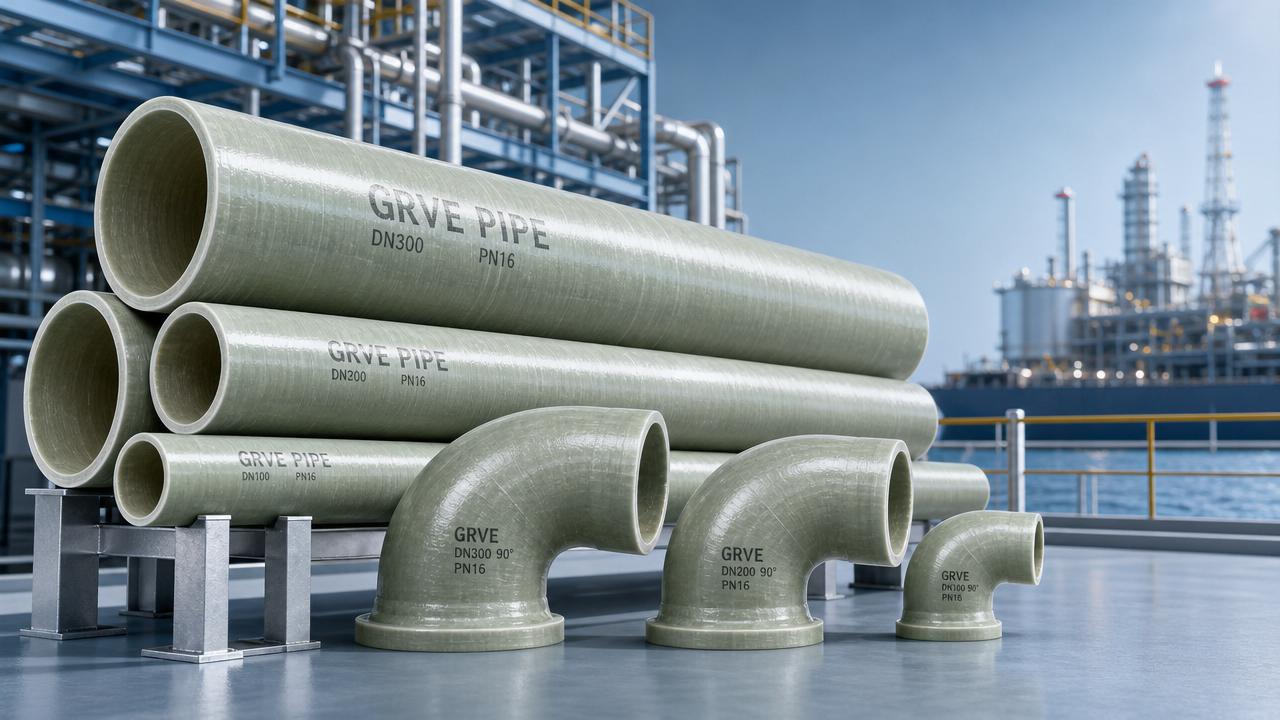
In 2026, more distributors, agents, and trading partners are asking for GRVE Pipe because end users want longer service life, corrosion resistance, and lower maintenance costs in demanding industrial environments.
As global projects in oil and gas, marine, LNG, and chemical processing continue to grow, GRVE Pipe is becoming a practical choice for buyers seeking reliable supply, proven performance, and stronger market competitiveness.
This shift is also linked to material performance. In glass and ceramic related material systems, reinforced composite piping offers stable operation where metal often fails early.
What is driving higher interest in GRVE Pipe in 2026?
The first driver is corrosion pressure. Many industrial fluids, salts, seawater, and chemical media attack steel quickly, especially in humid or coastal facilities.
GRVE Pipe answers that pain point with a reinforced structure that combines glass fiber strength and epoxy resin resistance. That balance supports durability without heavy anti-corrosion maintenance.
The second driver is lifecycle cost. Buyers are no longer comparing only purchase price. They are comparing shutdown risk, repair frequency, labor cost, and replacement intervals.
The third driver is project expansion. More LNG terminals, offshore systems, ballast lines, and process plants need lightweight, corrosion-resistant piping that can be installed efficiently.
As a result, GRVE Pipe is now searched not only as a material option, but as a risk-control and competitiveness decision.
Why does GRVE Pipe fit harsh industrial environments better than many traditional options?
Harsh environments usually combine temperature change, chemical exposure, moisture, vibration, and pressure. Few piping materials handle all of these factors equally well.
GRVE Pipe performs well because its composite wall resists internal and external corrosion. That matters in offshore platforms, ship ballast piping, and salt production systems.
Its lower weight also helps. Lighter pipe can reduce transport burden, simplify handling, and shorten installation time in projects where cranes, labor, and access are limited.
Another reason is hydraulic efficiency. Smooth inner surfaces can support stable flow and reduce scaling risks, which benefits water injection, cooling systems, and chemical transfer lines.
For applications requiring related tubing solutions, some projects also review GRE Tubing when matching pressure class and installation design.
Which applications are pushing more buyers toward GRVE Pipe?
Demand is rising across several sectors, especially where corrosion creates downtime or high coating costs. The strongest growth comes from process-heavy and marine-related systems.
1. Oil and gas systems
Produced water, fire water, utility water, and chemical media lines often need materials that stay stable under aggressive service conditions. GRVE Pipe is increasingly selected for these duties.
2. Marine and ship ballast piping
Seawater exposure causes ongoing metal corrosion. Composite solutions reduce coating dependence and help shipyards improve service reliability over long operating cycles.
3. LNG and chemical plants
These projects prioritize safety, predictable performance, and maintenance planning. Buyers often prefer GRVE Pipe where corrosion resistance supports stable plant operation.
4. Hot spring and salt making facilities
Mineral-rich water and saline conditions accelerate rust and scale. GRVE Pipe offers a practical answer where conventional materials require frequent intervention.
How should buyers judge GRVE Pipe quality before ordering?
Not all GRVE Pipe offers the same value. Performance depends on design, production control, raw materials, testing capability, and experience in real project environments.
A good first step is checking production scale. Stable factories usually provide better consistency across large orders and multiple pipe sizes.
Testing capacity also matters. Hydrostatic pressure testing, dimensional control, and fitting verification help confirm that the supplied GRVE Pipe matches application demands.
Project history is another strong indicator. A supplier serving oil and gas, shipbuilding, LNG, and chemical sectors usually understands stricter installation and service requirements.
Shandong Ocean Pipe Technology Co., Ltd. was established in 2012 in Dezhou, Shandong, China. It has grown into one of China’s top large manufacturers for Fiberglass Reinforced Epoxy pipe.
Ocean Pipe operates 16 winding production lines and 174 pipe fitting winding machines with micro control systems. It also has 5 static water pressure testing machines.
Its annual production and testing capacity reaches 25,000 tons. Products serve oil and gas, ship ballast piping, LNG, chemical plants, hot spring projects, and salt making companies.
That experience, including supply to major groups and overseas markets, gives buyers a clearer reference when evaluating GRVE Pipe supply reliability.
What mistakes do buyers make when comparing GRVE Pipe with metal pipe?
The most common mistake is focusing only on unit price. A cheaper metal pipe may create higher long-term cost through corrosion repair, insulation damage, labor, and shutdown events.
Another mistake is ignoring the full operating environment. Fluid chemistry, pressure cycles, UV exposure, and installation layout all affect whether GRVE Pipe is the better option.
Some buyers also underestimate joining systems and fittings. Pipe quality alone is not enough. The total piping system must be matched for pressure, media, and installation conditions.
It is also wrong to assume all composites behave the same. Resin type, reinforcement design, and manufacturing precision can create major differences in field performance.
In some line sections, engineers may compare GRVE Pipe with GRE Tubing to optimize routing, diameter, and service conditions.
What does the 2026 trend mean for sourcing, lead time, and market competition?
Rising demand means earlier planning becomes more important. When more global projects specify GRVE Pipe, buyers who confirm requirements late may face tighter production schedules.
This trend also raises expectations for documentation. Buyers increasingly ask for testing records, technical data, application references, and consistent production standards.
At the same time, market competition is improving product transparency. Better suppliers now compete not only on price, but on engineering support, testing strength, and delivery stability.
For channel development, GRVE Pipe creates room to serve higher-value projects. Corrosion-resistant composite piping is no longer a niche option in many industrial sectors.
Quick FAQ table: how can GRVE Pipe demand be evaluated effectively?
How can buyers respond to the GRVE Pipe trend now?
Start with application mapping. Identify lines affected by corrosion, maintenance burden, or repeated replacement. Those are usually the best candidates for GRVE Pipe evaluation.
Then compare options using lifecycle thinking, not simple purchase price. Review service media, pressure, fittings, testing requirements, and installation support together.
In 2026, the reason more buyers ask for GRVE Pipe is clear. They need durable piping that performs reliably in tough environments while improving long-term project value.
The next practical step is to prepare technical requirements early and discuss them with an experienced supplier that can support production, testing, and application matching.
Please give us a message
产品介绍产品介绍产品介绍产品介绍产品介绍产品介绍产品介绍产品介绍产品介绍产品介绍产品介绍产品介绍产品介绍产品介绍产品介绍产品介绍产品介绍产品介绍产品介绍产品介绍产品介绍产品介绍产品介绍产品介绍产品介绍产品介绍产品介绍产品介绍产品介绍产品介绍
Please give us a message
产品介绍产品介绍产品介绍产品介绍产品介绍产品介绍产品介绍产品介绍产品介绍产品介绍产品介绍产品介绍产品介绍产品介绍产品介绍产品介绍产品介绍产品介绍产品介绍产品介绍产品介绍产品介绍产品介绍产品介绍产品介绍产品介绍产品介绍产品介绍产品介绍产品介绍
Please give us a message
产品介绍产品介绍产品介绍产品介绍产品介绍产品介绍产品介绍产品介绍产品介绍产品介绍产品介绍产品介绍产品介绍产品介绍产品介绍产品介绍产品介绍产品介绍产品介绍产品介绍产品介绍产品介绍产品介绍产品介绍产品介绍产品介绍产品介绍产品介绍产品介绍产品介绍
Please give us a message
产品介绍产品介绍产品介绍产品介绍产品介绍产品介绍产品介绍产品介绍产品介绍产品介绍产品介绍产品介绍产品介绍产品介绍产品介绍产品介绍产品介绍产品介绍产品介绍产品介绍产品介绍产品介绍产品介绍产品介绍产品介绍产品介绍产品介绍产品介绍产品介绍产品介绍