
Trends in Offshore Composite Piping Demand: Why GRE Specification Is Growing for New Build FPSO Projects
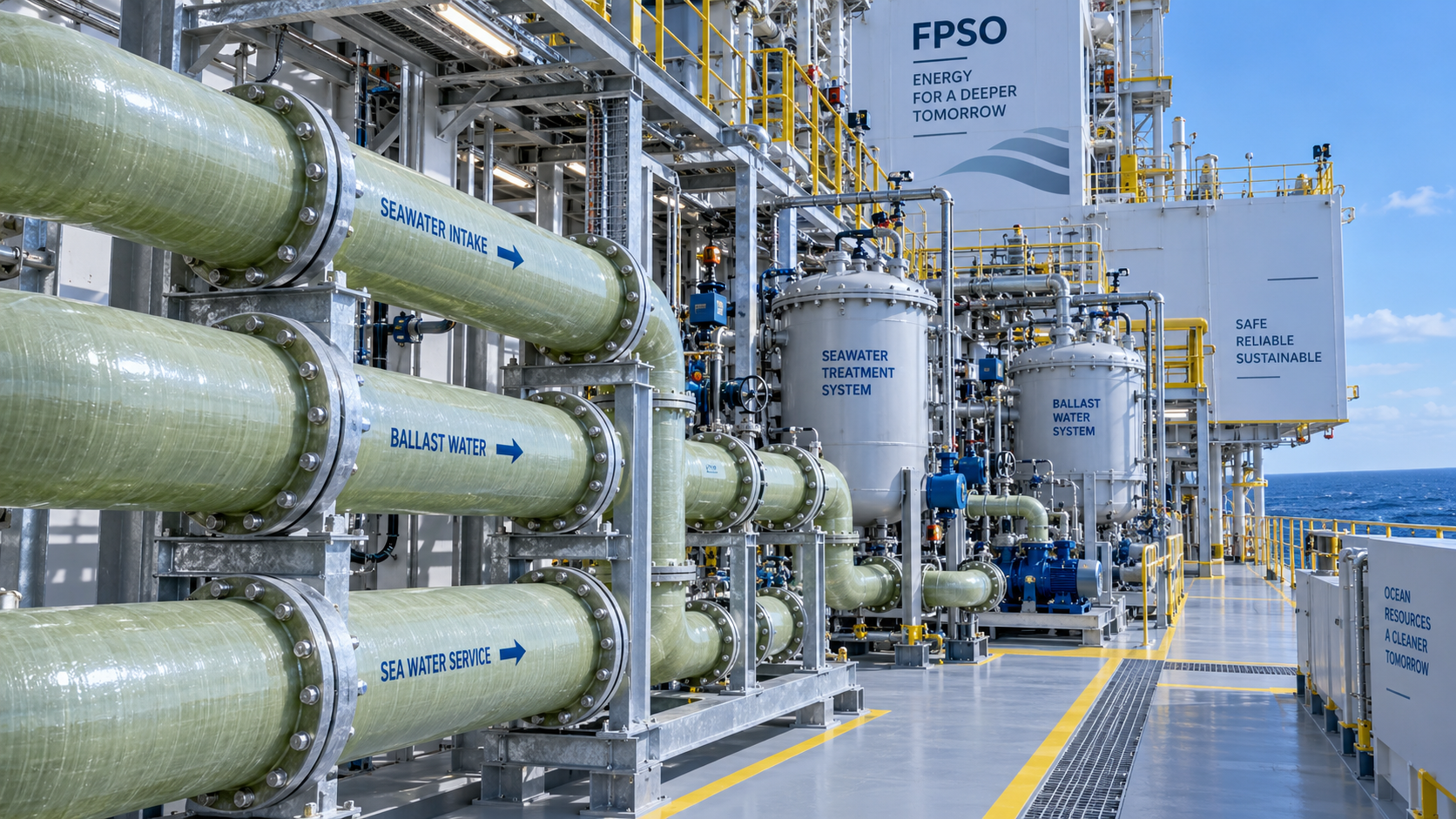
The offshore oil and gas industry has a habit of making life difficult for engineers who prefer certainty. Just when the sector settles into a comfortable rhythm with steel piping specifications, a new build FPSO comes along and forces everyone to rethink what “reliable” actually means in deep water. That is precisely what is happening with composite piping right now.
FPSO projects are moving into fields that were considered technically marginal a decade ago. Water depths increase, reservoir temperatures climb, and the chemistry of produced fluids gets more aggressive. In that environment, traditional carbon steel piping becomes a maintenance burden rather than a workhorse. Corrosion rates go up, inspection intervals shorten, and the weight of the piping system starts to affect the overall hull design. Composite piping — specifically Glass Reinforced Epoxy, or GRE — addresses all of these pain points at once, which is why the specification is showing up in more new build packages.
One of the clearest signals in the market is how engineering contractors have shifted their default positions. Five years ago, GRE was often treated as a niche alternative that had to be justified case by case. Today, several top-tier EPC firms include GRE pipe for offshore applications as a baseline option during front-end engineering. That is a meaningful change. The conversation has moved from “why use GRE?” to “where does GRE not fit?”
What Changed in the Specification Environment
Several factors are converging at once. First, topside weight reduction has become a harder requirement rather than a nice-to-have. Every kilogram saved on piping allows additional process equipment or payload without increasing hull steel. GRE pipe typically weighs around one-sixth to one-eighth of equivalent steel pipe with the same pressure rating. On a large FPSO topside, that translates into tens of tons of savings. For a hull designer working within a fixed displacement budget, that is a number that gets attention.
Second, the operational experience base has matured. It is one thing to claim that GRE resists corrosion; it is another thing to have a decade of service data from existing FPSO installations showing that the pipe retains its pressure capacity without significant wall loss. That kind of feedback pulls composite piping out of the experimental category and into proven technology. Operators are conservative for good reason, so the willingness to specify GRE on new builds reflects a genuine shift in risk perception.
Third, project schedules have compressed. Steel piping fabrication and coating require long lead times, and coating defects are a constant source of rework. GRE pipe arrives factory-cured, with no external coating process required in the yard. That simplifies the supply chain and removes an entire class of quality control issues from the construction schedule. For projects under pressure to hit first oil dates, this is a significant logistical advantage.
Where GRE Pipe for Offshore Gets Specified on FPSO New Builds
Not every service is suitable for composite piping, and the industry has learned this the hard way. The typical specification envelope for GRE offshore includes seawater systems, ballast lines, firewater deluge, fresh water, and certain produced water services. These are low-to-moderate temperature applications with fluids that are inherently corrosive to steel but well within GRE’s chemical tolerance.
Seawater piping is the most straightforward case. The external environment is corrosive by definition, and the internal environment is worse. Steel piping needs coatings, cathodic protection and regular inspection. GRE simply does not corrode in seawater service. It also resists biofouling more effectively than coated steel, which reduces the long-term drag on pumping efficiency.
Ballast piping is another area where the material transition is accelerating. Older FPSO designs used rubber-lined steel or even CuNi alloys for ballast lines. Both have proven problematic in service. Rubber lining delaminates, and CuNi is expensive and difficult to fabricate. GRE offers a predictable alternative with a documented service track record in ballast systems on both new builds and life extensions. For conversion projects — where the original tanker’s ballast system is often compromised — GRE is increasingly the first choice because installation can be carried out without hot work in many cases.
Firewater deluge systems are a less obvious but growing application. Deluge lines are normally empty, which means internal corrosion is less aggressive. But the external environment — salt spray, UV exposure, impact damage — dictates the service life. GRE’s resistance to external corrosion makes it attractive, but there is an important caveat: firewater systems must survive a fire condition without releasing the pipe contents. Not all GRE products carry the appropriate fire rating, so the specification must verify that the selected pipe grade meets the project’s fire endurance requirements. This is one of those points where engineers need to check the actual test data rather than assume all GRE pipe behaves the same.
Produced water systems are a growing area for GRE specification, although still not universal. Produced water is warm, contains dissolved gases, and often carries solids. GRE handles the chemical side well. The solids content is the limiting factor — erosion resistance depends on the pipe’s inner liner and the actual flow velocity. Projects with high sand production typically need to be evaluated case by case. It is not a blanket yes.
The Weight Question in Topside Design
The weight delta is real and it is measurable, but the full benefit only materializes when the design accounts for it upstream. If the piping system is specified as GRE from the start, supports can be lighter, structural steel can be reduced, and the overall topside module weight drops. That becomes a compounding advantage. But if GRE is substituted into a steel-oriented design late in the process, the savings are limited to the pipe weight itself — which is still worthwhile, but not transformative.
This is why the specification decision matters so early in the project. The engineering teams that realize the biggest gains are the ones that establish GRE pipe for offshore applications as a design basis rather than a replacement option. Some contractors have standardized GRE for all seawater and ballast lines in their FPSO reference designs. That is the kind of change that does not show up in press releases but becomes evident when the hull weight estimates come in under budget.
Manufacturing and Quality Assurance Considerations
The rise in GRE specification has put pressure on the manufacturing base. Not all suppliers are equal, and FPSO projects have long memories when a pipe fails in service. The qualification process for composite pipe manufacturers typically requires documented production experience, consistent quality control systems, and a track record of supplying to recognized standards such as ISO 14692 or API 15HR.
Chinese manufacturers have become increasingly competitive in this space, which has changed the supply landscape considerably. Shandong Ocean Pipe Technology, based in Dezhou, is a good example of the scale that the industry now expects from a GRE pipe supplier. The company operates 16 winding production lines and over 170 fitting winding machines, with a supported annual GRE pipe production and testing capacity of around 25,000 tons. That level of capacity matters for FPSO projects because delivery schedules are tight and the pipe supply is often on the critical path.
Ocean Pipe’s customer base includes shipyards such as Shanghai Waigaoqiao, Ningbo Xinle, and Wuhan Qingshan, along with energy groups like CNOOC, CNPC, and Sinopec. These are not soft references. FPSO and offshore projects from these clients tend to enforce strict inspection regimes, so a supplier that comes through those audits has already been tested. The company also holds static water pressure testing capacity, which is one of the more important quality gates in the manufacturing process.
What matters for the specifier is not the location of the factory but whether the manufacturer has the production depth and QC capacity to deliver consistent pipe over a multi-thousand-meter order without defects. The answer to that question is usually found in the manufacturer’s testing equipment, winding process control, and the number of similar projects already shipped. The days of treating GRE as a specialty commodity from a single source are over.
The Sour Service and Chemical Compatibility Caution
No material is universally applicable, and GRE has its limits. High-temperature services above roughly 100–110°C depending on the resin system, hydrocarbon lines with aromatic content, and services with continuous exposure to strong solvents are typically outside the GRE envelope. Hydrocarbon piping on FPSOs remains predominantly steel, and that is unlikely to change unless the resin chemistry improves significantly.
Sour service — meaning produced fluids with hydrogen sulfide — requires careful review. GRE is generally resistant to H2S, which is one of its selling points versus carbon steel that suffers sulfide stress cracking. But the casing and lining of the pipe need to be matched to the actual fluid composition, and not every product grade is suitable for every sour environment. The responsible engineering approach is to submit the process conditions to the manufacturer for review before finalizing the specification. This is one of those points where a short discussion with the supplier prevents a costly mistake later.
Why the Procurement Pattern Is Shifting
Procurement teams on FPSO projects are also paying attention to the total installed cost picture. The material cost of GRE pipe per meter can still be higher than bare carbon steel, but the comparison changes when coating, corrosion allowance, supports, and insulation are added to the steel package. With GRE, the corrosion allowance is effectively zero, external coating is not required, and support spacing can be wider because the pipe is lighter.
Installation labor is another factor that EPC estimators have begun to model more realistically. GRE jointing using adhesive systems or threaded connections is faster than welding, and it eliminates the need for weld inspection and post-weld heat treatment. On an FPSO topside with thousands of pipe joints, that difference shortens the mechanical completion schedule by a measurable amount. This is not a small consideration when the daily cost of a construction vessel or facility is substantial.
The Qualification Question That Still Comes Up
Every few months an operator asks whether GRE meets the latest offshore fire and blast requirements. The honest answer is that it depends on the product specification. GRE pipe is available with fire-retardant resin systems, and there are documented test results for jet fire scenarios on certain products. However, not every manufacturer offers the same fire performance. The specification should require third-party testing evidence rather than accepting generic claims. If the project’s safety case demands a specific fire endurance duration, the selected pipe must demonstrate that capability. This is not an area where assumption is acceptable.
Outlook for New Build FPSO Projects
The momentum behind GRE specification on new build FPSOs does not appear to be slowing. A combination of weight pressure, corrosion management, construction schedule demands, and a maturing supply base has moved composite piping into the standard design toolbox. The projects currently in FEED are more likely than not to include GRE in at least the seawater, ballast, and firewater systems. Whether that extends to produced water and chemical injection services depends on the specific process conditions and the operator’s risk appetite.
In the meantime, the suppliers who invested in production capacity and testing infrastructure are the ones positioned for the coming wave of FPSO awards. The GRE pipe market has grown past the point of being a niche alternative. It is becoming a default specification for a defined scope of services on offshore production projects. That is the kind of trend that engineers should plan for rather than react to.
Related Posts
- ▶ Trends in Offshore Composite Piping Demand: Why GRE Specification Is Growing for New Build FPSO Projects
- ▶ Handling Fatigue Loading on Topside GRE Pipe Supports: What Design Engineers Must Verify
- ▶ Typical Lead Time and Minimum Order Quantity for Offshore-Grade GRE Pipe: A Procurement Planning Guide
Please give us a message
产品介绍产品介绍产品介绍产品介绍产品介绍产品介绍产品介绍产品介绍产品介绍产品介绍产品介绍产品介绍产品介绍产品介绍产品介绍产品介绍产品介绍产品介绍产品介绍产品介绍产品介绍产品介绍产品介绍产品介绍产品介绍产品介绍产品介绍产品介绍产品介绍产品介绍
Please give us a message
产品介绍产品介绍产品介绍产品介绍产品介绍产品介绍产品介绍产品介绍产品介绍产品介绍产品介绍产品介绍产品介绍产品介绍产品介绍产品介绍产品介绍产品介绍产品介绍产品介绍产品介绍产品介绍产品介绍产品介绍产品介绍产品介绍产品介绍产品介绍产品介绍产品介绍
Please give us a message
产品介绍产品介绍产品介绍产品介绍产品介绍产品介绍产品介绍产品介绍产品介绍产品介绍产品介绍产品介绍产品介绍产品介绍产品介绍产品介绍产品介绍产品介绍产品介绍产品介绍产品介绍产品介绍产品介绍产品介绍产品介绍产品介绍产品介绍产品介绍产品介绍产品介绍
Please give us a message
产品介绍产品介绍产品介绍产品介绍产品介绍产品介绍产品介绍产品介绍产品介绍产品介绍产品介绍产品介绍产品介绍产品介绍产品介绍产品介绍产品介绍产品介绍产品介绍产品介绍产品介绍产品介绍产品介绍产品介绍产品介绍产品介绍产品介绍产品介绍产品介绍产品介绍