
Typical Lead Time and Minimum Order Quantity for Offshore-Grade GRE Pipe: A Procurement Planning Guide
Offshore GRE Pipe Procurement: What Realistic Lead Times and MOQs Look Like
For procurement professionals in oil and gas, the question of lead time and minimum order quantity (MOQ) for offshore-grade GRE pipe is rarely a simple supply chain checkbox. It is a cost and scheduling decision that directly impacts project milestones. The most direct answer: for a large-scale Chinese manufacturer with dedicated winding lines, you should plan for a production lead time of roughly 6 to 10 weeks for standard sizes, with total door-to-door delivery typically landing between 12 and 16 weeks depending on destination port and shipping schedule. MOQs usually start around 3 to 5 tons for standard pipe diameters, but that number changes significantly with specialty fittings, non-standard diameters, and pressure ratings.
These numbers are not arbitrary. They come from how GRE pipe is actually manufactured and tested. Understanding the mechanics behind those numbers—rather than just the numbers themselves—is what prevents costly procurement mistakes.
Why Lead Time Fluctuates More Than You Expect
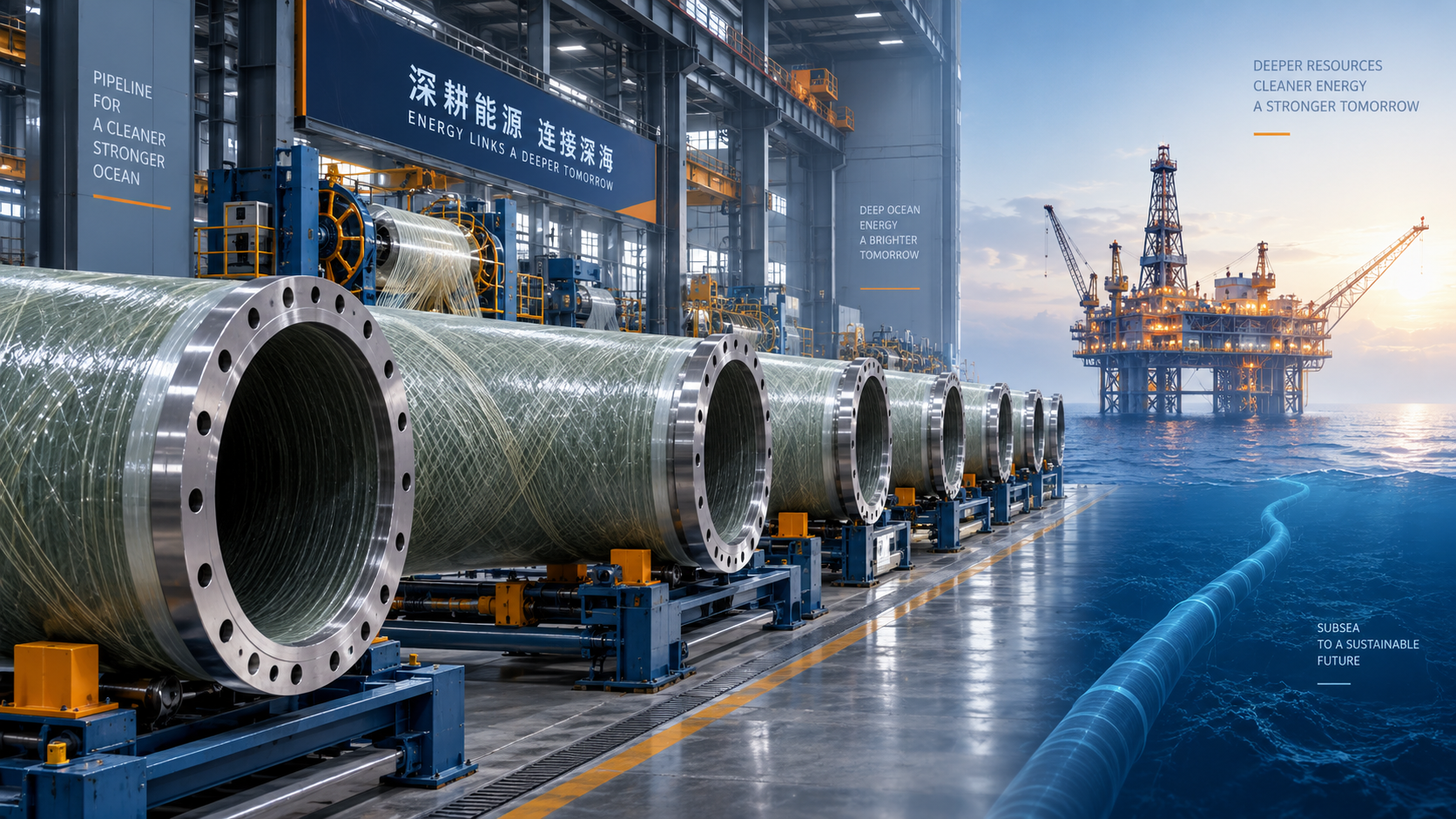
Offshore-grade GRE pipe is not a stocked commodity. It is wound, cured, and hydrostatically tested to meet specific project pressure ratings, often following standards like API 15HR or similar offshore requirements. A manufacturer like Shandong Ocean Pipe Technology, with 16 winding production lines and 5 static water pressure testing machines, can handle roughly 25,000 tons annually. But capacity and availability are not the same thing during peak procurement seasons.
Lead time is driven by three variables that buyers often underestimate:
- Fitting complexity: Straight pipe runs are relatively quick. But offshore projects require elbows, tees, flanges, and reducers. Fittings are wound on different machines—174 sets of fitting winding machines in Ocean Pipe’s case—and they often carry longer lead times than the pipe itself because of intricate geometry and additional curing cycles.
- Certification and testing windows: Each batch undergoes static water pressure testing. This is non-negotiable. A full production lot cannot be released until testing passes, and third-party inspection (like DNV or ABS for offshore use) adds days, sometimes weeks, to the schedule. If you need full traceability documentation for each joint, factor that into the timeline explicitly.
- Raw resin and glass supply: GRE pipe uses fiberglass and epoxy resin. Large suppliers usually hold buffer stock, but when oil and gas activities pick up globally, resin supply tightens. A manufacturer’s quoted lead time may be accurate at contract signing but can slip slightly if upstream feedstock delivery shifts.
For offshore projects, do not treat the manufacturer’s quoted production lead time as your procurement lead time. The safer calculation is: production lead time + 2 weeks for inspection and documentation + 3 to 5 weeks for sea freight. That is your real calendar. If you are sourcing for a fixed offshore installation window, a 16-week total timeline from order confirmation to site delivery is a prudent planning baseline.
MOQ: More Than Just Tonnage
Most mid-to-large Chinese GRE pipe manufacturers set a nominal MOQ around 3 to 5 tons for standard products. That sounds modest, but offshore-grade procurement rarely stays within simple tonnage boundaries. The practical MOQ is dictated by three factors that are more important than the base tonnage figure:
- Diameter and pressure class: If you are ordering 12-inch or larger pipe with high pressure ratings, the per-meter weight is high. A 3-ton MOQ might only cover 600 to 800 meters. For a small retrofit project, that can be acceptable. For a new platform or Subsea line, your real requirement will vastly exceed the MOQ, so the question becomes less about the minimum and more about the manufacturer’s ability to scale up production slots.
- Fitting and accessory ratio: Offshore installations use a higher percentage of fittings than onshore pipelines, often 15-20% by item count. Fittings have different manufacturing economics. A manufacturer may accept a low MOQ for straight pipe, but for custom fittings—especially non-standard angles or special pressure classes—they may effectively require you to order higher volumes to justify a dedicated winding setup.
- Shipping economics: A 3-ton order placed in a 40-foot container will have a high freight cost per ton. This alone often pushes smart buyers to consolidate orders into a 20-ton or 25-ton shipment to optimize logistics. In practice, many offshore procurement teams find that the theoretical MOQ is not the constraint; the container economics and project demand force larger orders anyway.
There is also a less visible MOQ factor: testing batch size. Static water pressure testing machines have finite capacities. If your order is too small, it may still take up a full testing bay slot, which manufacturers account for in pricing. Do not be surprised if a supplier quotes a slightly higher unit price for a small offshore-grade batch, not because of material costs but because of test cycle allocation.
How to Align Supplier Capacity with Your Project Milestones
The most common procurement mistake is asking for a lead time quote without giving the manufacturer your installation date and testing requirements upfront. Offshore GRE pipe is made to order. A manufacturer like Ocean Pipe, which supplies CNOOC, CNPC, and major shipyards, typically schedules production in order of project urgency and documentation complexity. If you approach them with a defined delivery window and required third-party certification, they can slot your order more accurately.
Consider requesting a production schedule that includes three critical review points:
Winding completion date: This is the point at which all pipe and fittings are physically manufactured. At this stage, you should request photo or video documentation of finished joints, especially if you are relying on remote inspection.
Hydrotesting completion date: This is your real quality gate. Before shipment release, every joint must pass static pressure testing. For offshore service, do not accept a shipment where only a sample batch was tested. Confirm that 100% of the order goes through the hydrostatic testing machines, and ask for the test charts as part of the documentation package.
Documentation packing date: For offshore projects, certificates of compliance, material test certificates, and traceability documents are often as critical as the physical pipe. Allocate at least one week in your procurement timeline for document review. If your project requires DNV, ABS, or other classification society survey, that adds another 2 to 4 days to the documentation phase. Missing this step is the most common cause of port delays and installation schedule slips.
Red Flags and Negotiation Levers
When comparing suppliers, treat a quote with a suspiciously short lead time—say, 2 to 3 weeks for offshore-grade GRE pipe—with caution. Unless they have identical stock sitting in a warehouse (rare for offshore specifications), a short lead time often indicates a plan to rush production, which can compromise curing quality. GRE pipe requires proper resin cure cycles. If a manufacturer tells you they can wind and ship in under four weeks, ask detailed questions about their cure oven capacity and whether they are skipping or shortening curing cycles.
On the negotiation side, the most effective lever is not asking for a lower price—it is asking for schedule flexibility. If you can accept a 2-week schedule buffer, many manufacturers will give you better pricing because it lets them optimize their winding line utilization across multiple projects. This works especially well with mid-capacity plants that have room to adjust production slots compared to factories running at full capacity.
Another practical lever is consolidating fittings with pipe in a single order. Because fittings require different production runs, ordering them together lets the manufacturer plan winding machine changeovers more efficiently. This can reduce your overall lead time by a week or two compared to issuing separate purchase orders for pipe and fittings.
Planning Your Procurement Calendar
For a typical offshore construction project, work backward from your installation date. If you need GRE pipe for offshore application on-site in 6 months, issue your RFQ now and place the order within 30 days. If you are only now starting supplier qualification, understand that the qualification process—including auditing the factory and getting your engineering team to approve materials—can add 4 to 6 weeks of calendar time before a purchase order is even placed.
The structural reality of offshore-grade GRE pipe procurement is that the manufacturing itself is not the bottleneck. The bottleneck is the coordination between your testing and documentation requirements and the manufacturer’s production scheduling. By understanding how lead times and MOQs actually behave against realistic project constraints, you can set a procurement timeline that does not rely on the optimistic numbers in a supplier’s brochure but on actual production physics. That is the difference between a procurement plan that survives contact with the project schedule and one that causes a costly offshore delay.
Related Posts
- ▶ Typical Lead Time and Minimum Order Quantity for Offshore-Grade GRE Pipe: A Procurement Planning Guide
- ▶ GRE vs. Flexible Composite Pipe for Subsea Water Injection Jumpers: Key Selection Criteria Explained
- ▶ Maximum Operating Pressure and Temperature Limits of GRE Pipe for Offshore: Interpreting API 15HR Data
Please give us a message
产品介绍产品介绍产品介绍产品介绍产品介绍产品介绍产品介绍产品介绍产品介绍产品介绍产品介绍产品介绍产品介绍产品介绍产品介绍产品介绍产品介绍产品介绍产品介绍产品介绍产品介绍产品介绍产品介绍产品介绍产品介绍产品介绍产品介绍产品介绍产品介绍产品介绍
Please give us a message
产品介绍产品介绍产品介绍产品介绍产品介绍产品介绍产品介绍产品介绍产品介绍产品介绍产品介绍产品介绍产品介绍产品介绍产品介绍产品介绍产品介绍产品介绍产品介绍产品介绍产品介绍产品介绍产品介绍产品介绍产品介绍产品介绍产品介绍产品介绍产品介绍产品介绍
Please give us a message
产品介绍产品介绍产品介绍产品介绍产品介绍产品介绍产品介绍产品介绍产品介绍产品介绍产品介绍产品介绍产品介绍产品介绍产品介绍产品介绍产品介绍产品介绍产品介绍产品介绍产品介绍产品介绍产品介绍产品介绍产品介绍产品介绍产品介绍产品介绍产品介绍产品介绍
Please give us a message
产品介绍产品介绍产品介绍产品介绍产品介绍产品介绍产品介绍产品介绍产品介绍产品介绍产品介绍产品介绍产品介绍产品介绍产品介绍产品介绍产品介绍产品介绍产品介绍产品介绍产品介绍产品介绍产品介绍产品介绍产品介绍产品介绍产品介绍产品介绍产品介绍产品介绍