
Maximum Operating Pressure and Temperature Limits of GRE Pipe for Offshore: Interpreting API 15HR Data
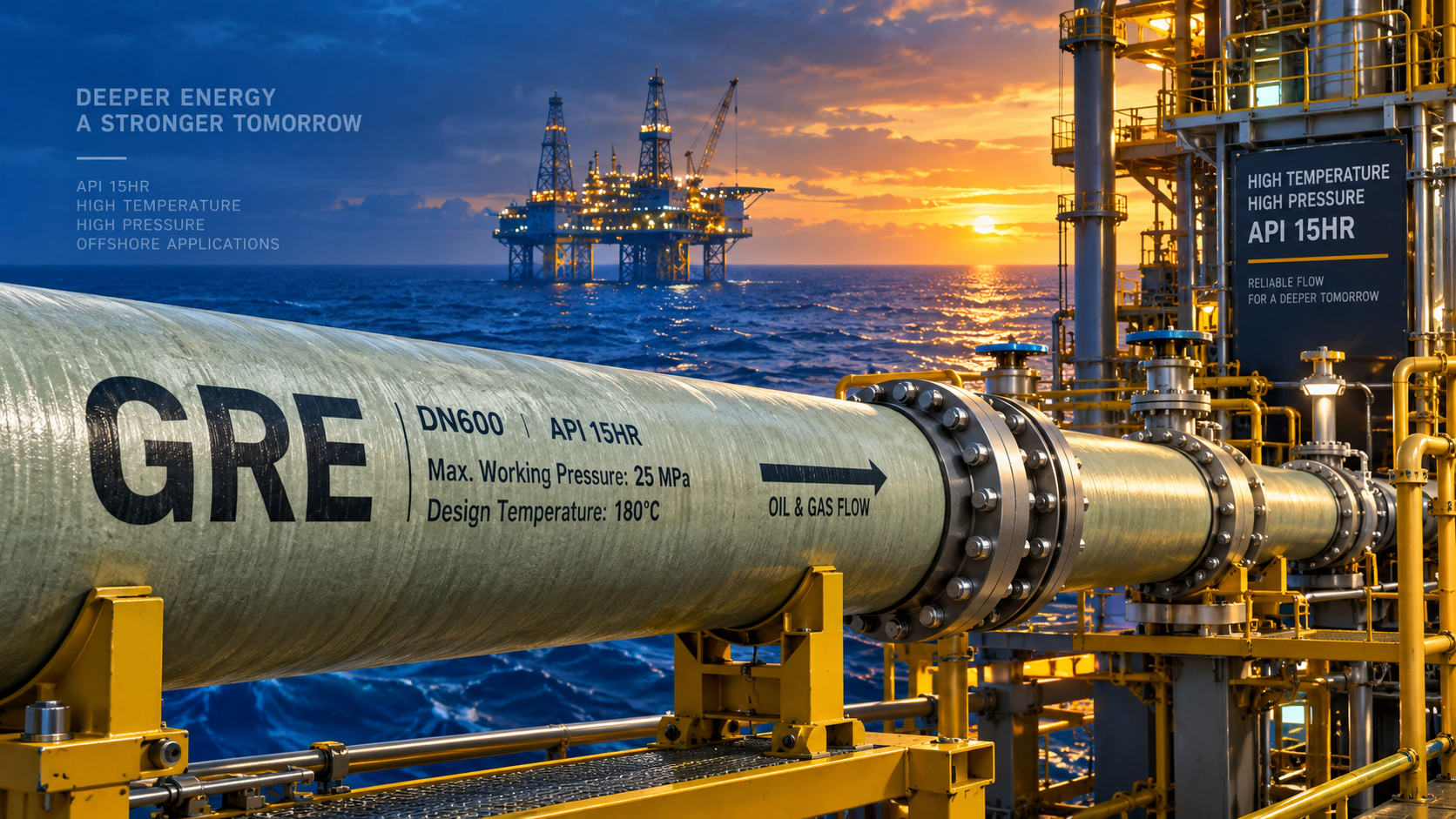
Offshore pipeline design rarely gives engineers the luxury of uncertainty. The material selected must survive decades of cyclic loading, aggressive seawater exposure, and the combined mechanical stress of internal pressure and elevated temperature. For glass-reinforced epoxy (GRE) pipe, those operating envelopes are not open-ended—they are defined by API 15HR, the specification that governs this class of composite piping for offshore service. Misreading those limits, or applying them without checking the specific product's ratings, can lead to over-specification that inflates project cost or, worse, under-specification that creates a latent failure risk.
The core figures to start with are straightforward: standard GRE pipe for offshore service typically carries a maximum operating pressure of 2,070 kPa (300 psi) and a maximum operating temperature of 93.3°C (200°F) per API 15HR conventions. But those numbers are not universal across all wall thicknesses, diameters, and joint configurations. What matters for a technical evaluator is not the headline number but the derating behavior—how allowable pressure changes as temperature rises, and how the pipe's pressure rating interacts with the specific service conditions on your platform or subsea line.
Where API 15HR Sets the Limits for GRE Pipe for Offshore
API 15HR is the governing document for high-pressure fiberglass line pipe, and it establishes the baseline ratings that manufacturers certify against. The standard’s temperature limit, 200°F (93.3°C), is not an arbitrary cap. It reflects the long-term mechanical property retention of the epoxy resin system when exposed to continuous heat in a wet environment—hydrolytic degradation accelerates noticeably beyond this threshold. The 300 psi pressure limit for standard products, meanwhile, relates to the cyclic fatigue performance of the laminate under offshore dynamic loading conditions.
For offshore risers, caissons, and ballast systems that run hotter or experience surging pressure, the standard product may not suffice. This is where the distinction between standard rating and actual allowable operating conditions becomes critical for project specifiers.
Pressure Derating as Temperature Increases
API 15HR-rated products are tested against a temperature/pressure matrix. A pipe that achieves a 300 psi cyclic rating at ambient temperature will not hold that same rating at 90°C. In practice, most manufacturers supply a derating curve that shows the fraction of rated pressure retained across the operating temperature range. Expect to see something in the range of:
- Up to 65.5°C (150°F): minimal derating, typically 90–100% of rated pressure retained.
- At 82.2°C (180°F): derating begins to become meaningful, often 75–85% of rated pressure.
- At 93.3°C (200°F): the maximum service temperature, where allowable pressure is typically reduced to around 60–70% of the base rating.
These figures vary by manufacturer and by pipe series, which is why the specific product data sheet is as important as the API 15HR requirement itself. Evaluators should request the exact derating table for the wall thickness under consideration rather than assuming a generic curve.
Application-Specific Limits for Ballast, Firewater, and Process Lines
The operating envelope also depends on what the pipe is carrying. GRE pipe for offshore shipboard ballast systems usually operates well below the thermal limit, so the temperature constraint is rarely the governing factor. Pressure surges during ballast transfer, however, can be frequent, and these fatigue cycles—not the steady-state pressure—determine the effective maximum operating pressure. API 15HR-rated pipe is designed to withstand a defined number of pressure cycles at a given magnitude, and exceeding that cyclic envelope accelerates micro-crack propagation in the laminate.
Conversely, firewater deluge systems on offshore topsides are one of the most demanding applications for GRE pipe. These lines sit dormant for long periods, then see sudden, high-velocity water flow. The concern shifts to hydraulic shock—water hammer—which can momentarily spike pressure well above the pump's rated output. When specifying GRE pipe for offshore firewater service, the decision hinge is not the average operating pressure but the worst-case surge pressure the system can produce. If that surge exceeds the pipe's short-term pressure rating—which is typically about twice the cyclic rating—the pipe will fail.
Joint and Fitting Considerations That Affect the Actual Limit
A straight run of pipe may have a temperature/pressure envelope that suits your process, but the joints often introduce a weaker link. API 15HR covers the pipe body, but the adhesive-bonded or threaded joints are subject to the same operating conditions, and their allowable pressure is sometimes lower than the pipe body. High-temperature service can reduce the shear strength of the adhesive used in tapered threaded joints, which shifts the limiting component from the pipe wall to the joint connection.
During evaluation, verify that the joint design rating—not just the pipe body rating—meets the maximum pressure and temperature combination projected for the most severe service case. Where pipe spools are fabricated with flanged ends, the gasket and flange material also have their own temperature ceiling that may fall below the pipe's limit.
How to Interpret a Manufacturer's API 15HR Data Sheet
When you sit down with a data sheet from a GRE pipe manufacturer—whether that is Ocean Pipe or another API 15HR-licensed producer—look for the following parameters in order of relevance to your operating conditions:
- Rated cyclic pressure: the maximum pressure the pipe can withstand for 150,000+ cycles without failure.
- Operating temperature range: the continuous service temperature window, typically 0°C to 93.3°C.
- Temperature derating table or curve: the multiplier to apply to rated pressure at elevated temperatures.
- Surge pressure rating: the absolute short-term pressure limit, which governs transient events.
- Joint ratings: the pressure rating for the specific connection type fitted to the pipe.
One common issue in technical evaluation: coupling a line that operates at 80°C and 250 psi steady-state pressure. The pipe body might be rated for exactly this condition with minimal derating, but the threaded joint's derating at 80°C could drop its allowable pressure to 220 psi. In that case, the system's maximum operating pressure is actually 220 psi—not the 250 psi you designed around.
Fatigue Life and the Effective Operating Envelope
The relationship between cyclic pressure and operating lifetime deserves close attention in offshore service. API 15HR products are performance-verified for 150,000 cycles at the rated pressure. If your process generates fewer expected cycles, there is headroom to push closer to the surge limit. But offshore installations often produce conditions that are difficult to predict precisely at design stage—especially for ballast and seawater intake lines exposed to sea states that create irregular pressure fluctuations.
A conservative, practical approach is to size the pipe so that the maximum expected cyclic pressure never crosses 85% of the manufacturer's rated cyclic pressure for the corresponding operating temperature. This margin absorbs irregularities in pump performance, surge events, and winter-to-summer temperature differences in the line.
Verification and Testing Requirements Before Approval
API 15HR compliance is verified by the manufacturer through static water pressure testing on the production line—a requirement that all licensed producers, including those from China and other manufacturing hubs, must meet to maintain their API monogram. As an evaluator, check that the manufacturer performs routine hydrostatic proof tests on each production lot, not just on type-tested prototypes. The test pressure applied is typically 1.5 to 2 times the rated pressure, and the temperature of the test medium matters. A test performed at room temperature confirms the pipe's structural integrity, but it does not validate high-temperature service suitability.
If your application runs near the upper temperature boundary, ask whether the manufacturer has performed cyclic fatigue tests at elevated temperature on the specific wall thickness and joint configuration you plan to use. Some manufacturers can provide this data upon request. If they cannot, the safer path is to limit the service temperature to a degree that leaves confidence margin below the API 15HR ceiling.
The takeaway for a technical evaluator is this: the 300 psi / 200°F headline rating of GRE pipe for offshore per API 15HR is a functional starting point, but the real specification for your project depends on the derating curve, joint ratings, surge allowance, and expected number of operating cycles. Get those four variables aligned with your worst-case service condition, and the pipe will perform to design life.
Related Posts
- ▶ Maximum Operating Pressure and Temperature Limits of GRE Pipe for Offshore: Interpreting API 15HR Data
- ▶ Connecting FRP Pipe to Existing Steel Pipelines in Refinery Retrofit Projects: Isolation and Flange Details
- ▶ Why FRP Pipe Delamination Occurs in High-Temperature Oil Emulsion Service and How to Prevent It
Please give us a message
产品介绍产品介绍产品介绍产品介绍产品介绍产品介绍产品介绍产品介绍产品介绍产品介绍产品介绍产品介绍产品介绍产品介绍产品介绍产品介绍产品介绍产品介绍产品介绍产品介绍产品介绍产品介绍产品介绍产品介绍产品介绍产品介绍产品介绍产品介绍产品介绍产品介绍
Please give us a message
产品介绍产品介绍产品介绍产品介绍产品介绍产品介绍产品介绍产品介绍产品介绍产品介绍产品介绍产品介绍产品介绍产品介绍产品介绍产品介绍产品介绍产品介绍产品介绍产品介绍产品介绍产品介绍产品介绍产品介绍产品介绍产品介绍产品介绍产品介绍产品介绍产品介绍
Please give us a message
产品介绍产品介绍产品介绍产品介绍产品介绍产品介绍产品介绍产品介绍产品介绍产品介绍产品介绍产品介绍产品介绍产品介绍产品介绍产品介绍产品介绍产品介绍产品介绍产品介绍产品介绍产品介绍产品介绍产品介绍产品介绍产品介绍产品介绍产品介绍产品介绍产品介绍
Please give us a message
产品介绍产品介绍产品介绍产品介绍产品介绍产品介绍产品介绍产品介绍产品介绍产品介绍产品介绍产品介绍产品介绍产品介绍产品介绍产品介绍产品介绍产品介绍产品介绍产品介绍产品介绍产品介绍产品介绍产品介绍产品介绍产品介绍产品介绍产品介绍产品介绍产品介绍