
Why FRP Pipe Delamination Occurs in High-Temperature Oil Emulsion Service and How to Prevent It
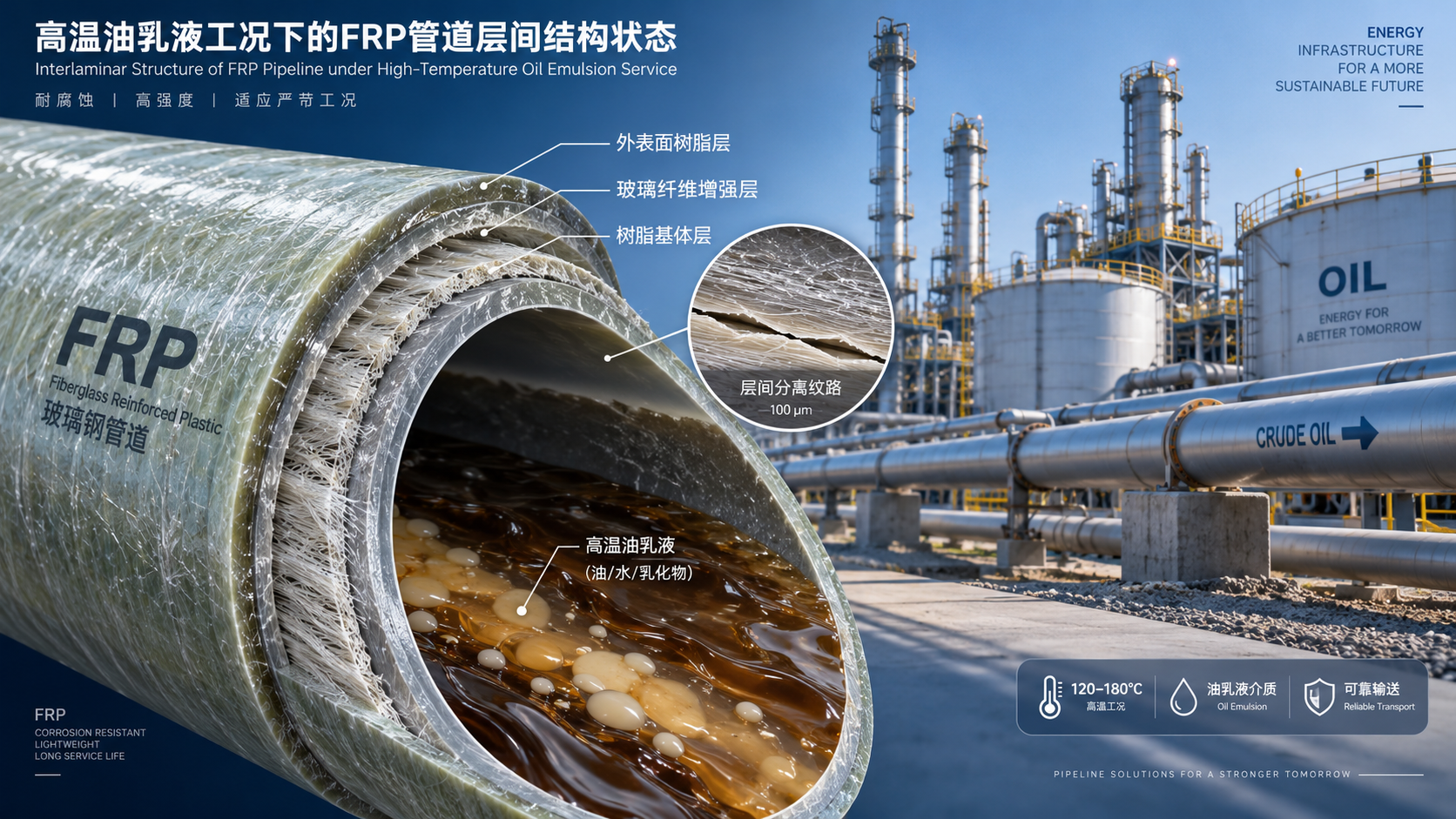
Why Delamination Shows Up in Hot Oil Emulsion Lines
Delamination in FRP pipe for oil and gas service is not the kind of failure that announces itself with a loud bang. It starts quietly—sometimes as a slight discoloration on the outer surface, sometimes as a faint white patch that looks like a surface blemish. By the time it becomes visible to the naked eye, the internal bond between the glass reinforcement and the resin matrix has already begun to break down.
For maintenance crews working in high-temperature oil emulsion service, this is a serious problem. The pipe may still hold pressure for a while, but the structural integrity is compromised. What was designed as a monolithic composite wall starts behaving like a stack of loose layers, and that changes everything about how the pipe responds to stress, thermal cycling, and hydraulic loads.
Understanding why this happens requires looking at both the material science and the operating conditions. In many cases, the root cause is not a single factor but a combination of thermal stress, chemical exposure, and manufacturing quality—sometimes compounded by installation practices that were perfectly acceptable for other piping materials but problematic for composites.
The Thermal Stress Problem That Won't Go Away
FRP pipes are laminated structures. They are built up layer by layer, with glass fibers embedded in a resin matrix. That construction gives them excellent corrosion resistance and a high strength-to-weight ratio—why they are widely used in oil and gas gathering systems, produced water lines, and firewater loops. But the same layered construction that makes FRP attractive also makes it vulnerable to differential expansion.
When the pipe carries hot oil emulsion at temperatures that fluctuate during normal operation, each layer expands and contracts at a slightly different rate. Glass fibers have a very low coefficient of thermal expansion. The resin system—even a high-performance epoxy—expands more. Over thousands of cycles, the repeated differential movement creates shear stress at the interface between layers. Once that shear stress exceeds the bond strength, micro-cracks develop. They grow with each subsequent cycle, and eventually the layers separate.
This is not a rare phenomenon. It is one of the most commonly cited reasons why FRP pipe for oil and gas applications fails in high-temperature service, especially where the temperature swings are significant. The problem is aggravated when the pipe is firmly restrained—like at flanges, supports, or where it enters equipment—because the thermal movement has nowhere to go.
Resin Degradation: The Chemical Side of the Story
High-temperature oil emulsion is not just hot. It is also chemically active. Water, salts, and sometimes dissolved gases like H₂S or CO₂ are all present. At elevated temperatures, the diffusion rates increase significantly. More aggressive species penetrate deeper into the pipe wall, and once they reach the resin, they attack it at the molecular level.
For epoxy-based systems, hydrolysis is the primary concern. Water molecules can break the chemical bonds in the epoxy network, reducing its mechanical properties and its ability to hold the glass fibers together. When the resin degrades, the interface between the resin and the glass fiber weakens. That is exactly where delamination tends to start—at the fiber-matrix interface, not in the bulk of the resin or in the glass itself.
Amine-cured epoxies are generally more resistant to hydrolysis than anhydride-cured systems, but performance depends heavily on the formulation details, the cure cycle, and the actual service conditions. One type of resin may perform well at 80°C with a specific produced water chemistry, while another fails at 60°C under different conditions. There is no universal answer. The material selection has to be matched to the specific service environment.
Manufacturing Quality: Where the Problem Can Be Prevented Before It Exists
Not all delamination failures are the result of operating conditions. Some are baked in from the start—during the winding process. If the resin does not fully wet out the glass fibers during manufacturing, there will be dry spots where the interlaminar bond is weak from day one. If the winding tension is inconsistent, the layered structure will be uneven. If the cure is incomplete, the resin will not reach its full mechanical properties and will be more susceptible to degradation.
This is why manufacturing process control really matters for FRP pipe used in demanding oil and gas service. A pipe that looks identical from the outside can have completely different internal quality depending on how it was made. Reputable manufacturers invest heavily in precise control of the winding process, resin mixing, and cure cycles.
Ocean Pipe, for example, operates 16 winding production lines and 174 sets of pipe fitting winding machines, all supported by winding micro control systems. The factory also has 5 static water pressure testing machines, with an annual production and testing capacity of 25,000 tons. That scale is not just about capacity—it is about consistency. When you have this level of control over the manufacturing process, you can monitor critical parameters throughout production and catch deviations before they become defects.
The company, established in 2012 and based in Wucheng Industrial Park, Dezhou City, Shandong Province, has become one of the top 10 largest GRE pipe manufacturers in China. Its products see service in oil and gas projects for companies like CNOOC, CNPC, and Sinopec, as well as in shipbuilding and chemical plant applications. Experience across these different sectors has shown repeatedly that the combination of a well-designed resin system and tight manufacturing control makes the difference for long service life.
Why Oil Emulsion Is Particularly Hard on FRP Piping
Oil emulsions create a unique set of challenges that are not present in simpler fluid services. The emulsion contains both oil and water phases, plus surfactants and other chemicals used to maintain the emulsion or break it downstream. This makes the fluid chemistry more complex than either pure hydrocarbon or pure water service.
The specific concern is that some compounds in the emulsion can act as plasticizers or swelling agents for the resin matrix. They penetrate the pipe wall and cause swelling, which changes the internal stress state. Combined with the differential thermal expansion between layers, this swelling can significantly accelerate the delamination process.
Another factor is viscosity. Heavy emulsions flow more slowly and can create higher localized temperatures at the pipe wall. The combination of high wall temperature and chemical exposure is the worst-case scenario for resin degradation. This is why pipes that perform well in one oilfield may struggle in another, even if the temperatures are similar—the chemical composition of the emulsion makes all the difference.
Practical Steps to Prevent Delamination in the Field
One of the most effective things maintenance teams can do is simply track the temperature profile of the pipe system. Not just the fluid temperature at the pump discharge, but the actual pipe wall temperature throughout the system, especially at points where the pipe passes near other hot equipment or where solar heating adds to the thermal load. If the wall temperature is consistently above the recommended service limit for the specific resin system, there will be trouble down the line.
Looking for early signs of delamination is also important. A simple tap test—listening for a dull sound that suggests a hollow area between layers—can reveal problems before they become visible. Ultrasonic inspection is more reliable, but tap testing is fast and can be done without special equipment. If you see areas that sound different from the surrounding pipe, mark them and monitor them. If they grow, that is a warning sign.
The condition of the pipe supports matters too. Any support or restraint that creates a hard point on the pipe will magnify thermal stress in that location. It is worth checking whether the pipe is allowed to move thermally as designed. Restrained thermal expansion is a leading contributor to interlaminar shear failure.
When selecting FRP pipe for oil and gas service in high-temperature emulsion lines, the operating envelope is critical. The service temperature, the chemical composition of the emulsion, and the presence of cyclic thermal loads all need to be spelled out clearly to the manufacturer. Under-specifying the service conditions is one of the most common mistakes in FRP pipe selection. A pipe ordered with a generic "oilfield service" specification may not have the specific resin system needed for your particular fluid.
At a minimum, clarify the maximum sustained temperature, the expected number of thermal cycles per year, and the full chemical analysis of the fluid including trace components. With that information, a manufacturer can select the appropriate resin system and pipe wall construction to provide a safe service life.
Knowing When to Replace Rather Than Repair
Once delamination is detected, the question becomes whether to repair or replace. In many cases, the answer depends on the extent of the damage. Small, localized areas of delamination can sometimes be repaired with a properly designed composite wrap. But if the delamination is widespread or if it has been growing over time, replacement is the safer choice.
A repair on a delaminated pipe only addresses the symptom. The underlying cause—whether thermal stress, chemical degradation, or a manufacturing defect—may still be present. If you do not correct the root cause, the problem will return. This is why any delamination event should trigger a broader review: is the pipe operating within its design envelope? Is the material selection still appropriate for the current service conditions? Have the process conditions changed since the pipe was installed?
For operators who have been through this, the most cost-effective approach is usually to prevent delamination from the start by selecting the right pipe specification, installing it properly, and monitoring it over time. The upfront engineering effort costs less than an unplanned shutdown.
What Maintenance Crews Should Keep in Mind
FRP pipe for oil and gas has proven itself across thousands of installations in demanding service. It does not fail quickly like a metal pipe might, but it also does not show obvious external warning signs when it is degrading internally. The failure mode is subtle, and it is too easy to miss the early indicators until the pipe is already significantly damaged.
Delamination in high-temperature oil emulsion service is not a mystery. It is the predictable result of thermal stress, chemical attack, and material limitations—acting over time on a structure whose strength depends entirely on interlaminar bonding. Once you understand that, the prevention strategy becomes clearer: control the operating conditions, specify the right material for the actual service, and inspect for early signs of bond degradation.
If you are reviewing your current FRP piping systems or planning a new installation for oil emulsion service, it is worth documenting the full operating data now—temperatures, pressure, fluid chemistry, and anticipated thermal cycles—and checking whether your current pipe specification aligns with those conditions. That review might save your operation from the downtime and cost of a delamination failure that was entirely avoidable.
Please give us a message
产品介绍产品介绍产品介绍产品介绍产品介绍产品介绍产品介绍产品介绍产品介绍产品介绍产品介绍产品介绍产品介绍产品介绍产品介绍产品介绍产品介绍产品介绍产品介绍产品介绍产品介绍产品介绍产品介绍产品介绍产品介绍产品介绍产品介绍产品介绍产品介绍产品介绍
Please give us a message
产品介绍产品介绍产品介绍产品介绍产品介绍产品介绍产品介绍产品介绍产品介绍产品介绍产品介绍产品介绍产品介绍产品介绍产品介绍产品介绍产品介绍产品介绍产品介绍产品介绍产品介绍产品介绍产品介绍产品介绍产品介绍产品介绍产品介绍产品介绍产品介绍产品介绍
Please give us a message
产品介绍产品介绍产品介绍产品介绍产品介绍产品介绍产品介绍产品介绍产品介绍产品介绍产品介绍产品介绍产品介绍产品介绍产品介绍产品介绍产品介绍产品介绍产品介绍产品介绍产品介绍产品介绍产品介绍产品介绍产品介绍产品介绍产品介绍产品介绍产品介绍产品介绍
Please give us a message
产品介绍产品介绍产品介绍产品介绍产品介绍产品介绍产品介绍产品介绍产品介绍产品介绍产品介绍产品介绍产品介绍产品介绍产品介绍产品介绍产品介绍产品介绍产品介绍产品介绍产品介绍产品介绍产品介绍产品介绍产品介绍产品介绍产品介绍产品介绍产品介绍产品介绍