
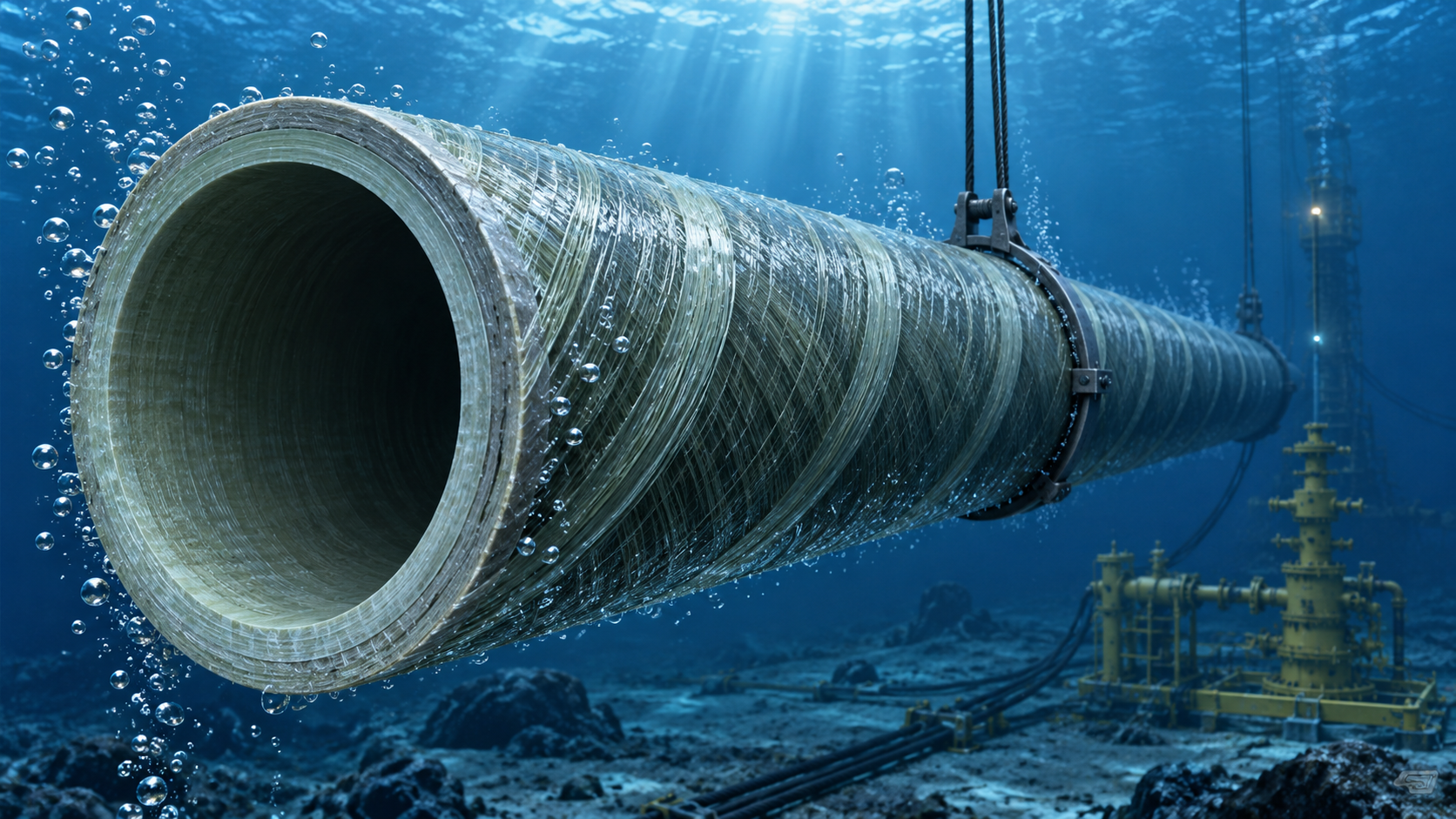
When specifying FRP pipe for high-depth offshore water injection, the first thing to understand is that wall thickness is not a standalone calculation. It is the output of a structural check against external hydrostatic pressure, internal operating pressure, and installation loads. For project managers, the risk is not in finding a pipe that meets one of these conditions — it is in balancing all of them simultaneously while keeping the overall design within allowable strain limits.
The primary load case: external pressure and collapse resistance
At depths beyond roughly 300 meters of seawater, external hydrostatic pressure dominates the wall thickness requirement. Unlike onshore piping where internal pressure is the governing factor, a deepwater water injection line must first survive the ambient pressure before any internal pressure is applied. During installation and before commissioning, the pipe may be empty or only partially filled, meaning the external pressure acts on an unpressurized vessel. This is the most severe collapse condition the pipe will encounter in its service life.
The governing failure mode here is elastic instability and collapse, not burst. FRP pipes under external pressure fail by ovalization or local buckling at stress levels far below their rated internal pressure capacity. The critical collapse pressure is proportional to the pipe's flexural stiffness, which is a function of the cube of wall thickness. This means a small reduction in wall thickness produces a disproportionately large drop in collapse resistance. For deepwater service, this is where most specification errors originate — engineers extend the internal pressure rating logic to a deepwater scenario, then wonder why the same nominal pressure rating pipe is unsuitable subsea.
Internal pressure: not the governing case in deepwater, but still relevant
Water injection lines typically operate at surface injection pressures of 100 to 300 bar. The internal pressure requirement is usually met by the same wall thickness that satisfies the collapse check at depth, provided the pipe is designed for the combined condition. However, the interaction between internal pressure and external pressure changes the stress state. When the pipe is in operation, internal pressure offsets a portion of the external hydrostatic load, reducing the net compressive hoop stress. The worst-case net external pressure occurs during installation, hydrotesting, or in an operational scenario where the injection pump trips and the line pressure bleeds down while the column remains full of seawater.
Project managers should therefore specify wall thickness checks for both scenarios: the empty pipe at maximum installation depth, and the depressurized pipe filled with water at maximum seabed depth. Some codes and standards address this through a design factor on the external pressure case, but the recommended practice is to calculate both conditions explicitly and verify the governing case.
Axial loads from installation: the factor most often underestimated
Deepwater FRP pipe installations are not lowered into place like steel pipe. The lightweight nature of FRP means the pipe is often pulled into position, laid from a reel, or towed in bundles. These installation methods generate axial tensile loads and bending moments that the pipe must withstand during the brief but critical installation window. A wall thickness that satisfies static pressure conditions may not provide adequate resistance to installation-induced bending, especially at pipe joints where stress concentrations occur.
The joint is the structural weak point in any FRP piping system. A wall thickness calculation that treats the pipe body as a uniform cylinder will always underestimate the requirement at the adhesive-bonded or mechanical joint location. The pipe body may be adequate at 20 mm wall thickness, but the joint region requires additional reinforcement or a greater wall thickness to carry the same axial load. This is not a theoretical concern — it is the most common cause of installation failures in deepwater FRP water injection lines.
Pipe stiffness and the role of hoop modulus
Wall thickness in an FRP pipe is not simply a dimension; it determines the structural stiffness in the circumferential and axial directions. The filament winding pattern, the angle of the glass reinforcement, and the resin system all interact with thickness to produce a specific stiffness profile. Two pipes with the same wall thickness but different winding angles will have different collapse pressures and different axial stiffness values.
For deepwater service, the circumferential (hoop) modulus is the critical material parameter. A pipe with a low hoop modulus will require a greater wall thickness to achieve the same collapse resistance as a pipe with a higher hoop modulus. This is why comparing pipe specifications from different manufacturers solely on wall thickness is misleading — the modulus values must be part of the comparison. When evaluating FRP pipe for oil and gas applications, ensure the manufacturer provides the actual laminate modulus values under the specified winding angle, not just a generic E-glass modulus figure.
Long-term behavior: creep and fatigue in service
Offshore water injection service is a cyclic operation. Injection pressures fluctuate, shutdowns occur, and the pipe experiences repeated pressure cycles over its design life. For FRP pipes, cyclic loading can initiate micro-cracks in the resin matrix, leading to progressive stiffness degradation. This long-term fatigue behavior directly impacts the required wall thickness. A static design that passes the initial collapse pressure check may fail over time if the pipe's stiffness degrades under cyclic loading and the collapse resistance drops below the external pressure requirement.
The standard approach is to apply a long-term design safety factor on the short-term mechanical properties. Typical factors range from 0.5 to 0.67 on the initial hoop modulus and strength values, depending on the design life and the severity of cyclic loading. For high-depth water injection, where external pressure remains constant, a higher safety factor is warranted. A pipe that is borderline acceptable for a 20-year life at 500 meters depth becomes unacceptable when the cyclic loading history is properly accounted for.
Practical specification guidance for project managers
The specification process should begin with a qualification test. Before committing to a wall thickness, require the manufacturer to provide collapse test data at the actual design depth pressure, not just theoretical calculations. A full-scale collapse test on a sample pipe with the specified wall thickness, winding angle, and joint configuration is the most reliable verification. This testing is not expensive compared to the cost of a subsea failure and should be a non-negotiable requirement.
Second, specify the wall thickness in relation to the pipe's minimum tolerance. FRP pipes are wound on mandrels, and the wall thickness can vary slightly along the length and circumference. The nominal wall thickness is always higher than the minimum wall thickness, and the collapse pressure calculation must use the minimum value. A specification that does not state the minimum acceptable wall thickness leaves room for interpretation that can result in an undersized pipe being installed.
Third, evaluate the joint system at the specified wall thickness. Ask for the manufacturer's joint design verification under the installation bending loads expected at your site. If the joint requires a thickened bell end or a reinforcing overwrap, this must be captured in the overall pipe specification and not treated as a separate item.
Finally, review the compatibility between the pipe's rated internal pressure and its collapse resistance at your specific depth. Some manufacturers offer the same nominal pipe in different wall thickness grades. Selecting a pipe solely on its internal pressure rating may result in a wall thickness that is insufficient for the external pressure at depth. The specification must clearly state the service depth as a design parameter, not just the internal working pressure.
The decision point
The commercially-driven impulse to reduce material cost by selecting a thinner wall is dangerous in deepwater service. The cost difference between a pipe that barely passes the static checks and one that has adequate margin for installation loads, cyclic degradation, and manufacturing tolerance is small relative to the cost of retrieving and repairing a failed subsea line. For the project manager, the correct specification is the one that passes all load cases with a defensible safety factor — not the one that meets the minimum requirement of any single condition.
For high-depth offshore water injection, the starting point must always be the collapse pressure at the maximum installation depth, with an empty or depressurized pipe. From that baseline, add in the installation load case and the long-term material degradation factors. The resulting wall thickness will be higher than what a purely internal-pressure-based design produces. That is not a defect in the FRP pipe; it is the actual engineering requirement of the service environment.