
FRP Pipe for Oil and Gas Applications: Qualified Resin Systems That Resist H2S and CO2 Attack
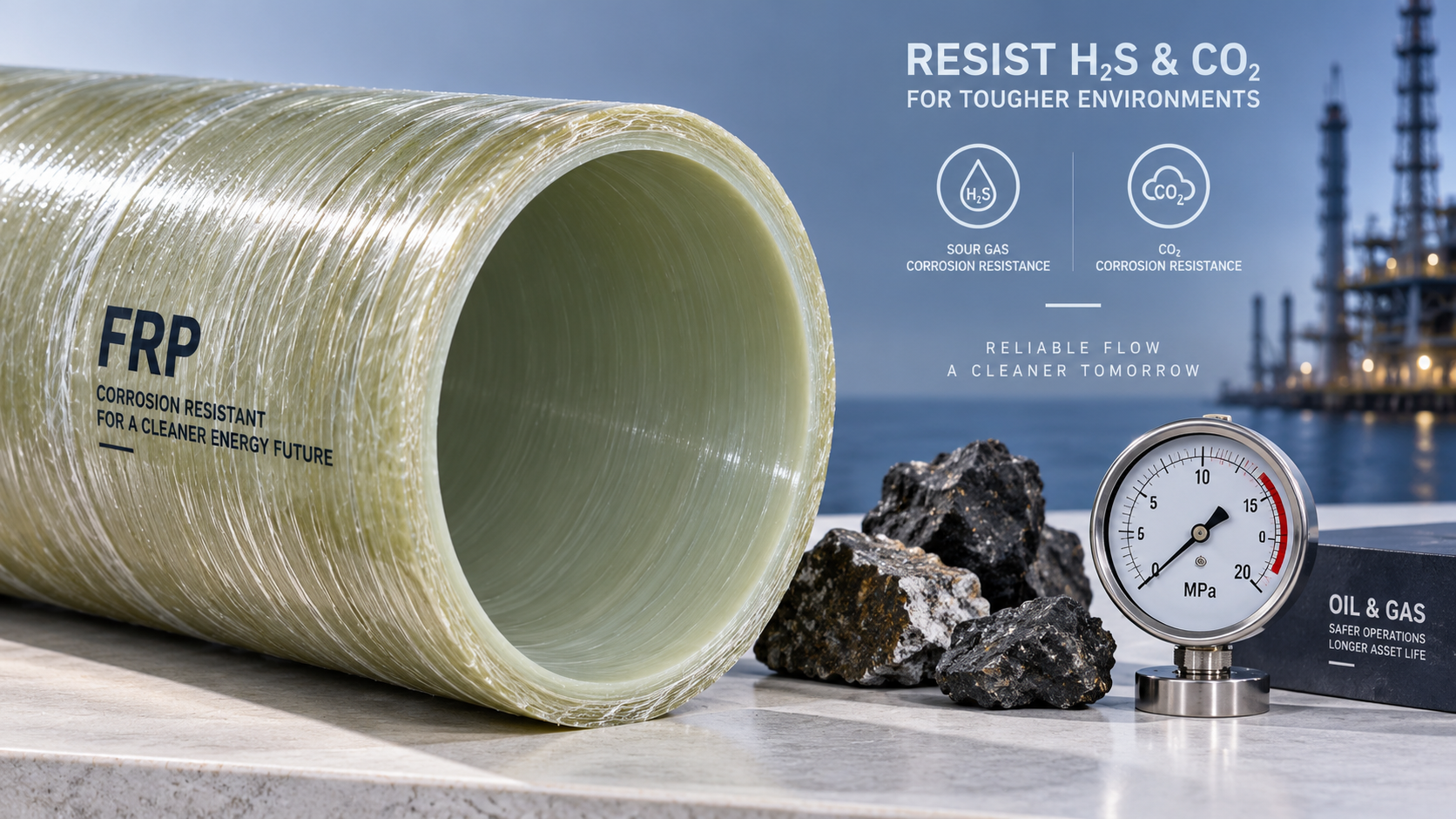
Qualified Resin Systems for FRP Pipe in H₂S and CO₂ Service
The first decision when selecting FRP pipe for oil and gas applications is not pipe wall thickness or joint design—it is the resin system. The resin matrix determines how the pipe behaves under prolonged exposure to sour hydrocarbons, wet CO₂, and the elevated temperatures that often accompany these fluids. A pipe that performs flawlessly in fresh water service can fail prematurely in sour service if the resin chemistry is not qualified for the specific corrosive environment.
Why H₂S and CO₂ Demand a Different Resin Qualification Protocol
Hydrogen sulfide and carbon dioxide are not aggressive in their dry, anhydrous state. The damage mechanism begins when these gases dissolve in produced water to form weak acids—H₂S producing sulfide ions and CO₂ producing carbonic acid. The severity of attack depends on three interacting variables: partial pressure of the corrosive gas, temperature, and the presence of free water. A resin system that passes testing at 1% H₂S may fail at 5% H₂S, not because the concentration is five times higher, but because higher partial pressure drives deeper acid penetration into the resin matrix.
Another often-misunderstood factor is the difference between continuous exposure and cyclic exposure. Production wells do not operate at steady-state conditions. Shutdowns, pressure drops, and water breakthrough episodes create cycling conditions that stress the resin differently than constant exposure. Some resin systems appear adequate in static autoclave tests yet develop micro-cracking under cyclic thermal and pressure loading, opening pathways for corrosive media to reach the fiber reinforcement.
Key Resin Chemistries for Sour and Sweet Service
Not all epoxy resins respond to H₂S and CO₂ attack in the same way. The chemical structure of the epoxy molecule, the curing agent, and the additives all influence permeability and chemical resistance. The most commonly specified resin types for oil and gas FRP pipe include:
- Bisphenol A epoxy (DGEBA): A general-purpose resin that offers good mechanical properties but limited resistance to highly sour environments. It performs adequately in sweet service with low CO₂ partial pressures and temperatures below 65°C.
- Novolac epoxy: Higher crosslink density than DGEBA systems gives novolac resins better chemical resistance and higher temperature capability. These systems can handle more aggressive H₂S concentrations and temperatures up to approximately 95°C, depending on the specific formulation.
- Bisphenol F epoxy: Lower viscosity than DGEBA allows better fiber wet-out, producing a more homogeneous pipe wall. The chemical resistance profile is similar to DGEBA but with slightly improved resistance to aromatic hydrocarbons that can co-exist with produced fluids.
The curing agent is equally important as the base resin. Aromatic amine hardeners produce higher crosslink density and superior chemical resistance compared to aliphatic amine hardeners. However, aromatic amine-cured systems are more brittle, which affects the pipe's ability to handle impact loads during handling and installation. The balance between chemical resistance and mechanical toughness must be evaluated for each specific service condition.
How the Acid Number and Leachable Content Affect Qualification
Qualification testing for FRP pipe in sour service goes beyond mechanical burst testing. Two parameters require particular attention: acid number and leachable content. The acid number measures residual acidic species in the cured resin. High acid numbers indicate incomplete curing or the presence of unreacted acidic catalysts, both of which make the pipe more vulnerable to H₂S attack. Quality manufacturing processes should produce pipe with consistently low acid numbers, but variability between production runs is not uncommon—which is why lot-to-lot verification matters more than a single type test.
Leachable content testing measures the amount of unpolymerized material that can be extracted from the pipe wall. High leachables correlate with higher permeability to corrosive gases. This is particularly relevant for pipes manufactured with fast-cure systems where incomplete crosslinking can occur in thick pipe walls. The thickest section of the pipe—typically the bell or spigot end—may have different leachable content than the pipe body due to different thermal histories during curing.
Glass Reinforcement Selection Is Not Independent of Resin Choice
The corrosion barrier in FRP pipe relies on a resin-rich layer at the inner surface. But beneath this layer, the structural wall combines glass reinforcement with the resin matrix. The glass type matters. E-glass suffers from acid attack—sulfuric acid, in particular, can leach calcium and aluminum from the glass fibers, weakening the structural wall over time. ECR-glass or C-glass resistant to acidic attack provides longer service life in sour applications. However, these glass types have different mechanical properties and bonding characteristics with epoxy resins, potentially affecting the pipe's pressure rating and stiffness.
The resin-to-glass interface is the hidden vulnerability. Even with a qualified resin system, poor interfacial adhesion creates capillary pathways for corrosive media to migrate along the fiber length. This is why qualified resin systems for H₂S service typically undergo interlaminar shear strength testing after exposure, not just before. A system that passes initial mechanical testing but shows significant shear strength degradation after 90 days of exposure may not provide the required long-term performance.
What Autoclave Testing Actually Shows
Standard qualification testing for FRP pipe in sour service usually involves exposing samples to simulated production fluids in a pressurized autoclave. The test conditions attempt to reproduce the worst-case combination of H₂S partial pressure, CO₂ partial pressure, temperature, and water chemistry. But two pitfalls commonly lead to misleading results.
The first pitfall is insufficient test duration. Some accelerated test protocols use shorter exposure times with higher temperatures to extrapolate long-term behavior. The Arrhenius relationship used for this extrapolation assumes a single degradation mechanism dominated by temperature. In reality, H₂S attack involves multiple mechanisms—diffusion, hydrolysis, and oxidation—each with different temperature dependencies. Extrapolation from short-term high-temperature testing can produce optimistic performance predictions.
The second pitfall is the omission of cyclic conditions. Many qualification tests expose samples to constant conditions for the entire test duration. Production operations, however, experience shut-ins, pressure fluctuations, and temperature swings. These cyclic loads not only stress the material mechanically but also alter the diffusion kinetics of corrosive media into the pipe wall. Some resin systems that pass constant-exposure testing develop cracks under cyclic conditions because the thermal expansion coefficient of the resin differs from that of the glass reinforcement, creating internal stresses during each cycle.
Practical Criteria for Resin System Selection
Rather than relying solely on manufacturer data sheets, technical evaluation should consider several factors together before specifying a resin system for a particular application:
- Partial pressure of H₂S in the gas phase: This determines whether the service is classified as sour or sweet, and how aggressive the H₂S attack will be. Low-partial-pressure environments below 0.05 psia are far less demanding than systems with H₂S partial pressures above 1 psia.
- Operating temperature: Above 60°C, diffusion rates in the resin matrix increase significantly. Each 10°C increase roughly doubles the rate of chemical attack for most resin systems.
- Water cut and condensate chemistry: Produced water with high chloride content increases the aggressiveness of the corrosive environment. Chlorides can penetrate the resin matrix and attack the glass fibers at points where the resin coverage is thin.
- Cyclic operation frequency: Wells that are frequently shut in and restarted subject the pipe to thermal and pressure cycling that accelerates the development of micro-cracks in the resin matrix.
- Manufacturing quality indicators: Look for consistent acid number values and low leachable content in the cured pipe. Lots with high or variable leachable content are at higher risk of premature permeation failure.
One Environment, Different Resin Requirements
Two facilities can process fluids with identical H₂S and CO₂ concentrations, yet require completely different resin systems. The difference comes from pressure and temperature. A low-pressure well at 40°C with 10% H₂S is far less demanding than a high-pressure injection well at 90°C with the same 10% H₂S. The partial pressure of H₂S in the latter case can be ten or more times higher, dramatically increasing the diffusion gradient that drives acid penetration into the pipe wall.
The same logic applies to CO₂. In low-pressure systems, CO₂ alone may not justify a specialty resin system. But in CO₂-enhanced oil recovery projects, where the injection pressure is high and the CO₂ is recycled, the carbonic acid concentration at the pipe surface can be substantial. This increases the importance of resin qualification for CO₂ resistance, particularly in the presence of free water.
Field Verification and Commissioning Considerations
Qualification testing in the laboratory is the first step, but it cannot account for all variables present in actual operations. When commissioning FRP pipe for sour service, several practical verification steps are appropriate. Pressure testing with water containing no chemical additives minimizes the risk of incompatible test fluids interacting with the pipe material. If oxygen scavengers or corrosion inhibitors must be added to the test water, confirm that they are compatible with the resin system. Some common oilfield chemicals attack epoxy resins, particularly at elevated temperatures during pressure testing.
Pipeline commissioning procedures should also account for drying requirements. Most FRP pipes are not completely impermeable to gas molecules. Under high partial pressures, H₂S can slowly permeate through the pipe wall, creating corrosion risks for the surrounding environment. This is particularly relevant for above-ground installations where the outer surface is accessible. Unqualified resin systems with high permeability to H₂S can pose safety hazards, not just integrity issues.
Manufacturing Consistency as a Qualification Factor
Resin qualification is not a one-time event. Variability in resin batches, curing conditions, or winding parameters can change the performance of the final pipe. This is why experienced purchasers require qualification testing on the actual production pipe, not just on resin samples. The interaction between the selected resin and the specific glass reinforcement, winding pattern, and cure cycle of a particular factory produces unique performance characteristics.
The position of the pipe in the production line also matters. The first pipe produced after a resin batch change may have different cure characteristics than pipes produced when the process is fully stabilized. Temperature variations across a large pipe during the winding and curing process can create local variations in crosslink density, producing corresponding variations in chemical resistance. These effects are more pronounced in large-diameter pipes and fittings with thick walls.
Qualified Resin Systems Are Application-Specific, Not Universal
The qualification of a resin system for one set of operating conditions does not guarantee performance under different conditions. A resin qualified for 2,000 ppm H₂S at 75°C in a water injection system may not be suitable for a gas lift line with 50,000 ppm H₂S and cyclic operation. Each new application requires its own evaluation of the specific conditions and the expected performance margin.
In practice, one of the most common failure modes observed in FRP sour-service lines is not catastrophic rupture but gradual permeation and blistering. This develops when the corrosive media slowly diffuses through the resin matrix, builds up pressure at the resin-glass interface, and creates internal delamination. This type of attack is difficult to detect externally until significant damage has already occurred, which makes the correct initial resin selection and the verification of manufacturing quality especially critical for sour service applications.
Related Posts
Please give us a message
产品介绍产品介绍产品介绍产品介绍产品介绍产品介绍产品介绍产品介绍产品介绍产品介绍产品介绍产品介绍产品介绍产品介绍产品介绍产品介绍产品介绍产品介绍产品介绍产品介绍产品介绍产品介绍产品介绍产品介绍产品介绍产品介绍产品介绍产品介绍产品介绍产品介绍
Please give us a message
产品介绍产品介绍产品介绍产品介绍产品介绍产品介绍产品介绍产品介绍产品介绍产品介绍产品介绍产品介绍产品介绍产品介绍产品介绍产品介绍产品介绍产品介绍产品介绍产品介绍产品介绍产品介绍产品介绍产品介绍产品介绍产品介绍产品介绍产品介绍产品介绍产品介绍
Please give us a message
产品介绍产品介绍产品介绍产品介绍产品介绍产品介绍产品介绍产品介绍产品介绍产品介绍产品介绍产品介绍产品介绍产品介绍产品介绍产品介绍产品介绍产品介绍产品介绍产品介绍产品介绍产品介绍产品介绍产品介绍产品介绍产品介绍产品介绍产品介绍产品介绍产品介绍
Please give us a message
产品介绍产品介绍产品介绍产品介绍产品介绍产品介绍产品介绍产品介绍产品介绍产品介绍产品介绍产品介绍产品介绍产品介绍产品介绍产品介绍产品介绍产品介绍产品介绍产品介绍产品介绍产品介绍产品介绍产品介绍产品介绍产品介绍产品介绍产品介绍产品介绍产品介绍