
Fire-Safety Properties of Glass Reinforced Epoxy Pipe: How Resin Choice Affects Flame Spread Ratings
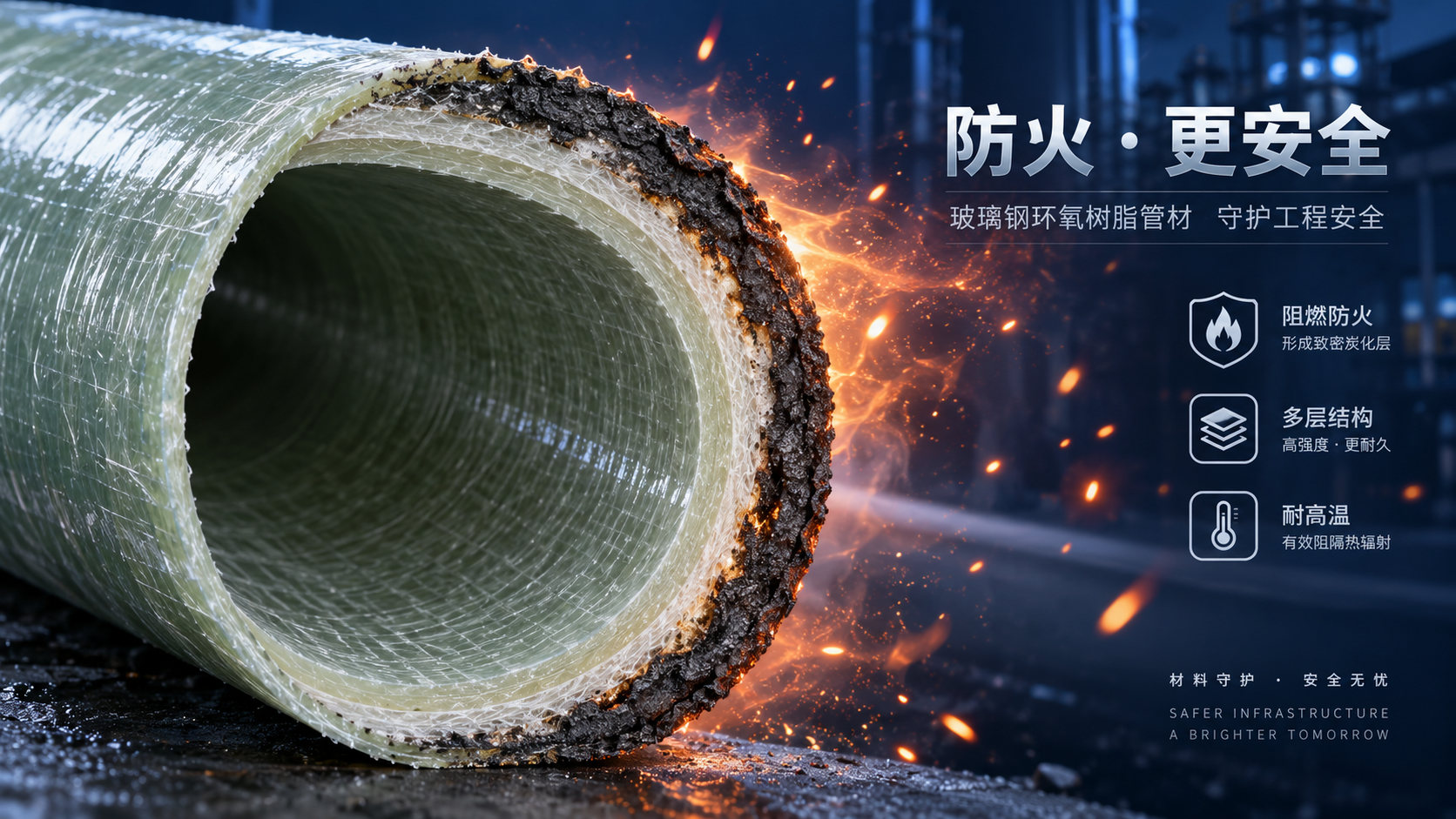
Walk onto any offshore platform or into a midstream processing facility, and you’ll notice something quickly: the sheer volume of piping running overhead and beneath your feet. In high-risk zones, every component carries its own fire risk profile, and in the oil and gas industry, the stakes are simply too high for guesswork. For quality control and safety management professionals, the question isn’t just whether a pipe can handle pressure or chemicals—it’s what happens when that pipe is exposed to flame or radiant heat.
Glass Reinforced Epoxy (GRE) piping systems have long been recognized for their corrosion resistance, light weight, and long-term structural integrity. But the fire-safety side of the equation often gets less attention than it deserves. That’s a gap worth closing. The real story behind GRE fire performance isn’t in the glass fibers—it’s in the resin matrix that binds them together. How that resin system is selected, formulated, and processed determines the flame spread rating you’ll end up with on your data sheet, and more importantly, what that rating actually means once the pipe is installed in a pipe rack or a cramped module.
The Basics of Flame Spread Ratings
Let’s start with the metric itself. Flame spread rating measures how far and how quickly a flame travels across a material’s surface under standardized test conditions. Lower numbers are better—typically, a material with a flame spread index of 25 or less is considered Class A in many building and industrial codes. For GRE pipes, this rating is generally evaluated using ASTM E-84 or similar protocols adapted for pipe geometry.
But here’s a nuance that often gets lost: the flame spread rating is not purely a material property. It’s a system property influenced by resin chemistry, glass content, wall thickness, and the surface characteristics of the finished pipe. Two GRE pipes may look identical in a spec sheet, yet behave very differently in a vertical flame test. That’s where the resin choice steps into the spotlight.
Why Resin Choice Trumps Glass Content in Fire Scenarios
Fiberglass reinforcement contributes structural strength, but glass itself does not burn—and it also does not protect the resin. The resin is the continuous phase, the part that surrounds every fiber and fills the interstitial space. When a GRE pipe is exposed to flame, it’s the resin that ignites, pyrolyzes, and feeds the fire. The glass may remain behind, but a char layer and a structural collapse are the likely outcomes if the resin system wasn’t designed for fire resilience.
The most common resin systems in GRE pipe manufacturing include bisphenol-A epoxy, novolac epoxy, and increasingly, brominated epoxy variants. Each brings its own balance of mechanical performance and fire behavior:
- Standard bisphenol-A epoxy: Excellent mechanical properties and chemical resistance. However, unmodified, it tends to produce higher flame spread and greater smoke generation than specialty fire-retardant grades.
- Novolac epoxy: Higher crosslink density, better thermal stability, and improved char formation. Typically offers a lower flame spread index compared to bisphenol-A systems, especially when paired with a brominated co-resin.
- Brominated or halogenated epoxy: Introduces flame-retardant chemistry directly into the polymer backbone. These systems interrupt combustion through radical quenching in the gas phase. Result: markedly lower flame spread ratings and slower heat release rates.
Of course, adding flame-retardant chemistry isn’t a free lunch. Higher bromine content can affect viscosity during winding, impact hydrolytic stability, and shift long-term aging behavior. That’s why the selection can’t be made on fire performance alone—it has to be balanced against the operating environment, service temperature, and the aggressive media being carried.
A Practical Look at Test Standards and Compliance
Beyond the numbers, what matters most is whether your pipe system meets the specific code requirements for the region and application. Offshore installations, for instance, frequently reference NORSOK C-002 or API 15HR. For topside hydrocarbon services, fire testing may go beyond laminar flame spread and include jet-fire resistance testing or pool fire endurance.
One common misstep among procurement teams is assuming a single flame spread value is universally accepted. It’s not. The classification boundary, test protocol, and acceptance criteria vary by jurisdiction and by application class. A pipe with an ASTM E-84 Class A rating may still fail a modified vertical burn test required by an offshore operator’s internal standard. That’s why detailed attention to the test method referenced in your project specification matters as much as the rating itself.
For safety managers, the practical takeaway is to verify three things before signing off on a GRE order: the exact test standard used, the fire-retardant nature of the resin system, and whether the pipe’s rating applies to the actual wall thickness and diameter you’re installing. Fire test results are thickness-dependent—a rating achieved on an 8-inch, schedule 40 pipe may not apply to a 2-inch thin-wall line.
Realistic Scenarios: Where GRE Pipe Fire Safety Matters Most
Think about a seawater cooling water system on an offshore platform, often running in fire zones adjacent to process equipment. Or consider a produced-water disposal line snaking through a congested utility corridor. In such environments, a fire incident isn’t hypothetical. Heat flux exposure, pool fires, or even a small jet fire can challenge the pipe long before flame contact occurs.
Resin choice affects the outcome here in a visible way. A brominated novolac epoxy system tends to form a dense, insulating char layer that slows heat penetration into the pipe wall. The vapor space inside the pipe—whether carrying seawater or process fluids—absorbs heat, keeping internal temperatures low. This adds valuable minutes during an emergency response, possibly preventing a small fire from escalating into a full-blown line failure.
Another often-overlooked point is smoke opacity. In enclosed modules, smoke generation can be more dangerous than the flames themselves. Some fire-retardant resin systems—particularly those relying on additives rather than reactive bromine—may perform well on flame spread but produce thick smoke that hampers evacuation and complicates firefighting. Quality control teams should examine smoke data and heat release curves, not just flame spread ratings, when comparing resin systems.
Questions to Ask Your GRE Pipe Supplier
If you’re evaluating GRE pipe for a new project, a few pointed questions will get you far beyond glossy brochures:
- What resin system is actually used, and is it reactive or additive-based for flame retardancy? Reactive systems bond the halogen into the polymer chain, providing more stable performance over time. Additive systems can be more prone to leaching, especially in hot water service, degrading fire performance mid-life.
- Can you provide flame spread test data from a third-party laboratory for the exact pipe dimensions I’m specifying? Not for a single size, but for the full size range you intend to buy.
- Does your qualification cover both sustained burning and droplet ignition? In some test standards, flaming droplets that ignite the cotton indicator below the pipe cause an automatic fail. This is particularly relevant for fittings and flanges, where resin-rich areas may behave differently than the pipe barrel.
- How do your fire ratings age under service conditions? This is less commonly asked but vitally important. A marine environment, repeated thermal cycling, or UV exposure can alter surface chemistry and fire performance over time.
The Hidden Risk in Resin-Rich Areas
During filament winding, the pipe is built with carefully controlled fiber-to-resin ratios. But the joints, flanges, and adhesive bonds may be fabricated using cast resin systems that are effectively resin-rich. The flame spread behavior of these fittings can be different from that of the laminate pipe body. Many fire tests are conducted on pipe sections alone, leaving fittings unassessed. A fire in a flange arrangement can propagate along the line much more rapidly if the fitting resin is not equal to the pipe’s fire-retardant standard.
Shandong Ocean Pipe Technology, a manufacturer based in Shandong’s Wucheng Industrial Park, addresses this by applying consistent resin selection across not only the pipe but also the fitting winding. It’s a small operational detail, but for safety auditors, it demonstrates the kind of systemic awareness that prevents unpleasant surprises during fire testing or audits.
Weighing Fire Performance Against Mechanical Properties
There is always a tension between fire resistance and mechanical performance. A resin system engineered for maximum flame retardancy may have lower elongation at break, marginally higher brittleness, or reduced impact strength. The trick is finding a balance suited for your service conditions. For lines operating under high pressure or experiencing thermal expansion, a resin that is over-optimized for fire may lead to cracking issues and long-term structural problems.
That’s why an intelligent fire-safety strategy doesn’t simply demand the lowest possible flame spread number—it specifies a resin system that achieves acceptable fire performance while preserving the fatigue resistance, pressure capability, and chemical compatibility that keep the line operational. Experienced manufacturers will provide comparative test data showing the trade-offs so your team can make an informed engineering decision rather than a checkbox compliance one.
Making the Right Call for Your Next Project
For safety management personnel, the process of vetting a GRE pipe system shouldn’t end with checking a certification certificate. It should extend to understanding the exact resin chemistry, the test methodology, and the long-term stability of fire properties under your specific service environment. The difference between a compliant material and a genuinely resilient one often lies in those details.
When reviewing documentation from a potential supplier, note whether the resin manufacturer is a recognized name with traceable formulations, whether the fire testing was performed on representative samples, and whether there’s a documented QC process ensuring batch-to-batch consistency. In an industry where hidden defects can surface decades later, birthdays of documentation and traceability matter enormously.
The bottom line is straightforward: GRE pipes can deliver excellent fire-safe performance, but only when resin selection is treated as a rigorous technical decision rather than a commodity choice. With the right system, the fire performance is baked in from the first winding revolution. That’s the approach that separates a piping system that merely passes inspection from one that holds the line when it truly counts.
Related Posts
Please give us a message
产品介绍产品介绍产品介绍产品介绍产品介绍产品介绍产品介绍产品介绍产品介绍产品介绍产品介绍产品介绍产品介绍产品介绍产品介绍产品介绍产品介绍产品介绍产品介绍产品介绍产品介绍产品介绍产品介绍产品介绍产品介绍产品介绍产品介绍产品介绍产品介绍产品介绍
Please give us a message
产品介绍产品介绍产品介绍产品介绍产品介绍产品介绍产品介绍产品介绍产品介绍产品介绍产品介绍产品介绍产品介绍产品介绍产品介绍产品介绍产品介绍产品介绍产品介绍产品介绍产品介绍产品介绍产品介绍产品介绍产品介绍产品介绍产品介绍产品介绍产品介绍产品介绍
Please give us a message
产品介绍产品介绍产品介绍产品介绍产品介绍产品介绍产品介绍产品介绍产品介绍产品介绍产品介绍产品介绍产品介绍产品介绍产品介绍产品介绍产品介绍产品介绍产品介绍产品介绍产品介绍产品介绍产品介绍产品介绍产品介绍产品介绍产品介绍产品介绍产品介绍产品介绍
Please give us a message
产品介绍产品介绍产品介绍产品介绍产品介绍产品介绍产品介绍产品介绍产品介绍产品介绍产品介绍产品介绍产品介绍产品介绍产品介绍产品介绍产品介绍产品介绍产品介绍产品介绍产品介绍产品介绍产品介绍产品介绍产品介绍产品介绍产品介绍产品介绍产品介绍产品介绍