
GRE Piping for Desalination Plants: Long-Term Performance Under Constant Chlorine Exposure
Ask any plant manager who has operated a desalination facility for more than a decade, and they will likely have a story about piping failures. It usually starts with a small leak, a stain on the insulation, or a slight pressure drop that gets dismissed as routine. Then comes the unplanned shutdown, the costly repair, and the nagging question: “Why didn’t we choose a more durable material from the start?”
In desalination, the enemy is not just saltwater. It is the combination of saltwater and chlorine—added continuously to control biofouling—that creates a chemical assault few materials can withstand over the long haul. For project managers and engineering leads responsible for lifecycle costs, uptime, and safety, the piping material decision is arguably one of the most consequential choices made during the design phase.
The Chlorine Problem: Why So Many Materials Fall Short
Chlorine is added to desalination intake and process streams to prevent biological growth in membranes and downstream equipment. But the very property that makes chlorine effective as a biocide—its reactivity—also makes it aggressively corrosive to many conventional piping materials.
Steel, even with protective coatings, is vulnerable to pitting and crevice corrosion when exposed to chlorinated seawater. Coating failures at joints and fittings are not a matter of if, but when. And once corrosion begins beneath an intact coating, it can go undetected until catastrophic failure. Copper alloys face similar challenges, with erosion-corrosion accelerated by flow velocity and elevated chlorine residuals.
Project managers who have lived through these failures understand something important: maintenance schedules and sacrificial anodes are not solutions. They are delays. What desalination plants require is a material engineered for continuous chemical exposure from day one.
Glass Reinforced Epoxy: A Different Approach to Chemical Resistance
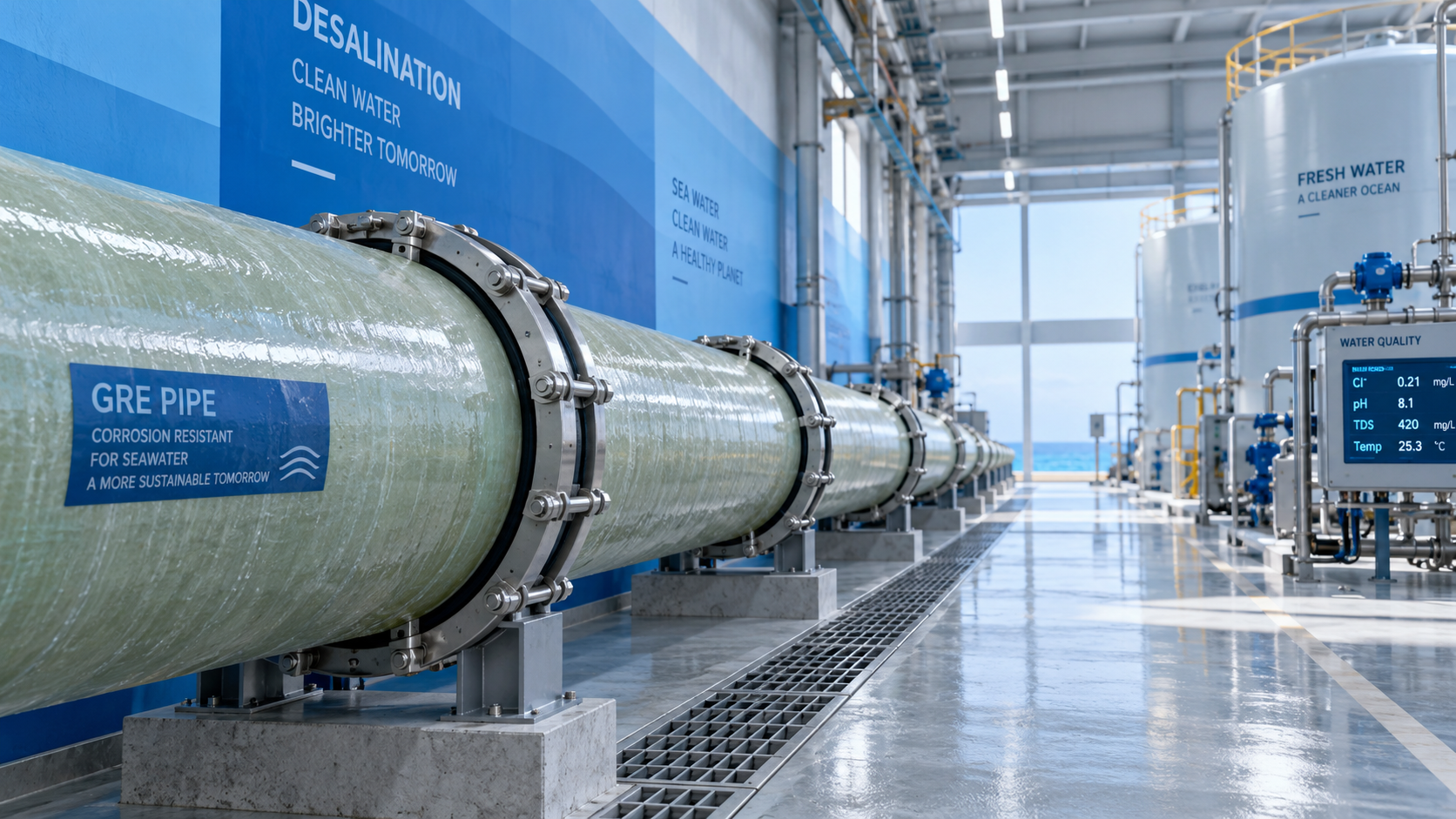
Glass Reinforced Epoxy, or GRE piping, is not a coating solution applied to a vulnerable substrate—it is the substrate itself. The composite structure, which embeds continuous glass filaments within an epoxy resin matrix, offers an inherently corrosion-resistant barrier.
But the real advantage lies in how GRE behaves under constant chlorine exposure. Unlike steel, GRE does not rely on a passive oxide layer that can be disrupted by chlorides. The epoxy matrix is chemically formulated to resist hydrolysis and oxidation in chlorinated aqueous environments. This is not a claim made in a marketing brochure—it is a fundamental difference in material chemistry.
For ship ballast, offshore platforms, and especially desalination plants, this translates into a straightforward operational benefit: piping that doesn’t suddenly develop pinhole leaks in year five of a 25-year service life.
What “Long-Term Performance” Actually Means in Real Numbers
When we speak of long-term performance, it helps to frame it through the lens of what project managers track.
GRE piping, manufactured to recognized standards, is designed for a minimum service life of 20 to 30 years in seawater service, including continuous exposure to chlorine residuals in the range of 1–5 ppm—the typical dosing range in desalination pretreatment. This is not a theoretical exercise. Static water pressure testing, interfacial adhesion verification, and cyclic fatigue testing are standard quality assurance measures used by established manufacturers to validate performance before installation.
The importance of these tests is not merely academic. A pipe that passes rigorous pressure testing at the factory level provides the kind of confidence that enables project managers to focus on other critical aspects of plant commissioning, rather than worrying about buried or inaccessible pipeline segments.
Lifecycle Economics: Where GRE Quietly Wins
Project managers evaluate piping options not just on chemical compatibility, but on total cost of ownership. And this is where GRE’s true value becomes apparent.
Consider the conventional materials used in desalination plants:
- Duplex stainless steel offers excellent corrosion resistance, but at a premium material cost. Welding requirements demand skilled labor and stringent quality control, and any post-weld treatment errors can compromise corrosion resistance at the weld zone.
- Rubber-lined carbon steel requires meticulous lining inspection and is vulnerable to liner disbondment at flanged joints and under vacuum conditions.
- High-density polyethylene is cost-effective but comes with limited pressure ratings at elevated temperatures and requires electrofusion equipment and certified operators.
Glass Reinforced Epoxy piping sits in a distinct position. Its material cost is significantly lower than duplex stainless steel. Its installation weight is about one-sixth of steel, reducing the need for heavy lifting equipment and simplifying support structures. Jointing is mechanical—tapered or adhesive-bonded bell-and-spigot systems—which eliminates welding-related inspection and heat-affected zone concerns.
But the most compelling economic argument emerges over time. With no internal coating to fail, no cathodic protection system to maintain, and no weld seams to inspect, GRE piping dramatically reduces the operations and maintenance burden. For a 10-kilometer piping network inside a desalination plant, the annual inspection and repair costs can be reduced to a fraction of what steel-based systems require.
Navigating the Installation Reality: What Project Managers Should Know
If you are evaluating GRE for a current project, there are practical considerations that make the difference between excellent performance and disappointment down the road.
First, pay attention to the pressure rating. While GRE handles continuous pressure well, it is important to specify the correct rating for the specific service conditions—including pressure spikes from pump start-up or rapid valve closure. A reputable manufacturer will ask about your operating pressure envelope before recommending a specific pipe series and wall thickness.
Second, understand the thermal limitations. GRE performs well in typical desalination process temperatures of 40–70°C, but should not be used above its rated temperature—usually around 110°C for most standard products. In brine heater recirculation lines where temperatures are elevated, confirm that the selected pipe grade is suitable.
Third, think about installation quality. While GRE is forgiving of minor misalignments compared to rigid steel, proper support spacing and correct use of adhesive joint compounds are non-negotiable. A slightly under-supported GRE line can develop excessive sag over time, placing stress on joints that were never designed to bear sustained loads. Work with installers who have prior GRE experience, or require factory-supervised installation training during initial spool installation.
Beyond Corrosion: The Underappreciated Advantages of GRE
One benefit that goes under-discussed is GRE’s superior hydraulic performance. The smooth bore of GRE piping — with a friction coefficient lower than steel — means reduced pumping energy over the life of the plant. When you multiply this across hundreds of meters of intake, transfer, and distribution lines, the energy savings are not trivial.
Another advantage is thermal insulation. GRE has significantly lower thermal conductivity than metal piping, which helps maintain water temperature and reduces the risk of condensation on cold water lines—a common source of corrosion for metal supports and adjacent structures in humid coastal environments.
And for plant managers who value operational flexibility, GRE piping is available in a wide range of diameters—from small bore 25 mm instrument lines to large 1,200 mm intake headers—which means a consistent material specification across the entire plant, simplifying spare part inventory and reducing the number of installation techniques on site.
Final Thoughts: Making the Informed Choice
Choosing piping for a desalination plant is not an exercise in maximizing any single performance parameter. It is about finding a balance—between chemical resistance and structural integrity, between initial capital cost and lifetime operating expenses, between common practice in the industry and proven engineering reality.
Glass Reinforced Epoxy piping has been used in seawater applications for over 40 years, and the accumulated field experience is substantial. For project managers who are still weighing options, visiting an existing facility that has used GRE for a decade or more can offer more practical insight than any white paper. Look at the state of the pipe exteriors, ask maintenance crews about the frequency of repairs, and observe how the lines have held up under the aggressive chlorine-charged environment.
That is where the real evidence lives—under the harsh operating conditions of an active desalination plant—where the choice of piping material is the difference between a smoothly running facility and one that demands constant attention.
Please give us a message
产品介绍产品介绍产品介绍产品介绍产品介绍产品介绍产品介绍产品介绍产品介绍产品介绍产品介绍产品介绍产品介绍产品介绍产品介绍产品介绍产品介绍产品介绍产品介绍产品介绍产品介绍产品介绍产品介绍产品介绍产品介绍产品介绍产品介绍产品介绍产品介绍产品介绍
Please give us a message
产品介绍产品介绍产品介绍产品介绍产品介绍产品介绍产品介绍产品介绍产品介绍产品介绍产品介绍产品介绍产品介绍产品介绍产品介绍产品介绍产品介绍产品介绍产品介绍产品介绍产品介绍产品介绍产品介绍产品介绍产品介绍产品介绍产品介绍产品介绍产品介绍产品介绍
Please give us a message
产品介绍产品介绍产品介绍产品介绍产品介绍产品介绍产品介绍产品介绍产品介绍产品介绍产品介绍产品介绍产品介绍产品介绍产品介绍产品介绍产品介绍产品介绍产品介绍产品介绍产品介绍产品介绍产品介绍产品介绍产品介绍产品介绍产品介绍产品介绍产品介绍产品介绍
Please give us a message
产品介绍产品介绍产品介绍产品介绍产品介绍产品介绍产品介绍产品介绍产品介绍产品介绍产品介绍产品介绍产品介绍产品介绍产品介绍产品介绍产品介绍产品介绍产品介绍产品介绍产品介绍产品介绍产品介绍产品介绍产品介绍产品介绍产品介绍产品介绍产品介绍产品介绍