
GRE vs. Steel Piping for Corrosive Fluids: Which Option Delivers Lower Total Ownership Cost?
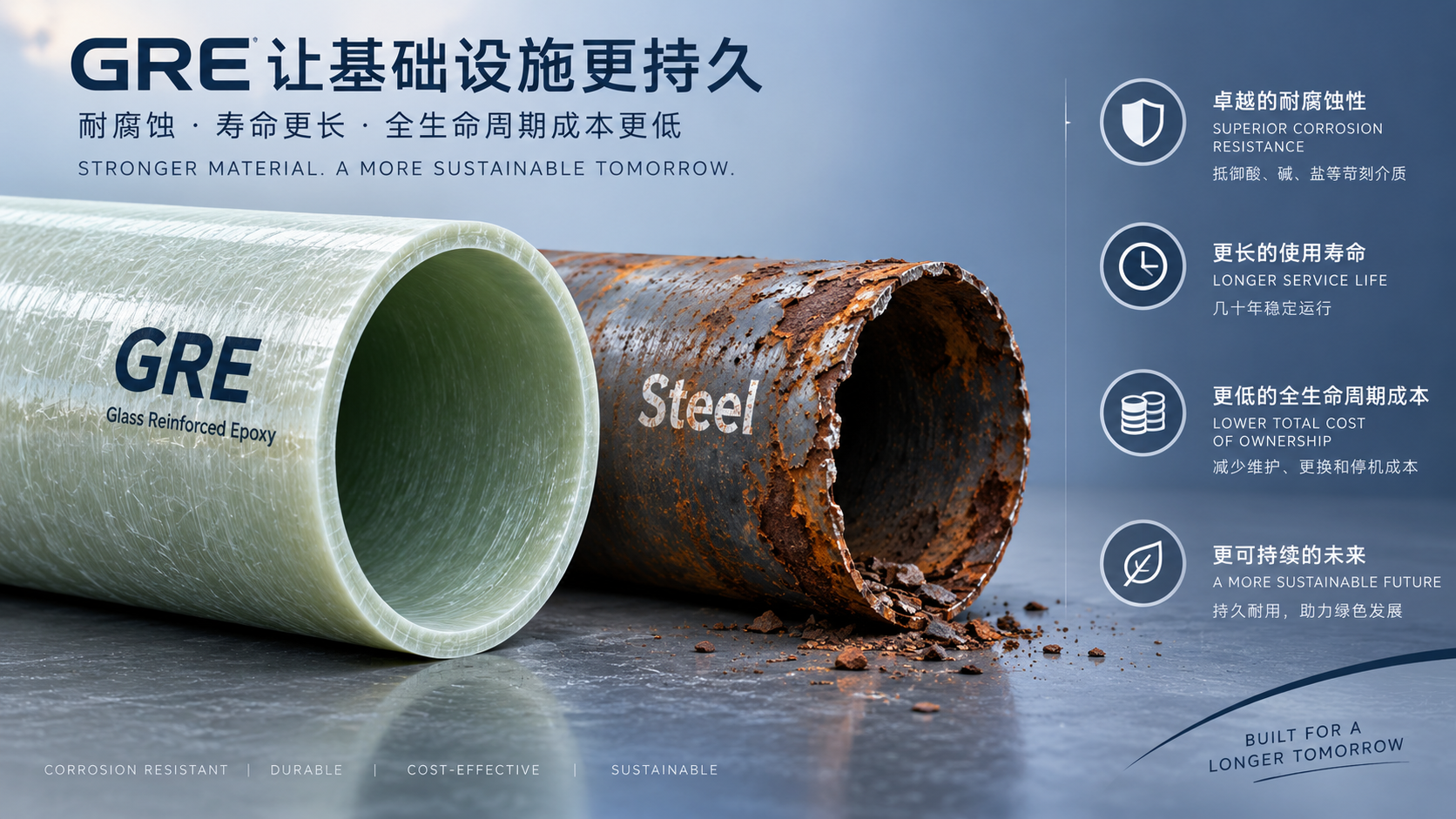
For procurement teams specifying piping systems for corrosive fluids, the decision between Glass Reinforced Epoxy (GRE) and steel often comes down to upfront bid prices. But the real financial picture only emerges after factoring in installation labor, downtime during maintenance, and how many years the line actually stays in service. In most oil and gas applications, GRE piping delivers a measurably lower total ownership cost than carbon or stainless steel—not because the pipe itself is always cheaper, but because it eliminates the recurring expenses that steel inevitably brings.
Corrosive fluids—whether produced water, brine, chemical injection lines, or sour crude—attack steel from day one. Even with coatings, inhibitors, and cathodic protection, steel piping demands continuous monitoring and periodic replacement. GRE, by contrast, is inherently resistant to corrosion. The resin system and glass reinforcement are engineered for exactly these service conditions. For a procurement manager evaluating bids, the difference becomes clear when the comparison moves beyond the purchase order and into lifecycle cost.
Breaking down the cost components that actually matter
Total ownership cost for piping is not a single number. It is the sum of material, installation, operating maintenance, and replacement or repair over the design life of the system. Steel often wins on material price per meter, but that advantage fades quickly once the other components are added.
The numbers for steel lifespan vary widely. A well-protected carbon steel line in mildly corrosive service might last a decade. In aggressive conditions—high chlorides, sour gas, or elevated temperatures—steel can fail in a few years. That means the initial procurement cost is amortized over a much shorter period than the design life of the facility itself.
Installation: where GRE pulls ahead on labor and equipment
Steel installation is expensive because of the equipment and skill it demands. Every joint requires welding, radiographic inspection, and often post-weld heat treatment. Crane capacity and rigging crews are required for pipe handling. The speed of installation is also heavily dependent on weather conditions—rain, wind, and cold shut down welding operations.
GRE pipe is significantly lighter—typically one-tenth the weight of steel for the same pressure rating. Jointing is done with adhesive or mechanical connections, no hot work involved. The crew does not need certified welders, and the inspection requirement for joints is straightforward. This translates directly into faster project schedules and less coordination overhead.
A practical comparison: one GRE installation crew can complete roughly the same footage in a week that takes a steel crew two to three weeks, depending on pipe diameter and joint count. For remote oilfield locations, this also reduces the cost of transporting heavy lifting equipment to site. The financial advantage grows further when the pipeline is in a congested plant area where welding permits are difficult to obtain and fire watch requirements add labor costs.
Maintenance reality: steel needs repeated attention, GRE does not
Anyone who has managed a steel piping system knows the maintenance cycle. External corrosion starts at coating holidays and beneath insulation. Internal corrosion appears at weld zones and low points where water settles. Each identified issue becomes a repair ticket, a shutdown window, or an emergency response.
With GRE, the failure mode in corrosive service is fundamentally different. Since the material is non-metallic, it does not corrode. It can be damaged by mechanical impact or misapplication, but it does not degrade through electrochemical reactions with the transported fluid. This means the scheduled inspection workload drops substantially.
For oil and gas operators, corrosion-related shutdowns are among the most expensive events in the operating budget. Lost production alone can exceed the entire capital cost of the piping by an order of magnitude. GRE’s resistance to corrosion directly reduces this risk. When a process line carries salt water or chemicals at moderate temperatures and pressures, the piping is often the first component to fail—and replacing it with GRE breaks that cycle.
When steel is still the right choice
This does not mean GRE is universally superior. There are service envelopes where steel remains necessary. High-temperature steam lines above about 110–120°C exceed the practical range of standard GRE products. Large-diameter, high-pressure gas transmission lines also fall outside typical GRE specifications. If the fluid contains significant aromatic hydrocarbons or strong solvents that attack the resin system, steel may be the only viable option.
But these application boundaries are narrower than many procurement teams assume. GRE has been specified successfully for produced water injection, firewater systems, seawater cooling, and chemical transfer at pressures up to several thousand psi and temperatures within its rated limits. The key is matching the product grade to the actual service conditions—pressure rating, temperature, and chemical compatibility.
Lifespan and replacement cycles: the long-term view
The design life of a GRE system depends on the pipe grade, the wall thickness, and the operating conditions. A properly selected and installed GRE line can remain in service for 20 years or more. For a steel line in corrosive service, the realistic expectation is shorter. When steel fails, the replacement cost includes not just the pipe material but also removal of the old line, transportation, and installation labor—effectively paying for the piping twice.
The economic comparison also shifts if the system is meant for a short service life. A temporary water supply line being abandoned after two years does not justify the capital outlay for high-performance GRE. But for permanent infrastructure in oil and gas production, the longer the intended service life, the more decisive the GRE advantage.
What this means for procurement decisions
For the majority of corrosive fluid applications in oil and gas operations, Glass Reinforced Epoxy piping offers the lower total ownership cost. The savings accumulate through reduced installation time, no corrosion protection measures, minimal maintenance, and a longer service life. The procurement question should not be "Which pipe costs less per meter?" but rather "Which pipe delivers the required performance at the lowest cost over the life of the facility?"
That distinction matters. Operators that standardize on GRE for corrosive service tend to see fewer unplanned repairs, less production loss, and simplified crew requirements. Those are real budget numbers, not abstract engineering preferences. When reviewing your next piping specification, include lifecycle cost as the evaluation standard rather than first cost. The material choice becomes considerably easier when the full ownership period is part of the calculation.
Related Posts
Please give us a message
产品介绍产品介绍产品介绍产品介绍产品介绍产品介绍产品介绍产品介绍产品介绍产品介绍产品介绍产品介绍产品介绍产品介绍产品介绍产品介绍产品介绍产品介绍产品介绍产品介绍产品介绍产品介绍产品介绍产品介绍产品介绍产品介绍产品介绍产品介绍产品介绍产品介绍
Please give us a message
产品介绍产品介绍产品介绍产品介绍产品介绍产品介绍产品介绍产品介绍产品介绍产品介绍产品介绍产品介绍产品介绍产品介绍产品介绍产品介绍产品介绍产品介绍产品介绍产品介绍产品介绍产品介绍产品介绍产品介绍产品介绍产品介绍产品介绍产品介绍产品介绍产品介绍
Please give us a message
产品介绍产品介绍产品介绍产品介绍产品介绍产品介绍产品介绍产品介绍产品介绍产品介绍产品介绍产品介绍产品介绍产品介绍产品介绍产品介绍产品介绍产品介绍产品介绍产品介绍产品介绍产品介绍产品介绍产品介绍产品介绍产品介绍产品介绍产品介绍产品介绍产品介绍
Please give us a message
产品介绍产品介绍产品介绍产品介绍产品介绍产品介绍产品介绍产品介绍产品介绍产品介绍产品介绍产品介绍产品介绍产品介绍产品介绍产品介绍产品介绍产品介绍产品介绍产品介绍产品介绍产品介绍产品介绍产品介绍产品介绍产品介绍产品介绍产品介绍产品介绍产品介绍