
Glass Reinforced Epoxy Pipe Specifications: Key Strength and Temperature Limits for Chemical Transfer
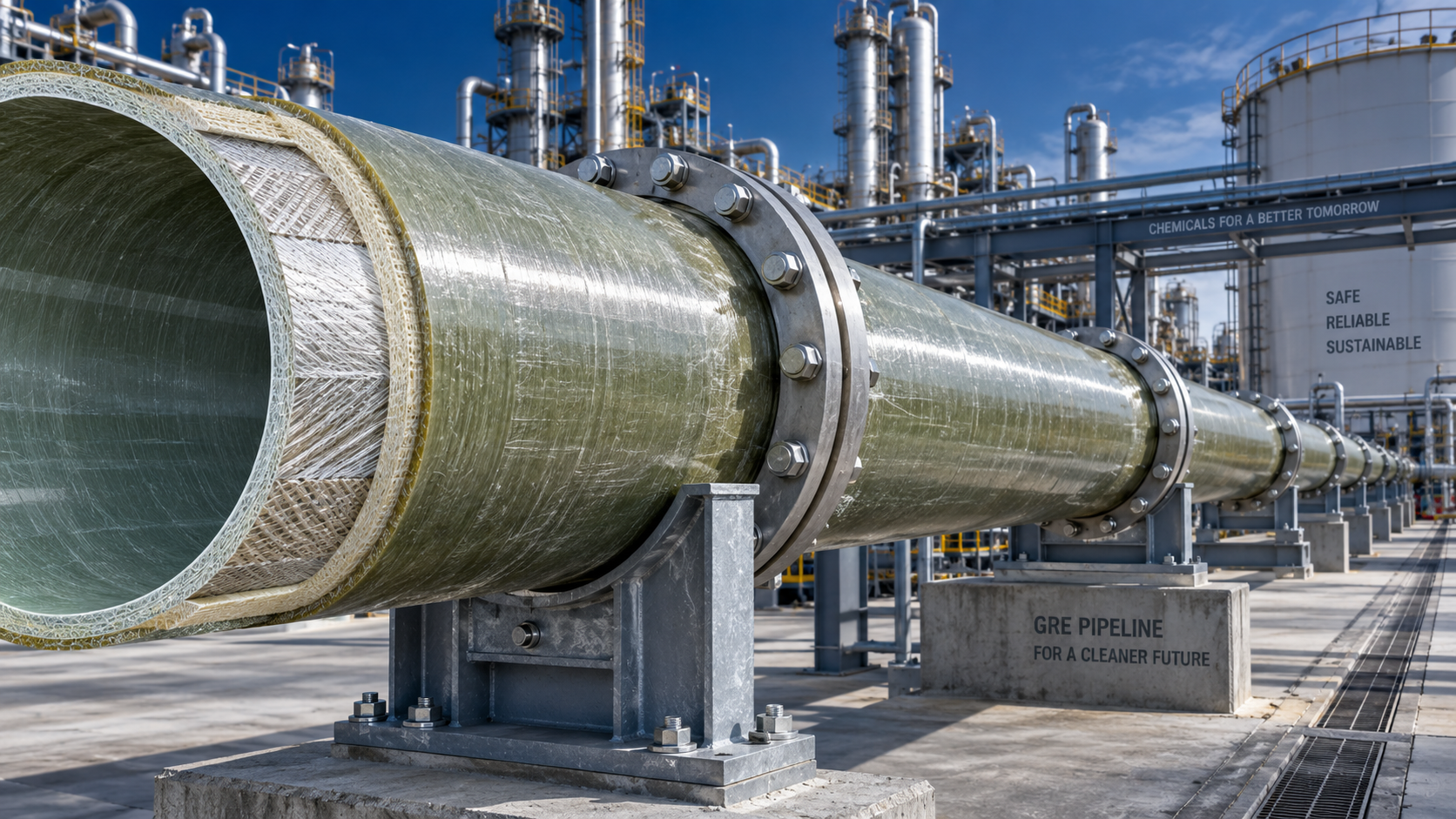
What Technical Evaluators Actually Need From GRE Pipe Specifications
Anyone who has spent time specifying piping for chemical transfer knows the drill. You are not just comparing diameters and pressure ratings. You are balancing corrosion resistance against temperature limits, weighing mechanical strength against installation constraints, and trying to predict how a pipe system will behave after years of exposure to aggressive media. Glass reinforced epoxy (GRE) piping has become a go-to solution in these situations, but only when the engineering team understands the actual specification limits.
The problem is that GRE pipe is not a single product. It is a family of composite systems where the resin, glass fiber orientation, winding angle, and curing process all contribute to the final performance. Two pipes with the same nominal diameter can have very different pressure ratings or chemical compatibility depending on how they were manufactured. For technical evaluators, this means the spec sheet has to go beyond basic dimensions and include meaningful mechanical and thermal data.
Let’s break down the specification areas that matter most for chemical transfer service, especially in oil and gas applications where failure is expensive and safety margins are non-negotiable.
Mechanical Strength Properties: Beyond the Burst Pressure Rating
The most common specification parameters for GRE pipe are hoop tensile strength and axial tensile strength. Hoop strength matters because it directly relates to the pipe's ability to contain internal pressure. Axial strength matters for thrust loads, thermal expansion forces, and support spacing. For most filament-wound GRE pipes used in chemical transfer, hoop tensile strength typically falls in a range that allows the pipe to be rated for working pressures from 10 bar to 25 bar or higher, depending on wall thickness and diameter.
What often gets less attention is the long-term strength under sustained loading. GRE pipes exhibit viscoelastic behavior. Under continuous pressure, the material can creep, which means the long-term hydrostatic strength is lower than the short-term burst strength. This is why standards such as ASTM D2992 or ISO 8513 are referenced in most reputable specifications. These standards define how to determine the long-term regression curve for pressure rating. If a supplier only gives you a burst pressure number without referencing a long-term test method, you are missing the information needed to design for a 20-year service life.
There is also the question of stiffness. GRE pipes have a modulus of elasticity roughly one-tenth that of carbon steel. That is not necessarily a drawback—it can actually be beneficial for handling thermal expansion without needing expansion loops—but it does mean support spacing and deflection limits need to be evaluated separately from steel pipe rules. Technical teams that come from a metallic piping background often underestimate how much sag can occur if supports are placed too far apart.
Temperature Ratings: Continuous Service vs. Peak Conditions
Temperature limits for GRE pipe are not a single number. They depend on the resin system, the curing agent, the glass content, and the internal pressure at the same moment. For a standard epoxy resin system, the maximum continuous operating temperature is typically in the range of 90°C to 110°C. Some specialized resin formulations can push toward 120°C or 130°C, but this often comes with trade-offs in chemical compatibility or mechanical properties.
The more important specification point is the pressure-temperature derating curve. As temperature increases, the allowable working pressure must be reduced because the resin matrix softens and the long-term strength decreases. A pipe rated for 16 bar at 25°C might only be rated for 8 bar at 90°C. This derating relationship is not linear across all GRE products and should be presented clearly in the manufacturer's data.
One issue that comes up frequently in chemical transfer service is peak temperature excursions. Perhaps a process upset causes a temporary temperature spike beyond the continuous rating. A well-specified GRE pipe system can often handle short-duration excursions, but this has to be confirmed against the manufacturer's testing data. Expecting a pipe to handle 130°C for days when it is rated for continuous service at 95°C is a design error that can lead to premature failure. The spec should define both the continuous temperature and any allowable peak temperature with a maximum duration.
Chemical Compatibility and the Temperature Factor
Chemical resistance in GRE pipe is primarily a function of the resin matrix. The glass fibers provide structural reinforcement, but aggressive chemicals attack the resin first. For oil and gas applications, the typical media of concern include produced water with high chloride content, sour crude with H2S, corrosion inhibitors, and various solvents used in separation and treatment processes.
Most GRE manufacturers provide chemical compatibility charts that rate performance against hundreds of media. What technical evaluators need to pay attention to is how temperature affects these ratings. A chemical that shows excellent compatibility at 25°C may show significant degradation at 80°C. This is especially true for aromatic hydrocarbons and some organic solvents that cause swelling or softening of the epoxy matrix.
There is also the question of cyclic exposure. In many chemical transfer lines, the pipe does not see a constant concentration of the same chemical. It may carry one product for a week, then be flushed and used for a different service. Chemical compatibility charts rarely capture these cyclic effects accurately. In such cases, it is wise to have a conversation with the pipe manufacturer's engineering team, rather than simply relying on chart data. Manufacturers with actual production and testing capacity—like Shandong Ocean Pipe Technology, which operates 16 winding production lines and performs static water pressure testing in-house—tend to have a more practical understanding of these service variables because they have worked through them on actual orders.
Standards and Testing Requirements to Look For
For oil and gas applications, GRE pipe specifications should reference recognized standards. Among the most relevant are API 15HR (for high-pressure fiberglass line pipe) and ASTM D2996 (for filament-wound reinforced thermosetting resin pipe). These standards spell out testing requirements for hydrostatic pressure, tensile properties, and dimensional tolerance checks.
A point that cannot be overstated: verify that the manufacturer has actual testing capacity. It is one thing for a factory to claim compliance with a standard. It is another to have the test equipment on site and the data sheets on file. A facility with static water pressure testing machines—capable of running controlled pressure tests on each production batch—offers a level of traceability that is hard to match with fully outsourced testing. Shandong Ocean Pipe Technology's factory in Dezhou City, for example, is equipped with five static water pressure testing machines and has an annual production and testing capacity of 25,000 tons. This kind of production scale means quality control is baked into the process, not bolted on afterward.
Beyond standard compliance, ask about batch traceability. If a pipe section fails in the field, can the manufacturer trace that specific product back to its production date, raw material lot, and quality testing record? For projects that are critical to production uptime—whether it is an LNG facility, a chemical plant, or a ship's ballast piping system—this level of traceability becomes an operational requirement, not just a paperwork exercise.
Installation-Related Strength Considerations
Another strength issue that technical evaluators need to account for is impact resistance. GRE pipes are lighter than steel, which is generally beneficial for installation and support structures. But lighter also means they can be more vulnerable to mechanical damage during handling, especially in cold weather when the resin is more brittle. Standards typically define impact resistance requirements, but field experience consistently shows that careful lifting and handling are just as important as the specification number.
Joint integrity is another spec point that deserves close attention. The joint—whether adhesive-bonded, threaded, or flanged—is frequently the weakest part of a GRE piping system. Specification data should clearly state the joint pressure rating relative to the pipe body. Many serious field failures originate not from the pipe wall but from a poorly made field joint. This is why factory-controlled fitting production matters. A manufacturer with 174 sets of pipe fitting winding machines has more control over fitting quality than one that outsources fitting fabrication to third-party shops.
Thermal expansion behavior is also a specification item that should not be overlooked. The coefficient of thermal expansion for GRE pipe is higher than for steel. With a relatively low elastic modulus, this means thermal forces are lower, but deflections and movements at connection points need to be managed. Proper anchor points, support spacing, and potentially expansion joints are all part of an engineered system, not things to guess at during installation.
What a Complete Specification Package Looks Like
For technical evaluators, a complete GRE pipe specification should be much more than a dimensional drawing and a price quote. Look for a package that includes:
- Long-term hydrostatic strength at the intended service temperature, not just an ambient-temperature burst value. The long-term regression curve should be available for reference.
- The pressure-temperature derating table covering the full range from ambient to the maximum rated temperature.
- Chemical compatibility data at service temperature, not at room temperature. Data for dilute or intermittent exposure should be clearly distinguished from data for continuous immersion.
- Impact resistance and handling requirements for the specific pipe size and wall thickness being supplied.
- Joint system details, including installation procedures, curing time for adhesives, and the allowable temperature range for making field joints.
- Quality traceability documentation, including batch numbers, production date, test results, and any relevant certificates.
It may take time to gather this information, but it is the difference between installing a piping system based on a real engineering basis versus installing something that meets a generic product description. When failure is not an option, the rigor of the specification process reflects the rigor of the operating culture.
Supplier Capability and the Practical Edge
There is a reason that project teams in the oil and gas sector put such weight on a manufacturer's actual production history. GRE pipe is a process-dependent product. The winding tension, the resin-to-glass ratio, the curing cycle, and the quality control testing all affect the final pipe's behavior. A factory that has been making GRE pipe since 2012 and has supplied projects for operators like CNOOC, CNPC, and Sinopec has manufacturing knowledge that cannot be transferred through a brochure.
Shandong Ocean Pipe Technology, based in Wucheng Industrial Park, Dezhou City, represents this kind of operational depth. With a registered capital of USD 4.2 million and a focus on fiberglass reinforced epoxy products, the company has grown into one of the top ten GRE pipe manufacturers in China. The scale of its operations—multiple production lines, in-house fitting manufacturing capability, and substantial annual testing throughput—means it can support large-scale oil and gas projects without the supply chain fragmentation that can plague smaller composite pipe fabricators.
Their client list, which includes Shanghai Waigaoqiao Shipyard, Ningbo Xinle Shipyard, and Wuhan Qingshan Shipyard, as well as overseas markets in Australia, Iraq, Kazakhstan, and Turkey, indicates a track record of meeting rigorous project requirements across different regulatory environments. Ship piping, in particular, imposes tight dimensional tolerances and demanding testing regimes, so manufacturers that perform well in that sector tend to have disciplined quality control systems.
Closing Recommendations for the Evaluation Process
If you are in the middle of a technical evaluation for chemical transfer piping, put the operational conditions first. Out of the possible pitfalls, the most common ones are overshooting the temperature derating and underestimating cyclic chemical exposure. Start with the media composition, then the actual operating temperature range including transients, and work backward to the pipe rating.
Require the manufacturer to document the application of their testing to your specific service conditions. A generic "meets industry standards" answer should be followed up with the specific standard and the test method they reference. For high-stakes applications, arrange a discussion with their technical team early in the process. A manufacturer's depth of knowledge often becomes visible exactly when you start asking about edge cases—high temperatures with sour gas present, or intermittent solvent service followed by long idle periods.
The advantage of doing this detailed evaluation is not just selecting a pipe. It is building a specification baseline that can be referenced during installation, commissioning, and future system modifications. Get this right, and the piping system functions quietly in the background for decades. Get the specification wrong, and it problems surface in the form of leaks, downtime, and high replacement costs—all of which could have been mitigated during the engineering review phase.
Related Posts
Please give us a message
产品介绍产品介绍产品介绍产品介绍产品介绍产品介绍产品介绍产品介绍产品介绍产品介绍产品介绍产品介绍产品介绍产品介绍产品介绍产品介绍产品介绍产品介绍产品介绍产品介绍产品介绍产品介绍产品介绍产品介绍产品介绍产品介绍产品介绍产品介绍产品介绍产品介绍
Please give us a message
产品介绍产品介绍产品介绍产品介绍产品介绍产品介绍产品介绍产品介绍产品介绍产品介绍产品介绍产品介绍产品介绍产品介绍产品介绍产品介绍产品介绍产品介绍产品介绍产品介绍产品介绍产品介绍产品介绍产品介绍产品介绍产品介绍产品介绍产品介绍产品介绍产品介绍
Please give us a message
产品介绍产品介绍产品介绍产品介绍产品介绍产品介绍产品介绍产品介绍产品介绍产品介绍产品介绍产品介绍产品介绍产品介绍产品介绍产品介绍产品介绍产品介绍产品介绍产品介绍产品介绍产品介绍产品介绍产品介绍产品介绍产品介绍产品介绍产品介绍产品介绍产品介绍
Please give us a message
产品介绍产品介绍产品介绍产品介绍产品介绍产品介绍产品介绍产品介绍产品介绍产品介绍产品介绍产品介绍产品介绍产品介绍产品介绍产品介绍产品介绍产品介绍产品介绍产品介绍产品介绍产品介绍产品介绍产品介绍产品介绍产品介绍产品介绍产品介绍产品介绍产品介绍