
Wastewater Discharge Rules from Scrubbers: Environmental Risks Operators Overlook in Ports
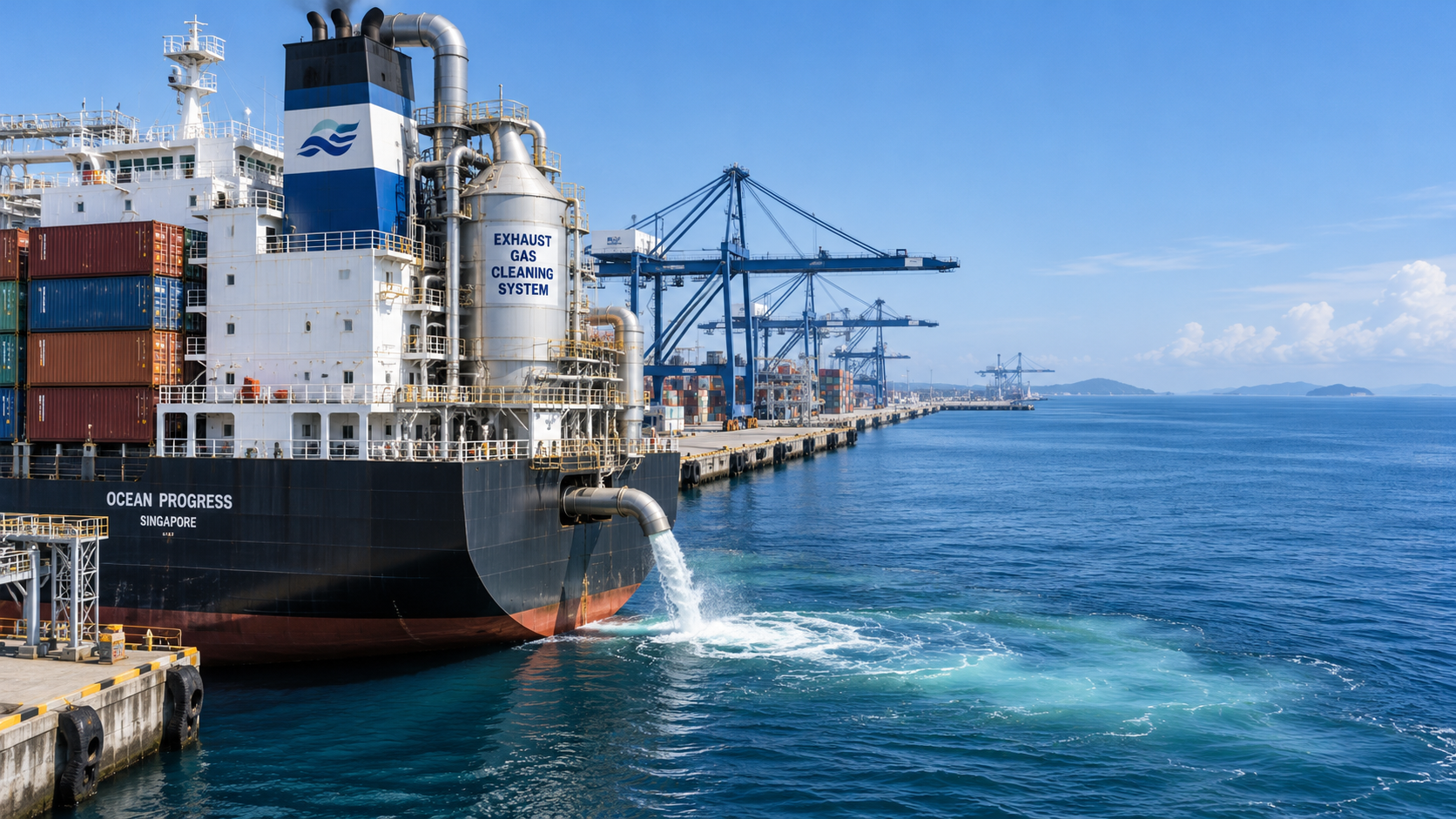
Scrubbers have become the default compliance route for many shipowners navigating the IMO 2020 sulfur cap. The logic seemed simple: burn heavy fuel oil, scrub the exhaust, and avoid the cost premium of compliant low-sulfur fuels. But that calculation stops at the waterline. What happens to the washwater after it captures sulfur oxides from the exhaust is now the problem — and in ports, it is a problem with real financial and operational teeth.
The core issue is not whether scrubbers work. They do. The challenge is that each discharge event transfers an environmental burden from the air to the water. Open-loop scrubbers, which use seawater and discharge washwater directly overboard, face mounting restrictions across major port jurisdictions. Closed-loop systems recirculate the water and store residues for shore reception, but they introduce their own disposal obligations and operational costs. The decision between these systems, or between retrofit and newbuild, is increasingly a decision about where and how you can operate — not just what meets the emission cap.
The environmental risk profile of scrubber discharge is more complex than most operational teams initially assume. Washwater contains sulfur compounds, polycyclic aromatic hydrocarbons (PAHs), heavy metals from the fuel and lubricating oil, and nitrate compounds. When an open-loop system operates in shallow, enclosed, or low-exchange waters, these contaminants concentrate rather than disperse. The consequence is localized acidification and toxicity that can exceed marine water quality standards. The discharge is technically legal under the MARPOL framework if it meets the pH, PAH, turbidity, and nitrite criteria laid out in the IMO 2021 Guidelines, but the national and port-level regulations deciding actual enforcement have moved well ahead of the international baseline.
This divergence between IMO standards and port rules is where operators get caught out. The Netherlands, France, and Portugal have established restrictions on open-loop scrubber discharge in certain ports and inland waters, with some requiring switch-off triggers based on water depth, temperature, or current. Norway has placed restrictions in its fjords, where the low exchange rate of water makes dilution ineffective. Several U.S. states, including California and Washington, have banned or tightened open-loop discharge within their waters. Germany, while initially open, has been reviewing the risk profile for its ports. The UAE and China have signaled that port-level discharge controls will become stricter as local environmental enforcement improves. None of these restrictions are abstract policy signals — each one directly affects routing, fuel strategy, and port call costs.
For operations teams, the most common misjudgment is assuming that a scrubber-equipped vessel can burn HFO everywhere and settle the compliance bill with the scrubber alone. That assumption fails the moment a vessel enters a jurisdiction with discharge restrictions. At that point, the crew must switch to compliant fuel or operate the scrubber in closed-loop mode. If the vessel is not fitted with a closed-loop capability, the switch to compliant fuel becomes mandatory. The cost of that switch — the price difference between HFO and VLSFO, the changeover time, and the risk of incompatibility between fuels in the system — is a direct and avoidable operational penalty. It is most painful precisely in ports with the strictest environmental oversight, which also tend to be the highest-traffic and most economically important hubs.
Closed-loop scrubbers present a different set of operational realities. They allow continued HFO use in discharge-restricted areas, but they depend on shore reception facilities for the collected residue. A well-known pattern emerges in ports where reception capacity is limited or where the facility charges rates that effectively penalize closed-loop operation. The vessel can comply with the discharge ban, but the cost of disposal, the scheduling delay, and the administrative burden can outweigh the fuel-cost advantage that justified the scrubber investment in the first place. In ports without adequate reception infrastructure, the closed-loop system becomes a liability, not an asset.
Port-level enforcement is not uniform, and that is exactly why operators need a practical assessment framework rather than a generic compliance checklist. The factors that matter are the vessel’s trading routes, the proportion of time spent in discharge-restricted versus unrestricted waters, the availability and pricing of compliant fuel along those routes, and the actual reception capability at the ports where the vessel calls most frequently. An operator running a transatlantic route with regular calls in Rotterdam and Hamburg faces a fundamentally different scrubber economics than a vessel trading between Asia and the Middle East on routes with fewer current restrictions. A scrubber system that is commercially rational on one route can be a negative-return investment on another.
There is also a technical dimension that often slips below the commercial radar. Scrubber washwater treatment and monitoring are not uniform across manufacturers or installation vintages. Newer systems include continuous monitoring of pH, turbidity, and PAH, which helps demonstrate compliance and reduces the legal exposure in port inspection. Older installations may lack these capabilities or have them in less reliable form — and when a port authority requests data during an inspection, the absence of credible monitoring records is a compliance failure even if actual discharge quality is acceptable. This is a documentation and instrumentation issue that operators rarely plan for, but one that port inspectors actively look for.
The operational team that has the fewest problems is the one that treats scrubber discharge rules as a route planning input, not as a shipboard troubleshooting topic. Retrofit decisions are locked at the yard, either during newbuild specification or drydocking planning. But routing decisions, fuel purchasing, and port contingency plans are exercised continuously. The practical shift is to include discharge restrictions in the voyage planning phase — identifying which ports enforce what, which anchorages have watch constraints, which coastal waters have shallow or low-dilution conditions. This is not a legal compliance exercise; it is an operational risk management task with direct cost implications.
The financial exposure from a single discharge violation in a restricted port is not limited to the fine, which can reach tens of thousands of dollars depending on the jurisdiction. The secondary costs are more damaging: the vessel may be held at berth while authorities carry out additional inspections, the detention period disrupts the entire itinerary and induces demurrage claims, and the incident becomes a mark against the owner or charterer in future vetting assessments by charterers who track environmental compliance. A single enforcement event can wipe out the fuel-cost savings from several months of scrubber operation on the affected route.
Operators who view scrubber discharge rules as a marginal compliance issue misread the direction of the industry. Port authority environmental departments, regional marine regulators, and classification societies are all developing more granular and more stringent oversight of washwater discharge. The IMO level guidelines are a floor, not a ceiling. As new scientific evidence on local ecotoxicological effects accumulates, the pressure on port-level action will increase. For a fleet that operates globally, the compliance envelope is tightening — and that trend is not reversed by technical appeal or commercial negotiation. The practical answer is upfront route-level analysis of scrubber operability, not reactive justification after a port call goes wrong.
The decision framework therefore circles back to the selection of the scrubber system itself. For vessel owners evaluating retrofit or newbuild specifications, the current distribution of port discharge restrictions should feed into the decision about open-loop versus hybrid versus closed-loop architecture. A hybrid system — capable of operating in both open and closed modes with minimal transition time — purchases operational flexibility at a marginal capital cost. Whether that flexibility has value depends on the trading routes and the port mix the vessel expects to serve over the next five to ten years. Vessels confined to a single route with no discharge restrictions can still justify an open-loop system, but those with variable trading patterns are buying a contractual right to operate in restricted ports — a right that will become more valuable as restrictions spread to additional jurisdictions. That is the analysis that matters now, before the vessel is built or the retrofit specification is locked.
Please give us a message
产品介绍产品介绍产品介绍产品介绍产品介绍产品介绍产品介绍产品介绍产品介绍产品介绍产品介绍产品介绍产品介绍产品介绍产品介绍产品介绍产品介绍产品介绍产品介绍产品介绍产品介绍产品介绍产品介绍产品介绍产品介绍产品介绍产品介绍产品介绍产品介绍产品介绍
Please give us a message
产品介绍产品介绍产品介绍产品介绍产品介绍产品介绍产品介绍产品介绍产品介绍产品介绍产品介绍产品介绍产品介绍产品介绍产品介绍产品介绍产品介绍产品介绍产品介绍产品介绍产品介绍产品介绍产品介绍产品介绍产品介绍产品介绍产品介绍产品介绍产品介绍产品介绍
Please give us a message
产品介绍产品介绍产品介绍产品介绍产品介绍产品介绍产品介绍产品介绍产品介绍产品介绍产品介绍产品介绍产品介绍产品介绍产品介绍产品介绍产品介绍产品介绍产品介绍产品介绍产品介绍产品介绍产品介绍产品介绍产品介绍产品介绍产品介绍产品介绍产品介绍产品介绍
Please give us a message
产品介绍产品介绍产品介绍产品介绍产品介绍产品介绍产品介绍产品介绍产品介绍产品介绍产品介绍产品介绍产品介绍产品介绍产品介绍产品介绍产品介绍产品介绍产品介绍产品介绍产品介绍产品介绍产品介绍产品介绍产品介绍产品介绍产品介绍产品介绍产品介绍产品介绍