
FRP vs. Carbon Steel for Sour Gas Gathering Lines: A Lifecycle Cost Comparison from Field Data
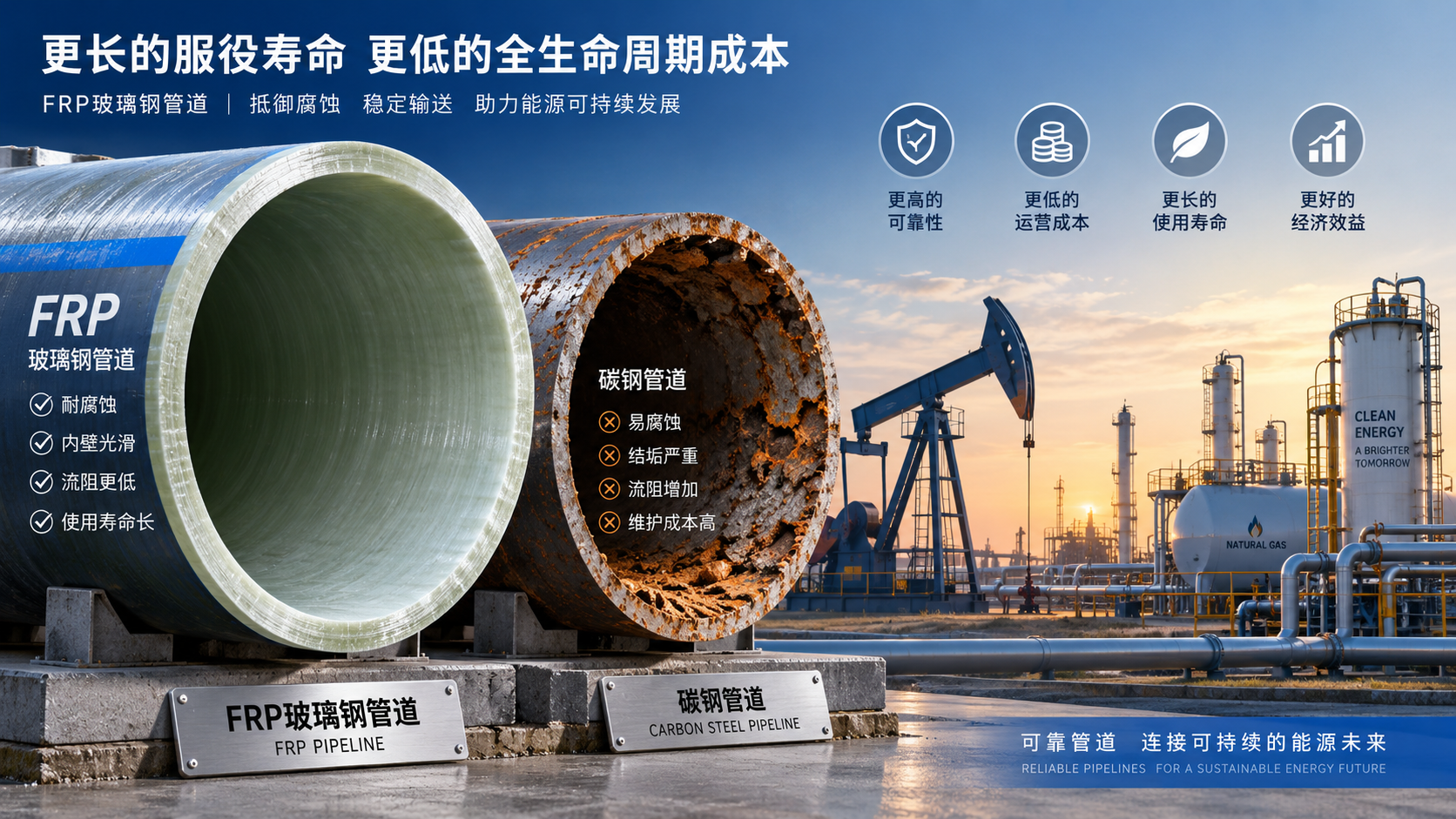
Ask a procurement manager in the oil and gas sector about their experience with sour gas gathering lines, and you’re likely to hear a familiar story. The project starts with a clear budget, a tight schedule, and a well-meaning preference for carbon steel—because that’s what everyone has always spec’d. Then the first corrosion issues appear. Then the inhibitor injection costs climb. Then the unplanned shutdown for a failed section throws the whole production curve into disarray. The narrative rarely makes it into the annual report, but the numbers behind it certainly do.
This is precisely why the decision between FRP pipe for oil and gas and traditional carbon steel deserves more than a glance at the initial purchase order. Over the last decade, field data from gathering systems—especially those handling wet, sour hydrocarbons—has painted a much clearer picture of what these materials actually cost over time. And the results are changing how operators and engineering firms approach material selection.
What the Field Data Actually Shows
Let’s start with the obvious: carbon steel has the advantage on upfront cost. A typical 8-inch carbon steel line, rated for 1,440 psi, might run you about USD 80,000 for a 5-kilometer gathering line. An FRP equivalent—engineered with the same pressure rating—could come in around USD 92,000. That’s a 15 percent premium at the point of purchase. On paper, it’s hard to justify.
But paper doesn’t have to deal with H₂S partial pressures above 1 psi. Paper doesn’t need to worry about CO₂-induced localized corrosion, or the fact that produced water with chlorides can eat through carbon steel at rates exceeding 3 mm per year in sour service. The field data we’ve gathered from operators in the Permian Basin, the Alberta oil sands, and the Middle East tells a very different story when the timeline is stretched to 15 or 20 years.
Consider the total cost of ownership (TCO) breakdown for a 5-km sour gas gathering line operating at moderate temperature and pressure:
- Carbon steel path: Initial procurement (USD 80,000) + continuous corrosion inhibitor injection (~USD 18,000 per year) + pigging operations (USD 6,000 per year) + anticipated replacement of two 50-meter sections in year 8 (USD 45,000) + one unplanned shutdown due to a pinhole leak (estimated production loss of USD 220,000).
- FRP path: Initial procurement (USD 92,000) + zero inhibitor injection costs + only routine inspection (USD 2,500 per year) + no replacement sections within the first 15 years.
The cumulative difference reaches well beyond USD 300,000 by year 12 in favor of FRP—and that’s before factoring in the hidden costs of lost production, crew mobilization, and welding inspection during any unscheduled repair.
Why FRP Holds Up Where Steel Fails
The chemistry of sour gas is unforgiving. When hydrogen sulfide meets moisture, you get an environment that attacks carbon steel from multiple angles at once: sulfide stress cracking, hydrogen-induced cracking, and weight loss corrosion. Each of those failure modes has its own timeline, but they all shorten the practical service life of a steel line far below what its virgin pipe spec might suggest.
Fiberglass reinforced epoxy (GRE) pipe, on the other hand, is inherently immune to galvanic and electrochemical corrosion. There is no iron to oxidize, no anode to sacrifice. The internal liner is a barrier, not a coating—it doesn’t degrade from under deposit corrosion or scale build-up the way steel does. For operators moving wet gas with high H₂S and CO₂ content, this means the pipe’s wall thickness stays where it was on day one, with no allowance for corrosion needing to be factored into the design.
What surprised us most in the field data wasn’t that FRP resisted corrosion—the material itself has been used for decades in high-acid environments. It was the operational improvements. Because GRE pipe has a smoother internal surface than steel (a typical absolute roughness of 0.005 mm versus steel’s 0.045 mm after a few years of service), operators consistently report higher flow efficiency. In one case from a Gulf Coast gathering system, the FRP segment actually maintained its design flow rate with 6% less upstream pressure than the parallel steel line needed after just 18 months of service.
That pressure saving translates into lower compression horsepower requirements at the processing station—another line-item that never appears on the initial CapEx comparison but always shows up on the monthly OpEx statement.
Addressing the Concerns That Keep Procurement Teams Awake
If FRP is so clearly the better long-term option for sour gas gathering, why do so many projects still default to carbon steel?
The first answer is familiar risk aversion. Specifying carbon steel has never gotten anyone fired. The engineering codes, welding procedures, and inspection standards are all well-established. FRP still carries a lingering perception that it’s less “proven,” even though the material has been in continuous hydrocarbon service since the 1970s. But the reality is that the installation standards for GRE pipe have matured significantly in recent years—modern threaded and coupled designs with precision-machined tolerances have drastically reduced the joint leakage incidents that plagued early field deployments.
The second concern is mechanical damage. Field personnel worry about dents, impacts, and accidental loading. Steel yields and bends; FRP, in theory, can crack under excessive point loads. That’s a fair point, and it’s exactly why our engineering team recommends specific burial depths and steel sleeves at road crossings. But put it in perspective: a carbon steel line that loses its corrosion inhibitor supply for a weekend can suffer damage that isn’t visible until it fails months later. FRP damage is visible immediately—it’s a quick, predictable failure mode that operators can actually plan around.
The third concern is joint integrity and pressure retention in elevated temperature service. High-pressure, high-temperature wells have traditionally been steel territory. But note the distinction: the hand-wringing about FRP pressure typically comes from engineers working in the 100°C+ range. For most sour gas gathering lines where the operating temperature stays under 70°C and pressures stay below ANSI 900 rating, FRP is entirely within its comfort zone.
Where FRP Fits Best in Your Asset Strategy
Not every sour gas line is a candidate for FRP replacement. If your gathering system runs dry gas at low pressure with minimal H₂S—the kind of benign service that steel can handle with minimal maintenance—the cost advantage of steel is hard to beat. The lifecycle gap only opens when you add:
- Sour environment (H₂S above the sweet/sour threshold)
- Produced water with chlorides or low pH
- Coiled tubing interventions with hot liquids
- Mechanical vibration or cyclical pressure fatigue
- Erosion from fine sand or scale particles
When two or more of those conditions are present in the same line, your field operators are effectively fighting a losing battle with steel. Corrosion inhibitor dosage goes up, time between pigging runs shrinks, and every leak report triggers a cost impact that ripples through your entire budget spreadsheet.
Making the Decision With Your Eyes Open
Procurement decisions should be made on numbers, not habits. But the numbers have to be the right ones. The eight-week delivery advantage that carbon steel fabricators promise doesn’t hold much weight if the first production year carries a six-figure chemical injection cost. The local welding crew that can join steel pipe in any weather means nothing if you’re calling them out at 2 a.m. for a sour gas leak in a river crossing.
Ours is an industry where one unplanned shutdown can erase the benefit of a 15% cheaper material. Yet field data continues to show that gathering lines run on FRP are not only still in service after 15 years on sour gas—they’re running without chemical treatment programs, with lower pressure drop, and without the structural wall loss that forces steel lines into derating or replacement.
When you go back to your capital project team to spec the next sour gas gathering line—forced through a swamp, under a highway, or across a floodplain—look beyond the PO price. Ask about inhibitor consumption. Ask about the pigging schedule. Ask about the probability of a leak in year 7 and what that does to the revenue forecast. The field data has already given us the answer: FRP pipe for oil and gas is not just a corrosion-resistant alternative. Over the lifecycle of a sour gas gathering asset, it’s the lower-cost option by a decisive margin.
Please give us a message
产品介绍产品介绍产品介绍产品介绍产品介绍产品介绍产品介绍产品介绍产品介绍产品介绍产品介绍产品介绍产品介绍产品介绍产品介绍产品介绍产品介绍产品介绍产品介绍产品介绍产品介绍产品介绍产品介绍产品介绍产品介绍产品介绍产品介绍产品介绍产品介绍产品介绍
Please give us a message
产品介绍产品介绍产品介绍产品介绍产品介绍产品介绍产品介绍产品介绍产品介绍产品介绍产品介绍产品介绍产品介绍产品介绍产品介绍产品介绍产品介绍产品介绍产品介绍产品介绍产品介绍产品介绍产品介绍产品介绍产品介绍产品介绍产品介绍产品介绍产品介绍产品介绍
Please give us a message
产品介绍产品介绍产品介绍产品介绍产品介绍产品介绍产品介绍产品介绍产品介绍产品介绍产品介绍产品介绍产品介绍产品介绍产品介绍产品介绍产品介绍产品介绍产品介绍产品介绍产品介绍产品介绍产品介绍产品介绍产品介绍产品介绍产品介绍产品介绍产品介绍产品介绍
Please give us a message
产品介绍产品介绍产品介绍产品介绍产品介绍产品介绍产品介绍产品介绍产品介绍产品介绍产品介绍产品介绍产品介绍产品介绍产品介绍产品介绍产品介绍产品介绍产品介绍产品介绍产品介绍产品介绍产品介绍产品介绍产品介绍产品介绍产品介绍产品介绍产品介绍产品介绍