
GRE vs. Flexible Composite Pipe for Subsea Water Injection Jumpers: Key Selection Criteria Explained
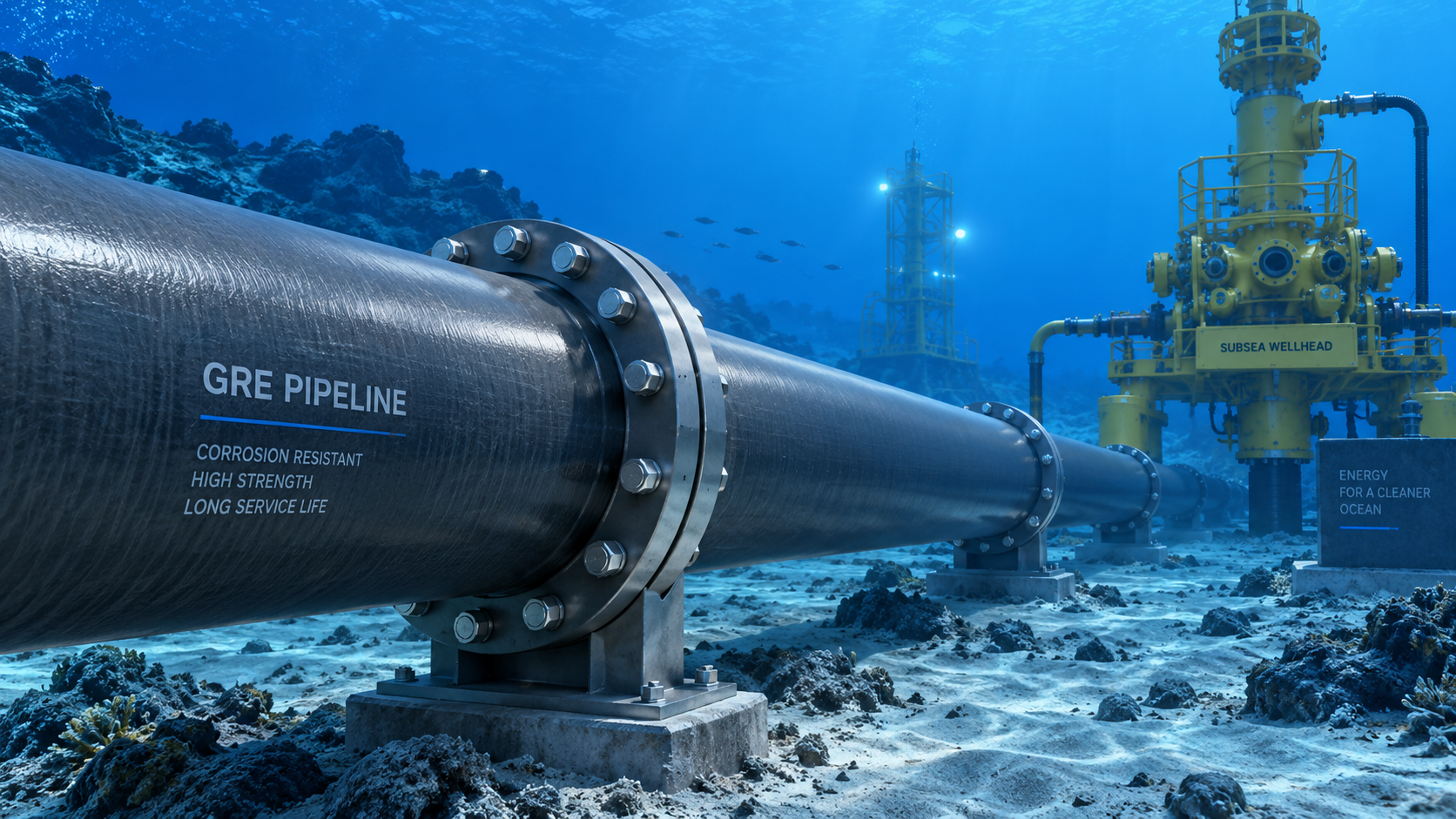
GRE vs. Flexible Composite Pipe for Subsea Water Injection Jumpers: Key Selection Criteria Explained
Choosing between GRE pipe for offshore water injection and flexible composite pipe often comes down to a handful of measurable parameters rather than general preferences. For subsea jumper service, the two materials behave differently under pressure cycling, thermal loading, and installation bending. The decision hinges on three core criteria: long-term pressure containment under sour or seawater service, allowable bending radius during installation and operation, and total lifecycle cost including riser or jumper configuration constraints.
Pressure rating alone is frequently misread. A flexible composite pipe may present a high burst rating on paper, but its axial stiffness and end fitting design can create failure modes unrelated to the pipe wall. GRE pipe, by contrast, has a well-documented fatigue response under cyclic pressure because the fiber architecture and resin system dominate the load path. For water injection jumpers, where the internal fluid is typically filtered seawater or produced water with low oxygen content, corrosion resistance is rarely the differentiator—both materials handle it. The real differentiator is how each behaves when the jumper experiences repeated thermal expansion and contraction from intermittent injection shut-ins.
GRE pipe for offshore service is a thermoset composite. Once cured, it does not creep under sustained load the way thermoplastic-based flexible pipes do. This means the long-term pressure retention is more predictable, especially at elevated temperatures above 80°C. The tensile strength of the glass reinforcement remains stable over decades provided the resin is not exposed to continuous temperatures beyond its glass transition. In water injection service, where temperature is moderate but pressure can reach 3,000 to 5,000 psi, GRE pipe maintains its stiffness and dimensional stability. That stability simplifies clamp spacing and reduces the need for additional thermal expansion loops.
Flexible composite pipe, typically built with a thermoplastic liner, reinforcement layers, and an outer sheath, offers a different advantage. Its lower bending stiffness allows the jumper to be coiled on a reel and laid with a smaller radius. This becomes decisive when the jumper route involves tight curves near the Christmas tree or when the vessel spread limits the crane capacity. However, the same flexibility comes with a cost: the pipe must be held within a minimum bend radius during operation. If the jumper experiences even moderate lateral movement due to seabed settlement or thermal expansion, the bending strain at the end fitting can exceed design limits. GRE pipe, being stiffer, transfers those loads more predictably to the connector or spool piece.
Installation method is where many projects lock in a wrong choice. For a short jumper between a subsea pipeline end terminal and a wellhead, a GRE spool piece fabricated onshore and lifted into place offers a predictable, repeatable fit. The pipe can be pre-tested hydrostatically onshore to full operating pressure, eliminating offshore commissioning surprises. Flexible composite pipe, in contrast, is often pulled through a J-tube or laid by a reel vessel. This works well when the jumper length exceeds what a rigid spool can practically handle, or when the route crosses an uneven seabed where a rigid spool would require multiple pipe supports.
But consider the fatigue interaction between the pipe and its connectors. GRE pipe ends are typically bonded to metallic flanges using an adhesive and key system. The joint is strong in tension and bending but has little tolerance for axial displacement. If the flowline or wellhead moves due to thermal expansion, the jumper must accommodate that movement through its own flexibility. GRE pipe can do this only if the jumper geometry itself—including elbows and bends—provides the necessary compliance. A straight, stiff GRE jumper with rigid flanges at both ends will transfer all movement to the flange bolts and the tubing hanger, a common failure point.
Flexible composite pipe handles axial displacement more gracefully at the pipe body level, but its end fittings are often the weakest link. The termination of the reinforcing layers into a metallic connector requires careful field installation. Any damage to the outer sheath during handling exposes the reinforcement to seawater, which can initiate corrosion in metallic layers or degrade the polymer structure if the reinforcement is aramid or steel. GRE pipe, being a single homogeneous wall, does not have this layered failure. If the outer surface is scratched or gouged, the remaining wall thickness still carries the pressure, and the glass fibers are not exposed to a corrosive medium because they are fully embedded in epoxy.
Flow assurance requirements also influence material selection. Water injection jumpers insulated to prevent hydrate formation in gas lift service are less common, but when the injection fluid is seawater with high sulfate content, the internal surface roughness of flexible composite pipe is generally smoother than GRE pipe. That reduces pressure drop over the jumper length, which is marginal for short spools but becomes relevant when the jumper exceeds 50 meters. However, GRE pipe can be manufactured with a smooth internal surface by controlling the mandrel finish and resin content. The difference is measurable but rarely decisive for jumpers under 100 meters.
Hydrostatic testing is another practical comparison point. GRE pipe is tested onshore before installation, typically to 1.5 times the design pressure, and the test can be repeated after installation without degrading the pipe. This is not always the case for flexible composite pipe. The thermoplastic liner can experience a phenomenon known as rapid crack propagation if the test pressure is applied too quickly, particularly at low temperatures. The test procedure for flexible pipe often requires a slower pressure ramp and a holding period to allow the liner to seat against the reinforcement layer. If the installation contractor is not familiar with this procedure, the offshore test can fail repeatedly, causing schedule delays.
Handling and storage conditions differ as well. GRE pipe is a rigid cylindrical object that must be lifted with spreader bars and stored on saddles. The pipe is susceptible to impact damage if dropped or struck by lifting equipment. Flexible composite pipe, though more tolerant of impact, must be stored on a reel and protected from UV radiation. The outer sheath is vulnerable to sunlight degradation if left on deck for more than a few weeks. In a remote offshore location where the pipe is delivered in advance and stored on the vessel, this can be a practical concern. The need for covered storage or UV-protective wrapping adds a logistics cost that is not always included in the initial procurement comparison.
The pressure rating of GRE pipe depends on the winding angle and the number of layers, which are set during manufacturing. This means the pipe supplier can tailor the wall construction to meet a specific pressure and temperature envelope. For water injection at 4,000 psi and 60°C, a standard GRE pipe configuration will typically suffice. But if the injection pressure is pulsating—for example, from a reciprocating pump without a pulsation damper—the cyclic component of the stress will be more critical than the mean pressure. GRE pipe has a well-defined fatigue curve, but only if the manufacturer has published the data based on cyclic testing of the actual pipe configuration. When evaluating quotes, request the S-N curve specific to the pipe grade being offered, not a generic curve from a database.
Flexible composite pipe manufacturers often provide a design life based on the internal pressure profile, but the effect of seawater ingress between the layers is harder to model. If the end fitting seal fails and water enters the annulus between the layers, the degradation can be hidden until the outer sheath begins to blister. GRE pipe does not have this failure mode. A single-wall structure means any leak path is directly through the pipe wall, which can be detected by a pressure drop during routine monitoring. For subsea jumpers that are not piggable and have limited instrumentation, this early detection capability carries significant weight.
The final decision often comes down to route geometry and installation vessel availability. If the jumper is short, straight, and installed with a crane from a dive support vessel, GRE pipe is the more reliable, fatigue-resistant, and quality-assurable choice. If the jumper must follow a curved route over an uneven seabed with multiple contact points, flexible composite pipe offers an easier installation and better conformability without additional pipe supports.
Economic comparison should not focus solely on the pipe unit price. The installed cost of GRE pipe includes fabrication, coating, lifting, alignment, and bolt torquing—all of which are predictable and can be pre-planned. The installed cost of flexible composite pipe includes reel handling, pull-in equipment, and a more conservative approach to seabed intervention. When subsea schedule delays are valued at the day rate of a multipurpose vessel, the difference in pipe purchase price becomes secondary. Projects that have switched from rigid to flexible pipe mid-design often discover that the topside tie-in and subsea alignment activities are not reduced by the pipe flexibility—they are merely relocated to the end fittings.
For subsea water injection jumpers operating at moderate pressure and temperature with limited thermal displacement, GRE pipe for offshore applications offers superior long-term pressure integrity, predictable fatigue response, and easier factory acceptance testing. Flexible composite pipe justifies its selection when the route bends are tight, the seabed is exceedingly uneven, or the jumper length exceeds 200 meters where the cumulative weight of a rigid spool becomes impractical to handle. In most cases, the limiting factor is not the pipe body itself but the interface between the pipe and its connectors—an area where GRE pipe has a longer track record and simpler quality control.
Related Posts
- ▶ GRE vs. Flexible Composite Pipe for Subsea Water Injection Jumpers: Key Selection Criteria Explained
- ▶ Maximum Operating Pressure and Temperature Limits of GRE Pipe for Offshore: Interpreting API 15HR Data
- ▶ Connecting FRP Pipe to Existing Steel Pipelines in Refinery Retrofit Projects: Isolation and Flange Details
Please give us a message
产品介绍产品介绍产品介绍产品介绍产品介绍产品介绍产品介绍产品介绍产品介绍产品介绍产品介绍产品介绍产品介绍产品介绍产品介绍产品介绍产品介绍产品介绍产品介绍产品介绍产品介绍产品介绍产品介绍产品介绍产品介绍产品介绍产品介绍产品介绍产品介绍产品介绍
Please give us a message
产品介绍产品介绍产品介绍产品介绍产品介绍产品介绍产品介绍产品介绍产品介绍产品介绍产品介绍产品介绍产品介绍产品介绍产品介绍产品介绍产品介绍产品介绍产品介绍产品介绍产品介绍产品介绍产品介绍产品介绍产品介绍产品介绍产品介绍产品介绍产品介绍产品介绍
Please give us a message
产品介绍产品介绍产品介绍产品介绍产品介绍产品介绍产品介绍产品介绍产品介绍产品介绍产品介绍产品介绍产品介绍产品介绍产品介绍产品介绍产品介绍产品介绍产品介绍产品介绍产品介绍产品介绍产品介绍产品介绍产品介绍产品介绍产品介绍产品介绍产品介绍产品介绍
Please give us a message
产品介绍产品介绍产品介绍产品介绍产品介绍产品介绍产品介绍产品介绍产品介绍产品介绍产品介绍产品介绍产品介绍产品介绍产品介绍产品介绍产品介绍产品介绍产品介绍产品介绍产品介绍产品介绍产品介绍产品介绍产品介绍产品介绍产品介绍产品介绍产品介绍产品介绍