
Durable GRE Pipe: What Does 50-Year Design Life Mean for Corrosion Allowance and Abrasion Resistance?
Fifty Years Is a Long Time. What Does It Actually Mean in Pipe Design?
Any engineer who has specified piping for a sour service or high-salinity produced water application knows the conversation never starts with "what looks good on paper." It starts with a brutal, practical question: how long can this line hold up before corrosion or erosion forces a shutdown? When a manufacturer talks about a 50-year design life for a GRE pipe, it is not a marketing slogan. It is a set of engineering assumptions baked into wall thickness, resin system, and liner selection. Understanding what that number means—and what it does not mean—is the difference between a trouble-free asset and a costly mid-life failure.
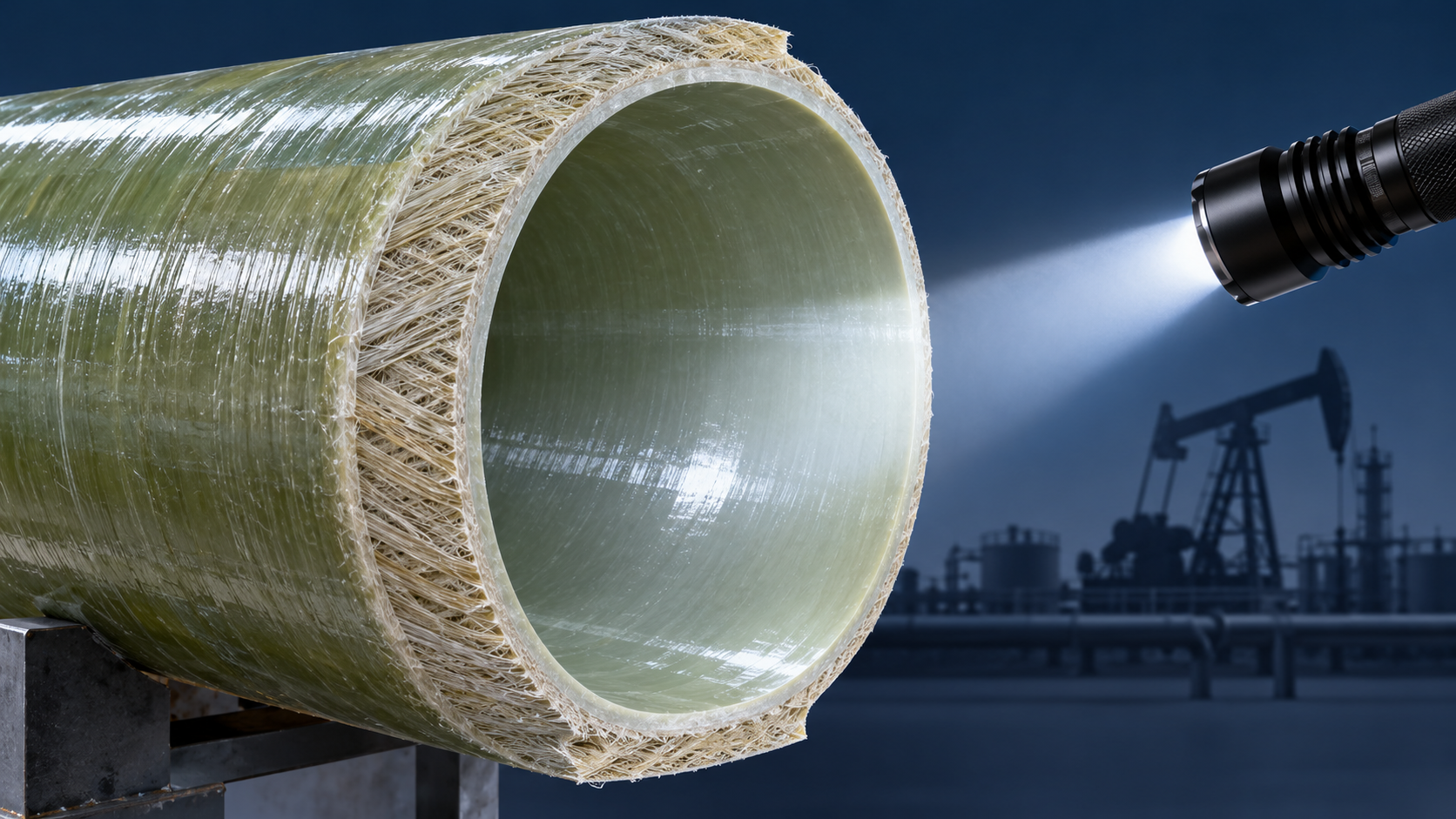
Corrosion allowance is the first place where the 50-year promise gets tested. In carbon steel, corrosion allowance is a sacrificial layer. You add extra wall thickness, accept that it will corrode at a predicted rate, and hope the remaining metal survives the design life. GRE pipe does not work that way. The epoxy matrix, combined with glass fiber reinforcement, does not pit or rust. It does not need a sacrificial thickness. The entire wall is the corrosion barrier. But that changes how you must evaluate the pipe. If the resin system is not properly cured, or if the fiber orientation is inconsistent, the "50-year" number becomes theoretical. It is only valid if the laminate is manufactured under tight process control—winding tension, temperature, and resin-to-glass ratio need to be consistent across every single joint, not just the test coupons.
Abrasion Resistance Isn't About Being Hard—It's About the System
Abrasion resistance is where a lot of evaluators get misled. They assume a "durable GRE pipe" must feel hard to the touch or should behave like a ceramic. In practice, abrasion resistance in composite pipe is about how the material responds to continuous impingement, not its surface hardness. GRE pipe handles sand-laden flow reasonably well because the glass fiber reinforcement is hard, but the exposed surface is still a resin-rich layer. Over time, fine particles can wear away the outer resin film if velocities are too high. The key is knowing your operating envelope. For most oil and gas water service lines, staying below a certain flow velocity—which should be confirmed against your project specifications—keeps erosion within acceptable limits. A 50-year design life assumes the system respects those boundaries.
What matters just as much is the transition between pipe section and fittings. In our experience at Shandong Ocean Pipe Technology, the weakest point in any GRE system is rarely the pipe barrel itself. It is the adhesive bond at the tapered joint or the geometry transition, where flow turbulence and internal stresses concentrate. Some buyers ask for additional abrasion-resistant liner options, and there are cases where that makes sense—particularly in produced water reinjection lines with sustained high solids content. But adding a liner changes the effective internal diameter and can affect pressure ratings, so it is not a decision to make in isolation. It should come from a flow assurance review, not just a sales sheet.
The Hidden Cost of Rating Everything at 50 Years
There is a subtle trap in specifying a 50-year design life. The engineer assumes the burst pressure and long-term hydrostatic strength from the short-term test—usually a 10,000-hour regression test per ASTM D2992—will hold for half a century. But the scatter band in those tests is real. Some manufacturers quote an optimistic upper-bound regression line. Others, ourselves included, prefer to rate pipe based on a more conservative position within the scatter band. The result is that one pipe rated at "50 years" may actually have a robust safety margin, while another pipe claiming the same number is operating on a much thinner reserve. As a buyer, always ask to see the regression curve and its confidence limits, not just the final pressure rating.
There is another overlooked factor: installation damage. You can buy the best GRE pipe in the world, but if the contractor drags it across sharp rock during lay, if they use an improper cutting tool, or if they over-torque the metal backing rings, you have just reduced a 50-year design life to a 5-year nuisance. Field handling is part of the lifespan equation, and reputable manufacturers train site crews as part of their supply scope. That is a practical point that does not show up in any standard, but it shows up in every decommissioning report.
What a Real 50-Year GRE Pipe Needs
A genuinely durable GRE pipe in oilfield service requires more than just a layer of glass fibers. It needs a resin system that survives aging—not just chemical resistance at a hot temperature for a month, but sustained exposure over years, with temperature cycling, pressure cycles, and occasional upsets. The pipe we build for marine ballast and LNG applications, for instance, is not the same specification we send for a high-salinity produced water project. The resin selection, the liner type, and the winding angle all shift based on what is actually flowing inside. That is why standard catalogs can only take you so far.
A 50-year design life is also a commitment to straightness and dimensional tolerances. GRE pipe relies on a series of tapered spigot-and-socket or butt-strap joints with adhesive. If the outside diameter tolerances drift from one joint to the next, the adhesive gap thickens or thins unpredictably, and the system becomes vulnerable. This is one tangible advantage of the 16 winding production lines and the wound micro-control systems in our own plant. Consistent joint geometry is not an aesthetic preference; it is a load-bearing property. It keeps the system tight, the stresses even, and the design life achievable.
A Practical Approach for Technical Evaluators
If you are evaluating a vendor for an oil and gas project, begin with the design life question, but push deeper immediately. Ask for their ASTM D2992 regression data, including the scatter band. Ask what temperature their long-term rating is based on, and what happens when your peak temperature exceeds that. Ask them about their experience with the fluid you are carrying—not just "oxidation-resistant" labels, but how the pipe actually performs after years of exposure to the specific blend of chlorides, H2S, or CO2 in your reservoir. They should be able to talk about the failure modes of that fluid, not just quote a pressure rating.
Also, do not treat abrasion as the only wear mechanism. Scale build-up, pigging frequency, and wax deposition all change the internal surface condition. Some line cleaning techniques—like aggressive scraping tools—can be harder on a composite liner than the produced fluid itself. This again depends on operational practice, and any answer that looks universal should raise a flag.
The 50-year design life is not a guarantee that the pipe will never fail. It is a condition-based prediction, and its accuracy depends on how closely your project stays within the assumed operating envelope. But if the pipe is specified correctly, installed without damage, and operated within intended parameters, that extended lifespan becomes a genuine economic advantage. It reduces replacement frequency, cuts downtime risk, and eliminates the need for repeated corrosion allowance checks in the field.
When you sit across from a pipe supplier, listen for how they talk about the product. If the conversation stays at the level of "this pipe lasts 50 years," that is a sales pitch. If it drifts into resin chemistry, joint geometry tolerances, regression curves, and field handling procedures, that is an indication they have seen the pipe fail enough times to know what actually matters. The latter is the conversation worth having. It will not produce a flashy brochure, but it will get you a piping system that holds up—year after year, well after many of your other components have been replaced.
Related Posts
- ▶ Comparing Fiberglass vs. Thermoplastic Pipes for Long-Term Brine Disposal Lines in Desert Climates
- ▶ Durable GRE Pipe: What Does 50-Year Design Life Mean for Corrosion Allowance and Abrasion Resistance?
- ▶ Hydrostatic Testing Requirements for Newly Installed Offshore GRE Piping Systems: Pressure Hold Criteria
Please give us a message
产品介绍产品介绍产品介绍产品介绍产品介绍产品介绍产品介绍产品介绍产品介绍产品介绍产品介绍产品介绍产品介绍产品介绍产品介绍产品介绍产品介绍产品介绍产品介绍产品介绍产品介绍产品介绍产品介绍产品介绍产品介绍产品介绍产品介绍产品介绍产品介绍产品介绍
Please give us a message
产品介绍产品介绍产品介绍产品介绍产品介绍产品介绍产品介绍产品介绍产品介绍产品介绍产品介绍产品介绍产品介绍产品介绍产品介绍产品介绍产品介绍产品介绍产品介绍产品介绍产品介绍产品介绍产品介绍产品介绍产品介绍产品介绍产品介绍产品介绍产品介绍产品介绍
Please give us a message
产品介绍产品介绍产品介绍产品介绍产品介绍产品介绍产品介绍产品介绍产品介绍产品介绍产品介绍产品介绍产品介绍产品介绍产品介绍产品介绍产品介绍产品介绍产品介绍产品介绍产品介绍产品介绍产品介绍产品介绍产品介绍产品介绍产品介绍产品介绍产品介绍产品介绍
Please give us a message
产品介绍产品介绍产品介绍产品介绍产品介绍产品介绍产品介绍产品介绍产品介绍产品介绍产品介绍产品介绍产品介绍产品介绍产品介绍产品介绍产品介绍产品介绍产品介绍产品介绍产品介绍产品介绍产品介绍产品介绍产品介绍产品介绍产品介绍产品介绍产品介绍产品介绍