
Comparing Fiberglass vs. Thermoplastic Pipes for Long-Term Brine Disposal Lines in Desert Climates
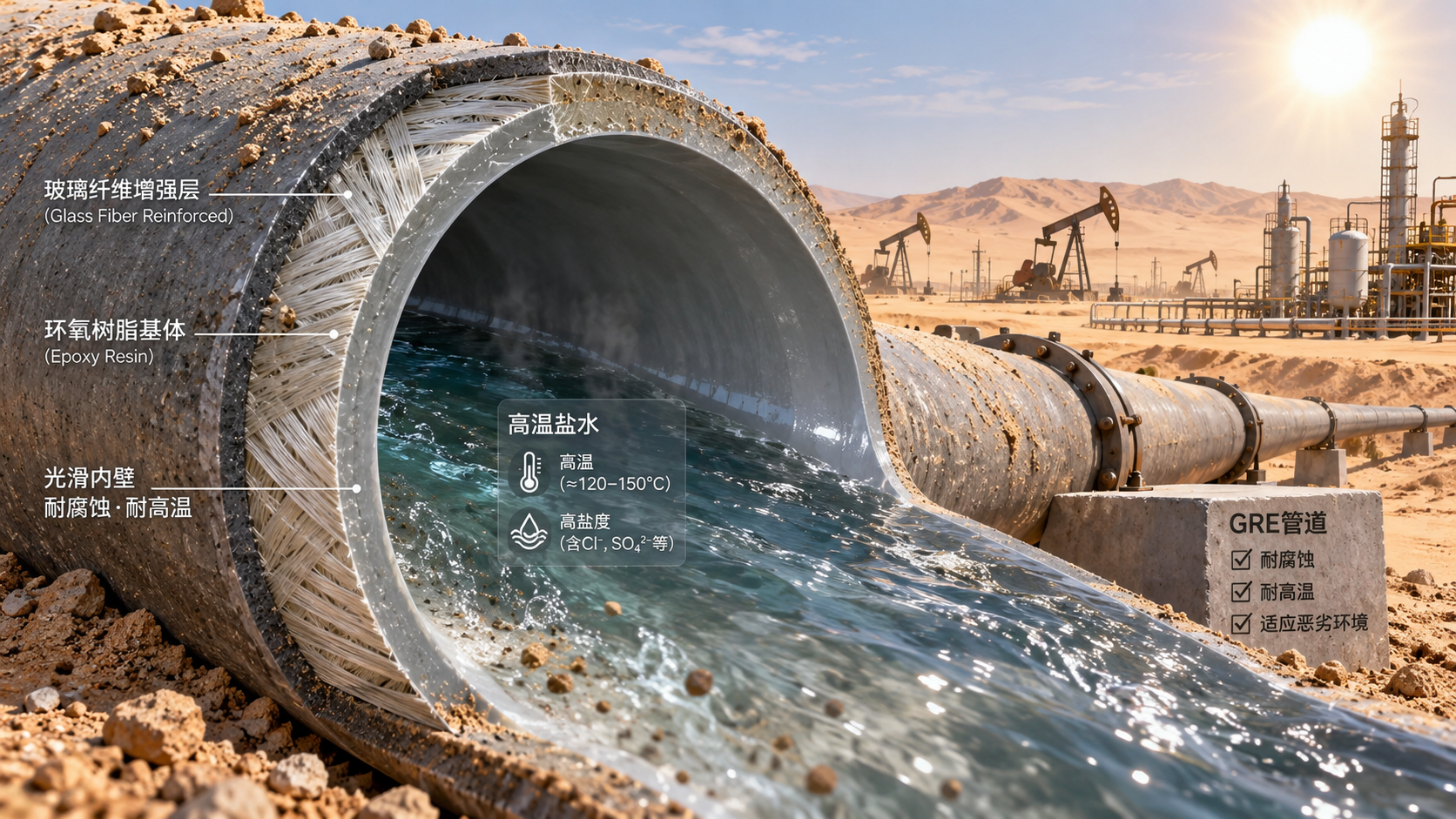
In desert oilfields, brine disposal lines run under conditions that quickly expose weak materials: daytime surface temperatures that push past 50°C, UV radiation that never lets up, and a continuous flow of highly corrosive saltwater at temperatures that can reach 80°C or more. For project managers responsible for 20-year asset life, the question is not which pipe survives the first year, but which one can still carry brine without failure long after the initial installation crews have moved on to other sites.
When comparing fiberglass reinforced epoxy (GRE) and thermoplastic pipes for these service conditions, the short answer is that a durable GRE pipe will generally outlast thermoplastic alternatives in high-temperature brine service. While thermoplastics like HDPE and PP have legitimate applications in oilfield water handling, they reach their performance ceiling at brine temperatures around 60°C. Desert disposal lines routinely exceed that threshold, which is why GRE has become the default material for produced water and brine disposal in Middle East and North African operations.
Why temperature ratings determine material selection
Let's look closely at what happens inside a brine disposal line. The water produced from oil and gas reservoirs carries dissolved salts, often at saturation levels, and leaves the separator at elevated temperatures. As it travels through the disposal pipeline, external desert heat adds to the thermal load on the pipe wall. For a project engineer planning a disposal line that must operate for two decades or more, the material's sustained operating temperature rating is the first filter in the selection process.
Thermoplastic pipes, including HDPE and PP, derive their mechanical strength from their molecular structure, which softens as temperature rises. At 40°C, an HDPE pipe rated for 16 bar may handle the pressure comfortably. But at 60°C, the same pipe requires derating that can cut allowable pressure by half. At 80°C, most standard thermoplastics begin to creep under sustained pressure, and fittings become the weak link. For desert brine service where both temperature and pressure fluctuate daily, relying on derated thermoplastics creates a risky margin of error.
GRE pipe, by contrast, uses fiberglass reinforcement in an epoxy matrix that retains structural integrity at elevated temperatures. Depending on the resin system and pipe design, a durable GRE pipe can be rated for continuous service at 95°C to 110°C without significant strength loss. This is not a small difference. It determines whether a disposal line design is feasible in the first place.
Corrosion behavior under abrasive saltwater flow
Beyond temperature, brine's chemical aggressiveness eliminates many metallic piping options without expensive internal coatings. But comparing GRE and thermoplastic on corrosion resistance alone is misleading. Both resist general corrosion. The real difference shows up when the flowing brine contains sand, scale particles, or other suspended solids.
Thermoplastic pipes are relatively soft. Fine sand entrained in brine, even at low concentrations, acts as an abrasive that gradually erodes the pipe wall. Over years of operation, this erosion reduces wall thickness and leaves the pipe vulnerable to failure precisely when it should still be mid-life. GRE pipe's fiberglass reinforcement provides significantly higher erosion resistance because the glass fibers and epoxy matrix form a hard, rigid surface that withstands particle impact.
Another factor that gets overlooked in long-term planning is scale buildup. Brine lines naturally deposit calcium carbonate and other scale on pipe walls. The smooth internal surface of a GRE pipe reduces scale adhesion, and its larger effective bore maintains flow rates over time. Thermoplastic pipes, particularly if they have been operating near their temperature limits, show more scale deposition because surface roughness increases as the material degrades from thermal cycling.
Mechanical strength and pressure handling in remote desert locations
Once a disposal line is buried, it must carry not only the operating pressure but also the load from soil cover, occasional surface traffic, and thermal expansion. In desert terrain, where soil conditions vary from compact sand to rocky fill sections, the pipe's stiffness and resistance to deformation directly affect long-term service life.
GRE pipe offers a much higher stiffness-to-weight ratio than thermoplastic alternatives. This means it can be installed with less bedding material and is less likely to ovalize under deep burial. When a thermoplastic pipe begins to deform, even by a small percentage, the structural integrity of the line changes. Long-term deflection in HDPE under deep soil cover has been documented as a progressive issue, especially when operating temperatures are elevated. The pipe ovalizes, leading to reduced flow area, increased stress at the spring line, and eventual cracking at the invert.
For projects where the pipeline must be installed through rocky sections using directional drilling or open trench, the ability of GRE pipe to handle point loads during installation is also worth considering. Its higher modulus of elasticity means it can span irregularities in the trench bottom without excessive bending stress.
Joint integrity over extended service life
Any pipeline failure in brine service tends to occur at joints rather than along the straight pipe body. The jointing method therefore becomes a critical life-cycle decision for project managers.
Thermoplastic pipes in larger diameters are typically joined by butt fusion welding. This process requires clean conditions, proper heating, controlled cooling, and skilled operators. In desert conditions with wind and blowing sand, maintaining the required cleanliness during field fusion is consistently difficult. Poorly fused joints become crack initiation points, and these areas fail unpredictably under thermal cycling.
GRE above-ground or buried lines, including those used for brine disposal, commonly use adhesive-bonded or bell-and-spigot joints that are completed with a guided winding process. The joint area is built up with glass fiber and epoxy resin, creating a connection that can match or exceed the pressure rating of the pipe body. Once cured, these joints are effectively as strong as the pipe itself, and they do not rely on operator skill to the same degree as heat fusion. For brine lines where a joint failure means a saltwater spill onto sensitive desert ground, the reliability of the bonding process is worth considerable weight in the selection decision.
Economic analysis across a 20-year operating window
Initial pipe cost per meter is often a poor guide for long-term asset decisions, but in practice it drives many purchasing decisions. Thermoplastic pipe pricing fluctuates closely with crude oil prices because HDPE is a petrochemical derivative. GRE pipe cost is less linked to feedstock swings and has remained more stable over supply cycles.
When comparing total installed cost, GRE pipe's lighter weight reduces lifting and welding time. A 12-meter joint of GRE pipe weighs far less than a steel alternative of equal diameter, and installation requires no heavy fusion equipment. Projects can lay more pipe per day with fewer crew members, which matters when working in remote desert locations where labor mobilization is costly.
Over the operating life, the risk profile shifts further toward GRE. A disposal line that needs repair after 10 years requires excavation, dewatering, pipe replacement, and re-burial. These costs are not simply linear with the initial budget, they are disruptive, require permits and disposal of contaminated soil, and interrupt disposal operations. For a project manager accountable for production uptime, avoiding this scenario entirely is worth significant capital expenditure.
Field performance evidence for GRE in brine service
Operators in deserts consistently report that GRE pipe installed in produced water and brine service over decades still tests at or near original pressure ratings. Thermoplastic pipe in the same service frequently shows measurable tensile strength degradation after 10 years, driven by UV exposure on any above-ground sections and by temperature-induced oxidative degradation on the buried portions of the line.
Inspection data from oilfield operators indicates that GRE lines maintain wall thickness in brine service, confirming the material's resistance to the combination of chemical attack and erosion. Thermoplastic lines inspected after similar periods routinely show wall thinning in the lower quadrant of the pipe, where sand and water separate and flow dynamics concentrate erosion.
Many of the world's leading oil operators, including CNOOC, CNPC, Sinopec, and major shipyards in Asia, have standardized on GRE pipe for demanding corrosive and high-temperature services. The manufacturing base in China that supplies this demand has matured significantly, with companies like Shandong Ocean Pipe Technology operating 16 winding production lines and a 25,000-ton annual production capacity, allowing operators to meet large project timelines consistently.
What project managers should take into account before finalizing pipe specifications
The choice between GRE and thermoplastic is rarely a single-decision event during FEED work. It is worth revisiting the material selection when the following conditions change:
- If projected brine temperature at the wellhead is expected to exceed 60°C at any point in the field life, GRE should be treated as the baseline option rather than a premium alternative.
- If the brine is expected to carry sand during early production or after fracturing operations, GRE's erosion margins provide insurance that thermoplastics cannot offer.
- If the pipeline route includes above-ground sections, GRE's UV resistance eliminates the need for protective wrapping or insulation that thermoplastics require.
- If the project timeline is driven by fast-track procurement, GRE manufacturers with substantial installed capacity can typically deliver a better match to the schedule.
For project managers designing brine disposal infrastructure that must operate for decades in harsh desert cycles, the comparisons consistently land on the same conclusion. The combination of sustained mechanical strength at high temperatures, superior erosion resistance, joint reliability that does not depend on field conditions, and favorable life-cycle economics makes a durable GRE pipe the defensible choice. Thermoplastic materials should be reserved for cases where brine temperatures remain consistently low, diameters are small enough to use coilable PE pipe, and the targeted service life is below 10 years.
Related Posts
- ▶ Comparing Fiberglass vs. Thermoplastic Pipes for Long-Term Brine Disposal Lines in Desert Climates
- ▶ Durable GRE Pipe: What Does 50-Year Design Life Mean for Corrosion Allowance and Abrasion Resistance?
- ▶ Hydrostatic Testing Requirements for Newly Installed Offshore GRE Piping Systems: Pressure Hold Criteria
Please give us a message
产品介绍产品介绍产品介绍产品介绍产品介绍产品介绍产品介绍产品介绍产品介绍产品介绍产品介绍产品介绍产品介绍产品介绍产品介绍产品介绍产品介绍产品介绍产品介绍产品介绍产品介绍产品介绍产品介绍产品介绍产品介绍产品介绍产品介绍产品介绍产品介绍产品介绍
Please give us a message
产品介绍产品介绍产品介绍产品介绍产品介绍产品介绍产品介绍产品介绍产品介绍产品介绍产品介绍产品介绍产品介绍产品介绍产品介绍产品介绍产品介绍产品介绍产品介绍产品介绍产品介绍产品介绍产品介绍产品介绍产品介绍产品介绍产品介绍产品介绍产品介绍产品介绍
Please give us a message
产品介绍产品介绍产品介绍产品介绍产品介绍产品介绍产品介绍产品介绍产品介绍产品介绍产品介绍产品介绍产品介绍产品介绍产品介绍产品介绍产品介绍产品介绍产品介绍产品介绍产品介绍产品介绍产品介绍产品介绍产品介绍产品介绍产品介绍产品介绍产品介绍产品介绍
Please give us a message
产品介绍产品介绍产品介绍产品介绍产品介绍产品介绍产品介绍产品介绍产品介绍产品介绍产品介绍产品介绍产品介绍产品介绍产品介绍产品介绍产品介绍产品介绍产品介绍产品介绍产品介绍产品介绍产品介绍产品介绍产品介绍产品介绍产品介绍产品介绍产品介绍产品介绍