
Hydrostatic Testing Requirements for Newly Installed Offshore GRE Piping Systems: Pressure Hold Criteria
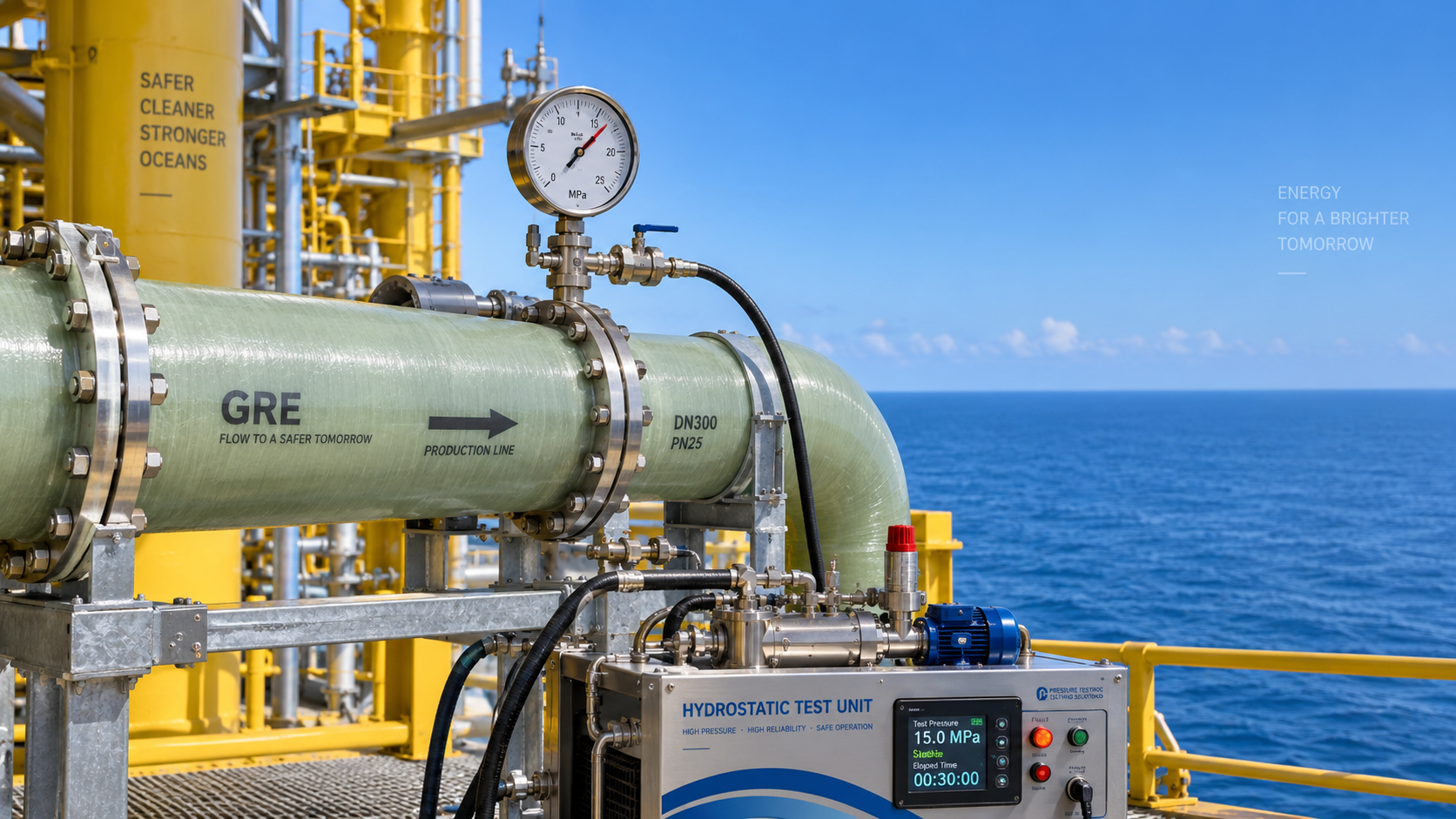
When a newly installed GRE piping system is being prepared for service on an offshore platform, the hydrostatic test is the moment where most installation errors surface. Poor joint makeup, incorrect flange torque, or minor impacts during handling that went unnoticed—all of these tend to reveal themselves as pressure drops during the hold period. For quality control and safety management personnel, the pressure hold criteria are not just a pass/fail threshold; they are the primary tool for deciding whether the system is safe to commission or needs to be cut out and re-made.
The general rule for offshore GRE piping is straightforward: the test pressure must be held long enough to confirm that the system is structurally sound and leak-free, but the exact hold time and acceptable pressure decay depend on the applicable standard, the pipe rating, and whether the system is above or below water. Most offshore projects follow ISO 14692 or API 15HR, and both standards place strict limits on how much pressure loss is acceptable over a defined period. Understanding these limits—and knowing when to reject a test—is far more important than simply reaching the target test pressure.
Setting the Test Pressure and Hold Period
Before discussing the hold criteria, it is worth clarifying how the test pressure itself is derived. For GRE piping in hydrocarbon service, the hydrostatic test pressure is typically set at 1.5 times the design pressure, but it is capped at a value that does not overstress the pipe or the joints. For offshore systems, the cap is often related to the maximum allowable stress of the GRE material at the test temperature. If the test pressure is too high relative to the pipe’s rated pressure, the test can cause micro-cracking in the glass fiber layers, which weakens the pipe even though it passes the test.
The hold time, on the other hand, is usually a minimum of 30 minutes for GRE systems, though many operators extend this to a full hour for critical services such as sea water lift lines or firefighting ring mains. The key distinction between GRE and carbon steel hydrostatic testing is that GRE pipes are much more sensitive to temperature changes during the test. A slight drop in ambient temperature can cause a measurable pressure decline in a GRE system—even when there is no leak at all. This makes it essential to read the pressure changes with the test medium temperature in mind.
Pressure Hold Criteria: What Actually Matters
For newly installed offshore GRE piping, the acceptance criterion is usually defined as the test pressure remaining within a specific tolerance for the entire hold duration. In practice, most operators use one of the following two approaches:
- No visible leakage with pressure maintained within ±1% of the test pressure: This is a common requirement for above-deck piping where the piping is visually accessible. If the pressure does not rise or fall by more than 1%, and there is no visible weeping at the joints, the test passes.
- Pressure decay not exceeding 5% over 30 minutes: This is a more practical criterion for larger systems or where the piping is insulated, coated, or located in areas where small variations are expected. A 5% drop is generally considered acceptable if it is steady and attributable to temperature stabilization rather than a sudden step change.
A sudden, rapid drop in pressure—particularly one that happens within the first 10 minutes—is almost always a real leak. In contrast, a gradual, linear decline over the full hold period often points to temperature effects or trapped air in the system. The distinction matters because re-pressurizing the system repeatedly in response to a temperature-driven drop wastes time and risks overstressing the pipe. The experienced approach is to allow a brief stabilization period—usually 10 to 15 minutes—after reaching the test pressure, during which the pressure is topped up as needed. Once the medium temperature stabilizes, the actual hold period begins and the pressure decay is measured.
Critical Factors That Influence Pressure Hold Results
Several factors specific to offshore installations can interfere with the pressure hold test, and being able to identify them quickly is part of the QC role. Trapped air is perhaps the most common issue. If air remains in the high points of the piping during filling, the pressure will appear to drop as the air compresses or dissolves into the test medium. This is especially problematic in GRE lines that are not equipped with bleeder vents at every high point. The simplest way to mitigate this is to fill the line slowly and open the vents systematically, but in practice this step is often rushed to save time.
Expansion of the pipe under pressure is another factor in GRE systems that is more pronounced than in steel. GRE has a lower modulus of elasticity than carbon steel, meaning it expands slightly more under internal pressure. This initial expansion requires additional water to be pumped into the line during the first few minutes of the test. If the test pump is stopped immediately after reaching the target pressure, the pressure will naturally decay as the pipe continues to expand. Allowing the system to stabilize and topping up the pressure once or twice before starting the hold clock avoids a false failure.
Temperature Effects on the Test Medium
Offshore environments create a specific challenge: the water temperature used for the test is often significantly different from the ambient air temperature. On a platform deck under direct sunlight, a GRE pipe filled with cold sea water will see the water temperature rise steadily over the test period. This causes the water to expand, which actually increases the pressure. The opposite happens at night or when sea water is pumped from deeper, colder layers while the deck is warm. A pressure rise during the hold can be just as problematic as a drop, because it may push the system above its allowable test pressure.
For this reason, the hold criteria should be evaluated in terms of pressure trend over the full hold period rather than a single reading at the end. A system that shows a slow, steady decline that stops after the first 15 minutes is usually temperature-related. A system that holds steady for 20 minutes and then drops suddenly has a joint problem or a flange leak that opened up as the pipe moved under pressure. Knowing which pattern points to what underlying cause allows the QC team to decide whether to continue the test, release the pressure and inspect a suspect joint, or abort the test entirely.
Joint Integrity and End Load Reaction
GRE piping systems are joined with either adhesive-bonded joints or mechanical couplings, and each behaves differently under hydrostatic pressure. Adhesive-bonded joints do not leak through the bond line when properly cured—if a bonded joint leaks, it is almost always because the adhesive was applied incorrectly or the joint was moved before curing was complete. In an offshore installation schedule, the pressure to move forward quickly sometimes results in joints being pressure-tested before the adhesive has reached its full cure strength. Most GRE adhesive systems require 24 hours at ambient temperature before the pipe can be pressure-tested. Testing earlier is one of the most common causes of joint weeping during the hold period.
Mechanical couplings, by contrast, rely on gasket compression and can sometimes be re-tightened if a leak appears. The hold period for systems that include mechanical couplings should be long enough to confirm that the gaskets are properly seated. A brief pressure drop followed by stabilization is normal with couplings because the gasket deforms slightly as it compresses. The concern is a continuous drop that does not level off, which usually indicates an under-torqued coupling or a damaged gasket.
Another issue that shows up only during the hydrostatic test is end load reaction at anchors and riser clamps. Since GRE pipe expands more than steel under pressure, the thrust forces at elbows, tees, and reducers are considerable. If the anchoring is not properly designed, the pipe will move during the test, and that movement can break a joint seal or cause a flange to shift. During the pressure hold, the QC crew should monitor the position of the pipe at major anchors and—if possible—at the riser transitions. Any visible movement at an anchor point during the hold period is a red flag that requires stopping the test, because the movement will only become worse under cyclic service loads later.
Test Records and Documentation for Offshore Systems
For offshore installations, the hydrostatic test record is part of the permanent installation file that is reviewed by the operator, the classification society, and in some cases the certifying authority. The record should include the test pressure, the hold time, the pressure readings at regular intervals—typically every 5 minutes—and the ambient and test medium temperature at the start and end of the hold period. It is also important to note the exact time when the pressure was topped up, if that was done during the stabilization phase, because this explains any step change in the pressure trace that an auditor might otherwise misinterpret as a leak.
If the system fails the pressure hold criteria, the record is equally important. The pressure decay readings, temperature data, and weather conditions at the time of the test can help determine whether the failure was due to a genuine leak or a test artifact. A depressurized and re-pressurized retest that passes does not—by itself—prove that the initial failure was not a real leak, particularly if the failure occurred at a joint. The correct approach is to locate the leak source, repair it, and re-test the affected section. Only when the pressure drop is clearly attributable to temperature or trapped air should the original hold be extended rather than repeated after repair.
Companies that manufacture GRE pipe for offshore service—such as Shandong Ocean Pipe Technology with its hydrostatic testing machines and production capacity for large-diameter pipe—typically perform their own factory hydrostatic tests on each pipe length before shipment. That initial test is performed with the pipe ends capped and is designed to confirm the pipe wall integrity. The site hydrostatic test after installation is a different test entirely, and the pressure hold criteria in the field must be judged according to the installed system configuration, joint types, and environmental conditions—not against the factory test results. Understanding this distinction helps QC personnel avoid the common error of expecting the installed system to behave exactly as it did during the factory pressure test.
The final point to keep in mind is that the hydrostatic test is the last chance to identify problems before the system is put into hydrocarbon service, where a joint failure can turn into a fire or an environmental release. A pressure hold criterion that is too lenient risks commissioning a system with a latent defect, while a criterion that is unreasonably strict consumes valuable project time by chasing pressure fluctuations that are normal physical behavior of GRE pipe in an offshore environment. Applying the criteria with the right understanding of temperature effects, pipe expansion, and joint behavior is what separates a reliable test from a purely procedural one.
Related Posts
- ▶ Hydrostatic Testing Requirements for Newly Installed Offshore GRE Piping Systems: Pressure Hold Criteria
- ▶ Trends in Offshore Composite Piping Demand: Why GRE Specification Is Growing for New Build FPSO Projects
- ▶ Handling Fatigue Loading on Topside GRE Pipe Supports: What Design Engineers Must Verify
Please give us a message
产品介绍产品介绍产品介绍产品介绍产品介绍产品介绍产品介绍产品介绍产品介绍产品介绍产品介绍产品介绍产品介绍产品介绍产品介绍产品介绍产品介绍产品介绍产品介绍产品介绍产品介绍产品介绍产品介绍产品介绍产品介绍产品介绍产品介绍产品介绍产品介绍产品介绍
Please give us a message
产品介绍产品介绍产品介绍产品介绍产品介绍产品介绍产品介绍产品介绍产品介绍产品介绍产品介绍产品介绍产品介绍产品介绍产品介绍产品介绍产品介绍产品介绍产品介绍产品介绍产品介绍产品介绍产品介绍产品介绍产品介绍产品介绍产品介绍产品介绍产品介绍产品介绍
Please give us a message
产品介绍产品介绍产品介绍产品介绍产品介绍产品介绍产品介绍产品介绍产品介绍产品介绍产品介绍产品介绍产品介绍产品介绍产品介绍产品介绍产品介绍产品介绍产品介绍产品介绍产品介绍产品介绍产品介绍产品介绍产品介绍产品介绍产品介绍产品介绍产品介绍产品介绍
Please give us a message
产品介绍产品介绍产品介绍产品介绍产品介绍产品介绍产品介绍产品介绍产品介绍产品介绍产品介绍产品介绍产品介绍产品介绍产品介绍产品介绍产品介绍产品介绍产品介绍产品介绍产品介绍产品介绍产品介绍产品介绍产品介绍产品介绍产品介绍产品介绍产品介绍产品介绍