
When Is FRP Pipe Worth the Investment for Industrial Fluid Systems?
Investment Value Starts with Lifecycle Risk
Choosing an FRP Pipe system is rarely a simple material substitution.
In industrial fluid systems, the decision affects corrosion exposure, maintenance frequency, shutdown risk, and long-term capital efficiency.
The initial purchase price may look higher than some metallic alternatives.
Yet that number can be misleading when the operating environment is chemically aggressive or maintenance access is difficult.
FRP Pipe becomes worth serious consideration when the cost of corrosion is larger than the cost of better material selection.
This is especially relevant in oil and gas, chemical plants, LNG facilities, ship ballast systems, hot spring networks, and salt production.
These applications often combine moisture, salts, acids, alkalis, temperature variation, and continuous flow.
Under those conditions, pipe failure is not just a repair issue.
It can interrupt production, increase safety exposure, and create unplanned costs across the whole system.
What FRP Pipe Means in Industrial Fluid Systems
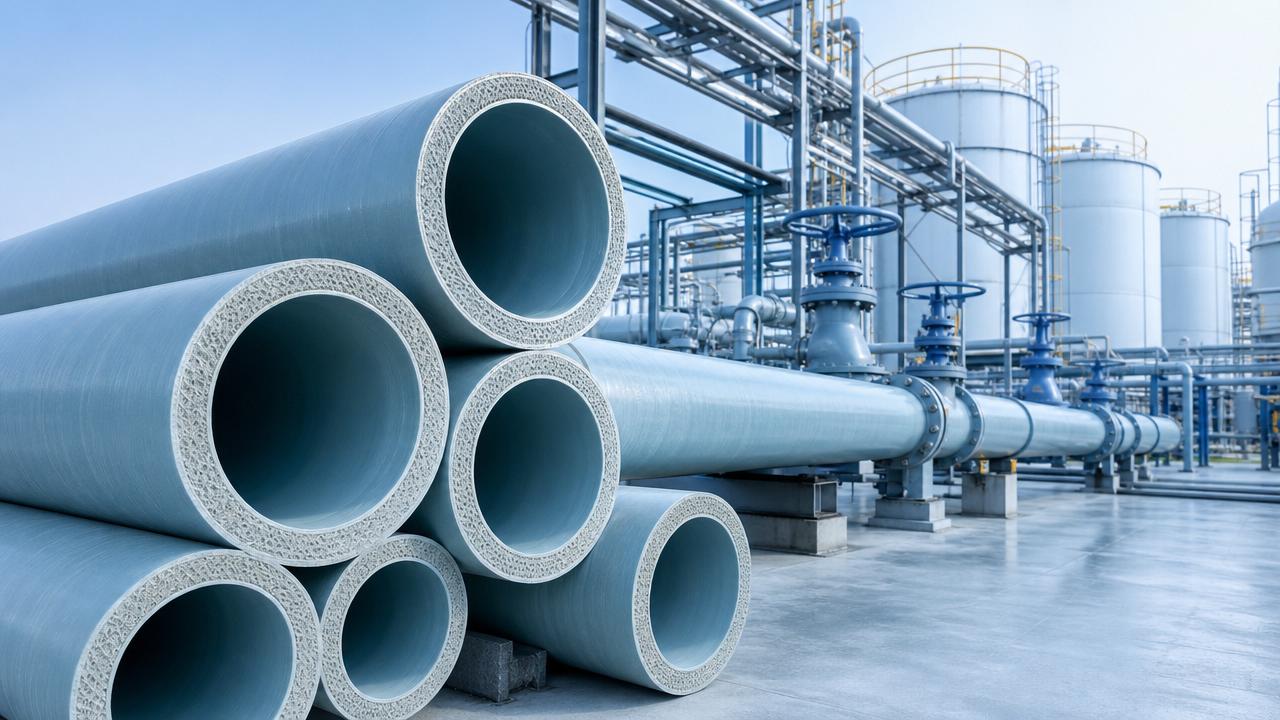
FRP Pipe generally refers to fiberglass reinforced plastic pipe.
In many industrial projects, GRE pipe is a common form, using fiberglass reinforcement with epoxy resin.
The structure is different from steel, stainless steel, or lined metallic pipe.
It relies on a composite wall designed for strength, corrosion resistance, and hydraulic performance.
This makes FRP Pipe part of the glass and ceramic materials value chain.
Glass fiber reinforcement provides mechanical strength, while the resin system protects against chemical attack.
The result is a pipe material that can reduce internal scaling and external corrosion.
For fluid transport, that can support more stable flow and lower cleaning requirements.
The value is not universal, however.
FRP Pipe delivers its strongest return when the application matches its design limits, resin chemistry, pressure rating, and installation conditions.
Where the Economics Often Shift in Favor of FRP Pipe
The business case usually changes when operating costs are examined over several years.
Metallic pipe may require coatings, corrosion allowance, cathodic protection, or frequent replacement.
Those items are easy to underestimate during early budgeting.
FRP Pipe can reduce several recurring cost categories when applied correctly.
This does not mean every system should use FRP Pipe.
It means the evaluation should include avoided costs, not only purchase cost.
When corrosion-related spending is predictable and frequent, lifecycle economics often become more favorable.
Applications Where the Investment Case Is Stronger
Industrial fluid systems differ widely, so the investment case depends on the service environment.
FRP Pipe is often more compelling in media that quickly damages carbon steel.
Oil, gas, and produced water
Oilfield water handling can involve salts, dissolved gases, suspended solids, and chemical additives.
In such systems, FRP Pipe can reduce corrosion risk in gathering, injection, and treatment lines.
Upstream projects may also use adjacent filtration or well-completion products.
For example, Sand Control Screens can appear in broader production planning where solids management affects downstream pipe performance.
Chemical plants and processing lines
Chemical facilities often transport acids, alkalis, brine, solvents, or mixed process water.
Material compatibility becomes a direct financial issue, not just a technical preference.
FRP Pipe can be valuable where resin selection matches the actual fluid chemistry and temperature.
Marine and ballast piping
Ship ballast systems face continuous seawater exposure and demanding maintenance access.
A lightweight, corrosion-resistant piping material can support vessel efficiency and reduce replacement work.
In shipyards, FRP Pipe can also help simplify installation compared with heavier metallic systems.
LNG, hot spring, and salt-making systems
These systems may involve temperature changes, mineral-rich fluids, or highly saline conditions.
FRP Pipe can be useful where corrosion, scaling, and maintenance access create recurring costs.
The key is confirming pressure, temperature, joint type, and installation design early.
Why Upfront Price Can Distort the Decision
A low pipe price can hide several later expenses.
These include coating renewal, shutdown coordination, leak repair, replacement inventory, and environmental risk controls.
FRP Pipe should be compared through a total cost model.
That model should include the expected service life and the cost of one unplanned outage.
The heavier the downtime penalty, the more valuable reliability becomes.
This is why projects with continuous operation often view FRP Pipe differently from smaller utility systems.
For a non-critical drainage line, the return may be limited.
For corrosive process water or seawater circulation, the avoided maintenance can be substantial.
In other words, the best comparison is not pipe against pipe.
It is system risk against system risk, measured over the asset’s intended operating life.
Technical Conditions That Influence Payback
A strong commercial case still needs technical discipline.
FRP Pipe must be selected according to service conditions, not generic preference.
- Fluid chemistry, including pH, salts, solvents, oxidizers, and additives.
- Design pressure, surge pressure, vacuum risk, and testing requirements.
- Operating temperature and short-term temperature peaks.
- Pipe diameter, flow velocity, abrasion exposure, and solids content.
- Aboveground or buried installation, including supports and soil conditions.
- Joint method, field bonding quality, and inspection procedures.
The installation stage deserves particular attention.
A well-designed FRP Pipe system can lose value if handling or bonding is poorly controlled.
Support spacing, thermal movement, trench preparation, and hydrostatic testing all affect performance.
For critical assets, supplier capability should also be part of risk evaluation.
Supplier Capacity Matters More Than It First Appears
Composite pipe quality depends on process control, winding precision, resin management, and testing discipline.
A reliable FRP Pipe supplier should be evaluated beyond catalog data.
Production capacity, fitting capability, pressure testing, and project experience all reduce delivery and performance uncertainty.
Shandong Ocean Pipe Technology Co., Ltd. was established in 2012 in Wucheng Industrial Park, Dezhou, Shandong Province.
The company focuses on fiberglass reinforced epoxy pipe and has grown into a major GRE pipe manufacturer in China.
Its registered capital is USD 4,200,000, supporting industrial-scale production and long-term project commitments.
Ocean Pipe operates 16 winding production lines and 174 pipe fitting winding machines with micro-control systems.
The factory also uses five hydrostatic pressure testing machines.
Annual GRE pipe production and testing capacity reaches 25,000 tons.
This matters when FRP Pipe is specified for large projects with strict delivery schedules.
Experience across CNOOC, CNPC, Sinopec, major shipyards, and overseas markets adds practical reference value.
Projects in Australia, Iraq, Kazakhstan, and Turkey also reflect exposure to varied site conditions.
A Practical Framework for Deciding Whether It Is Worth It
The investment decision becomes clearer when it is structured around measurable questions.
FRP Pipe is usually more attractive when several answers point toward corrosion, downtime, or maintenance exposure.
This framework helps avoid two common mistakes.
One is rejecting FRP Pipe because its initial price is higher.
The other is choosing it without confirming the engineering details.
Both can lead to poor financial outcomes.
When FRP Pipe May Not Be the Best Fit
A balanced evaluation should also recognize limitations.
FRP Pipe may not be ideal for every high-temperature or highly abrasive application.
It may require special attention around fire performance, impact protection, and mechanical loads.
Some projects also require compliance with specific standards, approvals, or owner specifications.
If the fluid composition is uncertain, testing and compatibility review should come before procurement.
If installation quality cannot be controlled, expected lifecycle benefits may be reduced.
These points do not weaken the value of FRP Pipe.
They simply show why material choice should be tied to real operating data.
Turning the Evaluation into a Clear Next Step
FRP Pipe is worth the investment when it reduces costs that would otherwise repeat for years.
Corrosion control, shutdown avoidance, maintenance planning, and installation efficiency are the main areas to examine.
The strongest cases usually involve aggressive media, seawater, brine, process chemicals, or continuous industrial operation.
The next step is to compare materials through a lifecycle cost view.
That review should include fluid chemistry, design pressure, temperature, maintenance history, downtime cost, and supplier testing capability.
With those factors defined, FRP Pipe can be judged as an investment, not just a line item.
For demanding fluid systems, that distinction often determines whether the chosen piping system protects both operations and long-term returns.
Please give us a message
产品介绍产品介绍产品介绍产品介绍产品介绍产品介绍产品介绍产品介绍产品介绍产品介绍产品介绍产品介绍产品介绍产品介绍产品介绍产品介绍产品介绍产品介绍产品介绍产品介绍产品介绍产品介绍产品介绍产品介绍产品介绍产品介绍产品介绍产品介绍产品介绍产品介绍
Please give us a message
产品介绍产品介绍产品介绍产品介绍产品介绍产品介绍产品介绍产品介绍产品介绍产品介绍产品介绍产品介绍产品介绍产品介绍产品介绍产品介绍产品介绍产品介绍产品介绍产品介绍产品介绍产品介绍产品介绍产品介绍产品介绍产品介绍产品介绍产品介绍产品介绍产品介绍
Please give us a message
产品介绍产品介绍产品介绍产品介绍产品介绍产品介绍产品介绍产品介绍产品介绍产品介绍产品介绍产品介绍产品介绍产品介绍产品介绍产品介绍产品介绍产品介绍产品介绍产品介绍产品介绍产品介绍产品介绍产品介绍产品介绍产品介绍产品介绍产品介绍产品介绍产品介绍
Please give us a message
产品介绍产品介绍产品介绍产品介绍产品介绍产品介绍产品介绍产品介绍产品介绍产品介绍产品介绍产品介绍产品介绍产品介绍产品介绍产品介绍产品介绍产品介绍产品介绍产品介绍产品介绍产品介绍产品介绍产品介绍产品介绍产品介绍产品介绍产品介绍产品介绍产品介绍