
GRE Pipes for Oil and Gas: Key Benefits and Limits
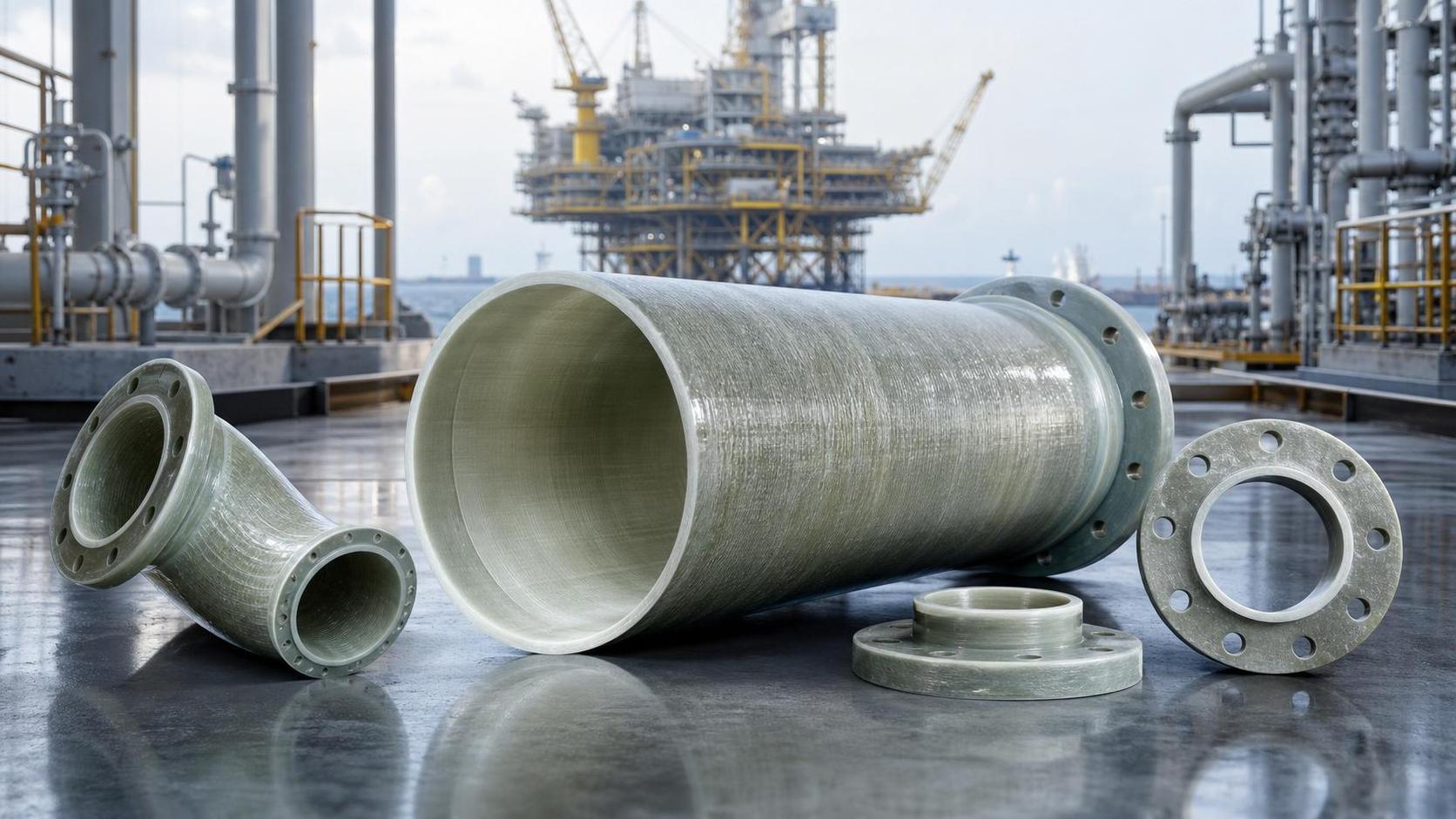
Why are GRE pipes for oil and gas getting so much attention?
GRE pipes for oil and gas are no longer a niche option. They are now a serious material choice for corrosive lines, produced water systems, and offshore support services.
The reason is practical rather than fashionable. Steel performs well in many duties, but corrosion, weight, and maintenance can raise lifetime costs in aggressive environments.
GRE, or glass reinforced epoxy, belongs to the broader family of engineered composite materials. Its glass fiber structure and epoxy resin matrix give it strength, chemical resistance, and a smoother internal surface.
In oil and gas projects, that combination matters. Many lines carry saline water, chemically treated fluids, or media that quickly challenge carbon steel and even some alloy options.
Another reason for rising interest is manufacturing maturity. Chinese producers such as Shandong Ocean Pipe Technology Co., Ltd. have developed large-scale winding capacity and testing capability for GRE systems.
Founded in 2012 in Dezhou, Shandong, Ocean Pipe operates 16 winding production lines and extensive pipe fitting winding equipment, supporting stable output and pressure-tested quality for demanding industries.
That background helps explain why GRE pipes for oil and gas are being studied more carefully. The material is no longer just about avoiding rust. It is about lifecycle decisions.
What makes GRE pipes for oil and gas a strong choice in real projects?
The biggest advantage is corrosion resistance. GRE does not corrode like steel when exposed to saline water, many chemicals, and humid marine conditions.
This is especially valuable in produced water handling, fire water systems, ballast lines, and selected process services. In these settings, corrosion can be a daily operating problem, not a remote risk.
Weight is another major benefit. GRE pipes for oil and gas are much lighter than metallic alternatives, which can reduce transport load, ease lifting, and shorten installation time.
That advantage becomes more visible offshore or in crowded plant layouts. Lower weight can support easier handling and may reduce demand on support structures.
The internal surface is also smooth. In practical terms, that can help maintain flow efficiency and reduce scaling or buildup in certain water service applications.
Long service life is often part of the decision. When the fluid, temperature, and pressure stay within design limits, GRE systems can offer stable performance with lower corrosion-related maintenance.
- Less corrosion-related shutdown risk in aggressive water service.
- Lower handling weight during transport and site assembly.
- Good hydraulic performance from a smoother bore.
- Reduced need for coatings in suitable applications.
In some projects, related composite components such as GRE Tubing are also reviewed when designers want consistency across non-metallic flow systems.
Where do GRE systems fit best, and where should caution start?
This is where many early evaluations go wrong. GRE pipes for oil and gas are useful, but they are not universal replacements for steel.
They fit best in corrosive utility and process-adjacent services. Common examples include produced water, seawater intake and discharge, ballast piping, cooling water, and some chemical transfer duties.
They are also relevant in LNG support systems and industrial plants where corrosion from wet service creates recurring maintenance burden. That is one reason composite pipe use has spread beyond a single sector.
Still, caution starts with temperature, pressure cycling, fire performance requirements, impact exposure, and installation quality. GRE behaves differently from metal under mechanical stress and thermal change.
A simple rule helps. If the application is highly corrosive but operational loads remain within validated design windows, GRE deserves serious attention. If loads are extreme, review limits first.
The table does not replace engineering review, but it gives a realistic first screen. Most problems come from mismatch, not from the material concept itself.
How do GRE pipes compare with steel beyond the obvious corrosion story?
Many people compare GRE and steel only on purchase price. That is too narrow. A more useful comparison includes maintenance, installation effort, inspection frequency, and expected operating environment.
Steel remains strong in high-temperature and high-mechanical-load service. It is familiar, widely specified, and often easier to integrate where fire resistance and structural demands dominate.
GRE pipes for oil and gas become attractive when corrosion protection systems for steel start adding complexity. Coatings, cathodic protection, internal lining failure, and replacement intervals all affect total cost.
Another difference is installation discipline. Steel welding has its own controls. GRE joining also requires strict procedures, but the risks are different, often involving surface preparation, curing, alignment, and support details.
In other words, GRE is not a shortcut material. It is a design-led material. When selected well, it reduces future problems. When selected casually, it creates avoidable surprises.
What limits or misconceptions should be checked before choosing GRE?
One common misconception is that all composite pipe behaves the same. In reality, resin system, fiber architecture, pressure rating, and manufacturing quality make a major difference.
Another misunderstanding is that corrosion resistance means zero maintenance. GRE systems still need inspection, especially at joints, supports, transitions, and areas exposed to misuse or accidental impact.
Thermal expansion behavior must also be reviewed carefully. Support spacing, anchor design, and movement control matter because composite systems respond differently than steel pipelines.
It is also worth checking certification, hydrostatic testing, and production consistency. Large manufacturers with established winding lines and testing equipment usually provide stronger process control.
That manufacturing depth is not a small detail. A producer with broad application history in oil and gas, ship ballast piping, LNG, and chemical service can often support more realistic specification decisions.
- Confirm operating temperature and pressure, not only nominal rating.
- Review joining method and installer qualification early.
- Check support design, vibration exposure, and impact risk.
- Ask for testing records and application references.
What is a sensible way to evaluate GRE pipes for oil and gas on a new project?
Start with the service conditions, not the material preference. Fluid chemistry, operating temperature, pressure profile, installation environment, and maintenance access should be mapped first.
Then compare options on lifecycle logic. A lower upfront steel cost may look attractive, but repeated corrosion control and replacement work can change the real economics over time.
It also helps to review supplier capability in practical terms. Production scale, fitting range, pressure testing resources, and export experience often indicate whether project support will be reliable.
For example, Ocean Pipe’s annual production and testing capacity, along with applications across China and overseas markets, suggests that GRE systems are being used in real operating conditions, not just promoted in theory.
If a project also needs matching composite flow components, reviewing options such as GRE Tubing during the same evaluation can keep specification work more consistent.
A balanced conclusion is usually the right one. GRE pipes for oil and gas offer clear value where corrosion, weight, and service life matter most, but they perform best when design limits are respected.
The next step is straightforward. List the actual media, pressure, temperature, installation constraints, and maintenance targets, then compare GRE against metallic options using those facts rather than assumptions.
Please give us a message
产品介绍产品介绍产品介绍产品介绍产品介绍产品介绍产品介绍产品介绍产品介绍产品介绍产品介绍产品介绍产品介绍产品介绍产品介绍产品介绍产品介绍产品介绍产品介绍产品介绍产品介绍产品介绍产品介绍产品介绍产品介绍产品介绍产品介绍产品介绍产品介绍产品介绍
Please give us a message
产品介绍产品介绍产品介绍产品介绍产品介绍产品介绍产品介绍产品介绍产品介绍产品介绍产品介绍产品介绍产品介绍产品介绍产品介绍产品介绍产品介绍产品介绍产品介绍产品介绍产品介绍产品介绍产品介绍产品介绍产品介绍产品介绍产品介绍产品介绍产品介绍产品介绍
Please give us a message
产品介绍产品介绍产品介绍产品介绍产品介绍产品介绍产品介绍产品介绍产品介绍产品介绍产品介绍产品介绍产品介绍产品介绍产品介绍产品介绍产品介绍产品介绍产品介绍产品介绍产品介绍产品介绍产品介绍产品介绍产品介绍产品介绍产品介绍产品介绍产品介绍产品介绍
Please give us a message
产品介绍产品介绍产品介绍产品介绍产品介绍产品介绍产品介绍产品介绍产品介绍产品介绍产品介绍产品介绍产品介绍产品介绍产品介绍产品介绍产品介绍产品介绍产品介绍产品介绍产品介绍产品介绍产品介绍产品介绍产品介绍产品介绍产品介绍产品介绍产品介绍产品介绍