
What temperature range is realistic for a GRE Pipe in field service
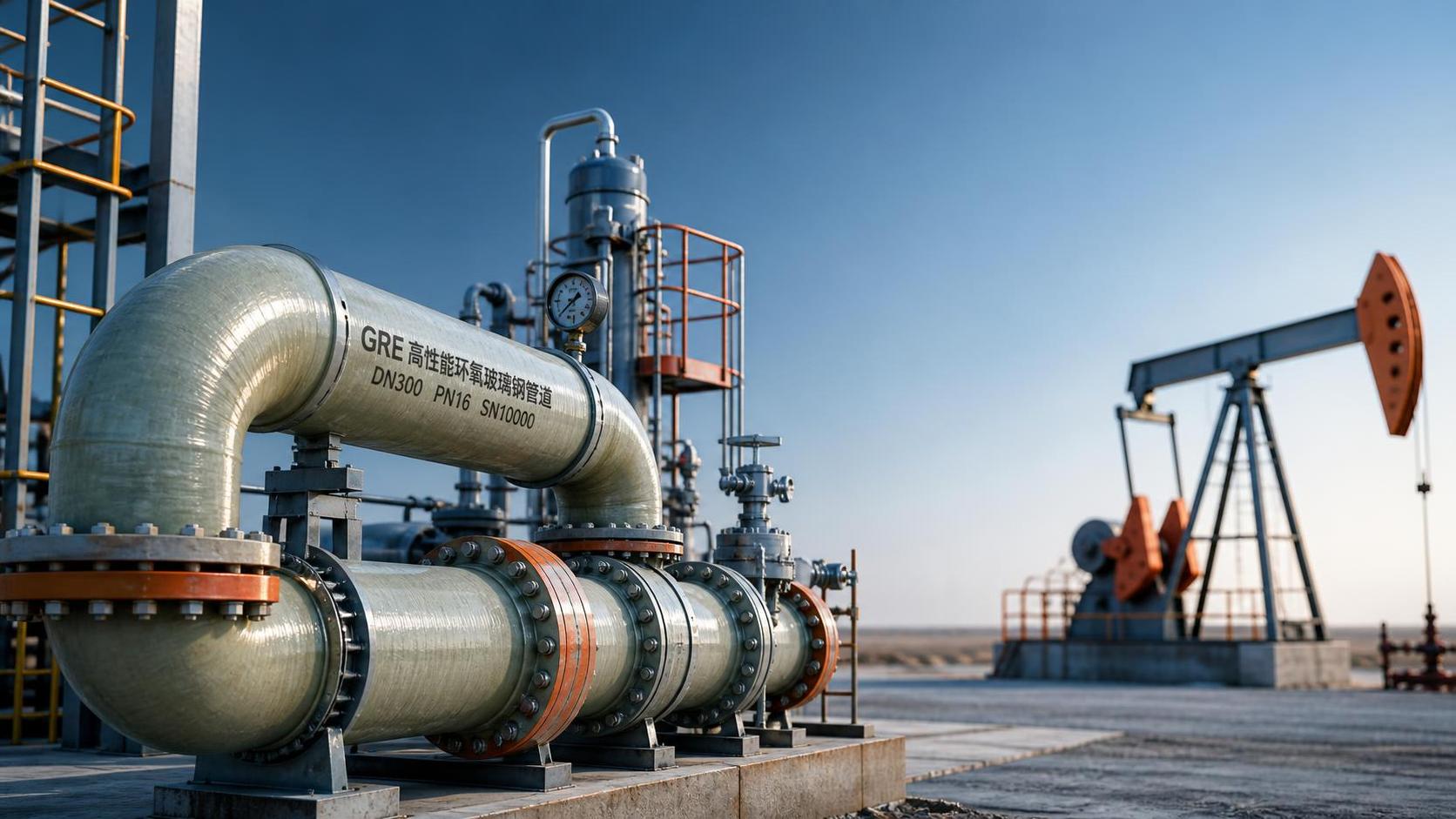
A realistic field-service temperature range for a GRE Pipe in oil-related service is usually narrower than the headline temperature shown in a material brochure. In practice, many systems operate comfortably in moderate conditions, while the upper limit becomes highly service-specific once pressure, chemical exposure, and thermal cycling are considered together. For continuous field operation, a common working view is that GRE Pipe often performs well in low to medium temperature service, but any move toward elevated temperature should be treated as a qualified design condition rather than a generic assumption.
The first distinction that matters is the difference between dry material capability and installed piping capability. A laminate coupon, a short spool in controlled testing, and a full pipeline in the field do not age in the same way. Once the pipe is carrying produced water, multiphase fluid, chemicals, or intermittent hot wash fluids, the resin matrix sees a different environment than it would in a laboratory. That is why a technically realistic temperature range is never set by temperature alone. It is set by temperature at pressure, for a defined fluid, over a defined service life, with a defined joint system.
Where the realistic range usually starts and ends
At the low end, GRE Pipe generally handles typical oilfield ambient and subzero outdoor conditions better than many people expect, provided impact loading during transport and installation is controlled. Low temperature by itself does not usually destroy the laminate; the practical risk is brittleness under handling shock, poor adhesive cure during assembly, and differential contraction at supports, branch connections, or metallic transitions. A line that is safe at low operating temperature may still be vulnerable during winter installation if joint preparation and curing are not aligned with the resin system requirements.
At the upper end, many evaluations become optimistic too early. A GRE Pipe may be described as suitable for elevated temperatures, but that statement only becomes meaningful when tied to one resin family, one pressure basis, and one chemical envelope. In field service, continuous operation in a moderate band is often realistic, while higher intermittent excursions may be acceptable only if the design code, qualification test data, and service fluid compatibility all point in the same direction. Short-duration spikes are not harmless by default. Repeated spikes can accelerate matrix softening, liner degradation, joint movement, and long-term stiffness loss even when no immediate leak is seen.
For oil production systems, gathering lines, produced water handling, utility water, and some injection services, the most defensible temperature assessment usually comes from the pressure-temperature rating curve issued for that exact pipe construction. If the curve drops sharply at higher temperature, that is not a conservative footnote; it is the real operating envelope. A pipe that appears acceptable at one pressure level may no longer be acceptable after a temperature increase, even though the fluid chemistry has not changed.
Why resin system changes the answer
The epoxy matrix is the main reason GRE Pipe can enter services where thermoplastics may struggle, but epoxy is still not a universal answer. Different resin formulations respond differently to heat, aromatic content, sour service components, treatment chemicals, and water absorption. The glass reinforcement carries much of the structural load, yet the resin transfers stress between fibers, protects the reinforcement, and controls resistance to chemical ingress. Once resin properties shift with temperature, the laminate does not fail in a simple on-off manner; it may lose margin gradually through creep, microcracking, or bond deterioration at joints.
That is why a realistic field-service range should always ask whether the service is continuous hot water, produced water with salts, crude with entrained solids, intermittent chemical injection, or gas service with condensate. These media can affect the same temperature rating differently. A line that is acceptable for clean water at a given temperature might require derating for a chemically aggressive stream. In some applications adjacent to Mining operations, solids loading and abrasion can also complicate the picture because internal wear exposes the laminate to a more severe combined mechanical and thermal condition.
Pressure and temperature cannot be separated
One frequent misjudgment is to ask only, “What temperature can this GRE Pipe handle?” The engineering question is, “At what pressure, with what surge profile, and for how long?” GRE systems are sensitive to sustained hoop stress. As temperature rises, allowable stress commonly falls. In real pipelines, operating pressure is rarely steady. Pump starts, valve closures, pigging operations, and sudden flow changes can create transient loads that consume temperature margin very quickly.
This matters especially in water injection and produced water transfer systems, where operators may focus on corrosion resistance and underestimate hydraulic events. A line that appears well inside temperature limits during steady flow may move close to its true limit when surge is included. The problem is sharper at elbows, reducers, dead legs, and poorly guided branch connections, where local stress concentration adds to the nominal hoop stress.
Field evaluation should also separate internal pressure from external restraint. Buried GRE Pipe, aboveground pipe on steel supports, and offshore utility systems expand and contract differently. Thermal expansion loads are modest compared with steel in some cases, but restraint can still produce unwanted loads at flanges, equipment nozzles, and anchors. When the design basis ignores support friction or anchor stiffness, the pipe may be thermally acceptable in theory and mechanically overstressed in service.
Joints often define the real limit
Many temperature discussions focus on the pipe barrel, even though the joint can be the first location to lose reliability. Adhesive-bonded joints depend on surface preparation, gap control, cure quality, and environmental conditions during assembly. Laminated joints require disciplined workmanship and cure management. Mechanical couplings and flanged connections introduce seals, bolts, and local restraint effects that may have their own temperature sensitivity.
For that reason, the realistic upper service temperature of a GRE Pipe system may be lower than the laminate capability advertised for straight pipe. If a line includes frequent dismantling, vibration, or repeated thermal swings, gasket relaxation, adhesive aging, or local peel stress can govern system life before the pipe wall itself becomes the weak point. Any temperature review that accepts the pipe body rating without checking the joint qualification basis is incomplete.
Installation temperature also matters. An adhesive joint assembled outside its recommended temperature window can carry a hidden defect into service. The line may pass an initial hydrotest yet develop leakage months later when temperature cycles begin to work on a partially cured bond line. This is one of the reasons field failures are sometimes misread as a material problem when the root cause is actually a construction-quality issue exposed by heat.
Thermal cycling is often more damaging than steady heat
A GRE Pipe in stable thermal service can behave predictably if the design envelope is appropriate. Repeated heating and cooling is harder on the system. Cyclic expansion and contraction affect the resin, the glass-resin interface, the joint, and the supports at the same time. When the fluid temperature swings between shutdown and operation, or between normal flow and cleaning cycles, the accumulated damage mechanism may be more relevant than the maximum recorded temperature.
Steam cleaning, hot flushing, or occasional process upsets deserve special scrutiny. Even when these events are short, they can create through-wall thermal gradients and local strain at restraints. If the line also contains trapped liquid pockets, rapid temperature change may generate pressure effects that were not included in ordinary design conditions. A field-service temperature range should therefore distinguish continuous operation, occasional upset, commissioning, hydrotest, and maintenance exposure. Treating them as one single number hides real risk.
Chemistry can lower the practical temperature limit
In oil service, the chemical side of the evaluation is rarely simple. Produced water may contain chlorides, dissolved gases, treatment residuals, and suspended solids. Crude service may include aromatics or other components that affect liners and resin differently from water service. Caustic or acidic cleaning agents can create compatibility concerns at temperatures where the base fluid alone would be acceptable.
This is why a realistic assessment should ask for chemical compatibility data tied to temperature bands, not a broad statement that the pipe is “chemical resistant.” Some incompatibilities appear first as a gradual increase in permeation, blistering, softening, or bond loss rather than immediate rupture. By the time visible symptoms appear on the outside surface, the laminate may already have lost part of its design reserve.
Common evaluation mistakes
- Using a peak temperature from a datasheet as though it were a continuous operating limit.
- Assuming field hydrotest success confirms long-term thermal suitability.
- Ignoring upset conditions such as hot flushing, deadheaded pumps, or tracing-related overheating.
- Reviewing barrel properties while leaving joint type, gasket material, and flange load out of the temperature assessment.
- Taking a pressure class at ambient conditions and mentally carrying it upward without derating.
Another recurring mistake is failing to distinguish external environment from process temperature. In desert, hot plant, or enclosed skid locations, solar gain and poor ventilation can raise pipe wall temperature above the bulk fluid temperature. The opposite can happen in cold climates where a warm process line is shut down and rapidly exposed to low ambient conditions, producing contraction loads and seal movement that were absent during operation.
What usually belongs in a defensible temperature review
A sound review typically starts with the exact pipe specification: diameter, pressure class, wall construction, resin system, liner details, and joint method. Then the service profile needs to be stated in operational terms: normal temperature, maximum continuous temperature, upset temperature, expected cycle frequency, fluid composition, solids content, and likely cleaning chemicals. Support spacing, anchor arrangement, branch details, and any transition to steel should sit in the same review package, because thermal acceptability is often lost at system interfaces rather than in the straight run.
Procurement documents sometimes compress this into a single line item such as “GRE Pipe suitable for high-temperature produced water.” That wording is too broad to be technically reliable. The realistic approach is to request the supplier’s pressure-temperature basis, chemical compatibility confirmation for the named fluid family, and joint qualification details for the intended installation method. If these documents rely on assumptions that do not match field operation, the apparent temperature range is already overstated.
Transport and storage conditions should not be dismissed either. Prolonged outdoor exposure before installation, poor end protection, stacking damage, or contamination of bonding surfaces can reduce confidence in the same system that looked fully adequate on paper. Temperature capability in service begins with laminate and joint quality as delivered to site.
In many oilfield applications, the most credible answer is therefore a range, not a single number: low and moderate temperatures are commonly realistic for continuous service, while higher temperatures may be viable only under controlled pressure, compatible chemistry, qualified joints, and limited cycling. Once those conditions are not well defined, the safe position is to narrow the claimed range rather than broaden it.
Please give us a message
产品介绍产品介绍产品介绍产品介绍产品介绍产品介绍产品介绍产品介绍产品介绍产品介绍产品介绍产品介绍产品介绍产品介绍产品介绍产品介绍产品介绍产品介绍产品介绍产品介绍产品介绍产品介绍产品介绍产品介绍产品介绍产品介绍产品介绍产品介绍产品介绍产品介绍
Please give us a message
产品介绍产品介绍产品介绍产品介绍产品介绍产品介绍产品介绍产品介绍产品介绍产品介绍产品介绍产品介绍产品介绍产品介绍产品介绍产品介绍产品介绍产品介绍产品介绍产品介绍产品介绍产品介绍产品介绍产品介绍产品介绍产品介绍产品介绍产品介绍产品介绍产品介绍
Please give us a message
产品介绍产品介绍产品介绍产品介绍产品介绍产品介绍产品介绍产品介绍产品介绍产品介绍产品介绍产品介绍产品介绍产品介绍产品介绍产品介绍产品介绍产品介绍产品介绍产品介绍产品介绍产品介绍产品介绍产品介绍产品介绍产品介绍产品介绍产品介绍产品介绍产品介绍
Please give us a message
产品介绍产品介绍产品介绍产品介绍产品介绍产品介绍产品介绍产品介绍产品介绍产品介绍产品介绍产品介绍产品介绍产品介绍产品介绍产品介绍产品介绍产品介绍产品介绍产品介绍产品介绍产品介绍产品介绍产品介绍产品介绍产品介绍产品介绍产品介绍产品介绍产品介绍