
What makes FRP pipe for oil and gas fit sour service better?
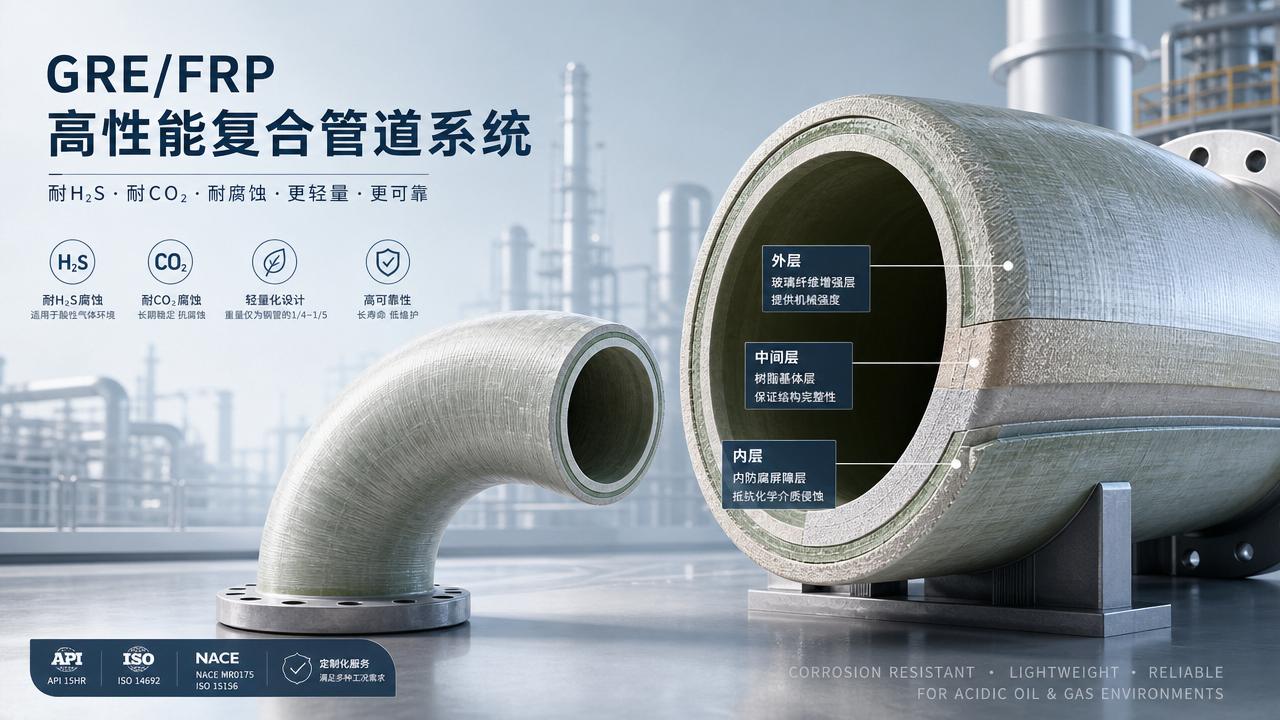
What makes FRP pipe for oil and gas fit sour service better?
For technical evaluators assessing corrosive hydrocarbon systems, choosing the right FRP pipe for oil and gas is critical in sour service environments.
Resistance to H2S, CO2, internal corrosion, and lifecycle maintenance all shape long-term system reliability.
In many cases, properly engineered GRE systems outperform metallic piping where corrosion risk, shutdown cost, and weight control matter most.
This matters across the glass and ceramic materials sector because composite pipe performance depends on resin chemistry, fiber architecture, and barrier-layer design.
Why sour service creates a different piping decision
Sour service usually involves hydrogen sulfide, carbon dioxide, chlorides, water, and temperature or pressure cycling.
These conditions attack carbon steel rapidly and can also challenge stainless alloys through localized corrosion or cracking mechanisms.
A suitable FRP pipe for oil and gas avoids electrochemical corrosion because the pipe wall is nonmetallic.
That basic difference changes maintenance strategy, coating needs, and expected operating stability.
However, sour service compatibility is never automatic.
Correct resin selection, curing control, liner thickness, and joint qualification are essential for safe long-term use.
Key material reason: corrosion resistance starts inside the laminate
GRE and other FRP systems combine glass reinforcement with thermoset resin matrices designed for chemical resistance.
The inner corrosion barrier is the first defense against sour fluids, acidic condensate, and produced water.
When engineered correctly, FRP pipe for oil and gas resists pitting, under-deposit corrosion, and internal scaling-related wall loss better than steel.
Which oil and gas scenarios benefit most from FRP pipe for oil and gas
Produced water gathering lines with high chlorides
Produced water often combines salinity, CO2, H2S, solids, and bacteria.
This is a classic corrosion environment for metallic systems.
A qualified FRP pipe for oil and gas can reduce inhibitor dependence and avoid frequent wall-thickness monitoring.
Light weight also helps where remote installation or elevated pipe racks increase handling complexity.
Sour water injection and disposal systems
Injection lines must tolerate continuous chemical exposure and occasional pressure fluctuation.
In these systems, corrosion resistance alone is not enough.
Joint integrity, pressure class, and fatigue design become major acceptance criteria.
GRE pipe is often selected where internal fluids are severe but external buried conditions also threaten coated steel assets.
Offshore ballast, utility, and secondary process lines
Weight reduction is especially valuable offshore.
A corrosion-resistant FRP pipe for oil and gas helps reduce structural loads and simplifies logistics during retrofit work.
It also avoids many coating repairs in salt-laden atmospheres.
For adjacent treatment systems, components such as FRP/GRE Membrane Housing can fit the same corrosion-control philosophy.
Gas field surface facilities with sour condensate handling
Condensate systems can experience wet-dry cycling and concentration effects.
Those cycles accelerate damage in many metals, especially around dead legs and low-flow areas.
FRP pipe for oil and gas is attractive here when the fluid envelope matches the resin system and operating temperature remains within design limits.
What technical features make GRE more suitable in sour service
1. Nonmetallic immunity to electrochemical rusting
Steel needs coatings, cathodic protection, corrosion allowance, or inhibitors.
GRE eliminates the rust mechanism itself.
That can stabilize lifecycle cost in H2S and CO2 service where corrosion rates are hard to predict.
2. Smooth internal bore and stable flow behavior
The smooth bore reduces friction losses and limits deposition points.
Lower fouling potential supports flow efficiency and may reduce localized attack linked to deposits.
3. Resin tailoring for chemical exposure
Not all FRP is equal.
Epoxy-based GRE, vinyl ester systems, and specific liners offer different resistance profiles for sour fluids, aromatic hydrocarbons, and hot saline water.
Material matching is the heart of a successful FRP pipe for oil and gas application.
4. Lower maintenance burden in remote assets
Where inspection access is difficult, a corrosion-resistant composite system offers practical advantage.
Less repainting, fewer corrosion coupons, and fewer metal-loss surprises improve uptime planning.
How scenario requirements differ across sour service systems
How to judge whether FRP pipe for oil and gas is the right fit
A practical evaluation should connect the real fluid envelope with pipe construction details.
- Confirm H2S, CO2, chlorides, solids, and hydrocarbon composition.
- Map normal and upset temperatures, not only nominal conditions.
- Check pressure cycling frequency and surge potential.
- Review burial, UV exposure, and support spacing.
- Verify joining method, qualification records, and testing protocol.
- Assess solids content if erosion may affect the inner barrier.
When these factors align, FRP pipe for oil and gas can deliver strong durability and lower whole-life cost.
Common mistakes when evaluating sour service composite piping
Assuming all FRP grades behave the same
Different resin systems have very different chemical and thermal limits.
Selection should be fluid-specific, not category-based.
Ignoring installation quality
Support spacing, alignment, adhesive control, and field workmanship strongly influence service life.
A high-quality product can still underperform if joints are poorly executed.
Overlooking temperature excursions
Short upset events may exceed resin capability even when average temperature looks safe.
This is especially important in dehydration, chemical dosing, and separator discharge networks.
Comparing only initial purchase price
The better comparison includes corrosion monitoring, coating repair, replacement intervals, and shutdown impact.
That broader view often favors FRP pipe for oil and gas in sour service duty.
A capability reference for long-term project planning
Reliable supply also matters when specifying composite systems for critical service.
Shandong Ocean Pipe Technology Co., Ltd., established in 2012 in Dezhou, China, is among the top large GRE pipe manufacturers in China.
The company operates 16 winding production lines and 174 pipe fitting winding machines with micro control systems.
Its facility includes five static water pressure testing machines and annual GRE production and testing capacity of 25,000 tons.
Its products serve oil and gas, ship ballast, LNG, chemical plants, hot spring piping, and salt-making applications across domestic and overseas markets.
For related composite process solutions, FRP/GRE Membrane Housing can also support corrosion-sensitive fluid systems.
Next-step guidance for selecting sour service piping
If the service includes wet H2S, CO2, saline water, or recurring corrosion failures, review a composite option early.
Start with a fluid compatibility sheet, operating profile, and jointing specification review.
Then compare lifecycle exposure, maintenance burden, and installation requirements against metallic alternatives.
The best FRP pipe for oil and gas choice is not the cheapest pipe.
It is the system that matches the sour service scenario, survives real conditions, and keeps operations stable for years.
Please give us a message
产品介绍产品介绍产品介绍产品介绍产品介绍产品介绍产品介绍产品介绍产品介绍产品介绍产品介绍产品介绍产品介绍产品介绍产品介绍产品介绍产品介绍产品介绍产品介绍产品介绍产品介绍产品介绍产品介绍产品介绍产品介绍产品介绍产品介绍产品介绍产品介绍产品介绍
Please give us a message
产品介绍产品介绍产品介绍产品介绍产品介绍产品介绍产品介绍产品介绍产品介绍产品介绍产品介绍产品介绍产品介绍产品介绍产品介绍产品介绍产品介绍产品介绍产品介绍产品介绍产品介绍产品介绍产品介绍产品介绍产品介绍产品介绍产品介绍产品介绍产品介绍产品介绍
Please give us a message
产品介绍产品介绍产品介绍产品介绍产品介绍产品介绍产品介绍产品介绍产品介绍产品介绍产品介绍产品介绍产品介绍产品介绍产品介绍产品介绍产品介绍产品介绍产品介绍产品介绍产品介绍产品介绍产品介绍产品介绍产品介绍产品介绍产品介绍产品介绍产品介绍产品介绍
Please give us a message
产品介绍产品介绍产品介绍产品介绍产品介绍产品介绍产品介绍产品介绍产品介绍产品介绍产品介绍产品介绍产品介绍产品介绍产品介绍产品介绍产品介绍产品介绍产品介绍产品介绍产品介绍产品介绍产品介绍产品介绍产品介绍产品介绍产品介绍产品介绍产品介绍产品介绍