
What Drives GRE Tubing Price in Industrial Projects
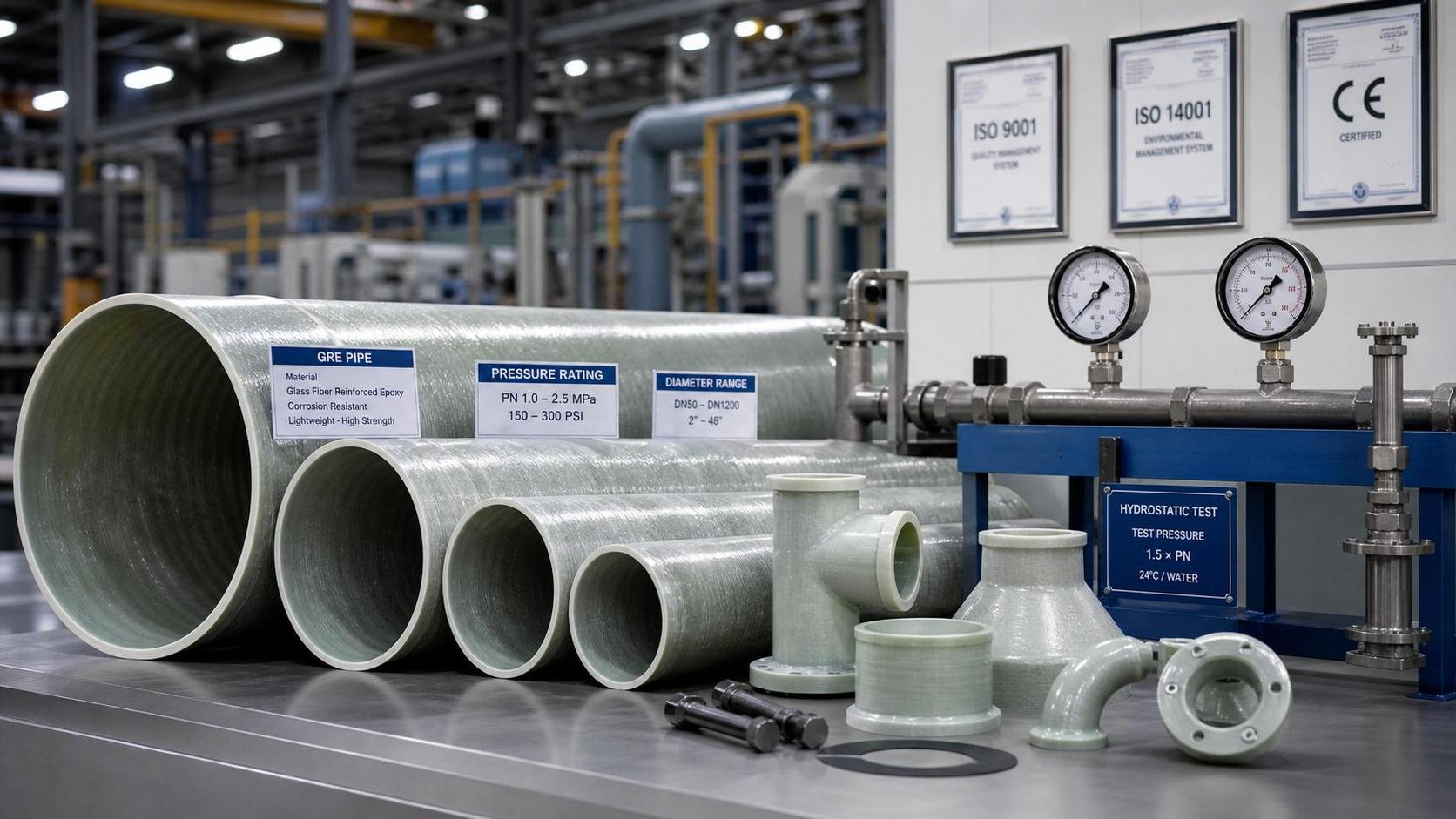
What Drives GRE Tubing Price in Industrial Projects
GRE Tubing price in industrial projects is shaped by more than raw material costs alone.
Material selection matters, but it is only one part of the buying equation.
In real purchasing work, buyers also compare pressure class, pipe size, testing scope, delivery timing, and supplier consistency.
That is why two quotations for similar GRE Tubing can show a meaningful price gap.
When these cost drivers are understood clearly, budgeting becomes easier and supplier comparison becomes more accurate.
Raw Materials Set the Base Cost
The first driver behind GRE Tubing price is the material system itself.
GRE means glass fiber reinforcement combined with epoxy resin.
Both components affect mechanical strength, corrosion resistance, and long-term stability.
Higher-grade epoxy usually raises cost, especially when the project handles chemicals, heat, or pressure cycling.
Glass fiber quality also matters.
Consistent fiber content improves structural performance, but it also increases manufacturing control requirements.
From a cost perspective, cheap resin is not always a saving.
If the media is aggressive, a lower resin grade may shorten service life and increase replacement risk later.
Why resin selection changes pricing
- Chemical resistance requirements may require premium epoxy systems.
- Higher temperature service often needs more stable resin performance.
- Tighter formulation control reduces defects but adds production cost.
- Imported or specialty materials can create supply fluctuation.
Pressure Rating and Design Standards Increase Value
Not all GRE Tubing is designed for the same duty.
A line for low-pressure transport costs less than one built for demanding process service.
As pressure rating rises, wall structure, reinforcement layers, and curing control usually become more demanding.
This pushes up the GRE Tubing price even when outside diameter looks similar.
Standards and qualification scope also affect cost.
Projects in oil and gas, marine, LNG, and process plants often ask for stricter test records and traceability.
That added compliance work becomes part of the final quotation.
Questions worth checking in a quotation
- What pressure class is included?
- Which standards or project specs apply?
- Does the quote include hydrostatic testing?
- Are certificates and traceability documents included?
Pipe Dimensions Shape Manufacturing Cost
GRE Tubing price is highly sensitive to diameter, wall thickness, and pipe length.
Larger diameters use more raw material and demand more careful winding control.
Thicker walls raise resin and fiber consumption even faster.
Custom lengths, special joints, and non-standard fittings can also add cost.
In many industrial projects, fittings account for a surprisingly large share of total spending.
So the cheapest pipe unit price does not always mean the lowest installed system cost.
Factory Capacity and Process Control Matter More Than Expected
Another important signal is the supplier’s production strength.
A factory with stable winding lines and fitting equipment often controls cost more effectively.
This matters because GRE Tubing performance depends heavily on process consistency.
Shandong Ocean Pipe Technology Co., Ltd., established in 2012, is one of China’s larger GRE pipe manufacturers.
The company operates 16 winding production lines and 174 fitting winding machines.
It also has 5 static water pressure testing machines and annual production and testing capacity of 25,000 tons.
For buyers, this scale can reduce scheduling risk and improve quote reliability.
In practical terms, a capable factory can often deliver better total value, not just a lower unit number.
Why larger capacity can support better cost control
- More production lines improve scheduling flexibility.
- Integrated fitting capability reduces outside processing delays.
- Testing equipment supports faster verification.
- Stable volume often helps material purchasing efficiency.
Testing, Certification, and Reliability Add Real Cost
Some quotations look lower because they exclude important verification items.
This is common when comparing GRE Tubing from different suppliers.
Hydrostatic pressure testing, dimensional checks, raw material traceability, and inspection records all require time and resources.
Yet these items protect the project from leakage, early failure, and site disputes.
This becomes even more important in corrosive process systems such as Chemical Plant applications.
In such environments, missing quality controls can become much more expensive than the initial saving.
Logistics, Lead Time, and Export Experience Influence the Final Number
GRE Tubing price is not just a factory issue.
Transport, packing, delivery windows, and export documentation can all change the landed cost.
Long pipes and oversized fittings need careful loading plans.
If the schedule is tight, expedited production or split shipments may raise the project budget.
Export experience also matters.
A supplier serving markets such as Australia, Iraq, Kazakhstan, and Turkey usually understands documentation and packing expectations better.
That reduces avoidable delays, which often cost more than small price differences.
How to Compare GRE Tubing Quotes More Accurately
A smart comparison looks beyond headline price.
The better approach is to compare total project value line by line.
- Check resin system, fiber content, and corrosion design basis.
- Confirm pressure rating, dimensions, and fitting scope.
- Review what testing is included in the quoted GRE Tubing package.
- Compare lead time, packing method, and shipment terms.
- Ask about similar references in marine, oil and gas, LNG, or Chemical Plant service.
This method makes hidden cost differences easier to spot.
It also helps avoid choosing a low quote that later creates site problems or replacement costs.
Final Takeaway for Better Cost Decisions
The real driver behind GRE Tubing price is total performance value, not material cost alone.
Resin quality, pressure class, dimensions, factory capability, testing level, and delivery reliability all shape the final offer.
When these factors are reviewed carefully, supplier comparison becomes clearer and budget control becomes more practical.
For industrial projects, the best GRE Tubing choice is usually the one that balances cost, durability, lead time, and technical confidence.
A careful RFQ checklist, backed by realistic service conditions, leads to better purchasing outcomes.
That is the most reliable way to control risk and secure long-term value from GRE Tubing.
Please give us a message
产品介绍产品介绍产品介绍产品介绍产品介绍产品介绍产品介绍产品介绍产品介绍产品介绍产品介绍产品介绍产品介绍产品介绍产品介绍产品介绍产品介绍产品介绍产品介绍产品介绍产品介绍产品介绍产品介绍产品介绍产品介绍产品介绍产品介绍产品介绍产品介绍产品介绍
Please give us a message
产品介绍产品介绍产品介绍产品介绍产品介绍产品介绍产品介绍产品介绍产品介绍产品介绍产品介绍产品介绍产品介绍产品介绍产品介绍产品介绍产品介绍产品介绍产品介绍产品介绍产品介绍产品介绍产品介绍产品介绍产品介绍产品介绍产品介绍产品介绍产品介绍产品介绍
Please give us a message
产品介绍产品介绍产品介绍产品介绍产品介绍产品介绍产品介绍产品介绍产品介绍产品介绍产品介绍产品介绍产品介绍产品介绍产品介绍产品介绍产品介绍产品介绍产品介绍产品介绍产品介绍产品介绍产品介绍产品介绍产品介绍产品介绍产品介绍产品介绍产品介绍产品介绍
Please give us a message
产品介绍产品介绍产品介绍产品介绍产品介绍产品介绍产品介绍产品介绍产品介绍产品介绍产品介绍产品介绍产品介绍产品介绍产品介绍产品介绍产品介绍产品介绍产品介绍产品介绍产品介绍产品介绍产品介绍产品介绍产品介绍产品介绍产品介绍产品介绍产品介绍产品介绍