
GRE Tubing vs Thermoplastic Tubing: Key Trade-Offs
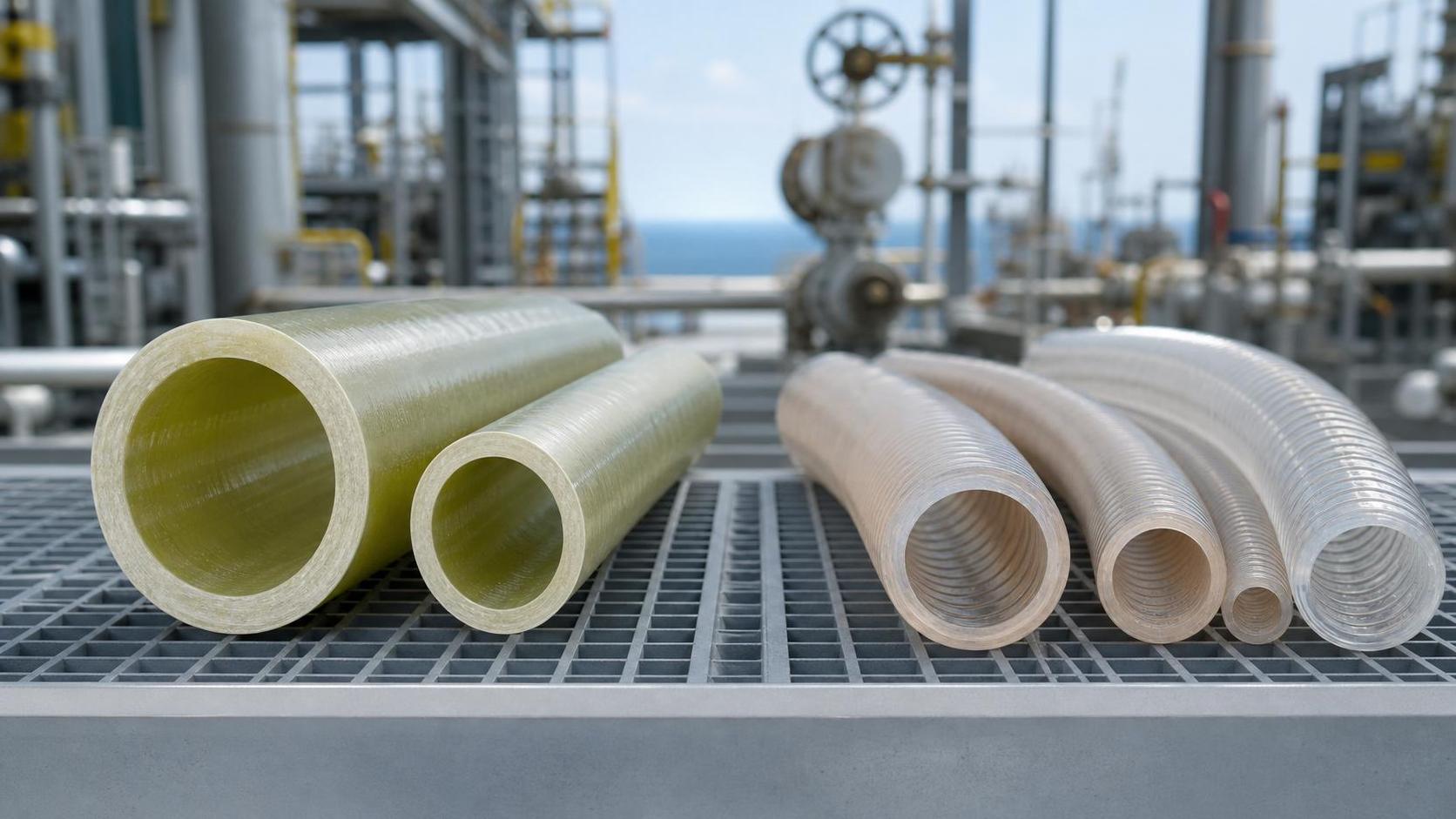
GRE Tubing vs Thermoplastic Tubing: Key Trade-Offs
When evaluating fluid transfer solutions, choosing between GRE Tubing and thermoplastic tubing means balancing corrosion resistance, pressure performance, lifecycle cost, and application fit.
For oil and gas, marine, LNG, and chemical projects, that choice affects reliability, shutdown risk, and long-term operating cost.
At first glance, both options look attractive because both resist corrosion better than many metal systems.
The real difference appears when you compare pressure rating, temperature stability, structural behavior, installation conditions, and service life expectations.
Why This Comparison Matters
In actual project reviews, tubing selection is rarely only about material price.
A lower upfront cost can become expensive if replacement cycles are short or downtime is frequent.
That is why GRE Tubing often enters serious discussions for demanding process environments.
Thermoplastic tubing, however, still has clear strengths in flexible routing, lightweight handling, and fast installation.
The best decision depends on where the line runs, what media it carries, and how failure would affect operations.
What GRE Tubing Offers
GRE Tubing is made from glass fiber reinforcement and epoxy resin.
This structure gives it strong mechanical performance with excellent resistance to corrosion and chemical attack.
Compared with many plastic-based tubing products, it usually performs better under sustained pressure and elevated temperatures.
It also keeps dimensional stability in systems where pressure fluctuation is part of daily operation.
For seawater, produced water, corrosive chemicals, and ballast applications, GRE Tubing is often chosen for durability rather than convenience alone.
Where Thermoplastic Tubing Stands Out
Thermoplastic tubing is valued for flexibility, easy cutting, and simplified field assembly.
It can work well in lower-pressure services, utility lines, and installations with frequent routing changes.
Its lighter weight can reduce labor time, especially in compact skids or temporary systems.
For non-critical duties, this can create a compelling total installed cost.
Still, flexibility is not always an advantage when structural rigidity and long-term pressure retention matter most.
Side-by-Side Trade-Offs
This comparison shows why selection should follow service conditions, not assumptions.
If the line is business-critical, the stronger engineering margin of GRE Tubing can justify a higher initial spend.
Pressure and Temperature Performance
Pressure and temperature usually drive the most important technical trade-off.
GRE Tubing is generally favored when systems face continuous pressure loading, surge events, or hotter operating windows.
Thermoplastic tubing may soften, creep, or lose performance margins faster under these conditions.
That does not mean thermoplastic is weak.
It means its ideal operating envelope is narrower and must be checked more carefully.
For decision-making, pressure cycling data matters more than brochure claims.
Corrosion and Chemical Resistance
Both materials are selected partly to avoid metal corrosion problems.
Even so, the corrosion story is not identical.
GRE Tubing has a strong reputation in saline water, aggressive process fluids, and offshore environments.
Its composite structure is especially useful where external corrosion and internal chemical exposure happen at the same time.
Thermoplastic tubing can also resist many chemicals well, but compatibility depends heavily on polymer grade.
So the smarter approach is always media-specific evaluation, not broad material labels.
Installation, Handling, and Project Schedule
From a schedule viewpoint, thermoplastic tubing often moves faster in the field.
It is easier to route through tight layouts and can reduce fitting complexity.
GRE Tubing needs more structured installation planning, especially for supports, jointing, and alignment control.
That extra planning, however, often supports longer service stability.
For permanent industrial systems, slower installation can still be the better commercial decision.
In sectors like mining, dewatering, and slurry-related support systems, project teams sometimes review adjacent composite solutions like Mining to compare durability priorities across applications.
Lifecycle Cost vs Purchase Price
This is where many decisions either improve or backfire.
Thermoplastic tubing may win on purchase price and installation speed.
GRE Tubing often wins on service life, lower maintenance frequency, and reduced replacement risk.
If failure triggers shutdowns, spills, safety exposure, or logistics delays, the cost picture changes quickly.
That is especially true in offshore platforms, LNG terminals, and chemical plants.
A simple total cost model should include material price, installation labor, inspection cycles, repair probability, and lost production impact.
How to Make the Right Selection
A practical evaluation process keeps the choice clear and defendable.
- Define actual media, temperature range, and pressure profile.
- Check whether the line is critical, secondary, or temporary.
- Review installation constraints, support spacing, and available labor skills.
- Estimate maintenance frequency and likely failure consequences.
- Compare full lifecycle cost, not only procurement numbers.
Using this method, GRE Tubing usually scores better in corrosive, high-value, and long-service infrastructure.
Thermoplastic tubing usually scores better in flexible, lighter-duty, or budget-sensitive installations.
Supplier Capability Also Matters
Material choice is only part of the outcome.
Manufacturing scale, quality control, and test capacity matter just as much.
Shandong Ocean Pipe Technology Co., Ltd., established in 2012 in Shandong, China, is one of China’s top ten large manufacturers of Fiberglass Reinforced Epoxy pipe.
With 16 winding production lines, 174 pipe fitting winding machines, and static water pressure testing equipment, the company supports large-volume and quality-focused GRE production.
Its products serve oil and gas, ship ballast piping, LNG, chemical plants, hot spring piping, and salt-making operations.
That kind of project exposure is valuable when evaluating GRE Tubing for mission-critical applications.
Final Decision Guidance
If the system needs flexibility, quick routing, and moderate service performance, thermoplastic tubing may be the more efficient answer.
If the system faces corrosion, pressure stress, longer operating life, and higher failure cost, GRE Tubing is often the safer investment.
The smartest selection is not about which material is universally better.
It is about which material fits the service envelope with the least long-term risk.
For many industrial projects, that is exactly why GRE Tubing remains a strong option in strategic evaluations.
Start with operating conditions, map total lifecycle cost, verify supplier capability, and the right tubing choice becomes much easier to defend.
Please give us a message
产品介绍产品介绍产品介绍产品介绍产品介绍产品介绍产品介绍产品介绍产品介绍产品介绍产品介绍产品介绍产品介绍产品介绍产品介绍产品介绍产品介绍产品介绍产品介绍产品介绍产品介绍产品介绍产品介绍产品介绍产品介绍产品介绍产品介绍产品介绍产品介绍产品介绍
Please give us a message
产品介绍产品介绍产品介绍产品介绍产品介绍产品介绍产品介绍产品介绍产品介绍产品介绍产品介绍产品介绍产品介绍产品介绍产品介绍产品介绍产品介绍产品介绍产品介绍产品介绍产品介绍产品介绍产品介绍产品介绍产品介绍产品介绍产品介绍产品介绍产品介绍产品介绍
Please give us a message
产品介绍产品介绍产品介绍产品介绍产品介绍产品介绍产品介绍产品介绍产品介绍产品介绍产品介绍产品介绍产品介绍产品介绍产品介绍产品介绍产品介绍产品介绍产品介绍产品介绍产品介绍产品介绍产品介绍产品介绍产品介绍产品介绍产品介绍产品介绍产品介绍产品介绍
Please give us a message
产品介绍产品介绍产品介绍产品介绍产品介绍产品介绍产品介绍产品介绍产品介绍产品介绍产品介绍产品介绍产品介绍产品介绍产品介绍产品介绍产品介绍产品介绍产品介绍产品介绍产品介绍产品介绍产品介绍产品介绍产品介绍产品介绍产品介绍产品介绍产品介绍产品介绍