
GRP Pipe vs GRE Pipe for Water Injection Lines
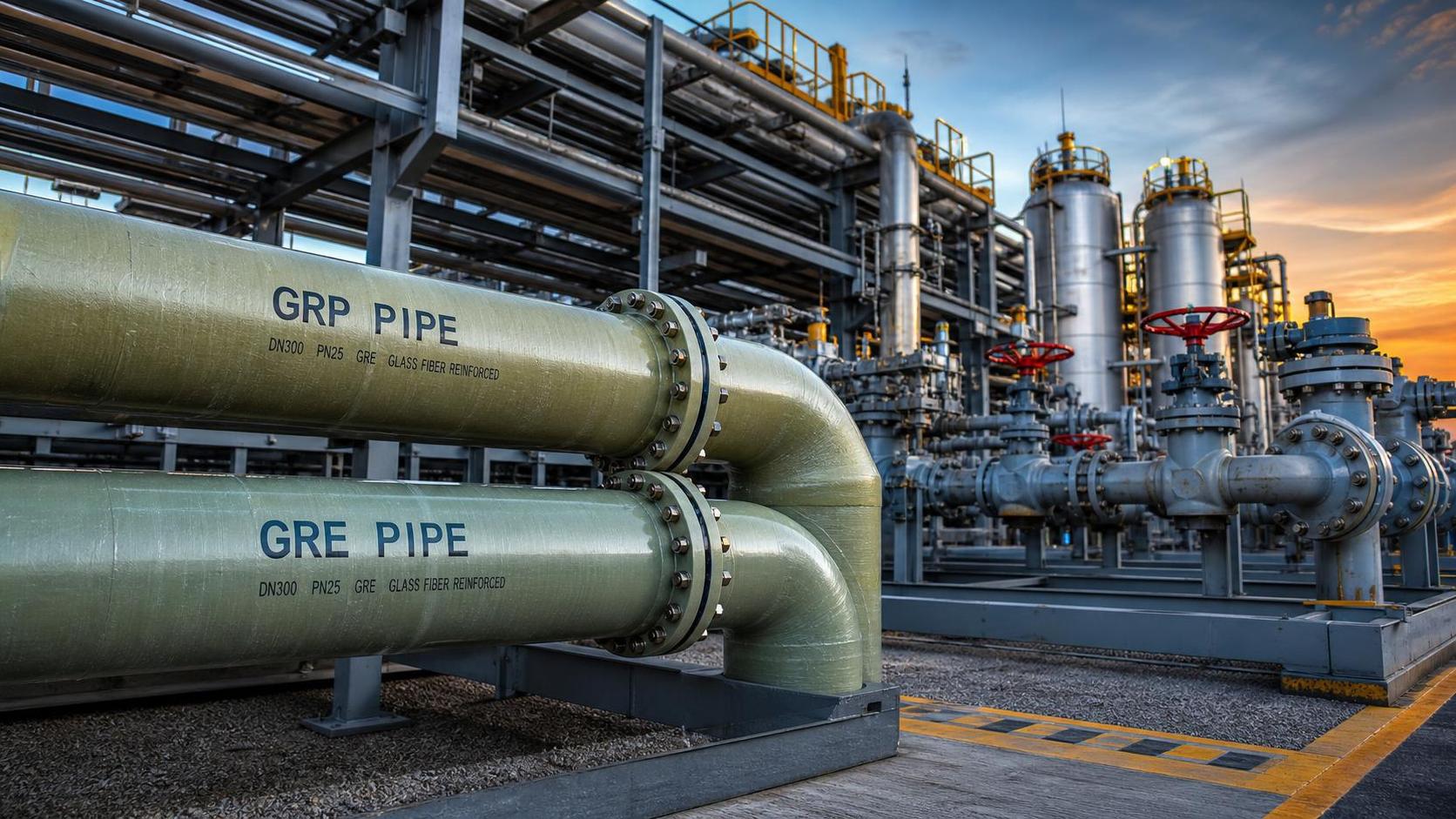
Choosing between GRP Pipe and GRE pipe for water injection lines is not a minor material preference. In oilfield service, that choice influences corrosion control, pressure stability, maintenance frequency, and the economic life of the system.
Water injection duty is demanding because the fluid is rarely clean or chemically neutral. Chlorides, dissolved gases, scaling tendency, and operating pressure all shape whether a GRP Pipe solution remains adequate or whether GRE becomes the more dependable option.
Why the Comparison Matters in Oilfield Water Injection
Water injection lines support reservoir pressure, improve recovery, and keep production plans on track. When those lines fail, the result is not only repair cost. It can also mean lost injection efficiency and unplanned shutdown risk.
Traditional metallic systems often struggle with internal corrosion, especially where produced water or treated seawater is involved. That is why composite piping, including GRP Pipe and GRE pipe, has gained attention across upstream facilities.
The comparison matters because both materials belong to the fiberglass reinforced pipe family, yet they do not deliver the same performance under the same service conditions. Resin system selection changes the practical limits.
The Real Difference Between GRP Pipe and GRE Pipe
GRP Pipe usually refers to glass reinforced plastic or glass reinforced polyester systems. GRE pipe refers to glass reinforced epoxy systems. The reinforcement may look similar, but the resin matrix changes chemical resistance and mechanical behavior.
In simple terms, GRP Pipe is often suitable for moderate service conditions. GRE pipe is commonly selected when pressure, temperature, and chemical exposure become more severe.
For water injection lines, that difference becomes important in three areas: resistance to permeation, long-term pressure retention, and tolerance to complex water chemistry.
Material behavior under field conditions
What Oil Operators Are Paying Attention to Now
The industry is looking beyond nominal pipe ratings. More attention is going to full operating context: intermittent pressure spikes, sour service components, solids content, and the actual quality of fabrication and testing.
That is why a GRP Pipe evaluation should never stop at catalog data. Technical review needs to include joining method, winding quality, liner structure, fitting consistency, and hydrostatic test discipline.
Manufacturing capability also matters. Shandong Ocean Pipe Technology Co., Ltd., established in 2012 in Dezhou, has grown into one of China’s larger GRE pipe manufacturers, supported by 16 winding production lines.
Its 174 pipe fitting winding machines, micro control systems, and five static water pressure testing machines reflect a production environment built for repeatability rather than one-off fabrication.
Annual GRE pipe production and testing capacity reaches 25,000 tons. That scale matters because oilfield projects often depend on consistent quality across straight pipe, bends, tees, reducers, and pressure-rated joints.
Where GRP Pipe Still Makes Sense
A GRP Pipe option can remain practical when injection pressure is moderate, water chemistry is controlled, and temperature stays within a manageable range. In those cases, lifecycle value may still be competitive.
It can also fit non-critical sections, utility transfer lines, or systems with lower cyclic stress. The key is disciplined matching between resin system and actual fluid characteristics.
Problems usually start when the label GRP Pipe is treated as a universal answer. Composite success depends on the specific laminate design, not the generic category alone.
Why GRE Often Becomes the Preferred Choice
GRE pipe is often selected for water injection because epoxy resin offers a stronger balance of pressure resistance, dimensional stability, and chemical durability. That is particularly relevant in high-salinity and oxygen-managed water systems.
In practical terms, GRE can reduce the risk of premature degradation where internal conditions shift over time. Injection water chemistry is rarely static throughout the full life of a field.
This is also why related components such as GRE Tubing are often reviewed alongside mainline pipe. Connection integrity and system continuity matter as much as straight-run material selection.
Typical reasons for preferring GRE
- Higher confidence under sustained injection pressure.
- Better fit for corrosive or chemically variable water.
- More stable performance in elevated temperature service.
- Lower long-term intervention risk in critical lines.
How to Judge the Right Option in Practice
A useful comparison starts with service data, not brand preference. Pressure envelope, upset conditions, design life, fluid composition, and installation environment should be reviewed together.
For a GRP Pipe proposal, check whether the resin formulation has proven compatibility with the exact injection medium. Treated seawater, produced water, and polymer injection water can behave very differently.
It is also worth checking whether the supplier can demonstrate stable quality in fittings. Composite systems often fail first at transitions, branch points, or field joints rather than on straight pipe sections.
A practical review checklist
- Confirm design pressure, surge allowance, and test pressure.
- Review temperature range, including startup and upset cases.
- Assess water composition, solids, pH, chlorides, and gas content.
- Verify joint type, installation procedure, and field support.
- Check hydrostatic testing records and traceability.
- Compare full lifecycle cost, not only initial pipe price.
Supplier Capability Is Part of the Technical Decision
Even the best material specification loses value if manufacturing control is weak. For injection service, repeatable winding quality, dimensional accuracy, and pressure testing discipline directly affect field reliability.
Ocean Pipe’s track record across oil and gas, LNG, ship ballast piping, chemical plants, hot spring pipe, and salt-making applications points to useful cross-sector experience in corrosive fluid handling.
Its supply history with groups such as CNOOC, CNPC, Sinopec, and major shipyards also suggests familiarity with projects that require documentation, consistency, and qualification under real operating demands.
Exports to Australia, Iraq, Kazakhstan, and Turkey add another signal. Materials for these markets usually need to perform across different standards, climates, and project execution conditions.
A Balanced Way to Move Forward
The GRP Pipe versus GRE discussion is really a service-fit decision. If the injection line is chemically mild and mechanically moderate, GRP Pipe may be sufficient with the right specification and controls.
When pressure duty rises, water quality becomes aggressive, or the line is operationally critical, GRE usually offers a more defensible long-term position. The decision should rest on data, not terminology.
A sensible next step is to map actual operating conditions against resin system capability, fitting quality, and test evidence. That approach gives a clearer basis for selecting the right composite pipeline solution and avoiding avoidable lifecycle risk.
Please give us a message
产品介绍产品介绍产品介绍产品介绍产品介绍产品介绍产品介绍产品介绍产品介绍产品介绍产品介绍产品介绍产品介绍产品介绍产品介绍产品介绍产品介绍产品介绍产品介绍产品介绍产品介绍产品介绍产品介绍产品介绍产品介绍产品介绍产品介绍产品介绍产品介绍产品介绍
Please give us a message
产品介绍产品介绍产品介绍产品介绍产品介绍产品介绍产品介绍产品介绍产品介绍产品介绍产品介绍产品介绍产品介绍产品介绍产品介绍产品介绍产品介绍产品介绍产品介绍产品介绍产品介绍产品介绍产品介绍产品介绍产品介绍产品介绍产品介绍产品介绍产品介绍产品介绍
Please give us a message
产品介绍产品介绍产品介绍产品介绍产品介绍产品介绍产品介绍产品介绍产品介绍产品介绍产品介绍产品介绍产品介绍产品介绍产品介绍产品介绍产品介绍产品介绍产品介绍产品介绍产品介绍产品介绍产品介绍产品介绍产品介绍产品介绍产品介绍产品介绍产品介绍产品介绍
Please give us a message
产品介绍产品介绍产品介绍产品介绍产品介绍产品介绍产品介绍产品介绍产品介绍产品介绍产品介绍产品介绍产品介绍产品介绍产品介绍产品介绍产品介绍产品介绍产品介绍产品介绍产品介绍产品介绍产品介绍产品介绍产品介绍产品介绍产品介绍产品介绍产品介绍产品介绍