
Standards for Corrosion Resistant FRP Pipe in Oil Projects
Why do standards matter so much for corrosion resistant FRP pipe in oil projects?
In oil facilities, piping failure rarely starts as a dramatic event. More often, it begins with a wrong material decision, a missed test, or an unclear acceptance rule.
That is why corrosion resistant FRP pipe is not selected by brochure claims alone. It has to meet design, manufacturing, inspection, and operating standards that match the real service condition.
For upstream and midstream work, the concern is not only corrosion. Pressure cycling, temperature variation, sour media, abrasion, fire exposure, and installation quality also shape long-term performance.
A practical review usually asks three things. Is the pipe chemically suitable, structurally reliable, and traceable through testing records?
Manufacturing capability also matters. Shandong Ocean Pipe Technology Co., Ltd., established in 2012 in Dezhou, has built GRE production around winding control, fitting fabrication, and hydrostatic testing capacity.
That background is relevant because oil projects depend on repeatable quality, not isolated samples. A supplier serving CNOOC, CNPC, Sinopec, shipyards, LNG, and overseas markets is usually working under broader compliance expectations.
When people say corrosion resistant FRP pipe, what standards are they usually referring to?
The term covers more than one document. In oil projects, corrosion resistant FRP pipe often means GRE or GRP systems assessed against material, pressure, joint, and qualification standards.
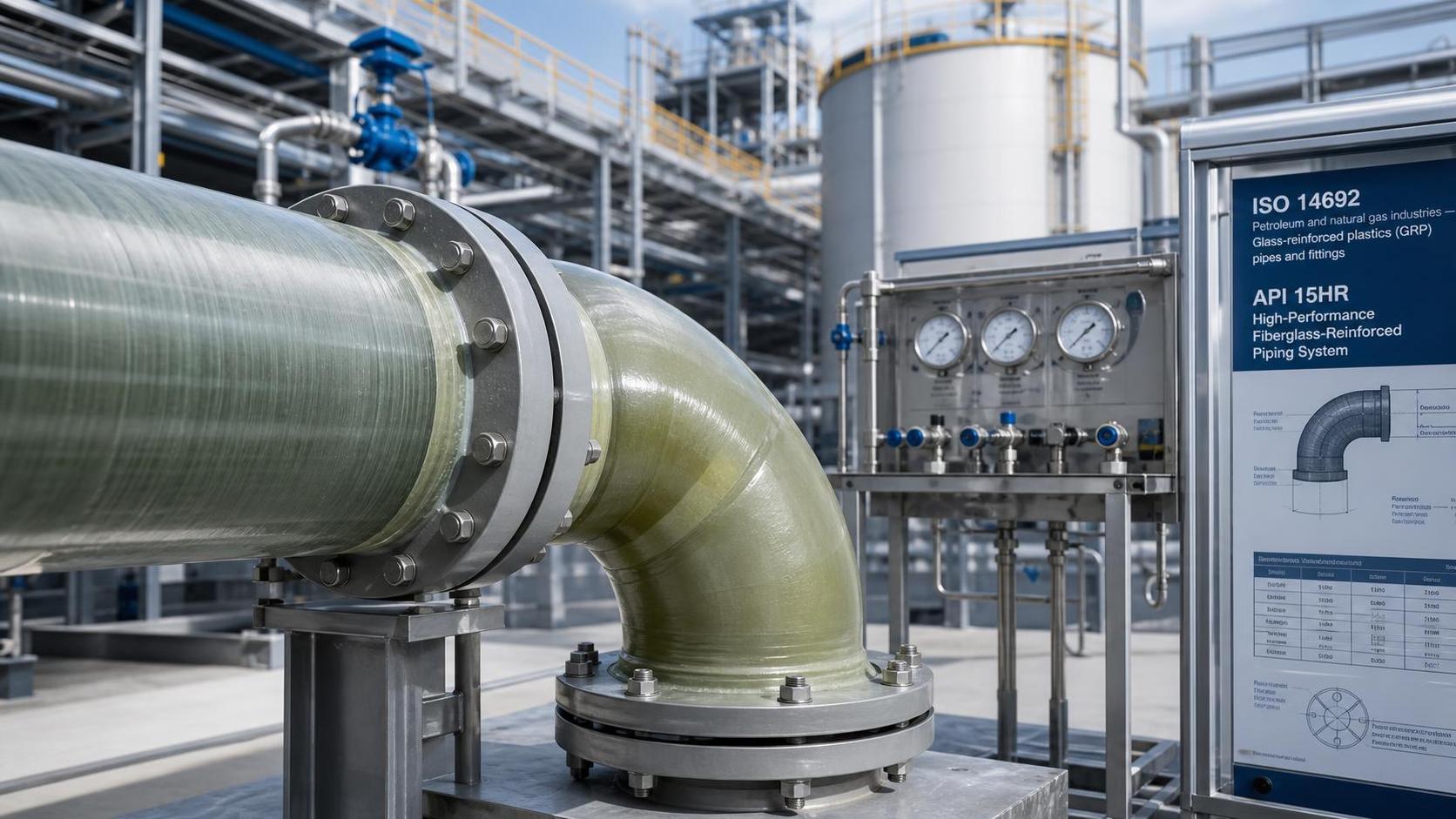
The most common references include API 15HR, ISO 14692, ASTM test methods, and project-specific specifications from EPC contractors or operators.
ISO 14692 is frequently used for fiberglass piping in petroleum and natural gas industries. It gives a framework for design basis, qualification, production control, installation, and operation.
API 15HR is often associated with high-pressure fiberglass line pipe. It becomes especially relevant where reinforced thermosetting resin pipe is used for oilfield gathering and injection service.
ASTM standards usually support the verification side. They help define how to test tensile behavior, ring stiffness, hydrostatic performance, chemical resistance, and other physical properties.
In actual procurement, the governing rule is usually a combination. The line may be designed to ISO 14692, tested by ASTM methods, and accepted under an owner specification.
A quick standards check helps avoid vague approvals
This is also where adjacent completion equipment can influence system thinking. In some developments, piping review is coordinated with items such as Sand Control Screens to keep material compatibility aligned across the flow path.
How can you judge whether a corrosion resistant FRP pipe is really fit for oil service?
The safer approach is to look beyond the nominal pressure rating. Corrosion resistant FRP pipe should be checked against the exact fluid, operating envelope, and installation method.
Start with the conveyed medium. Produced water, seawater injection, brine, crude with water cut, and chemical service do not attack the laminate in the same way.
Then review temperature. Resin performance changes with heat, and elevated temperature can reduce allowable stress over time. That reduction should be reflected in design factors, not guessed on site.
Joint type deserves equal attention. Adhesive-bonded joints, threaded joints, and mechanical couplings each have different installation tolerances and inspection priorities.
A useful qualification check includes the following points:
- Pipe construction details, including liner, structural wall, and corrosion barrier
- Resin system compatibility with hydrocarbons, water chemistry, and treatment chemicals
- Hydrostatic design basis and long-term regression data
- Fitting qualification under the same service class as the pipe
- Traceability from raw materials to final pressure test records
In practice, corrosion resistant FRP pipe performs well when the chemical barrier and structural design are chosen together. Failure often appears when one is considered and the other is assumed.
Which tests and documents should never be skipped during inspection?
Inspection becomes stronger when it follows the manufacturing route. A test report is valuable only when it is linked to the actual batch, dimensions, fitting type, and pressure class delivered to site.
For corrosion resistant FRP pipe, hydrostatic testing is usually the first document people ask for. It is important, but it is not enough on its own.
More complete review includes factory qualification data, routine production inspection, and field installation control records. That combination is what supports safe acceptance.
Core checks before release or installation
- Dimensions, wall thickness, end preparation, and visual laminate condition
- Barcol hardness or other relevant curing confirmation where specified
- Hydrostatic pressure test records with clear hold time and acceptance result
- Joint qualification records for couplings, adhesive systems, or threaded connections
- Material certificates for resin, glass reinforcement, and liner materials
- Installation procedures covering support spacing, torque, alignment, and field joining
A manufacturer with multiple winding lines and dedicated static water pressure testing machines can usually provide better batch consistency. That matters when a project includes both straight pipe and many fittings.
Where do projects make the wrong call on corrosion resistant FRP pipe?
The common mistake is treating FRP as a universal corrosion answer. It is corrosion resistant, but only within the limits of the selected resin system, pressure design, and installation quality.
Another weak point is comparing it to steel on initial price only. In oil service, lifecycle risk usually matters more than unit price, especially where internal corrosion management is expensive.
Misuse also happens at supports and layout changes. FRP systems respond differently to point loads, thermal movement, and impact. Steel support habits should not be copied without checking the piping design manual.
Some teams also approve straight pipe carefully but pay less attention to elbows, tees, reducers, and field joints. That creates a gap, because failures often start at transitions rather than barrel sections.
Where solids handling is part of the broader production system, related equipment choices such as Sand Control Screens may also affect how operators assess erosion, maintenance intervals, and media behavior downstream.
What is a sensible next-step checklist before approving a supplier or specification?
A good review is not complicated, but it has to be disciplined. The goal is to connect standards, plant conditions, and manufacturing evidence before the material reaches site.
For corrosion resistant FRP pipe in oil projects, it helps to build the approval process around a short checklist:
- Define the fluid composition, temperature range, and upset conditions
- Confirm the governing code set, such as ISO 14692 and applicable API or ASTM references
- Review pipe and fitting qualification under the same service category
- Request routine production test records, not just type-test summaries
- Check installation instructions for supports, field joints, and handling limits
- Verify project traceability from raw material lot to finished spool or pipe number
Corrosion resistant FRP pipe can be a strong choice for oil and gas service when standards are treated as operating controls, not paperwork. The best results usually come from early specification alignment, realistic test review, and strict attention to fittings and field installation.
Before final approval, compare the service conditions against the code basis, review the manufacturer’s qualification depth, and make sure every acceptance point can be verified in records. That is usually where dependable performance begins.
Please give us a message
产品介绍产品介绍产品介绍产品介绍产品介绍产品介绍产品介绍产品介绍产品介绍产品介绍产品介绍产品介绍产品介绍产品介绍产品介绍产品介绍产品介绍产品介绍产品介绍产品介绍产品介绍产品介绍产品介绍产品介绍产品介绍产品介绍产品介绍产品介绍产品介绍产品介绍
Please give us a message
产品介绍产品介绍产品介绍产品介绍产品介绍产品介绍产品介绍产品介绍产品介绍产品介绍产品介绍产品介绍产品介绍产品介绍产品介绍产品介绍产品介绍产品介绍产品介绍产品介绍产品介绍产品介绍产品介绍产品介绍产品介绍产品介绍产品介绍产品介绍产品介绍产品介绍
Please give us a message
产品介绍产品介绍产品介绍产品介绍产品介绍产品介绍产品介绍产品介绍产品介绍产品介绍产品介绍产品介绍产品介绍产品介绍产品介绍产品介绍产品介绍产品介绍产品介绍产品介绍产品介绍产品介绍产品介绍产品介绍产品介绍产品介绍产品介绍产品介绍产品介绍产品介绍
Please give us a message
产品介绍产品介绍产品介绍产品介绍产品介绍产品介绍产品介绍产品介绍产品介绍产品介绍产品介绍产品介绍产品介绍产品介绍产品介绍产品介绍产品介绍产品介绍产品介绍产品介绍产品介绍产品介绍产品介绍产品介绍产品介绍产品介绍产品介绍产品介绍产品介绍产品介绍