
Retrofitting Ship Ballast Piping Without Disrupting Vessel Operations
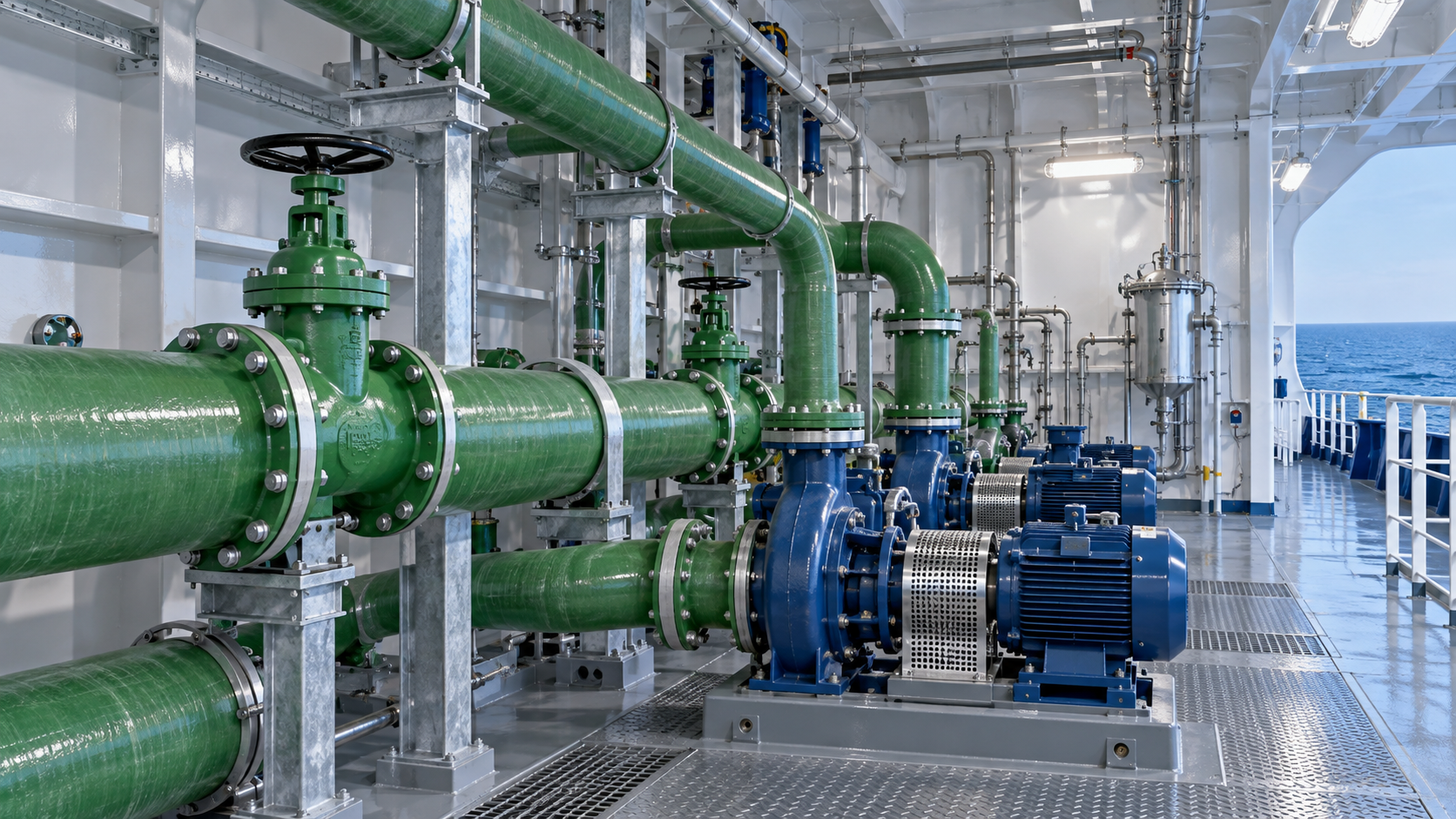
A ballast piping retrofit rarely happens at a convenient moment. The vessel may be trading under a tight charter schedule, preparing for dry docking, responding to inspection findings, or dealing with recurring maintenance around corroded steel lines. For project managers, the objective is not simply to replace pipe: it is to restore dependable ballast-system performance while protecting the operating plan, crew safety, and budget.
Retrofitting Ship Ballast Piping without disrupting vessel operations depends on decisions made well before the first spool is removed. The most successful projects combine a realistic condition assessment, accurate dimensional data, material selection suited to seawater service, prefabrication ashore, and an installation sequence that respects the vessel’s operational constraints. When those elements are coordinated, even a complex upgrade can be delivered in controlled work windows rather than becoming an open-ended onboard repair.
Begin with the operational question, not the pipe question
It is tempting to start with the obvious problem area: a leaking ballast line, wasted steel thickness, seized valve connection, or a section repeatedly repaired by the crew. Yet the more important question is how that individual failure affects the whole ballast arrangement. A replacement plan must consider tank filling and emptying routes, pump availability, stripping arrangements, remote controls, sounding systems, drainage, and access for inspection.
In oil-related marine operations, ballast capability can influence stability management, port calls, cargo sequencing, and safety procedures. Taking an entire system out of service for a prolonged period may not be acceptable. Project leaders therefore need to identify what functions must remain live throughout the work and what work can safely be isolated during a voyage, port stay, or scheduled maintenance period.
A practical early review should map each proposed replacement section against four questions:
- Which tanks, pumps, valves, or cross-connections depend on this line?
- Can the section be positively isolated, drained, gas-freed where necessary, and handed over safely?
- Is there a temporary operating route that maintains essential ballast capability?
- What is the consequence if installation or testing takes longer than planned?
This exercise often changes the scope. A line that appears easy to replace may be tied into a manifold with limited redundancy. Conversely, several small corroded sections may be grouped into one prefabricated package and installed during a single planned shutdown. The goal is to avoid discovering critical dependencies after the vessel has already been opened up.
Survey accuracy is the foundation of an off-vessel fabrication strategy
Offshore and marine retrofits are unforgiving of dimensional surprises. Older vessels may have undocumented modifications, steelwork changes, non-standard supports, or pipe routes that differ from original drawings. A spool fabricated only from legacy isometrics can arrive onboard with a flange that is slightly misaligned, a bend that conflicts with a bracket, or a connection that cannot be assembled within the available access space.
Before finalizing replacement spools, verify the physical route on board. A dimensional survey should capture pipe outside diameters, flange standards and drilling, face-to-face dimensions, valve positions, support elevations, penetration details, clearances around machinery, and practical lifting paths. Where the project is extensive or geometry is congested, laser scanning or disciplined 3D measurement can substantially reduce fit-up uncertainty.
Survey work should also look beyond the pipe itself. Corrosion beneath clamps, damaged foundations, poorly located supports, and restricted access through watertight divisions can all affect installation duration. Recording these conditions early gives the engineering team time to redesign a spool break, introduce a removable joint where appropriate, or modify supports before the vessel enters its work window.
Design for installation, not only for the drawing
A retrofit spool should be assessed in the same way a rigger or shipyard foreman will assess it: Can it pass through the access opening? Can it be lifted without striking existing equipment? Is there room to align the flange faces? Can technicians complete jointing and inspection without working in an unsafe posture? A design that looks clean on an isometric may still be difficult to install in a narrow pump room.
Breaking a long run into manageable prefabricated sections can make the work more predictable. However, excessive joints add labor, inspection points, and schedule exposure. The right balance depends on vessel access, routing complexity, material handling limits, and the available installation period.
Why GRE is often considered for ballast-water service
Conventional metallic ballast systems face an aggressive environment: seawater, wet-dry cycling, sediment, local coating damage, and difficult inspection access. Corrosion can consume maintenance time long before a complete replacement becomes unavoidable. For suitable service conditions, glass-fiber-reinforced epoxy piping provides a corrosion-resistant alternative that can reduce the maintenance burden associated with internal and external steel degradation.
Its lower weight is equally relevant during retrofit planning. Lighter spools can simplify onboard handling, reduce demands on temporary lifting arrangements, and lessen the load imposed on supports. That does not remove the need for engineering discipline. GRE systems require proper consideration of pressure rating, temperature, fluid compatibility, fire-safety requirements, installation rules, support spacing, expansion behavior, bonding methods, and the vessel’s applicable class and flag requirements.
For project teams evaluating composite replacement systems, GRE Pipe for Marine & Offshore can be considered as part of a material-selection review rather than as a like-for-like substitution. The pipe, fittings, flange interfaces, valves, supports, and bonding procedure must work as one system. A durable material will not compensate for an incorrectly prepared joint or an unsupported route subject to vibration.
Build the retrofit around controlled work packages
The phrase “minimize downtime” can create pressure to start quickly. In practice, speed comes from preparation. Dividing the project into controlled work packages makes it easier to coordinate vessel personnel, shipyard labor, inspectors, and suppliers while keeping the live operation visible to everyone.
A useful package normally contains a defined isolation boundary, marked-up drawings, a removal sequence, lifting and access requirements, prefabricated replacement parts, consumables, jointing instructions, inspection hold points, and a reinstatement checklist. It should state who is responsible for each handover: vessel crew, contractor supervisor, class representative where required, and project manager.
Work packages are particularly valuable when the retrofit must be completed in phases. One branch line can be renewed, pressure tested, and returned to service before the next section is isolated. This staged approach may take more planning than a full-system shutdown, but it provides the vessel with a clearer recovery path if weather, berth availability, or access restrictions affect the schedule.
Protect the critical path with prefabrication
Prefabrication shifts a large part of the work from the vessel to a more controlled manufacturing environment. Pipes can be cut, wound or assembled, fitted with required interfaces, labeled by location, and inspected before delivery. The onboard team then focuses on removal, support preparation, final fit-up, joint completion, and testing.
For GRE piping, controlled fabrication also supports consistency in component quality and joint preparation. Shandong Ocean Pipe Technology Co., Ltd., established in 2012, operates dedicated winding lines, fitting winding equipment, and hydrostatic testing capability for GRE pipe production. For marine projects, manufacturing capacity matters less as a marketing statement than as a scheduling factor: the supplier must be able to coordinate approved drawings, spool identification, packing, testing documentation, and delivery sequence with the shipyard’s installation plan.
Project managers should request a delivery breakdown that mirrors onboard priorities. Sending materials in one undifferentiated batch can create congestion and increase the risk of damage or misplaced components. Clearly tagged spools, fittings, gaskets, fasteners where applicable, repair materials, and installation instructions allow the team to release each area in an orderly manner.
Keep the vessel operational through isolation and sequencing
The installation sequence should be drafted alongside the vessel’s operations plan, not after it. Depending on the ballast system configuration, a temporary bypass, alternate pump route, or phased tank availability plan may be necessary. These measures must be engineered and approved as appropriate; an improvised temporary connection can introduce contamination, pressure, stability, or safety risks.
Before each isolation, confirm valve integrity and establish a reliable method of preventing unintended filling. Drain and ventilate the affected line, verify the condition at the worksite, and manage residual seawater. Where work occurs in tanks, pump rooms, or enclosed spaces, permit-to-work requirements, atmospheric testing, lighting, rescue arrangements, and communications require the same attention as the mechanical task.
There is also a human side to sequencing. Ship crews are often balancing cargo duties, maintenance, inspections, and port operations. A schedule that assumes unrestricted crew support will quickly become unrealistic. Clear daily interfaces between the vessel representative and the retrofit supervisor help resolve access conflicts before they become delays.
Joint quality and support details deserve disproportionate attention
Many retrofit failures are not caused by the selected pipe material; they originate at interfaces. For composite systems, bonding surfaces must be clean, correctly prepared, and protected from unsuitable environmental conditions. Technicians need documented procedures, appropriate training, and adequate curing time where required. Rushing a joint to meet a sailing deadline may create a hidden weakness that is far more expensive to address later.
Flange alignment should be achieved without forcing the pipe into position. Bolt tightening must follow the approved sequence and torque requirements. Connections to metallic equipment need careful attention to interface design, electrical continuity requirements where applicable, and prevention of local loads being transferred into the composite pipe.
Support design is another common blind spot. A lightweight pipe is not a “no-support” pipe. Supports should prevent sagging and vibration while avoiding sharp contact points or clamp arrangements that can damage the pipe surface. Locations near pumps, valves, bends, bulkhead penetrations, and long straight runs deserve particular review. If legacy steel supports are corroded or incorrectly spaced, replacing pipe without correcting the support arrangement merely carries the old problem into the new system.
Commissioning should prove readiness, not just completion
A line may look complete before it is genuinely ready for service. The commissioning plan should define the required visual checks, joint inspections, pressure or leak testing, flushing where applicable, valve-operability checks, and confirmation of tank and pump routes. Test pressure, duration, medium, and acceptance criteria should follow the approved engineering documentation and relevant vessel requirements.
Reinstatement is the moment when small documentation gaps can become operational problems. Update marked-up drawings, line labels, valve identification, support records, and maintenance information before the project team demobilizes. The crew should understand the changed routing, any revised isolation points, and the inspection practices appropriate to the installed system.
A concise close-out file is valuable months later, when a superintendent is troubleshooting an unusual operating condition or preparing the next docking package. It should include final as-built information, material traceability as required, test records, installation and repair guidance, and a list of outstanding items. This is not paperwork for its own sake; it preserves the decisions that made the retrofit safe and workable.
A practical decision framework for project managers
When comparing alternatives for Ship Ballast Piping, evaluate the full project outcome rather than the purchase price of pipe. A lower initial material cost can disappear if the solution requires heavy onboard fabrication, extended hot work, repeated corrosion repairs, or a shutdown longer than the vessel can tolerate. Equally, a technically attractive replacement system may create risk if the supplier cannot provide accurate prefabrication, delivery coordination, and installation support.
Ask potential partners how they will manage survey verification, spool splitting, fittings, testing, packing, documentation, and field jointing. Review their understanding of marine access limitations and their willingness to align manufacturing with the vessel’s work sequence. These practical details often decide whether a retrofit proceeds calmly or becomes a daily schedule crisis.
The strongest ballast piping retrofit is usually the one passengers never notice and operators no longer worry about. It returns the system to reliable service, fits the vessel’s operating reality, and leaves the crew with clear records rather than unresolved uncertainty. With disciplined planning, prefabricated GRE solutions where suitable, and careful control of installation interfaces, corrosion-driven renewal does not have to mean losing command of the vessel’s schedule.
Please give us a message
产品介绍产品介绍产品介绍产品介绍产品介绍产品介绍产品介绍产品介绍产品介绍产品介绍产品介绍产品介绍产品介绍产品介绍产品介绍产品介绍产品介绍产品介绍产品介绍产品介绍产品介绍产品介绍产品介绍产品介绍产品介绍产品介绍产品介绍产品介绍产品介绍产品介绍
Please give us a message
产品介绍产品介绍产品介绍产品介绍产品介绍产品介绍产品介绍产品介绍产品介绍产品介绍产品介绍产品介绍产品介绍产品介绍产品介绍产品介绍产品介绍产品介绍产品介绍产品介绍产品介绍产品介绍产品介绍产品介绍产品介绍产品介绍产品介绍产品介绍产品介绍产品介绍
Please give us a message
产品介绍产品介绍产品介绍产品介绍产品介绍产品介绍产品介绍产品介绍产品介绍产品介绍产品介绍产品介绍产品介绍产品介绍产品介绍产品介绍产品介绍产品介绍产品介绍产品介绍产品介绍产品介绍产品介绍产品介绍产品介绍产品介绍产品介绍产品介绍产品介绍产品介绍
Please give us a message
产品介绍产品介绍产品介绍产品介绍产品介绍产品介绍产品介绍产品介绍产品介绍产品介绍产品介绍产品介绍产品介绍产品介绍产品介绍产品介绍产品介绍产品介绍产品介绍产品介绍产品介绍产品介绍产品介绍产品介绍产品介绍产品介绍产品介绍产品介绍产品介绍产品介绍