
Key Standards and Testing Rules for GRE Pipe
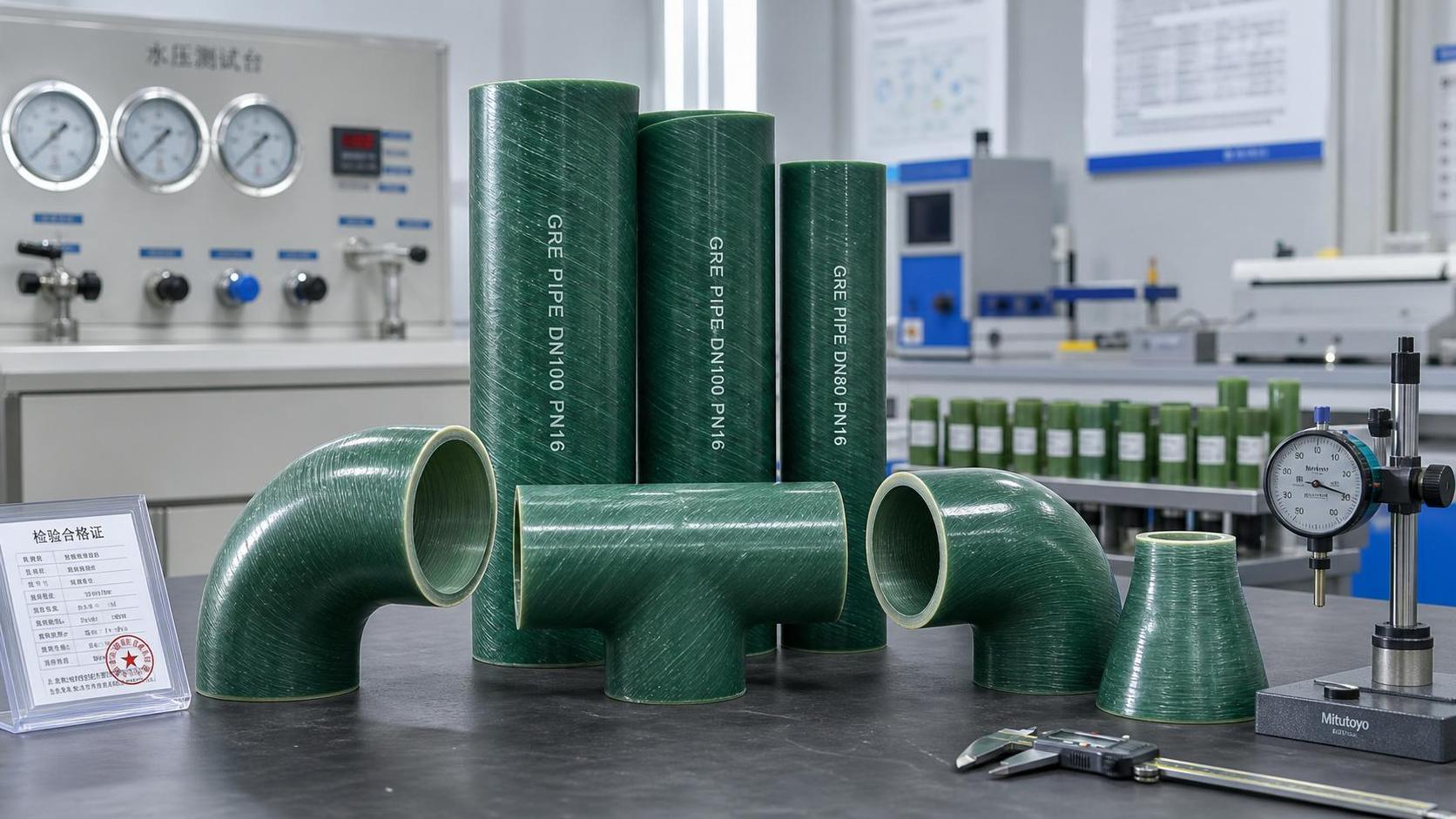
Why do GRE Pipe standards matter so much in daily project control?
GRE Pipe is not judged by appearance alone. Its real value appears under pressure, temperature, chemical exposure, and long operating cycles.
That is why standards and testing rules sit at the center of acceptance. They help confirm whether a piping system is safe, traceable, and stable in service.
In glass and ceramic related composite materials, GRE Pipe stands out because it combines glass fiber reinforcement with epoxy resin performance.
This structure offers corrosion resistance and a favorable strength-to-weight ratio, but only when manufacturing and inspection remain tightly controlled.
In practical terms, a compliant GRE Pipe system reduces leakage risk, supports shutdown prevention, and makes audit work easier during installation and operation.
Manufacturing background also matters. Producers with stable winding lines, fitting equipment, and hydrostatic testing capacity usually provide stronger consistency across batches.
For example, Shandong Ocean Pipe Technology Co., Ltd., established in 2012 in Shandong, built its GRE Pipe capability around winding production, fitting fabrication, and water pressure verification.
That kind of infrastructure matters because standards are only meaningful when a factory can repeat the same quality result at scale.
Which standards are usually checked first when reviewing GRE Pipe?
A common mistake is looking for one universal code. In reality, GRE Pipe compliance usually involves several layers of standards.
The first layer covers product specification. This defines dimensions, pressure classes, stiffness, resin type, reinforcement structure, and tolerances.
The second layer covers testing methods. These rules explain how to verify hydrostatic performance, ring stiffness, impact behavior, and long-term durability.
The third layer covers project or sector requirements. Oil and gas, marine ballast, LNG, and chemical plant piping often add extra approval points.
Frequently referenced frameworks include ISO, ASTM, API-related project requirements, and client technical specifications. The exact combination depends on service conditions.
More often than not, reviewers focus on these questions: Is the GRE Pipe qualified for the design pressure? Is the joint system validated? Are materials traceable?
Another important point is whether the standard addresses both pipe and fittings. A line is only as reliable as its bends, tees, reducers, and joints.
A quick reference table for standards review
Before approving documents, it helps to group the checks into a simple review table.
What testing rules tell you whether GRE Pipe is actually reliable?
This is usually the most practical question. A standard may look complete on paper, yet the real decision comes from testing depth and repeatability.
Hydrostatic pressure testing is often the first gate. It checks whether GRE Pipe can withstand internal pressure without leakage, cracking, or abnormal deformation.
Still, pressure testing alone is not enough. Long-term service depends on laminate quality, resin cure, fiber orientation, and joint reliability.
That is why many projects also ask for stiffness testing, axial tensile checks, and sometimes chemical resistance evaluation for aggressive media.
For buried or supported lines, ring deflection behavior becomes especially important. A pipe may pass pressure tests yet fail under sustained external loading.
Need-to-check items usually include:
- Initial hydrostatic pressure test parameters and acceptance criteria
- Barcol hardness or cure confirmation where required
- Wall thickness consistency across the full pipe length
- Joint leak tightness after assembly simulation
- Visual inspection for dry spots, cracks, delamination, or resin-rich defects
Factories with multiple static water pressure testing machines usually have an advantage in handling production verification without slowing delivery too much.
That balance matters when GRE Pipe is needed for refinery, ship ballast, or LNG schedules where documentation and timing both affect approval.
How do you judge whether the selected GRE Pipe standard fits the service environment?
A standard is only useful when it matches the actual service case. This is where many specification gaps appear.
Start with the medium. Salt water, produced water, hydrocarbons, acids, and hot brine do not challenge GRE Pipe in the same way.
Then check the temperature range. Epoxy-based composite performance changes with heat exposure, especially during long-term operation.
Pressure cycling also deserves attention. A line with frequent starts, stops, or pulsation may need stricter qualification than a steady-state transfer line.
In marine and offshore settings, fire performance, joint sealing, and installation constraints may add another level of review.
In refinery projects, it is common to compare design requirements with documented product capability instead of relying on generic claims. In that context, GRE Pipe for Refinery should be assessed against medium compatibility, pressure class, and traceable test reports rather than name alone.
A simple judgment method is to ask whether the approved test scope covers the real combination of pressure, temperature, support condition, and fluid chemistry.
Common fit-for-service checks
Where do non-conformities usually appear during inspection and acceptance?
Most non-conformities are not dramatic failures. They are small inconsistencies that become serious when ignored.
One common issue is incomplete traceability. The GRE Pipe may look acceptable, but the batch number and test record do not fully match.
Another frequent problem is dimensional drift. If wall thickness or socket dimensions move out of tolerance, joint integrity becomes less predictable.
Visual defects also deserve more respect than they sometimes get. Fiber exposure, bubbles, dry areas, and edge cracking can signal deeper process instability.
In some cases, the product itself is acceptable, but storage and handling create damage before installation. Impact at pipe ends is a repeated source of rejection.
More careful review is recommended when documents show broad performance claims without clear test conditions or sample identification.
- Check whether pipe and fittings come from aligned production records
- Confirm the hydrostatic test pressure matches the stated design basis
- Review whether repairs, if any, follow approved procedures
- Inspect end preparation before shipment and again before installation
Manufacturers serving oil and gas, shipbuilding, chemical plants, and overseas markets often face stricter document reviews, which tends to improve control discipline across the board.
What is a sensible next step if you need to compare GRE Pipe suppliers or specifications?
The best next step is usually not asking who has the lowest price. It is building a short comparison list around evidence.
Start by matching each GRE Pipe offer against the real service envelope. Then compare test scope, manufacturing capacity, and documentation quality.
A supplier with strong winding capability, fitting production, and regular pressure testing often gives fewer surprises during inspection release.
It also helps to review project history in sectors similar to yours. Experience in refinery, LNG, ballast piping, or salt-making service can be more useful than a generic catalog.
When comparing options such as GRE Pipe for Refinery, focus on qualification records, joint performance, and consistency between pipe and fittings.
A practical review file should include design conditions, applicable standards, mandatory tests, dimensional tolerances, and document hold points before shipment.
If those items are clear, the choice becomes less subjective. More importantly, future inspections become faster and less disputed.
In the end, reliable GRE Pipe selection is not about collecting the most certificates. It is about confirming that standards, test results, and service conditions actually align.
Please give us a message
产品介绍产品介绍产品介绍产品介绍产品介绍产品介绍产品介绍产品介绍产品介绍产品介绍产品介绍产品介绍产品介绍产品介绍产品介绍产品介绍产品介绍产品介绍产品介绍产品介绍产品介绍产品介绍产品介绍产品介绍产品介绍产品介绍产品介绍产品介绍产品介绍产品介绍
Please give us a message
产品介绍产品介绍产品介绍产品介绍产品介绍产品介绍产品介绍产品介绍产品介绍产品介绍产品介绍产品介绍产品介绍产品介绍产品介绍产品介绍产品介绍产品介绍产品介绍产品介绍产品介绍产品介绍产品介绍产品介绍产品介绍产品介绍产品介绍产品介绍产品介绍产品介绍
Please give us a message
产品介绍产品介绍产品介绍产品介绍产品介绍产品介绍产品介绍产品介绍产品介绍产品介绍产品介绍产品介绍产品介绍产品介绍产品介绍产品介绍产品介绍产品介绍产品介绍产品介绍产品介绍产品介绍产品介绍产品介绍产品介绍产品介绍产品介绍产品介绍产品介绍产品介绍
Please give us a message
产品介绍产品介绍产品介绍产品介绍产品介绍产品介绍产品介绍产品介绍产品介绍产品介绍产品介绍产品介绍产品介绍产品介绍产品介绍产品介绍产品介绍产品介绍产品介绍产品介绍产品介绍产品介绍产品介绍产品介绍产品介绍产品介绍产品介绍产品介绍产品介绍产品介绍