
GRVE Pipe Standards and Quality Checks Explained
Why do GRVE Pipe standards matter so much in oil service?
In oil production, piping failure rarely starts as a dramatic event.
It usually begins with a missed material check, a weak joint, or an incorrect pressure assumption.
That is why GRVE Pipe standards matter.
They create a common technical language for design, manufacturing, inspection, and field acceptance.
For oil systems carrying produced water, seawater, chemicals, or corrosive media, GRVE Pipe is often selected for corrosion resistance and lower maintenance demand.
But performance depends on more than material name alone.
The real question is whether the pipe meets verified standards for pressure, dimensions, curing quality, and long-term durability.
In practice, inspection teams usually focus on traceability first.
A compliant GRVE Pipe should connect raw materials, winding records, hydrostatic results, and final markings without gaps.
This becomes even more important in offshore and hazardous areas, where replacement work is expensive and shutdown windows are limited.
When people say GRVE Pipe compliance, what standards are they usually referring to?
The answer depends on project scope, but several reference points appear repeatedly.
For fiberglass reinforced epoxy systems, buyers often review ISO, ASTM, API-related specifications, and project-specific engineering requirements together.
More common checks include pressure class verification, stiffness, resin compatibility, dimensional tolerance, and hydrostatic qualification.
Some projects also require fire performance, electrical behavior, or offshore installation criteria.
So a GRVE Pipe can be technically sound, yet still fail approval if the documentation does not match the project code.
A practical way to read compliance is to separate three layers:
- Material qualification: resin, glass reinforcement, liner structure, curing system.
- Product qualification: dimensions, pressure rating, stiffness, joint performance.
- Manufacturing control: process records, testing frequency, traceable batch release.
Established producers usually make this easier by maintaining repeatable winding control and formal test capacity.
Shandong Ocean Pipe Technology Co., Ltd., founded in 2012 in Dezhou, operates 16 winding lines and five static water pressure testing machines.
That scale matters because GRVE Pipe quality is strongly linked to process stability, not only to final inspection.
Which quality checks actually decide whether a GRVE Pipe is reliable?
Many checks appear on paper, but a smaller group usually decides real service reliability.
The first is visual and dimensional inspection.
Look for cracks, dry fiber, resin-rich pockets, delamination signs, improper socket geometry, and marking consistency.
The second is hydrostatic pressure testing.
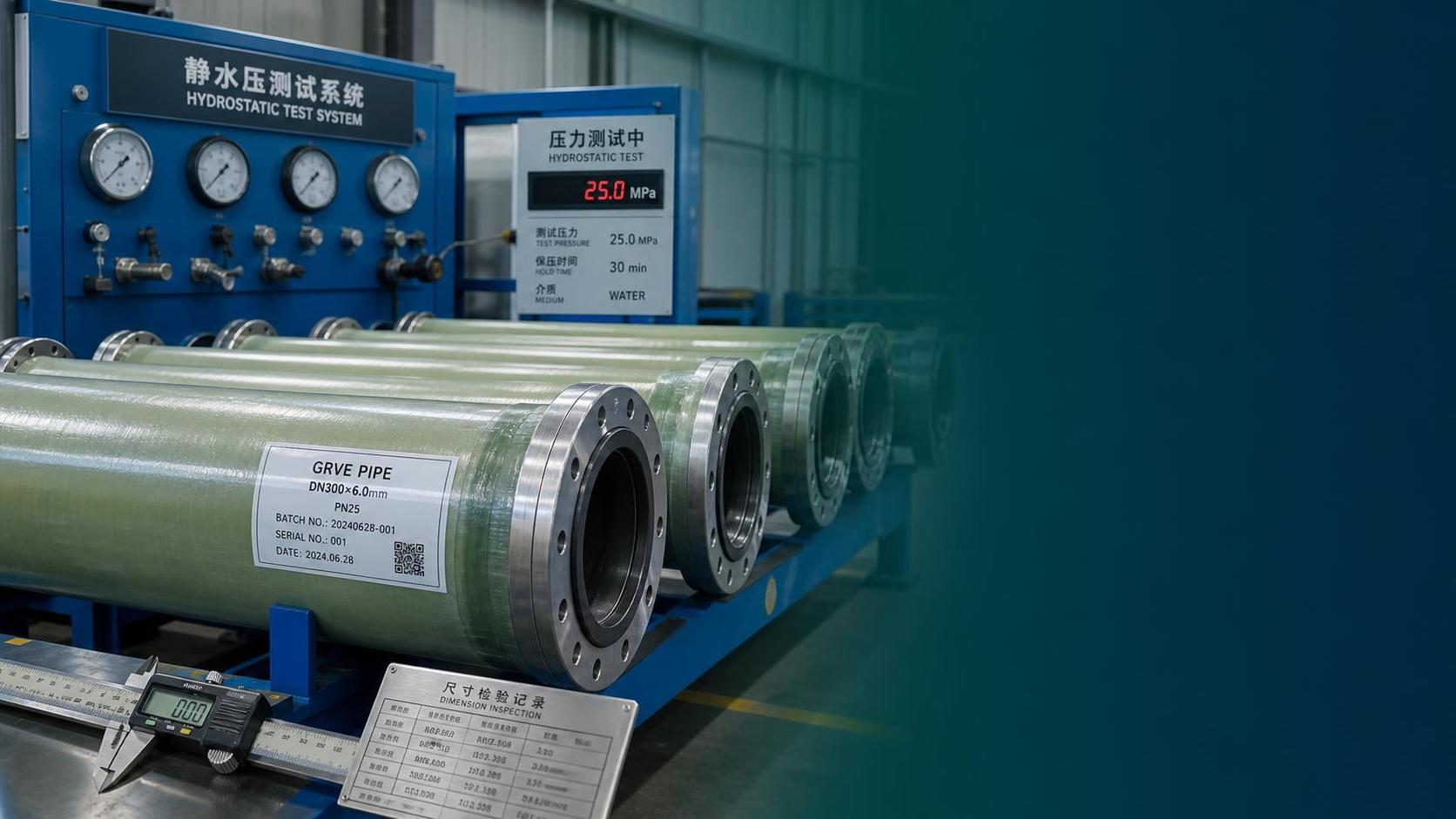
This confirms whether the GRVE Pipe and joint system can hold the specified pressure without leakage or structural change.
The third is cure control.
An under-cured pipe may pass a basic visual check but still perform poorly under temperature, chemicals, or cyclic loading.
The fourth is raw material verification.
If the resin system differs from the approved formulation, chemical resistance assumptions may no longer be valid.
The table below is a useful field reference.
If one of these items is weak, the GRVE Pipe should not be judged by appearance alone.
Is GRVE Pipe suitable for every oil and gas line?
Not automatically, and this is where many specification mistakes begin.
GRVE Pipe performs well in many corrosive services, especially produced water, seawater intake, utility systems, ballast-related lines, and selected chemical duties.
It can also be a strong option for marine and offshore support systems.
For example, projects evaluating GRE Pipe for Marine & Offshore often compare corrosion behavior, weight reduction, and installation constraints together.
Still, suitability depends on actual operating conditions.
- Operating pressure and surge pressure
- Fluid chemistry and concentration changes
- Operating and upset temperature
- External loads, supports, and vibration
- Buried, above-ground, or offshore exposure conditions
A GRVE Pipe that is ideal for saline water service may be unsuitable for another line with high temperature excursions or aggressive solvent exposure.
More careful reviews usually compare design envelope against the full operating profile, not only normal duty.
What mistakes are most likely to slip past inspection?
The most common problem is relying on a pass certificate without reviewing the scope behind it.
A hydro test confirms one condition.
It does not replace chemical compatibility review, installation control, or long-term stress assessment.
Another missed issue is joint quality.
Many line failures begin at bonded or mechanical joints, especially when alignment, adhesive handling, or insertion depth is inconsistent.
Transport and storage damage is also underestimated.
GRVE Pipe can be strong in service while still being vulnerable to poor lifting practice, impact at pipe ends, or prolonged UV exposure before installation.
A few warning signs deserve extra attention:
- Field-cut ends without proper finishing records
- Missing batch numbers or unreadable markings
- Different wall builds within the same tagged line class
- Joint kits stored outside recommended conditions
- Pressure retest plans that ignore temperature correction
These are not minor paperwork issues.
They often point to deeper control gaps.
How should a practical GRVE Pipe approval checklist be built?
A useful checklist should follow the life of the pipe, from material approval to site handover.
That makes decisions easier when schedule pressure increases.
A simple structure often works best.
- Confirm design basis: service fluid, pressure, temperature, code, and expected transients.
- Review manufacturer capability: winding equipment, testing capacity, quality records, and production consistency.
- Match qualification documents to the exact GRVE Pipe class being supplied.
- Define incoming inspection points, witness hold points, and retest triggers.
- Control storage, handling, installation, and jointing procedures at site.
- Close the loop with as-built traceability and final acceptance documentation.
This is also where supplier background becomes relevant.
Ocean Pipe serves oil and gas, LNG, ship ballast, chemical, and salt-making applications, with deliveries to major domestic and overseas markets.
That range is useful because field demands vary widely, and quality systems need to stay repeatable across them.
When the service condition overlaps marine exposure, reviewing GRE Pipe for Marine & Offshore within the same checklist can help align offshore expectations with oilfield risk control.
What is the best next step if a GRVE Pipe specification still feels unclear?
Start by narrowing the uncertainty.
Most approval problems come from mixed assumptions, not from missing data alone.
List the actual service medium, pressure range, design temperature, joint type, and installation environment.
Then compare those facts against the GRVE Pipe qualification records and factory test scope.
If there is a mismatch, resolve it before purchase release or site installation.
The strongest decisions usually come from combining standards review with process evidence.
That means not only asking whether the GRVE Pipe meets a code, but also whether manufacturing, inspection, and handling controls support the intended life of the line.
For oil service, that is the difference between nominal compliance and dependable performance.
A clear next move is to build a short project checklist, verify critical test records, and review joint and installation risks before final approval.
Please give us a message
产品介绍产品介绍产品介绍产品介绍产品介绍产品介绍产品介绍产品介绍产品介绍产品介绍产品介绍产品介绍产品介绍产品介绍产品介绍产品介绍产品介绍产品介绍产品介绍产品介绍产品介绍产品介绍产品介绍产品介绍产品介绍产品介绍产品介绍产品介绍产品介绍产品介绍
Please give us a message
产品介绍产品介绍产品介绍产品介绍产品介绍产品介绍产品介绍产品介绍产品介绍产品介绍产品介绍产品介绍产品介绍产品介绍产品介绍产品介绍产品介绍产品介绍产品介绍产品介绍产品介绍产品介绍产品介绍产品介绍产品介绍产品介绍产品介绍产品介绍产品介绍产品介绍
Please give us a message
产品介绍产品介绍产品介绍产品介绍产品介绍产品介绍产品介绍产品介绍产品介绍产品介绍产品介绍产品介绍产品介绍产品介绍产品介绍产品介绍产品介绍产品介绍产品介绍产品介绍产品介绍产品介绍产品介绍产品介绍产品介绍产品介绍产品介绍产品介绍产品介绍产品介绍
Please give us a message
产品介绍产品介绍产品介绍产品介绍产品介绍产品介绍产品介绍产品介绍产品介绍产品介绍产品介绍产品介绍产品介绍产品介绍产品介绍产品介绍产品介绍产品介绍产品介绍产品介绍产品介绍产品介绍产品介绍产品介绍产品介绍产品介绍产品介绍产品介绍产品介绍产品介绍