
How to Choose Corrosion Resistant FRP Pipe Grades
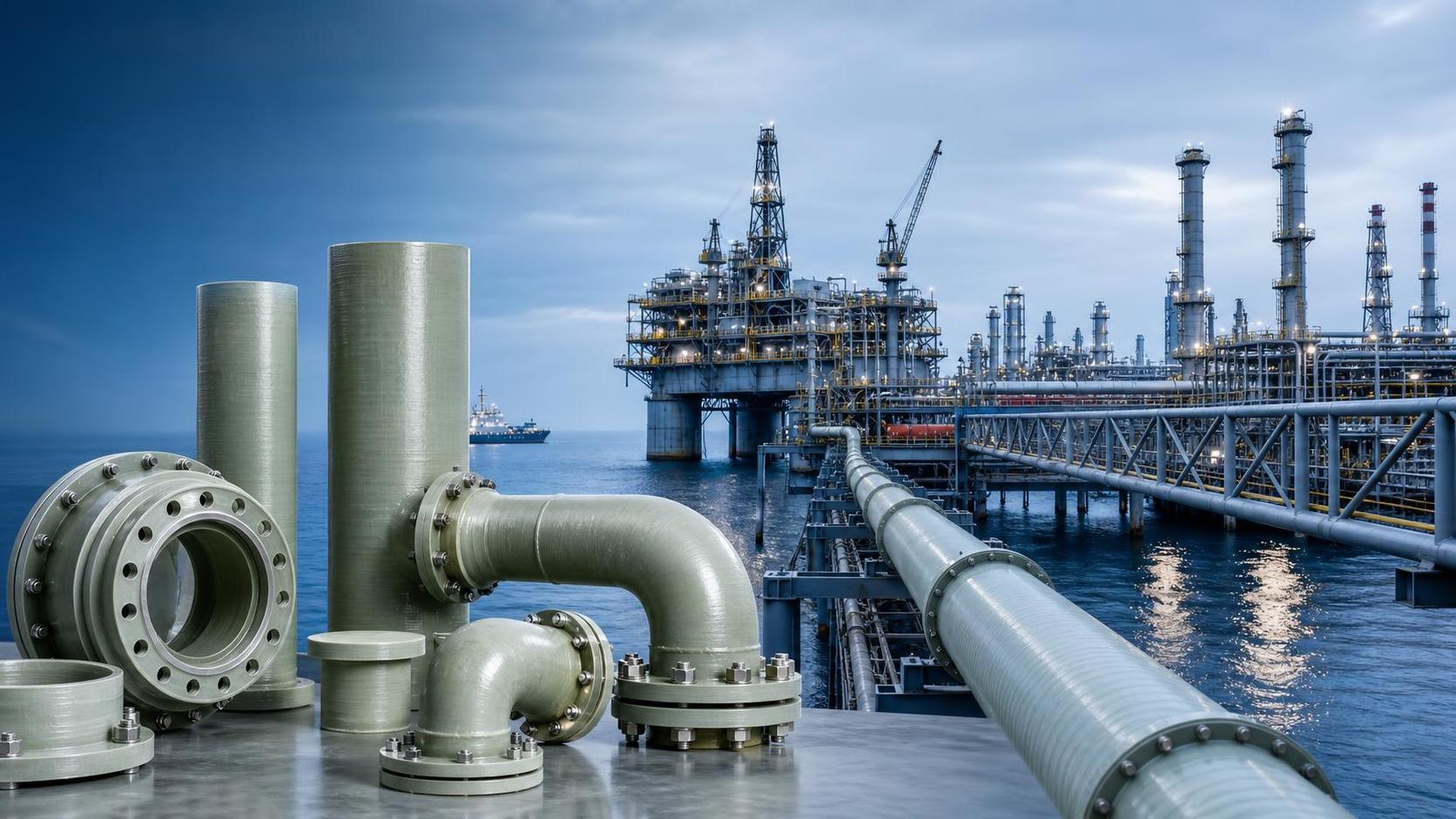
Choosing the right corrosion resistant FRP pipe grade is a technical decision with direct commercial consequences in oil projects. Media chemistry, operating pressure, temperature swings, and service life expectations all shape whether a pipeline performs reliably or becomes an early maintenance problem.
In upstream gathering, produced water handling, offshore utility lines, and refinery support systems, a suitable corrosion resistant FRP pipe can lower corrosion risk, reduce shutdown frequency, and improve lifecycle cost control. The key is not selecting the highest grade by default, but matching the grade to the actual duty.
What the grade really means in oil service
When people refer to FRP pipe grades, they usually mean the combination of resin system, reinforcement structure, liner design, pressure rating, and manufacturing standard. In oil applications, these factors work together rather than separately.
A corrosion resistant FRP pipe is not simply a plastic pipe with fiber added. Its performance depends on how the inner liner resists chemical attack, how the structural wall carries pressure, and how joints behave under field stress.
For many oil and gas systems, GRE pipe is preferred because epoxy resin offers strong chemical resistance and mechanical stability. That is why grade selection often starts with resin compatibility before moving to pressure and installation factors.
Why this choice matters more now
Oil infrastructure is operating under tighter reliability targets. Produced water is often more aggressive, fields are older, and operators expect longer service intervals with less unplanned intervention.
Steel remains common, but corrosion control programs add cost and complexity. Internal coatings, chemical dosing, and frequent inspection can protect steel, yet they also create operational overhead.
That is where corrosion resistant FRP pipe becomes attractive. In the right service, it can reduce dependence on corrosion inhibitors and limit internal scale or rust-related flow restrictions.
The market has also matured. Manufacturers with established winding capacity and testing capability now support large-volume supply for demanding sectors. Shandong Ocean Pipe Technology Co., Ltd., established in 2012 in Dezhou, operates 16 winding production lines, 174 fitting winding machines, and static water pressure testing equipment, with annual GRE production and testing capacity of 25,000 tons.
That scale matters because grade consistency is as important as grade selection. A strong specification loses value if wall construction, curing quality, or pressure verification varies across batches.
Start with the fluid, not the catalog
The first screening step is the fluid itself. Oil systems rarely carry one clean medium. They may transport crude, produced water, injection water, gas with condensate, seawater, or chemical blends.
Each service changes the resin requirement. High chloride water, sour media, aromatic hydrocarbons, and cleaning chemicals can affect liner durability in different ways.
A practical review should include these parameters before selecting a corrosion resistant FRP pipe grade:
- Normal and upset fluid composition
- Operating and design temperature
- Continuous and surge pressure
- Solid content and abrasion risk
- Cleaning, pigging, and chemical treatment routines
- External environment, including UV, soil, and marine exposure
This is often where poor decisions begin. A grade chosen only from nominal pressure data may look adequate on paper, yet fail early because the liner was never suitable for the real chemical environment.
Key grade selection factors to compare
Once the service envelope is clear, grade selection becomes more structured. The following comparison points usually separate a suitable option from a risky one.
Resin system and liner resistance
The liner faces the fluid first. For a corrosion resistant FRP pipe, resin choice determines resistance to hydrocarbons, salts, acids, alkalis, and treatment chemicals.
Epoxy-based GRE systems are widely used in oil and gas because they balance chemical resistance with mechanical strength. Still, not every epoxy formulation performs equally under high temperature or mixed chemical exposure.
Pressure class and structural wall
Pressure rating must cover normal operation, start-stop cycles, and transient spikes. A higher class is not always better if it complicates cost and installation without addressing the real duty profile.
Look for how the manufacturer defines hydrostatic basis, design factor, and long-term strength. Static test capacity is useful, but long-term qualification data matters more than a single factory test.
Temperature window
FRP pipe performance is temperature-sensitive. A grade that works well for ambient produced water may not remain stable for hot brine or elevated process service.
Design review should consider continuous temperature, upset temperature, and the combined effect of heat with internal pressure and chemical exposure.
Joint design and field assembly
Many failures happen at joints rather than in straight pipe. Adhesive-bonded, threaded, flanged, or laminated joints each have different installation controls and tolerance limits.
If the project site has limited assembly control, the best corrosion resistant FRP pipe grade may still fail because field joining quality was underestimated.
Typical oil and gas scenarios
Different services need different priorities, even when all are described as corrosion resistant FRP pipe applications.
Produced water lines often demand strong resistance to chlorides, dissolved gases, and scale treatment chemicals. Water injection systems may place more weight on pressure class and long operating cycles.
Offshore ballast and seawater systems emphasize external environment, salt exposure, and installation logistics. LNG and refinery utility systems may need tighter control of temperature and process compatibility.
This cross-sector experience is useful because proven GRE systems in adjacent services can reveal how grades behave under similar corrosive conditions. That is one reason related applications, including GRE Pipe Desalination Plants, are worth reviewing when comparing long-term water handling performance.
What to ask a supplier before approving a grade
A data sheet alone is not enough. Approval should be based on evidence that the grade is manufacturable, testable, and repeatable at project scale.
- Which standards govern design, testing, and qualification?
- What chemical compatibility data supports the proposed resin?
- How are pressure tests, dimensional checks, and cure controls documented?
- What is the joint qualification history for similar service conditions?
- Can the supplier demonstrate experience in oil, LNG, marine, or chemical projects?
Manufacturing depth also deserves attention. Ocean Pipe supplies GRE products to oil and gas, ship ballast, LNG, chemical plants, hot spring systems, and salt-making operations, with references that include CNOOC, CNPC, Sinopec, and major Chinese shipyards, plus overseas markets such as Australia, Iraq, Kazakhstan, and Turkey.
That kind of track record does not replace engineering review, but it does reduce uncertainty around production capacity, export execution, and application familiarity.
Common mistakes that lead to early failure
Several recurring issues appear in underperforming FRP systems. Most are preventable during specification and vendor evaluation.
- Using one grade across all lines without separating media conditions
- Ignoring pressure surge and vacuum conditions
- Treating temperature as a secondary variable
- Focusing on pipe body performance while overlooking joints and supports
- Selecting solely on initial price instead of lifecycle cost
A corrosion resistant FRP pipe performs best when the full system is considered. Supports, expansion behavior, fittings, field handling, and commissioning procedures all influence service life.
A practical path to the final decision
A sound selection process usually starts with a service matrix. Group the lines by medium, pressure, temperature, and installation environment. Then compare candidate grades against each group rather than across the entire project.
After that, request compatibility confirmation, pressure design basis, joint details, and quality records from shortlisted suppliers. For water-heavy systems, references from adjacent applications such as GRE Pipe Desalination Plants can add useful perspective.
The final choice should come from verified operating data, realistic installation conditions, and supplier consistency. That approach usually delivers better results than chasing the highest specification or the lowest purchase price.
For oil projects, the right corrosion resistant FRP pipe grade is the one that fits the exact duty, remains dependable through years of exposure, and keeps the pipeline predictable long after startup. The next useful step is to build that comparison around your actual media and design envelope.
Related Posts
Please give us a message
产品介绍产品介绍产品介绍产品介绍产品介绍产品介绍产品介绍产品介绍产品介绍产品介绍产品介绍产品介绍产品介绍产品介绍产品介绍产品介绍产品介绍产品介绍产品介绍产品介绍产品介绍产品介绍产品介绍产品介绍产品介绍产品介绍产品介绍产品介绍产品介绍产品介绍
Please give us a message
产品介绍产品介绍产品介绍产品介绍产品介绍产品介绍产品介绍产品介绍产品介绍产品介绍产品介绍产品介绍产品介绍产品介绍产品介绍产品介绍产品介绍产品介绍产品介绍产品介绍产品介绍产品介绍产品介绍产品介绍产品介绍产品介绍产品介绍产品介绍产品介绍产品介绍
Please give us a message
产品介绍产品介绍产品介绍产品介绍产品介绍产品介绍产品介绍产品介绍产品介绍产品介绍产品介绍产品介绍产品介绍产品介绍产品介绍产品介绍产品介绍产品介绍产品介绍产品介绍产品介绍产品介绍产品介绍产品介绍产品介绍产品介绍产品介绍产品介绍产品介绍产品介绍
Please give us a message
产品介绍产品介绍产品介绍产品介绍产品介绍产品介绍产品介绍产品介绍产品介绍产品介绍产品介绍产品介绍产品介绍产品介绍产品介绍产品介绍产品介绍产品介绍产品介绍产品介绍产品介绍产品介绍产品介绍产品介绍产品介绍产品介绍产品介绍产品介绍产品介绍产品介绍