
Is Corrosion Resistant FRP Pipe Worth the Added Cost?
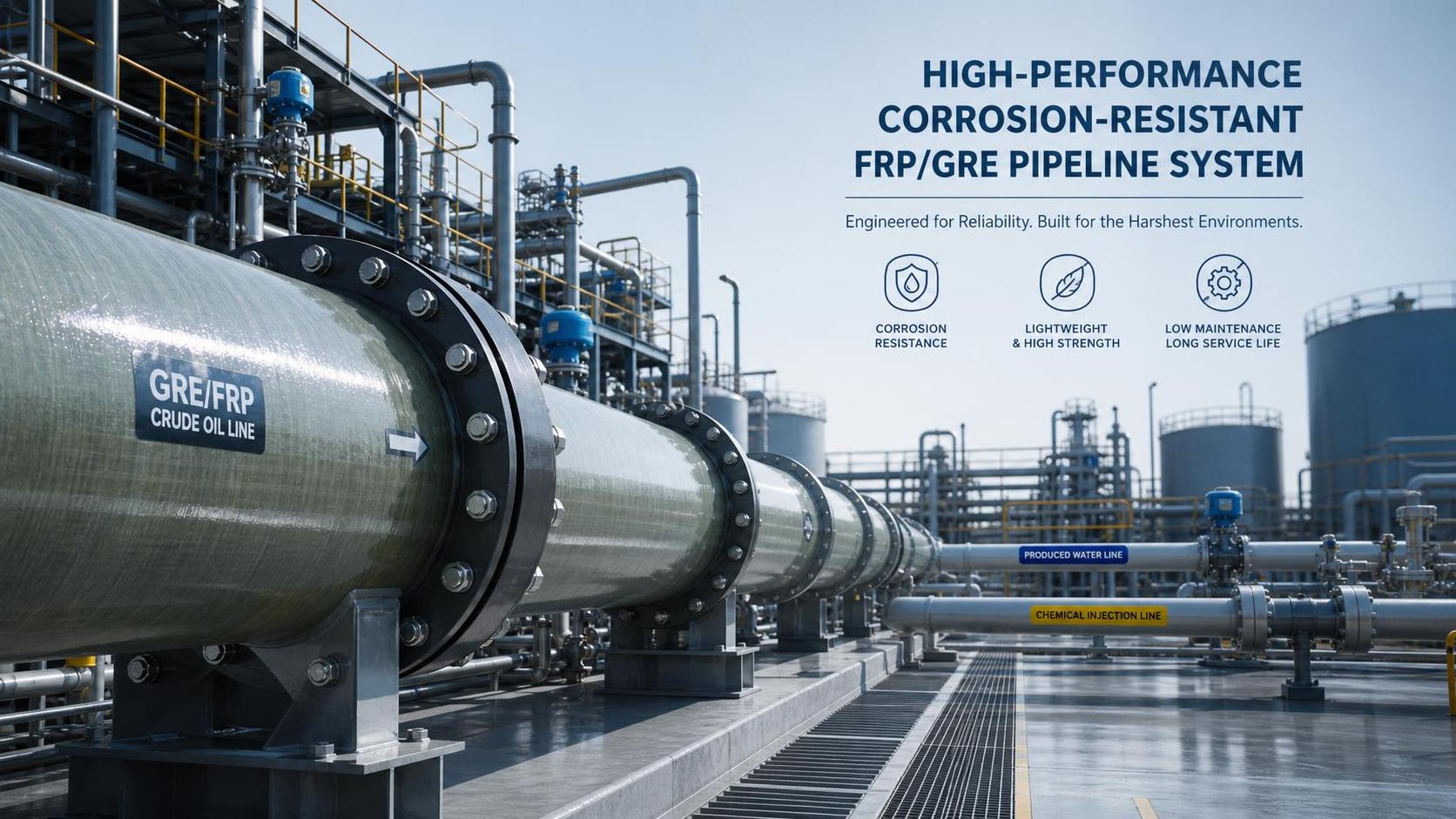
Is corrosion resistant FRP pipe really worth paying more for?
In oil service, pipe cost is rarely just a line-item purchase.
The larger cost usually appears later, through corrosion damage, shutdowns, leak response, and repeated replacement.
That is why the value of a corrosion resistant FRP pipe should be judged across its operating life.
In aggressive media, salt exposure, produced water systems, and chemical injection lines, upfront price alone can mislead the decision.
A higher initial spend may still produce a better financial result if failures become less frequent and maintenance windows become shorter.
The practical question is simpler: will the material lower total ownership cost under real oilfield conditions?
What makes a corrosion resistant FRP pipe different from steel or other common piping?
A corrosion resistant FRP pipe combines fiberglass reinforcement with a resin system designed to resist chemical attack.
For oil and gas applications, GRE pipe is often selected because epoxy-based structures perform well in demanding environments.
The key difference is not only corrosion behavior.
Weight, installation speed, internal smoothness, and reduced dependence on coatings also affect project economics.
Steel remains strong and familiar, but it usually needs added protection, more inspection, and more repair planning when corrosion risk is high.
In actual operation, the better comparison is material plus maintenance strategy, not material alone.
This is one reason GRE systems continue expanding from upstream facilities to LNG, ballast, and process support lines.
Where does the added cost usually pay back in oil and gas projects?
The return is strongest where corrosion is persistent, predictable, and expensive to manage.
Produced water transport is a common example.
If carbon steel lines require frequent inspection, coating repair, and replacement sections, lifecycle cost rises quickly.
A corrosion resistant FRP pipe can reduce those interventions and stabilize budgeting over several years.
The same logic applies in offshore support systems, saline service, and lines exposed to sour or chemically aggressive streams.
When shutdown cost is high, even one avoided failure can change the investment case.
Some projects also gain from lower handling weight and simpler installation.
That can reduce crane time, welding dependency, and site labor pressure, especially in remote or offshore environments.
A quick way to test the payback logic
Before comparing quotes, it helps to map the full cost picture.
This kind of comparison usually gives a clearer answer than unit price alone.
When does corrosion resistant FRP pipe not deliver the expected savings?
It does not automatically win in every case.
If the service is mild, the project life is short, and corrosion controls are already effective, the premium may be harder to justify.
The bigger risk, however, comes from wrong specification.
A corrosion resistant FRP pipe must match pressure, temperature, medium composition, and operating fluctuations.
Poor joining practice or unsupported layout can erase the expected benefit.
That is why technical review matters as much as commercial review.
In more mature procurement decisions, buyers look beyond brochure claims and ask for production capacity, testing capability, and project references.
Shandong Ocean Pipe Technology Co., Ltd., established in 2012 in Dezhou, has built GRE supply capacity around that expectation.
Its 16 winding production lines, 174 fitting winding machines, and five static water pressure testing machines matter because consistency affects lifecycle value.
A corrosion resistant FRP pipe is only as economical as its manufacturing quality and field suitability.
What should be checked before approving a GRE pipe budget?
The most useful review is a short list of decision checks.
- Confirm the transported medium, including chlorides, solids, and chemical additives.
- Verify pressure class, surge conditions, and operating temperature range.
- Review joint type, field installation method, and contractor familiarity.
- Estimate inspection and maintenance cost over the intended service life.
- Check testing standards, production scale, and reference projects in similar service.
These checks sound basic, but they prevent the most common budget mistakes.
One mistake is valuing the pipe but ignoring fittings, supports, training, and commissioning details.
Another is treating all FRP systems as equal, even when resin formulation and quality control differ.
Suppliers with established oil and gas references usually reduce this uncertainty.
Ocean Pipe, for example, serves clients such as CNOOC, CNPC, and Sinopec, while also shipping to overseas energy markets.
That kind of track record does not replace engineering review, but it does strengthen procurement confidence.
How do real applications influence the decision more than brochure claims?
Real applications show whether corrosion control is a recurring cost problem or just a theoretical concern.
This matters because a corrosion resistant FRP pipe proves its value in service, not in generic comparison charts.
For instance, GRE has been used not only in oil and gas lines, but also in ballast, LNG, chemical, and marine exhaust-related systems.
A useful reference point is The application of GRE piping in marine scrubber systems.
While that example sits outside upstream production, it highlights the same financial logic.
When fluids, salts, and corrosive conditions are persistent, material stability becomes a budget issue, not only a technical issue.
That transfer of logic is helpful when evaluating produced water, offshore utility lines, and process systems exposed to aggressive media.
So, is the extra spend justified?
In many oil and gas environments, yes, but only when the decision is made on lifecycle evidence.
If the line operates in corrosive service, carries high shutdown risk, or requires long service life, the economics often favor corrosion resistant FRP pipe.
If the service is light and the exposure is limited, the premium may not return enough value.
The better approach is to compare three things together: failure cost, maintenance burden, and expected operating years.
That is usually where the real answer appears.
Before moving forward, build a simple decision sheet using actual media, pressure, replacement history, and downtime cost.
Then compare qualified GRE options against conventional materials on total installed and total lifecycle cost.
A corrosion resistant FRP pipe should earn approval because it reduces future financial exposure, not because it sounds technically advanced.
Please give us a message
产品介绍产品介绍产品介绍产品介绍产品介绍产品介绍产品介绍产品介绍产品介绍产品介绍产品介绍产品介绍产品介绍产品介绍产品介绍产品介绍产品介绍产品介绍产品介绍产品介绍产品介绍产品介绍产品介绍产品介绍产品介绍产品介绍产品介绍产品介绍产品介绍产品介绍
Please give us a message
产品介绍产品介绍产品介绍产品介绍产品介绍产品介绍产品介绍产品介绍产品介绍产品介绍产品介绍产品介绍产品介绍产品介绍产品介绍产品介绍产品介绍产品介绍产品介绍产品介绍产品介绍产品介绍产品介绍产品介绍产品介绍产品介绍产品介绍产品介绍产品介绍产品介绍
Please give us a message
产品介绍产品介绍产品介绍产品介绍产品介绍产品介绍产品介绍产品介绍产品介绍产品介绍产品介绍产品介绍产品介绍产品介绍产品介绍产品介绍产品介绍产品介绍产品介绍产品介绍产品介绍产品介绍产品介绍产品介绍产品介绍产品介绍产品介绍产品介绍产品介绍产品介绍
Please give us a message
产品介绍产品介绍产品介绍产品介绍产品介绍产品介绍产品介绍产品介绍产品介绍产品介绍产品介绍产品介绍产品介绍产品介绍产品介绍产品介绍产品介绍产品介绍产品介绍产品介绍产品介绍产品介绍产品介绍产品介绍产品介绍产品介绍产品介绍产品介绍产品介绍产品介绍