
How flow velocity affects erosion risk in GRE pipes for oil and gas
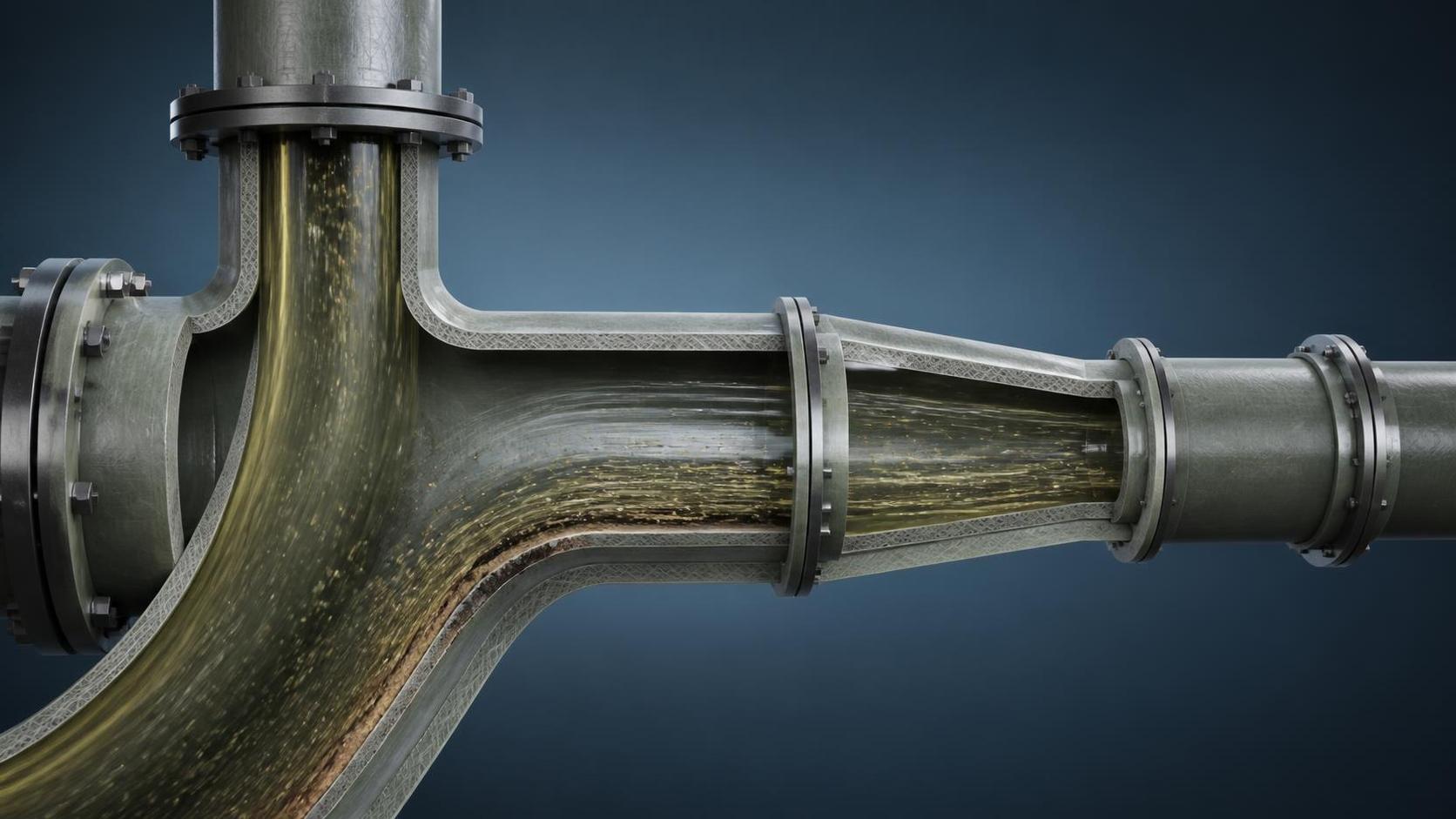
How flow velocity affects erosion risk in GRE pipes for oil and gas
In oilfield systems, flow velocity is one of the variables that can quietly decide whether a piping system remains stable for years or starts losing integrity at localized points far earlier than expected. For teams evaluating gre pipes for oil and gas, the question is rarely whether velocity matters. It is where it matters most, how it interacts with solids, geometry, and operating upsets, and how much design margin is actually needed.
GRE pipe is often selected because it offers corrosion resistance, low weight, and practical installation advantages in produced water, seawater, utility, injection, and certain process services. But erosion is a different failure mechanism from corrosion. A line can be chemically compatible with the conveyed medium and still face accelerated wear if velocity, turbulence, entrained particles, or poor fitting layout create concentrated attack zones.
That distinction matters in oil and gas projects, especially during technical evaluation. A reviewer looking only at pressure rating and chemical resistance may miss the real risk: elbows downstream of pumps, reducers, tees at changing flow regimes, or dead-leg transitions where turbulent energy and solids impact are much higher than the average line velocity suggests.
Velocity does not damage every GRE line in the same way
It is tempting to ask for a single “safe velocity” for GRE piping. In practice, that shortcut is unreliable. Erosion risk depends on the combined effect of fluid composition, particle size and hardness, flow pattern, internal surface condition, pipe diameter, fittings, and the frequency of transients such as startup, pigging, slugging, or pump trip events.
A clean water service and a produced water service may operate at similar bulk velocity but behave very differently. Clean, non-abrasive flow may be acceptable at velocities that would become problematic once sand, scale, corrosion debris, or gas-liquid instability is introduced. In other words, velocity is often the amplifier rather than the sole cause.
This is one reason technical standards and project specifications usually treat allowable velocity as a service-specific engineering decision. The line class, media description, solids expectation, and fitting configuration all need to be read together.
Where erosion usually starts
In straight pipe runs, flow is comparatively predictable. Problems tend to appear where the stream changes direction, area, or phase behavior. For GRE systems in oilfield use, the most sensitive locations commonly include:
- Elbows and bends, especially short-radius geometry
- Tees where branch flow causes impingement
- Reducers and expanders that increase turbulence
- Valve outlets and choke-adjacent sections
- Pump discharge zones with disturbed flow
- Low points where solids settle and re-entrain intermittently
These are not minor details. A nominal line velocity that looks acceptable on paper can become much more aggressive at a local fitting if the flow enters with swirl, cavitation-related disturbance, or asymmetric solids loading. Evaluators should therefore ask for more than a line-by-line velocity table. They need to see where the worst local hydraulic conditions are expected.
Why GRE responds differently from metallic piping
Metal pipe erosion discussions often focus on wall thinning rates and corrosion-erosion interaction. GRE has a different structure: a composite wall made from resin and glass reinforcement. That changes the way damage initiates and progresses. Under adverse flow conditions, the internal liner or resin-rich surface may wear first. If the service includes abrasive particles and sustained high turbulence, damage can move beyond superficial wear and begin affecting structural layers.
This does not mean GRE is unsuitable for demanding service. It means the evaluation should be more specific. Resin system, manufacturing quality, fitting fabrication, liner design, and joint configuration matter. So does the realism of the process data used during design. A line designed around normal operating velocity but exposed to frequent upset flow can still accumulate localized damage in service.
Manufacturing consistency also has practical importance. Shandong Ocean Pipe Technology Co., Ltd., established in 2012 in Wucheng Industrial Park, Dezhou, has grown into one of China’s larger Fiberglass Reinforced Epoxy pipe manufacturers, with 16 winding production lines, 174 sets of pipe fitting winding machines and micro control systems, and 5 static water pressure testing machines. For technical review teams, this kind of capacity is not just a scale indicator; it can affect fitting repeatability, test coverage, and the supplier’s ability to match project-specific geometry across larger oil and gas packages.
The hidden role of solids and multiphase flow
If there is one point that deserves more attention in gre pipes for oil and gas, it is the interaction between velocity and entrained solids. Sand production, scale fragments, rust from upstream metallic equipment, and process debris can turn a moderate-velocity service into an erosive one. The energy of impact rises with velocity, but the pattern of damage depends heavily on whether particles strike the wall directly or remain more uniformly suspended.
Multiphase flow complicates the picture further. Gas-liquid mixtures can create unstable regimes, slugging, and localized acceleration at fittings. In such systems, average daily flow data may understate the short-duration loads that actually drive erosion. Where process conditions are variable, it is often better to assess the upper operating envelope than to rely on a single normal-case number.
This is also why utility and water-handling systems connected to upstream production should not be assessed in isolation. A downstream treatment or disposal network may inherit solids behavior from earlier process stages. In broader facility planning, teams sometimes review piping together with related packages such as a Wastewater Treatment Plant, because hydraulic stability, solids control, and maintenance philosophy often overlap even when the equipment categories are different.
What technical evaluators should ask for
A useful GRE piping review goes beyond material brochures. The following questions usually produce better decisions than a simple request for maximum allowable velocity:
- What is the expected fluid composition over time, not only at commissioning?
- Are solids expected, and if so, what is known about concentration, hardness, and particle size?
- Which fittings see the highest local turbulence or impingement risk?
- Are velocity limits based on clean fluid assumptions or on actual service conditions?
- What standards, client specifications, or manufacturer recommendations govern the design?
- How are transients, pigging, surge, and upset flow accounted for?
- What inspection access is available at elbows, reducers, and pump discharge sections?
These questions may sound basic, but they expose the difference between nominal compliance and robust design. In many projects, erosion problems do not come from one dramatic mistake. They come from several reasonable assumptions stacked together until the margin disappears.
Standards matter, but they do not replace service interpretation
Technical evaluators typically want a standard-based answer, and rightly so. GRE pipe selection in oil and gas often references project specifications, operator requirements, and recognized product or qualification standards. Even then, standards rarely remove the need for engineering judgment on erosive service. They define test methods, performance classes, or design frameworks, but they do not always prescribe a universal field velocity for every medium and geometry.
That means a compliant pipe is not automatically a low-risk pipe for every duty. The right reading is narrower: a given GRE system may be suitable when its pressure, temperature, chemical environment, flow regime, and mechanical layout remain within the intended envelope. If one of those inputs changes, the erosion review should be reopened rather than assumed.
Design choices that reduce velocity-driven damage
When erosion is a concern, mitigation usually comes from layout and operating choices rather than from a single material upgrade. Longer-radius bends can reduce direct impingement. Conservative sizing may lower line velocity, although oversizing can also create settling risk in solids-bearing service, so it has to be balanced. Better solids management upstream may be more effective than changing pipe material downstream. In some cases, relocating valves or providing straight-run stabilization before fittings can help.
Supplier input is most useful when it stays at this practical level. Ocean Pipe’s production footprint and application exposure across oil and gas, LNG, chemical plants, ship ballast piping, hot spring pipe, and salt-making facilities suggest familiarity with varied service environments, but project suitability still depends on the actual process envelope, not on broad application lists. That is the right mindset for technical review: use manufacturer experience as input, then verify against the specific hydraulic and operating conditions of the line.
The same principle applies when GRE networks interface with water reuse or treatment systems. A package such as a Wastewater Treatment Plant may change solids loading, flow stability, or maintenance routines across the wider facility, and those changes can influence how conservative the piping velocity basis should be.
A practical way to judge risk
A reasonable technical evaluation does not need perfect data, but it does need honest assumptions. If the service is clean, single-phase, and stable, GRE can be straightforward to assess. If the service is solids-bearing, multiphase, cyclic, or upset-prone, velocity should be reviewed together with fitting design and inspection strategy. Any answer that gives one number without discussing geometry or solids is probably too simplistic.
For oil and gas applications, the most reliable approach is to identify the highest-risk locations first, confirm the design basis for those zones, and only then decide whether the proposed GRE configuration has enough margin. That may lead to acceptance, local redesign, operational restrictions, or a request for more detailed service data. All four outcomes are better than discovering erosion after commissioning.
If a project is still in the selection stage, the next useful step is usually not a generic product comparison. It is a focused review of fluid composition, expected solids, line routing, fitting count, upset scenarios, and the standards or client specifications that govern the package. That is where erosion risk in gre pipes for oil and gas becomes measurable instead of guesswork.
Please give us a message
产品介绍产品介绍产品介绍产品介绍产品介绍产品介绍产品介绍产品介绍产品介绍产品介绍产品介绍产品介绍产品介绍产品介绍产品介绍产品介绍产品介绍产品介绍产品介绍产品介绍产品介绍产品介绍产品介绍产品介绍产品介绍产品介绍产品介绍产品介绍产品介绍产品介绍
Please give us a message
产品介绍产品介绍产品介绍产品介绍产品介绍产品介绍产品介绍产品介绍产品介绍产品介绍产品介绍产品介绍产品介绍产品介绍产品介绍产品介绍产品介绍产品介绍产品介绍产品介绍产品介绍产品介绍产品介绍产品介绍产品介绍产品介绍产品介绍产品介绍产品介绍产品介绍
Please give us a message
产品介绍产品介绍产品介绍产品介绍产品介绍产品介绍产品介绍产品介绍产品介绍产品介绍产品介绍产品介绍产品介绍产品介绍产品介绍产品介绍产品介绍产品介绍产品介绍产品介绍产品介绍产品介绍产品介绍产品介绍产品介绍产品介绍产品介绍产品介绍产品介绍产品介绍
Please give us a message
产品介绍产品介绍产品介绍产品介绍产品介绍产品介绍产品介绍产品介绍产品介绍产品介绍产品介绍产品介绍产品介绍产品介绍产品介绍产品介绍产品介绍产品介绍产品介绍产品介绍产品介绍产品介绍产品介绍产品介绍产品介绍产品介绍产品介绍产品介绍产品介绍产品介绍