
Choosing Fiberglass Pipe for High-Pressure Oilfield Flowlines
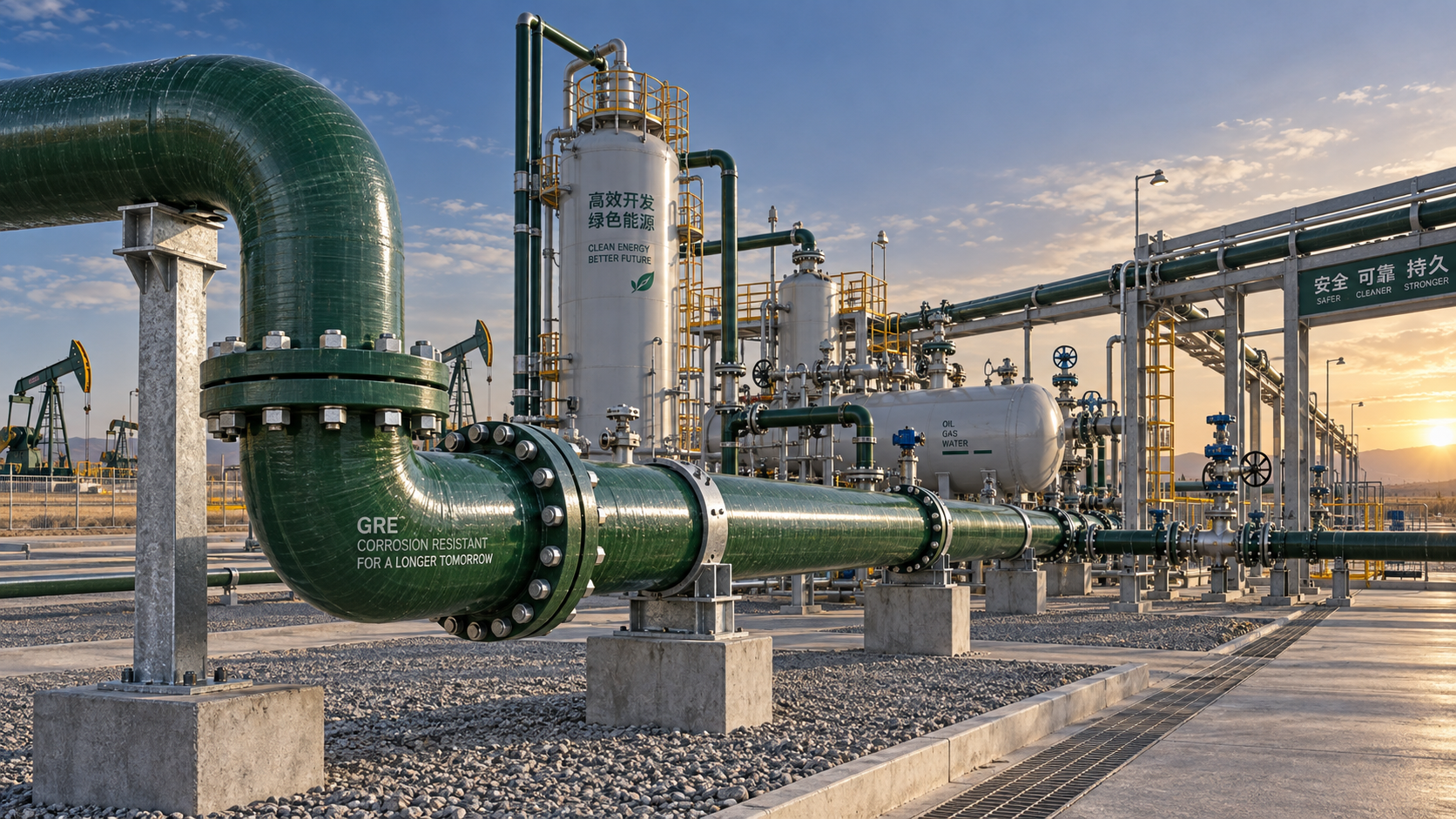
A high-pressure oilfield flowline should not be specified from a pressure class alone. Fiberglass Pipe can be a strong choice where produced water, saline fluids, corrosive injection media, or aggressive external environments make steel maintenance-heavy, but it must be evaluated as a complete pipe system: pipe wall, resin system, fittings, joints, supports, and installation controls.
The practical question is not simply whether a GRE line can withstand the stated operating pressure. It is whether the selected system will retain its pressure capability, chemical resistance, joint integrity, and mechanical stability throughout the real operating envelope, including start-up, shut-in, pressure cycling, temperature changes, and field handling.
Start with the actual duty, not the nominal line pressure
For a high-pressure flowline, the first screening step is to define the fluid and operating profile in enough detail for the manufacturer to design the laminate and jointing system. “Oilfield service” is too broad a description. A line carrying dry crude, produced water, water with dissolved gas, chemical-treated water, or multiphase fluid can impose very different demands on Fiberglass Pipe.
Document the normal operating pressure, expected peak pressure, pressure-test condition, operating temperature range, fluid composition, solids content, gas content, and the frequency of pressure or temperature cycles. Transient events deserve particular attention. Pump starts, rapid valve closure, slug flow, and shut-in can create short-duration loads that are more severe than steady-state operating conditions.
A pipe selected only for a stable pressure value may be poorly matched to a line with frequent cycling. Composite pipe responds differently from steel: it does not corrode like carbon steel, but its long-term behavior depends on the resin, reinforcement architecture, temperature, chemical exposure, and sustained stress. The design basis needs to reflect all of those conditions.
Pressure rating is a system property
For GRE pipe, the pressure capacity of the straight pipe is only one part of the assessment. Elbows, tees, reducers, flanges, adhesive-bonded joints, laminated joints, and mechanical connections must be compatible with the same design conditions. A strong pipe body does not compensate for an incorrectly selected fitting or an installation-sensitive joint.
Ask how the supplier establishes pressure capability for the proposed diameter and wall construction, and whether the stated rating applies at the intended operating temperature and fluid exposure. Also distinguish between continuous operating pressure, occasional surge conditions, and hydrostatic test pressure. Treating these as one interchangeable number is a common specification error.
Joint selection should be evaluated early because it changes both installation risk and future maintenance. Adhesive-bonded joints can provide a smooth internal bore and are widely used in composite piping, but their performance depends on correct surface preparation, adhesive handling, alignment, cure conditions, and installer discipline. Flanged connections simplify access to valves and equipment, yet require attention to gasket compatibility, bolt loading, flange alignment, and restraint against movement.
Questions that expose weak specifications
- Does the proposed pressure rating cover the full temperature range, not only ambient conditions?
- What surge cases have been included in the design pressure basis?
- Are fittings and joints rated for the same service, diameter, and operating envelope as the pipe?
- What installation tolerances and curing controls apply to field joints?
- How will the completed line be pressure tested, inspected, and accepted?
If these questions cannot be answered clearly, the specification is not complete enough for procurement.
Match the resin system to the fluid chemistry
“Fiberglass” describes the reinforcement, not the chemical barrier. In oilfield flowlines, the resin and liner construction largely determine how the pipe handles exposure to produced water, hydrocarbons, dissolved salts, treatment chemicals, acids, or other process fluids. Chemical resistance therefore cannot be inferred from the product name alone.
The evaluation should consider the complete fluid composition and the way it changes during operation. A water line may be exposed to intermittent chemical dosing. A crude line may carry water, gas, aromatic components, solids, or cleaning media. Temperature can accelerate chemical effects, so a resin that is suitable at one temperature may not be appropriate at another.
Request a service-specific compatibility review rather than a general statement that the material is corrosion resistant. The review should cover normal operation, cleaning fluids, upset conditions that are reasonably foreseeable, and the duration of exposure. Internal corrosion resistance is valuable only when the resin system is suited to the actual chemistry.
External exposure also matters. Buried pipelines may face wet soil, saline ground, groundwater, and settlement. Above-ground lines can see ultraviolet exposure, weathering, support abrasion, and mechanical impact. The external protection and installation method should be selected for the location instead of assumed to be identical across the facility.
Mechanical design is where many fiberglass pipe decisions fail
Fiberglass Pipe is light compared with steel and does not require corrosion allowance in the same way, but it is not a drop-in mechanical substitute for steel. It needs appropriate support spacing, guide locations, anchors, bends, and restraints. Unsupported spans, uneven supports, point loads, and poorly controlled flange connections can create local stresses that are not apparent in a simple pressure calculation.
For above-ground flowlines, review thermal movement, support configuration, vibration near pumps, and the possibility of accidental impact. A composite line can perform well when it is continuously and evenly supported, while localized contact or excessive clamp force can damage the outer surface. Supports should avoid sharp edges and allow the intended movement without creating abrasion.
For buried lines, the pipe-soil system becomes part of the design. Trench preparation, bedding, sidefill, compaction, cover depth, traffic loading, and ground movement influence deflection and long-term performance. A buried GRE line should not be evaluated only by its internal pressure rating. The installation specification needs to state how the line will be supported by the surrounding soil.
Do not treat temperature as a secondary condition
Temperature affects more than pressure capability. It can alter resin behavior, accelerate chemical attack, change stiffness, influence thermal expansion, and affect the performance of joints and seals. The correct design temperature is the highest credible pipe-wall temperature, not merely the average fluid temperature.
Temperature cycling needs separate attention. A line that repeatedly heats and cools will move, and connected steel equipment may move differently. That difference must be managed through layout, flexible sections where appropriate, guides, anchors, and properly designed transitions. Rigidly restraining a composite line without accounting for movement can transfer stress into fittings and joints.
Evaluate interfaces with steel, valves, and process equipment
Most oilfield systems are mixed-material systems. GRE pipe commonly connects to steel headers, pumps, separators, filters, valves, and instrumentation. These transitions should be designed as functional interfaces, not treated as standard details added after the pipe is selected.
Check flange facing, pressure class, gasket selection, bolt-tightening procedure, alignment tolerance, and the weight carried by connected equipment. Fiberglass flanges should not be used to correct poor piping alignment or to support heavy valves. Independent support is often required so that equipment weight and operational loads do not transfer into the composite pipe.
This point also applies to adjacent composite equipment. In water-treatment or produced-water handling packages, an FRP/GRE Membrane Housing may be part of the broader process arrangement. Its connection requirements, operating pressure, maintenance access, and support arrangement should be considered alongside the flowline rather than after the piping layout has been fixed.
Compare lifecycle cost through the maintenance plan
Initial material price is rarely the most useful comparison between GRE and metallic piping. A better comparison asks what inspection, coating repair, corrosion monitoring, replacement work, shutdown exposure, transport effort, and installation labor each option creates over the expected operating period.
GRE can reduce corrosion-related maintenance in suitable services, particularly where internal or external corrosion is a persistent issue. That advantage is weakened if the project underestimates installation quality, mishandles joints, or uses a support design developed for steel without modification. The economics depend on the whole system being designed and installed as composite piping.
Supplier capability should therefore be reviewed beyond brochure claims. Useful evidence includes manufacturing traceability, control of winding and fitting production, pressure-testing capability, quality documentation, installation procedures, field-joint training, and inspection support. For projects requiring a coordinated GRE supply, a manufacturer with dedicated winding lines, fitting production capacity, and static pressure-testing facilities can provide a more coherent system package than a pipe-only source.
A practical approval sequence
- Define fluid chemistry, pressure profile, temperature range, surge cases, and installation environment.
- Select a resin and liner construction that is compatible with the full fluid and temperature envelope.
- Confirm pipe, fittings, and joint types as one pressure-rated system.
- Review supports, anchors, buried installation details, transitions, and equipment loads.
- Set field installation controls, pressure-test procedures, inspection points, and acceptance records before material release.
The strongest selection outcome is usually not the pipe with the highest published pressure figure. It is the system whose material construction, jointing method, mechanical layout, and installation controls all match the conditions the flowline will actually experience.
Please give us a message
产品介绍产品介绍产品介绍产品介绍产品介绍产品介绍产品介绍产品介绍产品介绍产品介绍产品介绍产品介绍产品介绍产品介绍产品介绍产品介绍产品介绍产品介绍产品介绍产品介绍产品介绍产品介绍产品介绍产品介绍产品介绍产品介绍产品介绍产品介绍产品介绍产品介绍
Please give us a message
产品介绍产品介绍产品介绍产品介绍产品介绍产品介绍产品介绍产品介绍产品介绍产品介绍产品介绍产品介绍产品介绍产品介绍产品介绍产品介绍产品介绍产品介绍产品介绍产品介绍产品介绍产品介绍产品介绍产品介绍产品介绍产品介绍产品介绍产品介绍产品介绍产品介绍
Please give us a message
产品介绍产品介绍产品介绍产品介绍产品介绍产品介绍产品介绍产品介绍产品介绍产品介绍产品介绍产品介绍产品介绍产品介绍产品介绍产品介绍产品介绍产品介绍产品介绍产品介绍产品介绍产品介绍产品介绍产品介绍产品介绍产品介绍产品介绍产品介绍产品介绍产品介绍
Please give us a message
产品介绍产品介绍产品介绍产品介绍产品介绍产品介绍产品介绍产品介绍产品介绍产品介绍产品介绍产品介绍产品介绍产品介绍产品介绍产品介绍产品介绍产品介绍产品介绍产品介绍产品介绍产品介绍产品介绍产品介绍产品介绍产品介绍产品介绍产品介绍产品介绍产品介绍