
Fiberglass Pipe Explained: Where It Fits in Oilfield Fluid Transport
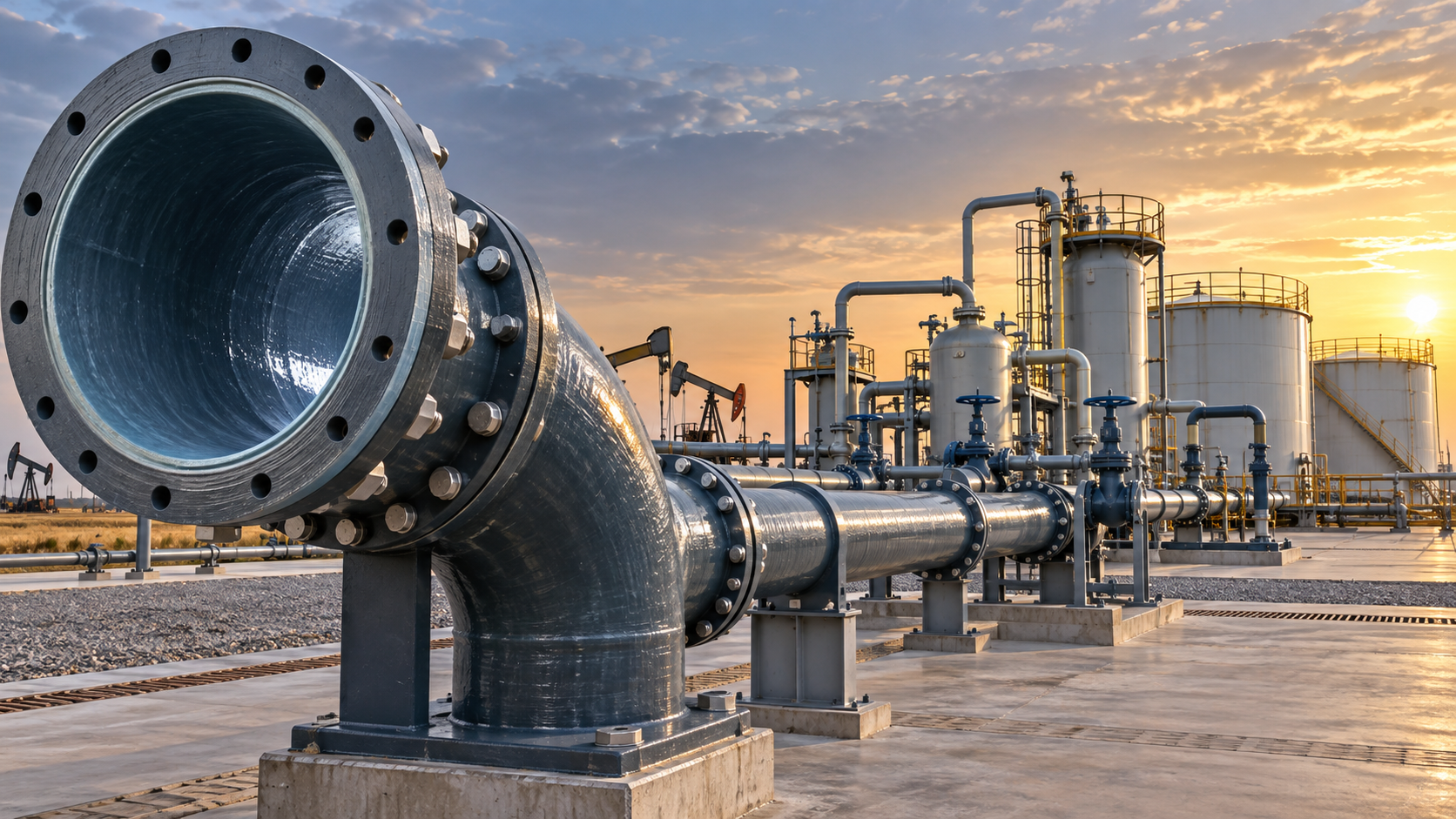
Fiberglass pipe earns its place in oilfield fluid transport when the dominant problem is corrosion rather than extreme temperature, extreme pressure, or severe mechanical abuse. In this context, the term usually refers to a composite pipe made from glass-fiber reinforcement embedded in a resin matrix. For many oil and gas applications, the relevant product is fiberglass reinforced epoxy (GRE) pipe: a pipe system designed to resist corrosive produced water, brines, selected chemicals, seawater, and other fluids that can make carbon-steel piping expensive to maintain.
The key point is that fiberglass pipe is not a universal replacement for steel. It is a material system with a different failure logic, installation method, and operating envelope. Steel is valued for high mechanical robustness, temperature tolerance, weldability, and familiarity. GRE is valued for corrosion resistance, low mass, smooth internal surfaces, and the ability to avoid some of the coatings, corrosion allowances, and repair cycles associated with metallic lines. Whether it fits an oilfield depends less on a general comparison of “composite versus steel” than on the specific fluid, pressure regime, temperature, route, jointing method, and consequences of failure.
What fiberglass pipe actually is
A fiberglass pipe wall is not simply plastic reinforced with fibers. Its performance comes from the relationship between three elements: the resin, the glass fibers, and the wall construction. The resin forms the corrosion barrier and binds the laminate together. Glass fibers carry much of the structural load. The orientation and amount of reinforcement influence hoop strength, axial strength, stiffness, and pressure capability.
GRE pipe commonly uses epoxy resin because epoxy systems can provide useful chemical resistance and mechanical performance in many industrial fluid services. Other fiberglass pipe systems may use polyester or vinyl ester resins, each with different chemical and temperature characteristics. This distinction matters. “Fiberglass” does not identify chemical compatibility on its own; the resin formulation, liner construction, cure quality, and service conditions must all be considered.
Many GRE pipes are produced by filament winding. Continuous glass fibers, wetted with resin, are wound onto a mandrel in controlled patterns. The process can produce a consistent laminate structure and allows the manufacturer to design the pipe around required pressure and stiffness criteria. Fittings are equally important. Elbows, tees, reducers, flanges, and branches must have compatible pressure ratings and geometry, rather than being treated as minor accessories to a pipe run.
Where it fits in oilfield fluid transport
The strongest case for fiberglass pipe is often found in services where the fluid creates sustained internal corrosion risk but the operating conditions remain within the composite system’s qualified limits. Produced-water transport is a prominent example. Produced water can contain dissolved salts, residual hydrocarbons, solids, treatment chemicals, and, depending on the field, gases or microorganisms that contribute to corrosion mechanisms in steel systems. A nonmetallic internal surface can remove the electrochemical corrosion pathway that affects bare carbon steel.
Water injection and disposal lines may also be suitable where fluid chemistry and pressure are compatible with the selected GRE design. These networks can be extensive, and lifecycle maintenance becomes material to operating economics when a steel system would otherwise need internal coating, corrosion inhibitor programs, regular inspection, localized spool replacement, or cathodic protection measures for external exposure.
Other potential applications include:
- Produced-water gathering lines and transfer lines;
- Brine and saline-water transport;
- Seawater utility, cooling, and firewater systems at coastal or offshore-related facilities;
- Chemical dosing lines where the selected resin has confirmed compatibility;
- Refinery and terminal utility services with corrosive aqueous media;
- Low- to moderate-temperature drainage, effluent, and waste-fluid systems.
The phrase “oilfield fluid transport” should not be understood as limited to production flowlines carrying untreated multiphase wellstream. A full wellstream may combine hydrocarbons, gas, water, entrained solids, pressure fluctuations, and elevated temperature. Those conditions can demand a more specialized engineering assessment than a relatively stable water-transfer duty. Fiberglass pipe can be used in certain hydrocarbon-related services, but the decision requires explicit confirmation of permeation behavior, static dissipation requirements where relevant, fluid composition, pressure cycling, and fire-performance obligations.
Why corrosion resistance changes the operating equation
Carbon steel is often the baseline material because it is widely available, mechanically durable, and supported by familiar construction practices. Yet in corrosive water service, the apparent simplicity of steel can conceal a broader system burden. Corrosion allowance increases wall thickness and weight. Linings or coatings introduce preparation and inspection requirements. Chemical treatment may reduce corrosion risk but becomes an operating dependency. Repairs can require shutdowns, hot-work controls, or replacement of affected spools.
Fiberglass pipe changes that equation because the conveyed fluid does not contact a metallic bore. Its resistance is not unlimited: aggressive oxidizers, aromatic solvents, concentrated acids or alkalis, high temperatures, and certain chemical combinations can degrade a resin system. However, where epoxy compatibility is established, GRE avoids the internal rusting mechanism that drives many failures in conventional steel water lines.
The smooth internal surface can also matter. A relatively low-roughness bore may reduce friction losses compared with aged steel pipe that has accumulated corrosion products or scale. That does not mean hydraulic performance should be assumed from a generic material claim. Design calculations still need the actual internal diameter, fittings, flow velocity, solids content, and expected condition of the line over time. In abrasive duties, suspended sand and solids can shift the question from corrosion resistance to erosion resistance, which is a different problem.
Low weight is useful, but it is not merely a logistics benefit
GRE pipe is substantially lighter than equivalent steel pipe, which can simplify transport, handling, and installation where lifting capacity is constrained. This is valuable in remote fields, congested plants, elevated pipe racks, marine facilities, and projects where construction access is difficult.
The greater implication is structural. Lighter pipe can reduce support loads and make manual positioning easier for smaller diameters. At the same time, its lower stiffness and different thermal expansion behavior require a support design specific to composite piping. A steel support arrangement cannot automatically be copied. Unsupported spans, clamp geometry, guide spacing, vibration exposure, thermal movement, and restraint locations need review. Excessive point loads, overly tight clamps, or poor support spacing can damage a composite pipe even when its internal pressure rating is adequate.
External conditions also matter. Buried pipe needs a proper trench, bedding, backfill selection, and compaction approach. Composite pipe can perform well underground, but poor installation can create uneven support, local deformation, or concentrated loads. Above ground, exposure to sunlight, mechanical impact, vehicle movement, and fire zones should be assessed rather than treated as secondary matters.
The limitations that determine whether steel remains the better choice
Temperature is one of the first screening factors. A GRE system has a defined maximum operating temperature linked to its resin, reinforcement, pressure rating, service life assumptions, and chemical environment. As temperature rises, resin properties can change and allowable pressure may decline. A pipe that is appropriate for ambient produced water may not be suitable for hot produced fluids, high-temperature injection duty, or process lines near heaters and separators.
Pressure alone is also not enough. Oilfield systems can experience pressure surges caused by pump starts, valve closure, rapid flow changes, or emergency shutdown conditions. Surge analysis should use the actual pipe system behavior, including material stiffness and wave speed. The governing design condition may be a transient event rather than normal operating pressure.
Mechanical damage is another boundary. Steel generally tolerates localized impacts, field modification, and rough handling more readily than composite pipe. GRE requires controlled cutting, end preparation, joint assembly, and protection against impact. It should not be selected on the assumption that field crews can repair or alter it using the same methods applied to welded steel spools.
Fire exposure deserves separate attention. Standard composite pipe systems are not interchangeable with fire-rated systems. Where a line must retain pressure or function during a defined fire scenario, the applicable project requirement and the product’s demonstrated qualification are decisive. A corrosion-resistant pipe is not automatically appropriate for a fire-critical service.
Joints are part of the piping system, not an installation detail
Fiberglass pipe performance depends heavily on joint selection and workmanship. Common joint types include adhesive-bonded socket joints, threaded connections for some smaller sizes and duties, flanged joints, and laminated or wrapped field joints in particular systems. Each has different requirements for alignment, surface preparation, cure time, torque control, and inspection.
Adhesive-bonded joints can provide a smooth and corrosion-resistant connection, but they are sensitive to preparation discipline. Contamination, incorrect adhesive mixing, insufficient cure, misalignment, or installation outside the permitted temperature range can compromise the joint. Flanged connections are useful at valves, equipment nozzles, and transition points, yet flange faces must be protected from uneven bolt loading. Excessive torque can damage composite flanges; insufficient or nonuniform torque can cause leakage.
This is why pipe specification should include more than nominal diameter and pressure class. The project needs a defined jointing system, installer qualification expectations, inspection method, cure requirements where applicable, and pressure-testing procedure. The quality of a composite piping installation is inseparable from the quality of its field assembly.
Chemical compatibility must reflect the real fluid, not its broad label
Calling a service “produced water” or “chemical water” is not enough for material selection. A compatibility review should identify water chemistry, salinity, pH, temperature, hydrocarbon content, dissolved gases, treatment chemicals, cleaning chemicals, and credible upset conditions. A pipe may be compatible with the normal fluid but unsuitable for a batch chemical used during cleaning or well stimulation.
Permeation also requires attention in hydrocarbon-containing service. Some chemicals can migrate into polymeric materials over time, affecting weight, stiffness, resin integrity, or emissions behavior. The risks depend on the resin system, fluid composition, temperature, pressure, and duration of exposure. A general statement that a composite pipe “resists oil and gas” is not a substitute for a documented compatibility decision.
For refinery-related corrosive utility and process support systems, a properly specified GRE Pipe for Refinery may be relevant where the fluid, temperature, pressure, and installation conditions fit the qualified design envelope. The important qualifier is “properly specified”: refinery service covers a wide range of chemicals and operating conditions, so one material designation cannot cover every line class.
How to compare fiberglass pipe with steel without oversimplifying the decision
A useful comparison begins with the failure mode the project is trying to avoid. If internal corrosion is the central cost and reliability issue, GRE deserves serious evaluation. If high temperature, frequent impact, high external load, fire survivability, or demanding pressure transients dominate, steel or another engineered solution may remain preferable.
Initial purchase price alone can distort the comparison. A steel system may require coating, corrosion allowance, welding, nondestructive examination, field painting, and later repair work. A GRE system may reduce some of those requirements but introduce factory lead-time dependence, controlled joining materials, installer training, and careful handling requirements. The relevant measure is not a generic claim of lower cost; it is the installed and operating cost of a defined line over its intended service period.
Questions that clarify the comparison include:
- What is the complete fluid chemistry in normal, startup, cleaning, and upset conditions?
- What are the maximum operating pressure, pressure cycles, and credible surge pressures?
- What temperature range applies at the pipe wall, rather than only at the source equipment?
- Will the line be buried, exposed, rack-mounted, submerged, or subject to vehicle traffic?
- Are sand, scale, or other abrasive solids present?
- What joint type is proposed, and can site conditions support consistent installation quality?
- Which project specifications, owner standards, and applicable piping codes govern design and acceptance?
These questions also prevent a common mistake: treating nominal pressure rating as the full definition of suitability. Pressure rating must be read alongside temperature, chemical environment, joint type, design life, external loads, and any stated derating factors.
What to look for in technical documentation
Reliable evaluation requires traceable documentation rather than broad material claims. A supplier should be able to identify the resin system, reinforcement type, pipe construction, size range, pressure class, temperature limits, jointing method, and chemical compatibility basis. Project teams should also request the applicable qualification or test documentation required by the contract, dimensional data, installation instructions, handling limits, and inspection guidance.
Standards can provide a common language, but they do not eliminate engineering judgment. Depending on the project and geography, specifications may refer to composite-pipe standards, oil and gas operator requirements, marine rules, pressure-piping codes, or regional regulations. The correct standard set depends on the service and installation location. A pipe qualified for one application should not be assumed compliant for another merely because both are described as industrial fluid transport.
Manufacturing capability matters most when the project requires consistent production across long pipe runs, fittings, and custom configurations. Filament-wound GRE production relies on control of winding, resin application, curing, dimensional accuracy, and hydrostatic or other required testing. For cross-border supply, documentation quality, packing method, shipment length constraints, and availability of installation support can be as consequential as the pipe body itself.
A practical place for GRE in the oilfield material mix
Fiberglass pipe is best understood as a targeted corrosion-management tool rather than a blanket substitute for metallic piping. It fits particularly well where corrosive aqueous fluids, manageable temperatures, and controlled installation conditions align with a qualified GRE system. Produced-water lines, brine transfer, water injection support systems, seawater utilities, and selected chemical services are the types of duties where its material advantages can be meaningful.
Its value declines when the service introduces conditions outside the composite design envelope: high heat, uncertain chemistry, harsh abrasion, severe external loading, uncontrolled impact risk, or fire-critical requirements. The right question is therefore not whether fiberglass pipe is “better” than steel. It is whether a specific GRE pipe design addresses the actual degradation mechanism and operating conditions of the line more effectively than the available alternatives.
Please give us a message
产品介绍产品介绍产品介绍产品介绍产品介绍产品介绍产品介绍产品介绍产品介绍产品介绍产品介绍产品介绍产品介绍产品介绍产品介绍产品介绍产品介绍产品介绍产品介绍产品介绍产品介绍产品介绍产品介绍产品介绍产品介绍产品介绍产品介绍产品介绍产品介绍产品介绍
Please give us a message
产品介绍产品介绍产品介绍产品介绍产品介绍产品介绍产品介绍产品介绍产品介绍产品介绍产品介绍产品介绍产品介绍产品介绍产品介绍产品介绍产品介绍产品介绍产品介绍产品介绍产品介绍产品介绍产品介绍产品介绍产品介绍产品介绍产品介绍产品介绍产品介绍产品介绍
Please give us a message
产品介绍产品介绍产品介绍产品介绍产品介绍产品介绍产品介绍产品介绍产品介绍产品介绍产品介绍产品介绍产品介绍产品介绍产品介绍产品介绍产品介绍产品介绍产品介绍产品介绍产品介绍产品介绍产品介绍产品介绍产品介绍产品介绍产品介绍产品介绍产品介绍产品介绍
Please give us a message
产品介绍产品介绍产品介绍产品介绍产品介绍产品介绍产品介绍产品介绍产品介绍产品介绍产品介绍产品介绍产品介绍产品介绍产品介绍产品介绍产品介绍产品介绍产品介绍产品介绍产品介绍产品介绍产品介绍产品介绍产品介绍产品介绍产品介绍产品介绍产品介绍产品介绍