
GRE Pipes for Oil and Gas: Meeting Firewater System Design Requirements
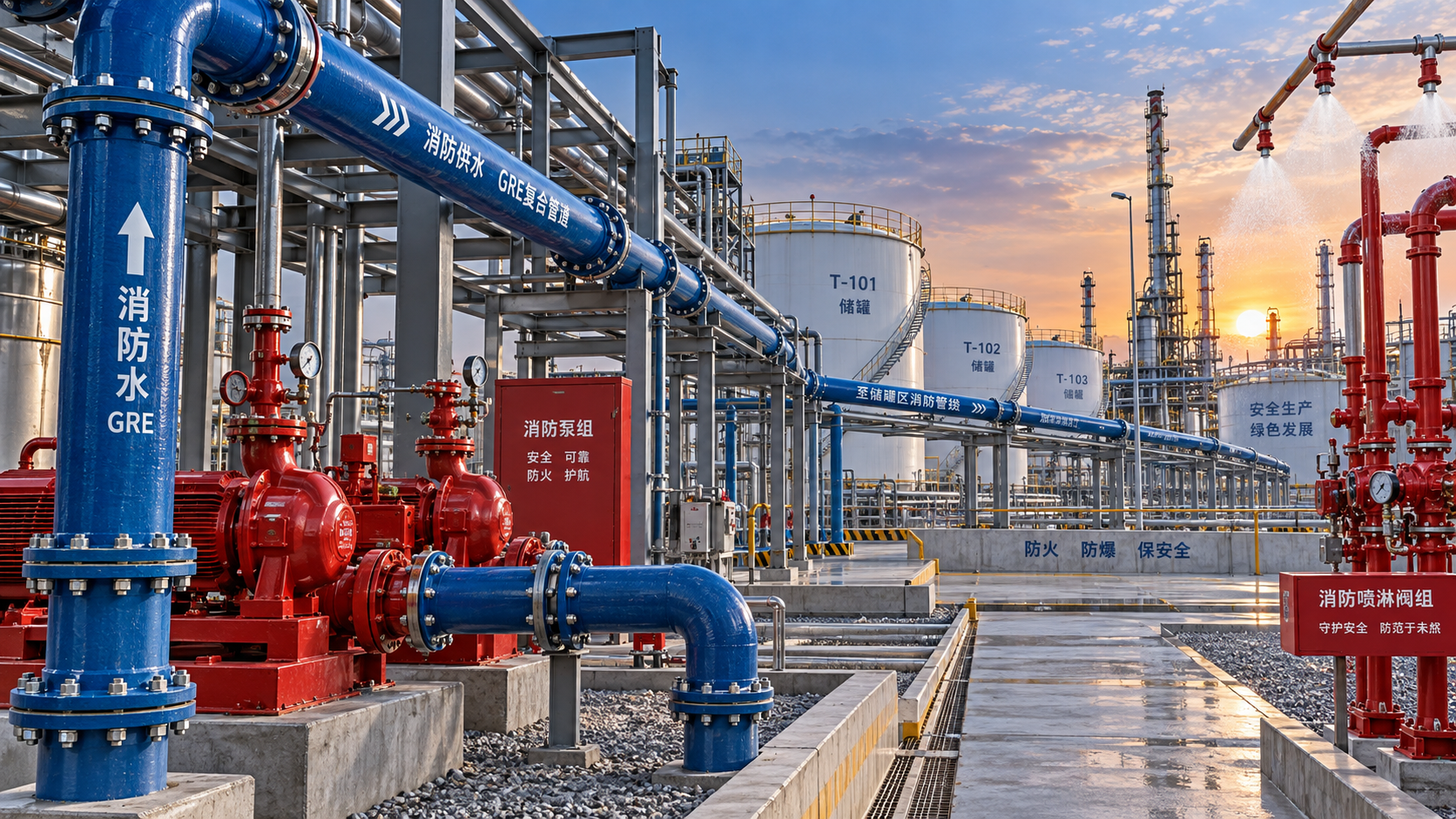
A firewater system is expected to work when the surrounding conditions are least forgiving: elevated temperature, mechanical disturbance, emergency pump start-up, and possible loss of routine access. In that setting, corrosion resistance alone does not establish suitability. GRE pipes for oil and gas firewater service must be selected as a complete engineered system, with verified pressure performance, joint integrity, material construction, fire-performance evidence where required, and installation controls that match the project specification.
A frequent design problem appears when a GRE piping proposal is reviewed only against normal operating pressure and water compatibility. The line may look acceptable on a process datasheet, yet the firewater specification can also impose requirements for fire endurance, low flame spread, impact resistance, antistatic performance, external exposure, emergency duty, or particular qualification tests. The correct starting point is not “Is GRE corrosion resistant?” but “What must this firewater line remain capable of doing during and after the defined design event?”
Start with the firewater duty, not the pipe material
Firewater networks vary substantially between onshore terminals, process plants, tank farms, offshore installations, LNG facilities, and utility areas. A buried ring main supplying hydrants has a different exposure profile from an above-ground deluge header located near hydrocarbon equipment. A seawater-based system also creates a different internal corrosion challenge from a treated freshwater network.
Before approving GRE for a line segment, the design and quality team should separate the service into practical questions:
- Will the pipe be buried, rack-mounted, exposed on deck, enclosed, or installed in a hazardous area?
- What is the required design pressure, including pump shutoff pressure, surge allowance, and transient events?
- Is the system normally dry, normally wet, intermittently tested, or continuously circulating?
- Can a fire expose the pipe directly, or is the piping expected to remain outside the defined fire zone?
- Must the line continue delivering water during a specified fire exposure, or is post-event containment the relevant criterion?
- Are there project-specific requirements for conductive or antistatic construction, flame spread, smoke, toxicity, or fire resistance?
- Which code, owner specification, insurer requirement, authority requirement, or class requirement governs acceptance?
These questions prevent a common mismatch: using a pipe qualified for general water transport where the firewater system requires evidence of performance under exceptional conditions. GRE is a composite material system, not a single fixed product category. Resin chemistry, reinforcement architecture, liner design, wall thickness, fittings, joints, and protective coatings can all affect its suitability.
Fire performance must be defined in measurable terms
It is unsafe to assume that a pipe is “fire resistant” simply because it contains glass reinforcement. Glass fibres do not burn, but the resin matrix, liner, adhesive components, and external coatings respond to heat in ways that depend on formulation and exposure. At sufficiently high temperatures, resin can soften, decompose, lose structural contribution, or generate smoke. The relevant question is therefore the required fire scenario and the acceptance criterion.
Specifications may distinguish between reaction-to-fire properties and fire endurance. Reaction-to-fire concerns how a material contributes to flame spread, smoke, or combustion under a prescribed test method. Fire endurance concerns whether a pressurized pipe assembly can maintain containment and function for a defined exposure duration. These are not interchangeable. A low-flame-spread property does not automatically prove that a pressurized pipe, elbow, flange, and joint will retain water under direct fire.
For firewater piping, the review should identify whether the project requires:
- Resistance to a cellulosic fire exposure, hydrocarbon fire exposure, or another defined thermal condition;
- Pressure retention during testing, including the required test pressure and duration;
- Limited flame spread or smoke performance for enclosed routes;
- Survival after direct flame exposure, radiant heat, or jet-fire-related conditions;
- Protection by fireproofing, shielding, burial depth, enclosure, or physical separation;
- Evidence for the complete piping assembly rather than pipe barrel samples alone.
Where a fire endurance rating is stated in a project requirement, the submitted evidence should match the actual construction proposed. A test report for one diameter, pressure class, resin system, or joint design cannot automatically be extended to every configuration. Any extrapolation should be supported by the manufacturer’s documented qualification basis and accepted by the responsible engineering authority.
Pressure integrity includes more than the nominal rating
Fire pumps can create demanding hydraulic conditions. Pump churn pressure, rapid valve operation, nozzle closure, deluge valve actuation, and filling of an empty branch can generate pressure transients beyond normal running conditions. A GRE design review should therefore examine the pressure envelope rather than relying on a single nominal pressure number.
The pressure envelope should include design pressure, maximum pump pressure, hydrostatic test pressure, operating temperature, cyclic pressure duty, vacuum possibility, and surge assumptions. The system layout matters as well. Long runs, high flow velocity, abrupt changes in direction, fast-closing valves, and poorly vented high points can increase transient risk. Where water hammer analysis is required by the project, the GRE pipe stiffness, restraint arrangement, valve operating times, and branch geometry should be included in that analysis.
External loads deserve similar attention. GRE pipe has different stiffness and support behavior from metallic pipe. Above ground, inadequate support spacing can lead to sagging, local stress at clamps, or damage near fittings. Underground, deflection, soil load, groundwater condition, bedding quality, traffic loading, and trench backfill determine long-term performance. Firewater mains are sometimes installed in areas where maintenance vehicles or emergency response equipment may pass; the burial and protection design should reflect that credible loading.
Joints are part of the pressure system
Joint selection is often where an otherwise sound material choice fails. Adhesive-bonded, laminated, threaded, flanged, mechanical, and restrained joint arrangements have different preparation requirements and different tolerance for field variability. A firewater line may remain idle for long periods, so a poor joint can remain hidden until pressure testing or emergency activation.
Review the joint system as carefully as the pipe barrel. Confirm the approved joining procedure, surface preparation requirements, curing conditions, allowable alignment tolerance, bolt tightening method for flanged connections, gasket compatibility, and inspection hold points. Field-made laminate joints require particular process discipline because ambient temperature, surface cleanliness, moisture, resin mixing, fibre placement, and cure time directly affect the completed connection.
The connection between GRE and metallic equipment also needs deliberate design. Valves, hydrants, pumps, strainers, deluge skids, and flange-mounted instruments may impose concentrated loads or torsional forces. Proper anchors, guides, support steel, and flexible layout details should prevent those loads from being transferred into a composite flange or pipe end beyond its intended limits.
Translate specifications into a submittal review matrix
Quality review becomes more reliable when the firewater specification is converted into a line-by-line compliance matrix before material approval. This avoids approving a brochure description that does not address the actual duty. The matrix does not need to be elaborate, but every requirement should have a clear response: compliant, not applicable with justification, subject to engineering confirmation, or not compliant.
The matrix should distinguish product evidence from project acceptance. A manufacturer’s technical document may establish the capabilities and limitations of a GRE system, but the engineering team must still confirm that those capabilities meet the project’s firewater design basis. This distinction is especially important when a specification refers to a recognized standard without stating the exact test method, performance threshold, or installation condition expected.
Installation quality determines whether design intent survives the field
Even correctly specified GRE piping can be compromised by uncontrolled handling. Composite pipe should not be dragged across sharp surfaces, struck by lifting equipment, stored on uneven supports, or lifted from a single point without suitable handling methods. Surface scratches, crushed ends, delamination indications, and damage to protective layers should be assessed before installation rather than covered by paint or wrapping.
For a firewater installation, inspection planning should follow the actual construction sequence. Incoming inspection can confirm marking, dimensions, visible condition, and traceability. Before jointing, inspectors should verify that materials are within their permitted storage life and that joint surfaces are clean and dry. During jointing, they should record the approved procedure, installer authorization, ambient conditions where relevant, mixing and cure controls, and fit-up. Before hydrostatic testing, the line should be adequately supported, restrained, vented, and isolated from equipment not intended for the test pressure.
A pressure test is valuable, but it is not a substitute for construction surveillance. A poorly prepared adhesive joint may not fail during a short test if the pressure, temperature, or loading conditions do not reveal the defect. Conversely, a test failure does not automatically identify the root cause. The investigation should consider joint preparation, cure condition, alignment, pressure instrumentation, trapped air, temporary restraints, and whether the tested assembly matches the approved design.
Control changes that affect qualification
Substitutions should be treated cautiously. A change in resin, fitting supplier, joint geometry, liner, wall thickness, or external protective treatment can affect the basis on which fire and pressure evidence was accepted. The same applies when an approved buried line is rerouted above ground, moved into a fire-exposed area, or connected to a new valve arrangement that introduces higher local loads.
A useful rule is that changes affecting material composition, assembly configuration, exposure condition, or load path should trigger a documented engineering review. The question is not whether the replacement appears similar; it is whether the approved qualification and design assumptions still apply.
Where GRE is often a sound choice—and where its limits need attention
GRE can be well suited to firewater duties where corrosion from seawater, brackish water, chemically treated water, or aggressive soil would create a maintenance burden for conventional metallic systems. Its relatively low weight can also simplify handling in selected layouts, while smooth internal surfaces may support hydraulic design objectives. These benefits are meaningful only when the composite system is selected for the actual pressure, temperature, mechanical, and fire exposure conditions.
For broader water infrastructure work, a product such as GRE Pipe for Municipal Project may be relevant where the service conditions and project requirements align. It should not, however, be treated as automatic evidence of suitability for an oil and gas firewater duty. Firewater service needs its own review of emergency exposure, approval documentation, interfaces, and installation requirements.
Extra caution is warranted for pipework in direct hydrocarbon-fire zones, locations exposed to severe radiant heat, areas where impact from emergency operations is credible, and routes requiring continuity of function during a defined fire event. In such locations, the design may require a specifically qualified composite system, a protective arrangement, a different routing strategy, or another piping material. The governing project requirement should decide the boundary.
Questions to resolve before release for purchase
Before a purchase order is released, the technical package should make the acceptance path unambiguous. Confirm the pipe and fitting pressure class, the exact joint system, the pressure-temperature limits, required fire-related performance, allowable installation environment, and testing obligations. Ask whether fire-performance documents cover fittings and joints as well as straight pipe. Confirm whether the stated performance relies on a coating, enclosure, water-filled condition, or other installation feature that must be maintained in the field.
It is also important to define the records required at handover. Traceability between delivered materials, installed spool sections, joint records, inspection reports, and pressure-test documentation makes later maintenance and incident review more manageable. For a life-safety system that may remain dormant for extended periods, documentation is not administrative excess; it is part of demonstrating that the installed network matches the approved design basis.
The most defensible approach to GRE pipes for oil and gas firewater systems is therefore requirement-led: establish the emergency duty, verify the complete piping assembly against that duty, control field joints and supports, and prevent unreviewed changes from breaking the qualification chain. That process gives safety and quality teams a practical basis for accepting GRE where it fits—and for identifying locations where additional protection or a different solution is necessary.
Please give us a message
产品介绍产品介绍产品介绍产品介绍产品介绍产品介绍产品介绍产品介绍产品介绍产品介绍产品介绍产品介绍产品介绍产品介绍产品介绍产品介绍产品介绍产品介绍产品介绍产品介绍产品介绍产品介绍产品介绍产品介绍产品介绍产品介绍产品介绍产品介绍产品介绍产品介绍
Please give us a message
产品介绍产品介绍产品介绍产品介绍产品介绍产品介绍产品介绍产品介绍产品介绍产品介绍产品介绍产品介绍产品介绍产品介绍产品介绍产品介绍产品介绍产品介绍产品介绍产品介绍产品介绍产品介绍产品介绍产品介绍产品介绍产品介绍产品介绍产品介绍产品介绍产品介绍
Please give us a message
产品介绍产品介绍产品介绍产品介绍产品介绍产品介绍产品介绍产品介绍产品介绍产品介绍产品介绍产品介绍产品介绍产品介绍产品介绍产品介绍产品介绍产品介绍产品介绍产品介绍产品介绍产品介绍产品介绍产品介绍产品介绍产品介绍产品介绍产品介绍产品介绍产品介绍
Please give us a message
产品介绍产品介绍产品介绍产品介绍产品介绍产品介绍产品介绍产品介绍产品介绍产品介绍产品介绍产品介绍产品介绍产品介绍产品介绍产品介绍产品介绍产品介绍产品介绍产品介绍产品介绍产品介绍产品介绍产品介绍产品介绍产品介绍产品介绍产品介绍产品介绍产品介绍