
Glassfiber Reinforced Epoxy Pipe vs Steel: A Lifecycle Cost Comparison
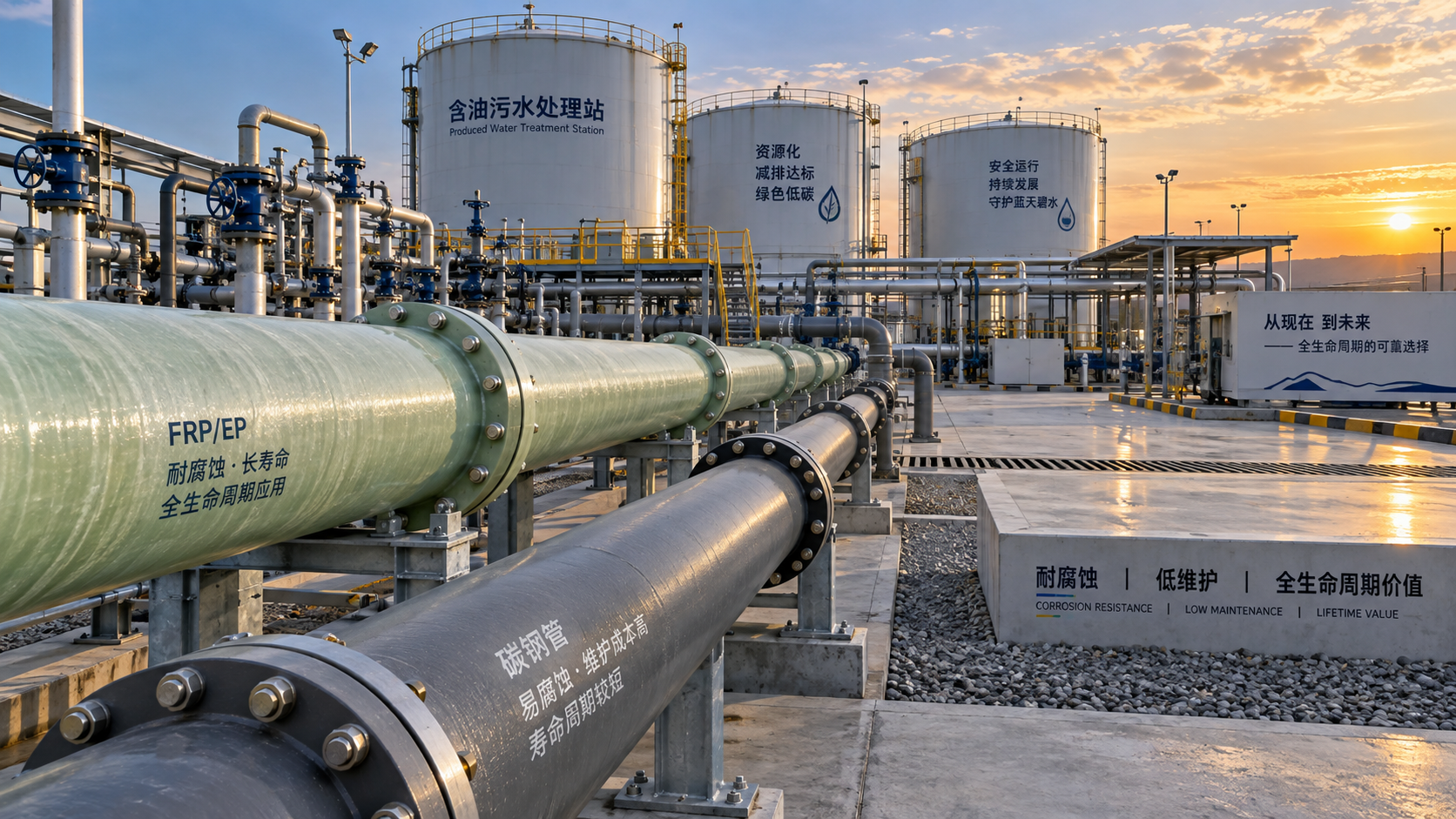
For oil and gas operators, the real cost of a piping system rarely appears on the first purchase order. It emerges over years of exposure to saline water, produced water, corrosive chemicals, temperature cycling, shutdown windows, repair work, inspection routines, and the consequences of an unexpected leak. A lower initial material price can become expensive very quickly when a line requires repeated coating repairs, corrosion monitoring, replacement spools, or extended downtime.
This is why the comparison between Glassfiber Reinforced Epoxy Pipe and steel should be made on a lifecycle basis rather than on material cost alone. Steel remains an essential choice for many high-pressure, high-temperature, and structurally demanding systems. Yet for corrosive fluid transport duties, a properly specified GRE piping system can materially change the cost profile of an asset over its operating life.
For procurement leaders, project managers, and asset owners, the key question is not “Which pipe costs less per meter?” It is: Which system delivers the required performance with the lowest total cost, lowest operational disruption, and most manageable risk over the intended service period?
Why upfront pipe price is an incomplete comparison
The purchasing price of pipe, fittings, flanges, coatings, supports, and installation labor is visible early in a project. Many of the larger cost drivers are not. They are distributed across engineering, construction, commissioning, operation, and eventual replacement.
A meaningful lifecycle cost comparison should include the following:
- Initial supply cost: pipe, fittings, joints, accessories, protective systems, and documentation.
- Engineering and design effort: pressure class selection, corrosion allowance, support spacing, joining method, layout constraints, and interface design.
- Transportation and installation: handling equipment, manpower, welding or bonding, inspection, lifting requirements, and worksite access.
- Corrosion control: coatings, linings, cathodic protection where applicable, periodic surveys, touch-up work, and corrosion allowance.
- Maintenance and repair: leak response, spool replacement, surface preparation, hot-work controls, and availability of trained personnel.
- Production impact: downtime, safety restrictions, environmental exposure, and lost operating capacity caused by repair activities.
Steel may appear attractive when a project evaluates only purchase cost, particularly where the supply chain is familiar and local welding resources are readily available. However, the economics can shift when corrosion mitigation and long-term maintenance are included. Glassfiber Reinforced Epoxy Pipe is often evaluated precisely because it removes or reduces some of these recurring obligations in corrosion-prone services.
The cost profile changes with the fluid, not just the pipe diameter
There is no universal winner. The correct choice depends on what flows through the system, how it is operated, and what failure would mean to the facility.
Steel is frequently justified in services involving very high temperature, very high pressure, severe mechanical loading, fire exposure requirements, or applications requiring welded structural integration. Its mechanical familiarity also gives many operators confidence when modifications are expected during the life of the plant.
GRE pipe, by contrast, is particularly relevant where internal or external corrosion is a persistent operating concern. Typical evaluation areas include produced water, injection water, seawater, ballast systems, saline process streams, selected chemical services, wastewater, and utility piping exposed to aggressive environments. The composite construction does not rely on a metallic corrosion allowance in the same way as carbon steel. That can simplify long-term integrity planning when the resin system is compatible with the conveyed medium and operating conditions.
Compatibility must still be treated seriously. Resin selection, pressure rating, temperature limits, chemical concentration, permeation risk, joint design, UV exposure, and installation conditions all need to be assessed before GRE is approved. A composite pipe is not a shortcut around engineering discipline; it is a different engineered system with its own design rules.
Where lifecycle savings commonly come from
1. Corrosion management can become a recurring steel expense
For carbon steel piping in wet, saline, sour, or chemically active environments, corrosion control is rarely a one-time event. External coatings can be damaged during transport, installation, or later maintenance. Internal linings may require inspection and repair. Corrosion under insulation, localized pitting, and degradation around welds or transitions can complicate integrity management. Even when a steel line remains in service, the operator may spend substantial effort verifying that it is still safe to operate.
Glassfiber Reinforced Epoxy Pipe is naturally resistant to many corrosion mechanisms that affect metallic piping. In suitable service, this can reduce the burden of coating restoration and corrosion-related wall-thickness monitoring. The economic benefit is not merely fewer repair invoices. It is the ability to plan maintenance around operations instead of reacting to degradation discovered too late.
That said, buyers should avoid assuming that GRE is maintenance-free. It still requires proper inspection of joints, supports, flange connections, impact-prone areas, and any sections subject to vibration or movement. The point is that the maintenance focus shifts from managing metal loss to preserving mechanical integrity and installation quality.
2. Lower weight can reduce site complexity
GRE pipe is significantly lighter than steel of comparable diameter, a characteristic with practical consequences for remote oilfield sites, offshore-adjacent logistics, congested process areas, and long above-ground pipe runs. Lower weight may reduce lifting demands, simplify manual handling for smaller sizes, and ease transportation planning.
Installation savings are most visible when labor access is difficult or when steel fabrication would require extensive welding activity. Steel systems often involve cutting, beveling, welding, non-destructive examination, coating repair, and hot-work management. GRE installation uses joining methods designed for composite systems, such as adhesive-bonded joints, laminated joints, or mechanical connections depending on the project specification.
These methods are not automatically faster in every setting. They require trained crews, controlled surface preparation, correct curing conditions, and disciplined quality checks. But when a qualified installation team is available, GRE can shorten field work and reduce the amount of hot work performed in sensitive operating environments.
3. Downtime has a cost that pipe schedules often miss
A pipeline repair is never only a repair. It may trigger isolation, depressurization, draining, gas testing, permits, access scaffolding, environmental safeguards, and production rescheduling. For a system carrying produced water, seawater, or process effluent, a corrosion-driven failure can also create an environmental and operational event that consumes management attention well beyond the maintenance department.
The lifecycle argument for GRE becomes stronger when failure avoidance has a high value. Lines that are difficult to access, buried, routed through active facilities, or located in regions with limited repair capacity deserve a higher weighting for reliability and maintenance interruption. In these cases, the expected cost of a future steel repair may exceed the apparent savings achieved at initial procurement.
A practical comparison for decision-makers
How to build a credible lifecycle cost model
Decision-makers do not need a perfect twenty-year forecast to make a better choice. They need a transparent model that identifies the assumptions likely to change the outcome. Start with the design life and the service conditions: fluid chemistry, solids content, operating pressure, temperature range, pressure cycling, external environment, and expected inspection access.
Then compare the two alternatives using the same scope. A steel estimate should include coating or lining requirements, corrosion allowance, welding consumables, inspection, field coating repair, and expected corrosion-management activities. A GRE estimate should include the required resin system, pipe class, fittings, joining materials, installation supervision, crew qualification, testing, and any special support or transition details.
It is useful to model at least three scenarios:
- Base case: normal operations and planned maintenance.
- Corrosion-intensive case: more frequent steel repair or coating intervention than originally expected.
- Access-constrained case: repair work requires shutdown, mobilization, special lifting, or restricted work permits.
For each scenario, include direct maintenance cost and the value of lost availability. This approach often reveals that the selection is less sensitive to the pipe purchase price than expected. In a non-corrosive, easy-access utility line, steel may remain the sensible economic decision. In a remote water injection or saline drainage system, GRE may provide a more favorable ownership profile even if its initial package cost is higher.
Common mistakes that distort the comparison
Comparing bare pipe against a complete system. A GRE quotation may include fittings and jointing components while a steel price is quoted only as bare pipe. Normalize the bill of materials before comparing costs.
Assuming every composite pipe is interchangeable. The performance of GRE depends on fiber reinforcement, resin chemistry, laminate construction, pressure class, fittings design, and production controls. A generic “fiberglass pipe” comparison is not enough for a critical oil and gas application.
Ignoring installation competence. Poor adhesive bonding, inadequate curing, incorrect support spacing, or excessive field damage can undermine an otherwise sound GRE design. The contractor’s composite installation capability should be evaluated alongside the pipe supplier.
Treating steel corrosion as inevitable and GRE as invulnerable. Both assumptions are poor engineering. Properly protected steel can serve reliably in many duties. GRE can also fail if exposed beyond its approved temperature, chemical, pressure, or mechanical limits. The comparison must be service-specific.
GRE beyond upstream and midstream water service
The same lifecycle logic applies in supporting infrastructure where corrosive liquid handling is central to operations. For example, treatment facilities may combine chemical exposure, wet environments, and difficult-to-maintain pipe networks. A properly engineered Wastewater Treatment Plant can be part of a broader strategy to control effluent quality while selecting piping materials that reduce corrosion-related intervention throughout the system.
Marine ballast piping, LNG-related auxiliary systems, chemical plant utility networks, hot spring piping, and salt-making operations also present conditions where material selection deserves an ownership-cost review rather than a simple commodity purchase decision.
What procurement teams should ask before awarding
A strong supplier review should move beyond unit price and delivery date. Ask for the recommended service envelope, resin compatibility basis, pressure rating, jointing method, test requirements, installation guidance, support recommendations, and quality-control documentation. Clarify which components are included: straight pipe, elbows, tees, reducers, flanges, adhesive kits, gaskets, and field support.
Manufacturing capacity and process consistency matter as well, particularly for projects requiring substantial quantities of fittings or phased deliveries. Shandong Ocean Pipe Technology Co., Ltd., established in 2012 in Dezhou, China, operates 16 winding production lines and 174 pipe fitting winding machines with micro-control systems. Its production and testing setup includes static hydrostatic pressure testing capability and an annual GRE pipe production and testing capacity of 25,000 tons. These capabilities are relevant when buyers need coordinated supply of pipe and fittings rather than isolated components.
For decision-makers, the most defensible choice is the one supported by documented operating conditions, a complete installed-cost scope, and a realistic maintenance forecast. Steel remains the right material for many applications. But where corrosion, access difficulty, and downtime risk dominate the equation, Glassfiber Reinforced Epoxy Pipe can offer a compelling lifecycle-cost advantage—one measured not only in fewer maintenance events, but in a more predictable and resilient operating system.
Please give us a message
产品介绍产品介绍产品介绍产品介绍产品介绍产品介绍产品介绍产品介绍产品介绍产品介绍产品介绍产品介绍产品介绍产品介绍产品介绍产品介绍产品介绍产品介绍产品介绍产品介绍产品介绍产品介绍产品介绍产品介绍产品介绍产品介绍产品介绍产品介绍产品介绍产品介绍
Please give us a message
产品介绍产品介绍产品介绍产品介绍产品介绍产品介绍产品介绍产品介绍产品介绍产品介绍产品介绍产品介绍产品介绍产品介绍产品介绍产品介绍产品介绍产品介绍产品介绍产品介绍产品介绍产品介绍产品介绍产品介绍产品介绍产品介绍产品介绍产品介绍产品介绍产品介绍
Please give us a message
产品介绍产品介绍产品介绍产品介绍产品介绍产品介绍产品介绍产品介绍产品介绍产品介绍产品介绍产品介绍产品介绍产品介绍产品介绍产品介绍产品介绍产品介绍产品介绍产品介绍产品介绍产品介绍产品介绍产品介绍产品介绍产品介绍产品介绍产品介绍产品介绍产品介绍
Please give us a message
产品介绍产品介绍产品介绍产品介绍产品介绍产品介绍产品介绍产品介绍产品介绍产品介绍产品介绍产品介绍产品介绍产品介绍产品介绍产品介绍产品介绍产品介绍产品介绍产品介绍产品介绍产品介绍产品介绍产品介绍产品介绍产品介绍产品介绍产品介绍产品介绍产品介绍