
How to Qualify Suppliers of GRE Pipes for Oil and Gas Projects
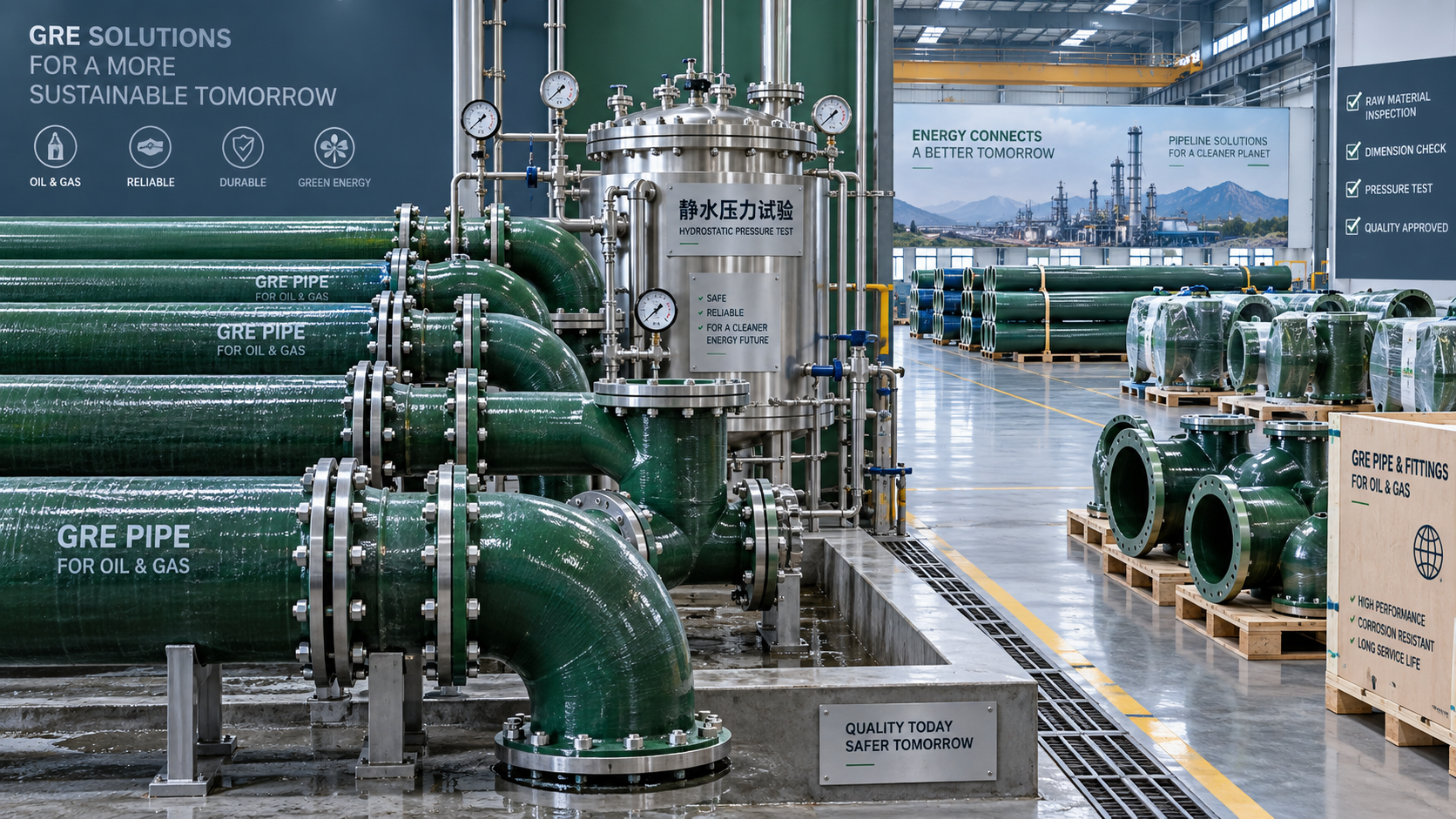
Qualifying a supplier of GRE pipes for oil and gas projects is a risk-control exercise, not a catalogue comparison. A pipe that looks acceptable on a datasheet may still create problems if its laminate design, joint system, quality records, or delivery capability do not match the actual service conditions. For procurement teams, the objective is to identify suppliers that can repeatedly manufacture a documented, project-specific piping system, including fittings and joints, rather than simply source nominally equivalent pipe.
This matters most where failure consequences are high: produced-water lines, firewater systems, seawater cooling, offshore utility piping, chemical injection support systems, LNG-related facilities, and corrosive process services. GRE can offer strong corrosion resistance and low weight, but these benefits depend on correct engineering, fabrication, installation, and inspection. Supplier qualification should therefore begin with the duty, then test whether the supplier can support that duty from design review through delivery.
Start with the service envelope, not the pipe diameter
Before issuing an RFQ, procurement should establish the operating envelope that the GRE system must handle. “Oil and gas service” is too broad to support a meaningful technical comparison. A supplier needs enough information to select resin, reinforcement structure, pressure class, connection type, and testing scope.
The specification should distinguish among continuous operating pressure, design pressure, surge pressure, operating temperature, maximum temperature, fluid composition, solids content, and external environment. A produced-water line with residual hydrocarbons, chlorides, scale-forming chemicals, and temperature cycling presents a different challenge from a clean firewater system. Likewise, an above-ground pipe rack, buried line, marine ballast area, and offshore deck each introduce different loads and exposure conditions.
- What fluid will contact the internal liner, and at what concentrations and temperatures?
- Will the line see pressure cycling, pump starts and stops, water hammer, vacuum, or intermittent operation?
- Is the pipe exposed to sunlight, salt spray, soil loads, vessel movement, vibration, or fire protection requirements?
- Are installation constraints likely to impose bending, misalignment, lifting damage, or limited access for jointing?
- Which project standard, owner specification, and third-party inspection requirements govern the supply?
These questions prevent a common procurement error: comparing suppliers only by nominal pressure rating and unit price. A nominal rating does not, by itself, establish suitability for the required temperature, chemical exposure, joint arrangement, or cyclic loading profile.
Assess the supplier as a system manufacturer
GRE pipe is rarely a standalone purchase. The project requires straight pipe, elbows, tees, reducers, flanges, branch connections, spools, jointing materials, installation guidance, and often repair procedures. A supplier that can manufacture straight lengths but depends on loosely controlled external sources for fittings or connection components introduces avoidable interface risk.
During prequalification, ask how pipe and fittings are designed and manufactured together. The supplier should be able to explain whether fittings use the same resin system and reinforcement approach as the pipe, how pressure capability is verified at geometry transitions, and how dimensions are controlled to ensure fit-up in the field. Fittings are usually where a piping package becomes difficult: their geometry is more complex, their manufacturing route may differ, and a late dimensional issue can delay installation even when the straight pipe has already arrived.
Manufacturing capacity should also be examined in practical terms. A large stated annual capacity is less useful than evidence that the supplier has adequate winding lines, fitting capability, curing control, testing equipment, trained operators, and inspection resources available for the project schedule. Procurement should ask for the proposed production plan, expected batch sizes, hold points, and the maximum realistic output during the required delivery window.
It is also useful to establish whether the supplier manufactures the selected pipe system itself or primarily acts as a trader. Trading arrangements are not automatically unacceptable, but they require greater visibility over who owns design responsibility, who controls production records, who handles non-conformities, and who will support site issues after shipment.
Check material traceability and laminate control
The core technical question is whether the supplier can demonstrate control of the composite structure. GRE performance depends on the resin formulation, glass reinforcement, curing process, liner construction, laminate thickness, winding angle, and fabrication consistency. A material description such as “epoxy fiberglass pipe” is not enough for a critical procurement decision.
Request the supplier’s technical submittal for the proposed system, including material descriptions, applicable design basis, dimensional tolerances, pressure classes, temperature limits, joint details, and chemical-resistance basis for the relevant fluid. The review should show a coherent relationship between the service data and the proposed construction. If the response relies only on generic brochures, pressure tables without conditions, or unqualified statements of corrosion resistance, it does not provide sufficient assurance.
Traceability should extend from incoming raw materials to finished pipe and fittings. Procurement does not need to prescribe every factory procedure, but it should verify that the supplier can identify resin and reinforcement batches, link them to production lots, retain cure and inspection records, and mark finished products so documentation can be matched to delivered items. This becomes important when a project requires replacement materials, investigates a defect, or receives mixed shipments over several months.
A useful discussion point is how the supplier manages changes. Changes in resin source, reinforcement type, fitting method, curing cycle, or joint configuration can affect the qualified system. The purchase order and quality plan should require notification and approval before any material or process substitution relevant to performance is made.
Do not treat hydrostatic testing as the entire quality program
Hydrostatic testing is important, but a passed pressure test alone does not prove that every pipe length and fitting will perform through its intended life. Pressure testing can identify some manufacturing defects, yet it cannot replace controls over dimensions, laminate construction, curing, visual inspection, and joint components.
Ask suppliers to provide an inspection and test plan that identifies what is checked, when it is checked, who witnesses it, and what records are issued. The appropriate plan depends on project criticality, but procurement should expect a defined approach to incoming materials, in-process checks, finished-product inspection, pressure testing, and final release.
Particular attention should be paid to the acceptance criteria for visible defects. Surface irregularities are not all equivalent, but cracks, dry areas, delamination indications, voids, damaged liners, poor flange faces, or exposed reinforcement should trigger a documented assessment rather than informal acceptance. The supplier should have a clear non-conformance process covering segregation, engineering disposition, rework limitations, and traceable closure.
For projects with client inspection or independent verification, align witness and hold points before manufacturing begins. Attempting to add inspection requirements after production is underway often creates disputes over documentation, test availability, and delivery dates.
Review joints, fittings, and field installation support early
Many GRE piping failures originate at interfaces rather than in straight pipe. The connection system should therefore be qualified with the same discipline as the pipe wall. Whether the project uses adhesive-bonded joints, flanged connections, mechanical couplings, laminated joints, or another approved configuration, the supplier should provide installation procedures, dimensional requirements, environmental limits, cure requirements where relevant, and inspection criteria.
Adhesive-bonded joints require especially close attention. Field joint quality can be affected by surface preparation, adhesive storage, ambient temperature, humidity, alignment, cure time, and installer competence. Procurement should establish who provides training, whether installation supervision is available, what records installers must complete, and what happens when site conditions fall outside the approved range.
Flanged assemblies need their own review. Check flange face dimensions, bolt patterns, gasket compatibility, tightening guidance, support requirements, and compatibility with mating equipment or metallic piping. A GRE flange connection may be supplied correctly yet still fail in service if excessive bolt load, poor alignment, or unsupported adjacent steelwork transfers stress into the composite component.
For a package that includes small-bore lines or specialized applications, GRE Tubing should be reviewed against the same installation and connection requirements. Smaller dimensions do not eliminate the need for chemical compatibility, pressure-cycle assessment, and clear field handling instructions.
Use project experience carefully
Relevant project history is valuable when it is comparable. A supplier may have extensive experience in water, marine, chemical, or industrial applications, but that does not automatically demonstrate fitness for a specific oil and gas duty. Procurement should look for similarities in fluid chemistry, operating temperature, pressure range, project standards, pipe size, location, and installation method.
The objective is not to demand an identical reference for every purchase. It is to understand whether the supplier has handled comparable technical obligations and can produce the documentation expected by oil and gas owners, EPC contractors, and inspectors. Ask what portion of the prior scope was manufactured by the supplier, whether it included fittings and jointing support, and what quality documentation accompanied the supply.
References should support technical confidence, not replace technical review. A supplier with a strong reference list can still be unsuitable if the proposed configuration differs materially from the referenced system.
Make delivery reliability part of technical qualification
GRE pipe packages often appear simple in procurement schedules until the project reaches spool coordination, fitting release, site installation, or documentation close-out. Delays are commonly associated with non-standard fittings, late dimensional clarifications, incomplete test records, damaged packing, or missing jointing materials rather than with straight pipe production alone.
Supplier qualification should include a review of the proposed document schedule and logistics plan. Confirm when drawings, data sheets, inspection plans, manufacturing records, packing lists, and certificates will be submitted. Verify whether pipe lengths and fittings will be tagged in a way that supports site identification. For export projects, packaging must protect pipe ends, flange faces, fittings, and joint materials against handling, moisture, ultraviolet exposure, and transit damage.
It is also sensible to separate manufacturing lead time from total ready-for-shipment time. A supplier may complete pipe production while still waiting on fittings, test completion, final inspection, or document approval. Purchase orders should define the agreed delivery milestone clearly.
Build the qualification decision around evidence
A practical supplier evaluation does not need to become excessively complicated. It should, however, score evidence rather than claims. The strongest candidates can show a project-specific technical proposal, controlled manufacturing of pipe and fittings, traceable materials, documented testing, competent jointing support, relevant application experience, and a credible delivery plan.
Price remains important, particularly on large-diameter or high-volume packages. Yet the lowest quotation can become the highest-cost option if it omits fittings, assumes unsuitable joints, leaves testing undefined, or relies on delivery assumptions that are not reflected in the project schedule. For GRE pipes for oil and gas applications, the procurement decision is more defensible when the scope, service conditions, inspection requirements, and installation responsibilities have been resolved before award rather than after materials arrive on site.
Please give us a message
产品介绍产品介绍产品介绍产品介绍产品介绍产品介绍产品介绍产品介绍产品介绍产品介绍产品介绍产品介绍产品介绍产品介绍产品介绍产品介绍产品介绍产品介绍产品介绍产品介绍产品介绍产品介绍产品介绍产品介绍产品介绍产品介绍产品介绍产品介绍产品介绍产品介绍
Please give us a message
产品介绍产品介绍产品介绍产品介绍产品介绍产品介绍产品介绍产品介绍产品介绍产品介绍产品介绍产品介绍产品介绍产品介绍产品介绍产品介绍产品介绍产品介绍产品介绍产品介绍产品介绍产品介绍产品介绍产品介绍产品介绍产品介绍产品介绍产品介绍产品介绍产品介绍
Please give us a message
产品介绍产品介绍产品介绍产品介绍产品介绍产品介绍产品介绍产品介绍产品介绍产品介绍产品介绍产品介绍产品介绍产品介绍产品介绍产品介绍产品介绍产品介绍产品介绍产品介绍产品介绍产品介绍产品介绍产品介绍产品介绍产品介绍产品介绍产品介绍产品介绍产品介绍
Please give us a message
产品介绍产品介绍产品介绍产品介绍产品介绍产品介绍产品介绍产品介绍产品介绍产品介绍产品介绍产品介绍产品介绍产品介绍产品介绍产品介绍产品介绍产品介绍产品介绍产品介绍产品介绍产品介绍产品介绍产品介绍产品介绍产品介绍产品介绍产品介绍产品介绍产品介绍