
How GRP Pipe Reduces Corrosion Risk in Underground Piping Networks
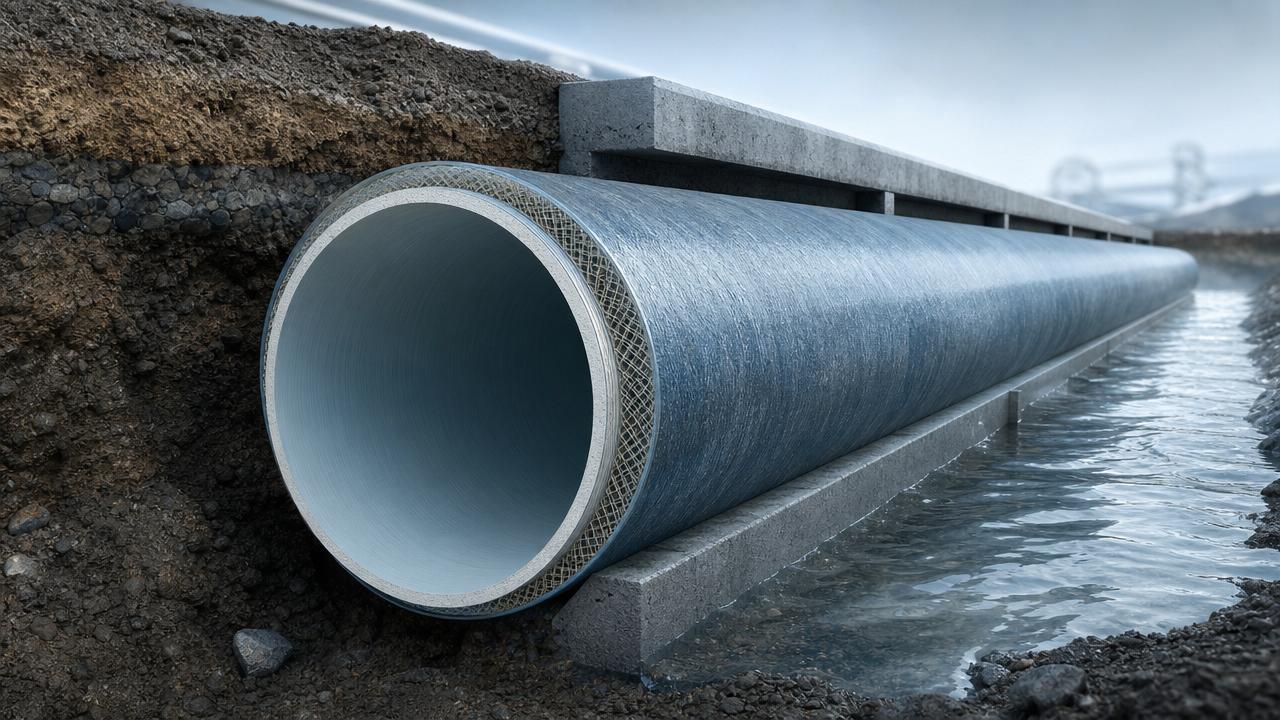
Corrosion in underground piping networks can drive up maintenance costs, disrupt operations, and shorten asset life.
For safer and more durable infrastructure, GRP Pipe offers a practical alternative to traditional metallic pipelines.
Made from glass fiber reinforced materials, it resists soil chemicals, moisture, and electrochemical corrosion in demanding underground conditions.
Its value is especially clear in oil and gas, chemical plants, LNG, marine piping, hot spring systems, and salt-related projects.
What Makes GRP Pipe Different in Underground Corrosion Control?
GRP Pipe is built from glass fibers and a polymer resin matrix.
This composite structure gives the pipe mechanical strength and strong chemical resistance.
Unlike steel or ductile iron, GRP Pipe does not rely on metallic surfaces for load-bearing performance.
That difference reduces the risk of rust, pitting, and galvanic corrosion underground.
Soil often contains chlorides, sulfates, acids, moisture, and stray electrical currents.
These conditions can attack metal pipelines, especially at coating defects or welded zones.
GRP Pipe avoids many of these failure pathways because it is inherently non-metallic.
For buried networks, this means fewer corrosion points and more predictable service behavior.
How does the glass fiber structure help?
Glass fiber reinforcement provides hoop strength, axial strength, and dimensional stability.
The resin protects fibers from surrounding media and forms the chemical barrier.
Together, they create a corrosion-resistant pipe wall suited for buried service.
Proper resin selection is important for acids, hydrocarbons, brine, wastewater, or high-temperature fluids.
Why Does Underground Corrosion Become So Expensive?
Underground corrosion is difficult to detect early.
Leaks may remain hidden until soil settlement, pressure loss, or environmental damage appears.
Repair work usually requires excavation, shutdown planning, safety control, and replacement materials.
These indirect costs often exceed the price of the damaged pipe section.
GRP Pipe helps reduce this exposure by lowering corrosion-related intervention needs.
Its smooth inner surface also helps maintain hydraulic efficiency over time.
Less roughness growth means lower pumping energy and more stable flow performance.
What hidden costs should be considered?
- Excavation and backfilling around failed buried pipe sections.
- Production loss caused by unplanned pipeline shutdowns.
- Environmental cleanup when corrosive fluids escape into soil.
- Repeated coating repair, cathodic protection checks, and inspection labor.
- Reputation impact when network reliability becomes uncertain.
A corrosion-resistant composite pipeline can reduce these long-term risk factors.
That is why GRP Pipe is often evaluated through life-cycle value, not only initial cost.
Where Is GRP Pipe Most Useful in Buried Networks?
GRP Pipe is useful where soil conditions, fluids, or operating environments increase corrosion pressure.
Common uses include water transmission, industrial discharge, seawater intake, brine transport, and chemical plant utilities.
In oil and gas facilities, buried utility lines may face hydrocarbons, salts, and aggressive drainage media.
In coastal regions, high chloride soil can quickly challenge conventional metal systems.
Marine yards and ship-related infrastructure also benefit from non-metallic corrosion resistance.
For refining environments, epoxy-based composite systems can offer strong chemical compatibility.
A relevant example is GRE Pipe for Refinery, used where durability and chemical resistance matter.
Which project conditions favor GRP Pipe?
- Soil contains chlorides, sulfates, acids, or industrial contaminants.
- The pipeline crosses wet ground, marsh areas, or coastal zones.
- Fluid media includes brine, seawater, process water, or chemical wastewater.
- Maintenance access is difficult after installation.
- Long service life is required with controlled shutdown frequency.
When these factors combine, GRP Pipe can provide a stronger risk-reduction strategy.
How Does GRP Pipe Compare with Metallic Underground Pipe?
The main difference is corrosion behavior.
Metal pipe usually needs coating, lining, cathodic protection, or corrosion allowance.
GRP Pipe relies on its composite material properties and compatible resin system.
This can simplify corrosion management in many buried applications.
Weight is another practical difference.
GRP Pipe is generally lighter than steel or ductile iron pipe.
Lower weight can support easier handling, faster installation, and reduced lifting requirements.
However, composite pipelines still require correct trench design and installation quality.
This comparison does not mean one material fits every project.
Pressure class, soil load, temperature, fluid chemistry, and standards must guide selection.
What Should Be Checked Before Selecting GRP Pipe?
Material selection should begin with the operating environment.
The fluid, temperature, pressure, soil condition, and installation depth all influence pipe design.
GRP Pipe performance depends on matching the laminate, resin, stiffness, and pressure rating correctly.
A technical review should also include external loads from traffic, groundwater, and trench backfill.
Joint selection matters because many underground failures begin at connection points.
Good engineering practice includes pressure testing, dimensional verification, and installation inspection.
Selection checklist for corrosion-sensitive projects
- Identify all internal fluids and possible concentration changes.
- Confirm temperature range during normal and upset conditions.
- Assess soil resistivity, groundwater, and chemical contamination.
- Define pressure class, stiffness class, and safety margin.
- Review joint method, fitting availability, and testing plan.
- Check supplier production capacity and quality control systems.
These steps help ensure GRP Pipe is selected for the right technical reasons.
They also reduce costly changes during installation or commissioning.
Which Mistakes Increase Corrosion or Failure Risk?
A common mistake is treating composite pipe like metal pipe during installation.
GRP Pipe requires proper bedding, side support, alignment, and joint handling.
Sharp stones, poor compaction, or careless lifting can damage the pipe wall.
Another mistake is ignoring chemical compatibility.
Even corrosion-resistant materials must be matched with actual operating media.
Temperature excursions and mixed chemicals should be reviewed before final approval.
Overlooking fittings can also create problems.
Bends, reducers, tees, and flanges must meet the same performance expectations as pipe sections.
Risk reminders for underground GRP Pipe networks
- Do not skip hydrostatic testing before backfilling critical sections.
- Do not use incompatible sealants or gaskets in chemical service.
- Do not compact backfill with impact directly on the pipe crown.
- Do not assume all resin systems handle the same fluids.
- Do not ignore manufacturer installation guidance and project standards.
Good installation protects the corrosion advantages already built into GRP Pipe.
How Can Supplier Capability Support Long-Term Reliability?
Reliable underground networks need consistent manufacturing quality.
Pipe wall uniformity, curing control, pressure testing, and fitting accuracy all affect performance.
Shandong Ocean Pipe Technology Co., Ltd. was established in 2012 in Dezhou, Shandong, China.
The company has become one of China’s top large manufacturers for fiberglass reinforced epoxy pipe.
Its factory operates 16 winding production lines and 174 sets of pipe fitting winding machines.
It also uses winding micro control systems and five static water pressure testing machines.
Annual GRE pipe production and testing capacity reaches 25,000 tons.
Products serve oil and gas, ship ballast piping, LNG, chemical plants, hot spring pipelines, and salt production.
Experience with CNOOC, CNPC, Sinopec, and shipyards supports demanding industrial requirements.
Export activity in Australia, Iraq, Kazakhstan, Turkey, and other markets adds international project exposure.
FAQ Summary: Practical Answers About GRP Pipe
Conclusion: Turning Corrosion Control into a Design Advantage
Underground piping networks face moisture, soil chemistry, stray currents, and difficult maintenance access.
GRP Pipe reduces corrosion risk by replacing vulnerable metallic surfaces with reinforced composite materials.
It can improve durability, hydraulic stability, and maintenance planning in demanding industrial environments.
The best results come from correct resin selection, verified pressure class, reliable fittings, and disciplined installation.
For projects involving buried chemical, marine, refinery, LNG, or salt-related systems, evaluate GRP Pipe early.
Prepare fluid data, soil information, pressure requirements, and installation conditions before technical confirmation.
This approach turns corrosion control from a repair issue into a stronger infrastructure decision.
Please give us a message
产品介绍产品介绍产品介绍产品介绍产品介绍产品介绍产品介绍产品介绍产品介绍产品介绍产品介绍产品介绍产品介绍产品介绍产品介绍产品介绍产品介绍产品介绍产品介绍产品介绍产品介绍产品介绍产品介绍产品介绍产品介绍产品介绍产品介绍产品介绍产品介绍产品介绍
Please give us a message
产品介绍产品介绍产品介绍产品介绍产品介绍产品介绍产品介绍产品介绍产品介绍产品介绍产品介绍产品介绍产品介绍产品介绍产品介绍产品介绍产品介绍产品介绍产品介绍产品介绍产品介绍产品介绍产品介绍产品介绍产品介绍产品介绍产品介绍产品介绍产品介绍产品介绍
Please give us a message
产品介绍产品介绍产品介绍产品介绍产品介绍产品介绍产品介绍产品介绍产品介绍产品介绍产品介绍产品介绍产品介绍产品介绍产品介绍产品介绍产品介绍产品介绍产品介绍产品介绍产品介绍产品介绍产品介绍产品介绍产品介绍产品介绍产品介绍产品介绍产品介绍产品介绍
Please give us a message
产品介绍产品介绍产品介绍产品介绍产品介绍产品介绍产品介绍产品介绍产品介绍产品介绍产品介绍产品介绍产品介绍产品介绍产品介绍产品介绍产品介绍产品介绍产品介绍产品介绍产品介绍产品介绍产品介绍产品介绍产品介绍产品介绍产品介绍产品介绍产品介绍产品介绍