
GRP Pipe vs HDPE Pipe: Which Is Better for Large-Diameter Water Lines?
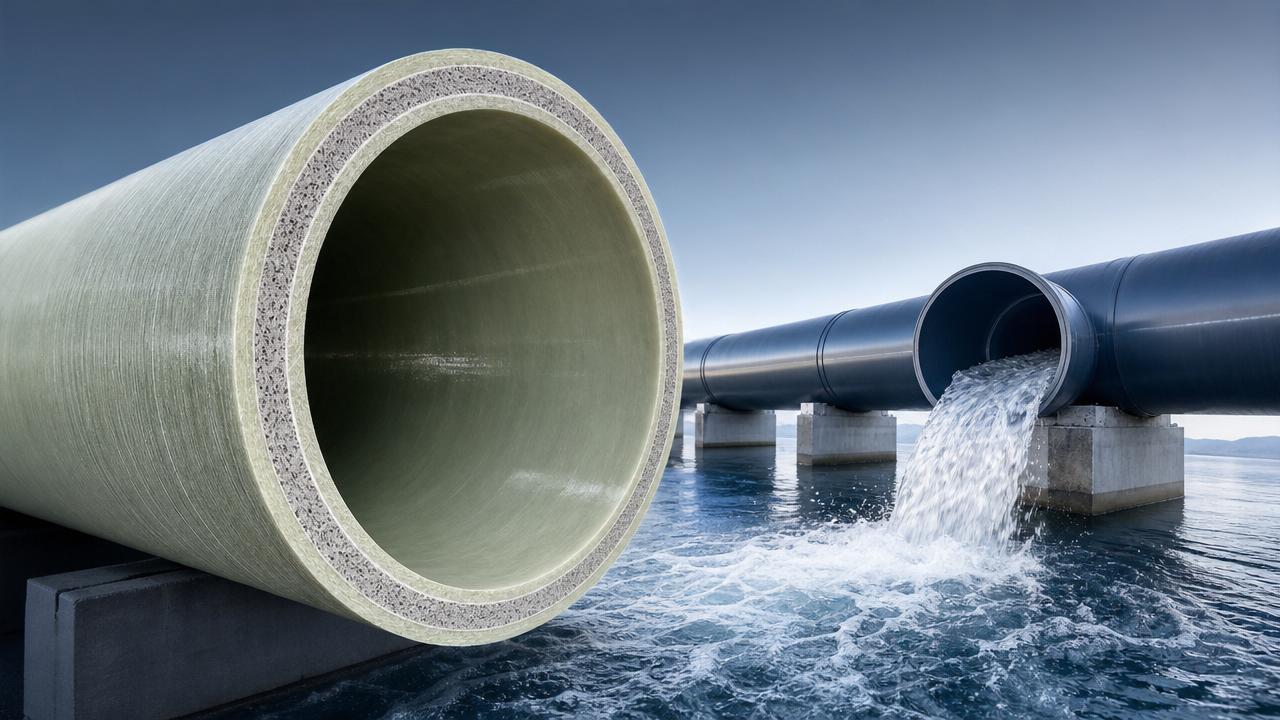
For large-diameter water lines, choosing between GRP Pipe and HDPE pipe is not simply a matter of material preference—it affects hydraulic efficiency, structural performance, installation cost, service life, and long-term maintenance risk.
Technical evaluators must consider pressure rating, stiffness, corrosion resistance, joint reliability, and project conditions such as soil load, terrain, and water quality.
This article compares GRP Pipe and HDPE pipe from an engineering perspective to help decision-makers identify which solution is better suited for demanding large-scale water transmission projects.
Large-Diameter Water Projects Are Moving Toward Higher Efficiency and Lower Lifecycle Risk
Water transmission systems are changing as cities, industrial parks, desalination plants, and mining areas demand longer pipelines with fewer operational interruptions.
In this environment, GRP Pipe has gained attention because it combines glass fiber reinforcement, resin chemistry, and engineered wall structure.
HDPE pipe remains popular for flexible layouts, trenchless installation, and smaller pressure networks. Its ductility is valuable in many utility applications.
However, large-diameter water lines place different demands on pipe stiffness, hydraulic stability, joint control, and long-term deformation behavior.
That is why the comparison between GRP Pipe and HDPE pipe has become a practical engineering question, not a theoretical material debate.
Trend Signals: Why GRP Pipe Is Increasingly Considered for Main Transmission Lines
The first signal is the growing focus on hydraulic performance. Pumping energy often dominates the operating cost of water infrastructure.
GRP Pipe usually offers a smooth internal surface and stable inner diameter, helping maintain efficient flow over long service periods.
HDPE pipe also has a smooth bore, but large diameters may require careful attention to ovality, wall thickness, and installation deformation.
The second signal is lifecycle accountability. Infrastructure owners are now evaluating replacement risk, leakage risk, and shutdown consequences.
GRP Pipe supports this trend through corrosion resistance, dimensional stability, and predictable mechanical performance when properly designed and installed.
The third signal is wider industrial adoption. Water supply, seawater intake, cooling water, irrigation, and process water systems increasingly use composite pipelines.
Main Drivers Behind the Material Choice Shift
These drivers show why the best choice depends on project scale, not only material reputation.
For small networks, HDPE pipe can be very competitive. For large-diameter water lines, GRP Pipe often offers stronger overall balance.
Hydraulic Performance: Stable Diameter Matters Over Decades
Hydraulic efficiency is one of the most important arguments for GRP Pipe in large transmission lines.
A small difference in friction loss can become a major energy cost when flow rates are high and pumping hours are continuous.
GRP Pipe is manufactured with a controlled composite wall, often using glass fiber, resin, and sand reinforcement in engineered layers.
This structure helps preserve pipe geometry under external load when bedding, backfill, and stiffness class are correctly specified.
HDPE pipe can also deliver good hydraulic performance, especially in moderate diameters and well-controlled installations.
Yet because HDPE is more flexible, deformation checks become more critical for large diameters and deep burial conditions.
Structural Behavior: Rigid-Flexible Balance Changes the Decision
GRP Pipe is not a heavy rigid pipe like concrete, nor is it as flexible as HDPE.
Its composite structure gives a useful balance of stiffness, strength, and relatively low weight.
For large-diameter water lines, this balance can reduce handling difficulty while maintaining reliable ring performance after burial.
HDPE pipe depends more heavily on soil-pipe interaction. Proper compaction and trench geometry are essential to control deflection.
In poor soils, high traffic zones, or deep trenches, GRP Pipe may provide a clearer design margin.
The better option is determined by pressure class, stiffness class, burial depth, live load, groundwater level, and construction quality.
Corrosion Resistance: Composite Materials Fit Aggressive Water Conditions
The glass and resin foundation of GRP Pipe is highly relevant to the glass and ceramic materials industry.
Glass fibers provide reinforcement, while resin systems protect the pipe from corrosion, saline water, and many chemical conditions.
This makes GRP Pipe attractive for seawater transfer, desalination intake, industrial water, cooling water, and wastewater-related networks.
HDPE pipe also performs well against many chemicals and does not suffer metallic corrosion.
The difference appears when high stiffness, large diameter, and aggressive fluid conditions must be satisfied together.
In those cases, GRP Pipe often becomes a stronger technical candidate for long service life planning.
Joint Reliability and Installation: Different Strengths, Different Risks
Joint performance can decide whether a pipeline succeeds in operation.
GRP Pipe commonly uses gasketed couplings, flanges, or laminated joints depending on project requirements and pressure conditions.
These joints can support rapid installation when alignment, trench preparation, and quality control are properly managed.
HDPE pipe is often joined by butt fusion or electrofusion, creating continuous welded sections with strong leak resistance.
However, fusion quality depends on temperature control, equipment condition, operator skill, and site cleanliness.
For long, large-diameter routes, installation planning should compare joint speed, inspection methods, repair access, and weather sensitivity.
Where HDPE Pipe Still Has Clear Advantages
HDPE pipe should not be dismissed. It has clear advantages in flexible routing and seismic movement zones.
It is also useful for trenchless construction, directional drilling, temporary water transfer, and smaller distribution pipelines.
Where the pipeline needs continuous fusion joints and high flexibility, HDPE can be a very practical solution.
The question is whether those strengths outweigh diameter, stiffness, hydraulic, and lifecycle requirements.
For large-diameter water transmission, GRP Pipe frequently delivers better value when design conditions are demanding.
Impact on Project Cost: Initial Price Is Only One Layer
A reliable cost comparison should include pipe price, fittings, joints, excavation, bedding, transport, installation, pumping energy, and maintenance.
GRP Pipe is lightweight compared with many traditional materials, reducing lifting requirements and transport complexity.
Its hydraulic performance may also reduce operating cost when pump stations run continuously.
HDPE pipe can be cost-effective in certain diameters, especially where flexibility reduces fittings or supports trenchless construction.
However, large HDPE wall thickness, fusion time, and deformation control may increase total project cost.
The better material is the one with the lowest lifecycle risk, not only the lowest purchase price.
Business and Operation Impacts Across the Pipeline Lifecycle
- Design stage: GRP Pipe requires pressure, stiffness, hydraulic, and soil-load coordination from the beginning.
- Procurement stage: specifications should define standards, resin type, liner design, testing, and documentation.
- Construction stage: both materials need disciplined trench preparation, bedding, alignment, and inspection.
- Operation stage: energy use, leakage control, and access for repair become long-term performance indicators.
Industrial applications also influence material preference. Remote water lines in Mining areas often face abrasive conditions, difficult terrain, and limited repair windows.
In such projects, GRP Pipe can be evaluated for its corrosion resistance, structural stability, and suitability for long transmission routes.
Key Evaluation Points Before Choosing GRP Pipe or HDPE Pipe
- Confirm design pressure, surge pressure, and safety factors under real operating conditions.
- Compare pipe stiffness against burial depth, soil quality, groundwater, and traffic load.
- Review hydraulic loss over the entire pipeline, not only nominal internal roughness.
- Check chemical compatibility with raw water, seawater, industrial water, or treated water.
- Assess joint method, field quality control, inspection access, and repair strategy.
- Compare lifecycle cost using energy, maintenance, downtime, and replacement assumptions.
These points prevent oversimplified selection. GRP Pipe and HDPE pipe each perform best when matched to the correct engineering context.
Practical Judgment: Which Is Better for Large-Diameter Water Lines?
For large-diameter pressure water lines, GRP Pipe is often the better option when stiffness, hydraulic efficiency, and corrosion resistance are priorities.
It is especially suitable for long-distance water transmission, seawater systems, industrial cooling water, and high-flow infrastructure.
HDPE pipe may be better when flexibility, trenchless installation, fusion continuity, or complex routing dominate the project requirements.
The most accurate conclusion should come from project-specific design data, including diameter, pressure, soil, installation method, and operating profile.
How to Move From Material Comparison to Reliable Specification
Material selection should finish with a clear technical specification, not a general preference statement.
For GRP Pipe, specify pressure class, stiffness class, design standard, resin system, joint type, testing requirements, and acceptance criteria.
For HDPE pipe, specify material grade, SDR, fusion procedure, allowable deflection, pressure rating, and inspection requirements.
Shandong Ocean Pipe Technology Co., Ltd. focuses on fiberglass reinforced epoxy pipe production and testing for demanding industrial applications.
Its production capacity, winding systems, hydrostatic testing equipment, and project experience support technical evaluation for composite pipeline solutions.
For large-diameter water lines, the next step is to prepare design data and request a project-specific GRP Pipe assessment.
A disciplined comparison will show whether GRP Pipe, HDPE pipe, or a combined system provides the safest lifecycle result.
Please give us a message
产品介绍产品介绍产品介绍产品介绍产品介绍产品介绍产品介绍产品介绍产品介绍产品介绍产品介绍产品介绍产品介绍产品介绍产品介绍产品介绍产品介绍产品介绍产品介绍产品介绍产品介绍产品介绍产品介绍产品介绍产品介绍产品介绍产品介绍产品介绍产品介绍产品介绍
Please give us a message
产品介绍产品介绍产品介绍产品介绍产品介绍产品介绍产品介绍产品介绍产品介绍产品介绍产品介绍产品介绍产品介绍产品介绍产品介绍产品介绍产品介绍产品介绍产品介绍产品介绍产品介绍产品介绍产品介绍产品介绍产品介绍产品介绍产品介绍产品介绍产品介绍产品介绍
Please give us a message
产品介绍产品介绍产品介绍产品介绍产品介绍产品介绍产品介绍产品介绍产品介绍产品介绍产品介绍产品介绍产品介绍产品介绍产品介绍产品介绍产品介绍产品介绍产品介绍产品介绍产品介绍产品介绍产品介绍产品介绍产品介绍产品介绍产品介绍产品介绍产品介绍产品介绍
Please give us a message
产品介绍产品介绍产品介绍产品介绍产品介绍产品介绍产品介绍产品介绍产品介绍产品介绍产品介绍产品介绍产品介绍产品介绍产品介绍产品介绍产品介绍产品介绍产品介绍产品介绍产品介绍产品介绍产品介绍产品介绍产品介绍产品介绍产品介绍产品介绍产品介绍产品介绍