
How FRP Pipe performs in sour water disposal applications
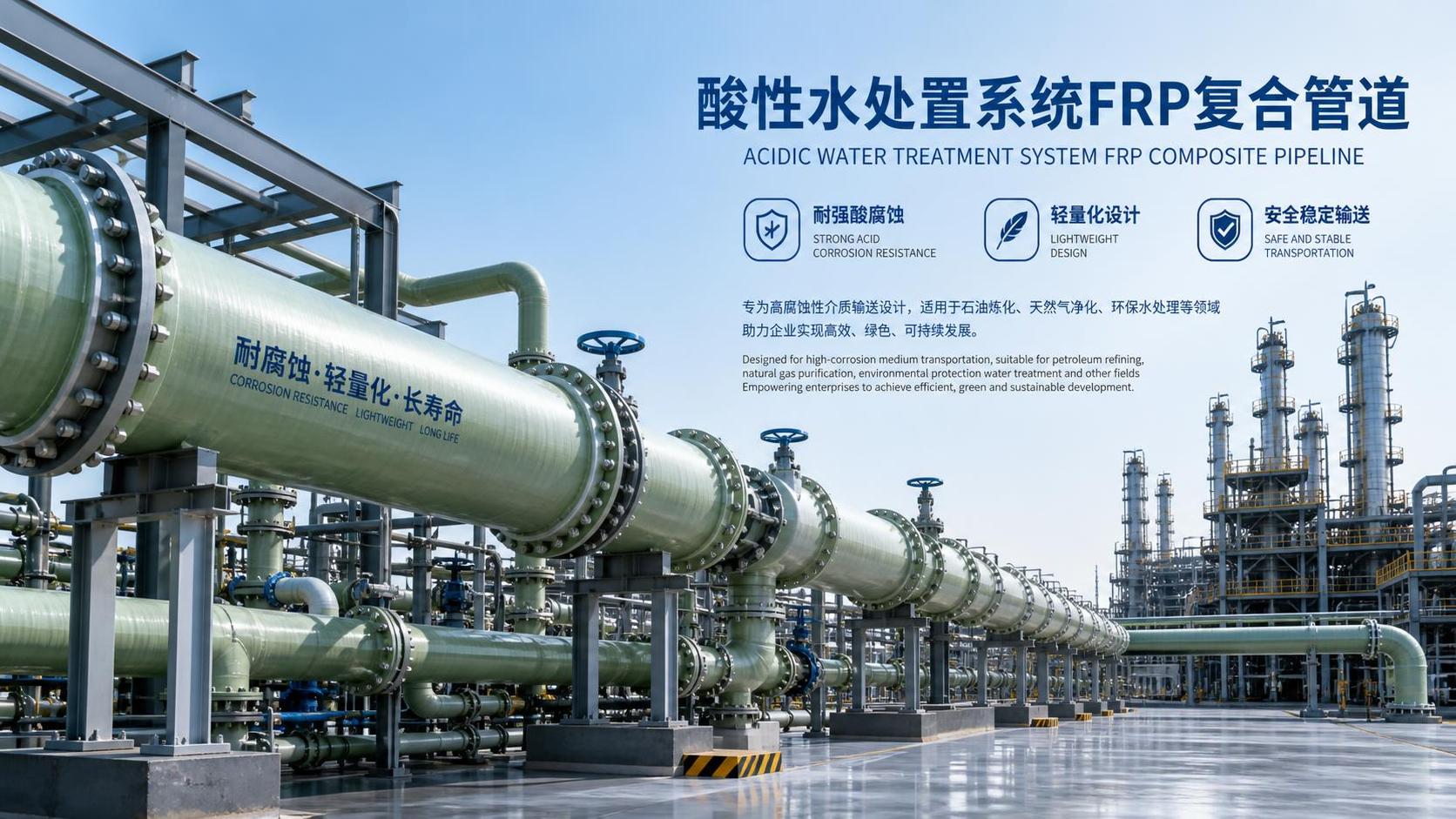
In sour water disposal systems, FRP Pipe offers a compelling balance of corrosion resistance, lightweight handling, and long-term reliability for oil industry projects. For technical evaluators comparing material performance under aggressive chemical conditions, understanding how FRP Pipe responds to H2S-bearing fluids, temperature variation, and maintenance demands is essential to selecting a safe, cost-effective piping solution.
The real evaluation challenge is not whether FRP can resist corrosion in a general sense. It is whether a specific FRP pipe system can maintain mechanical integrity, hydraulic performance, joint reliability, and inspection confidence under the exact sour water chemistry and operating envelope of a given facility. In oilfield and refinery practice, sour water is rarely a simple service. It may contain dissolved H2S, CO2, chlorides, ammonia, suspended solids, hydrocarbons, and sometimes oxygen ingress during upset conditions. That combination changes the material selection logic significantly.
Why sour water disposal is difficult for conventional piping materials
Sour water disposal lines sit in an awkward zone between corrosion engineering and operations reality. Carbon steel remains common because of familiarity and cost, but it can become a maintenance-heavy option when internal corrosion rates rise, localized attack develops, or scale and under-deposit corrosion complicate monitoring. Stainless steels may solve some corrosion issues, yet they introduce higher capital cost and still require careful review where chlorides, stress corrosion concerns, or contamination risks are present.
This is where FRP Pipe enters the conversation. In properly designed service, it avoids the electrochemical corrosion mechanisms that drive many failures in metallic systems. That does not mean it is a universal replacement. It means the evaluator can shift attention from corrosion allowance and inhibitor dependence toward resin compatibility, permeation resistance, temperature limits, pressure design, support design, and installation quality.
What “good performance” means in sour water service
For technical assessment, performance should be judged across five dimensions rather than one headline property.
The first is chemical resistance. The pipe wall and liner must tolerate the actual fluid composition over time, including upset chemistry rather than only normal design chemistry.
The second is structural reliability. Sour water systems may see pressure cycling, transient flow, occasional vacuum conditions, and support movement. A corrosion-resistant pipe that lacks sufficient stiffness, joint strength, or surge tolerance is not a successful solution.
The third is operational stability. Disposal systems often run continuously and are not always easy to isolate. A material that reduces internal corrosion but becomes difficult to inspect, repair, or join in the field may create different project risks.
The fourth is lifecycle predictability. Technical teams are usually less concerned with brochure-level corrosion claims than with whether field performance is repeatable across batches, diameters, fittings, and installation contractors.
The fifth is compliance with project standards. Depending on the region and owner specification, material qualification may require alignment with recognized design and testing standards such as API, ASTM, ISO, or owner-specific GRE/GRP requirements. Exact applicability should be verified case by case because sour water systems can fall under different piping classes and regulatory frameworks.【待核实】
Where FRP Pipe usually performs well
In many sour water disposal applications, FRP Pipe performs best when the service is dominated by internal corrosion risk rather than extreme temperature or severe mechanical abuse. Produced water disposal lines, sour water transfer pipelines, utility connections around treatment units, and some injection or outfall services are typical areas where engineers consider GRE or related FRP constructions.
The appeal is straightforward. FRP does not rust, does not require corrosion allowance in the same way carbon steel does, and generally lowers maintenance associated with internal wall loss. Its smooth internal bore can also help preserve hydraulic efficiency over time, especially where metallic systems would otherwise roughen due to corrosion products or deposits.
Weight is another practical advantage that evaluators should not treat as secondary. On remote oilfield projects, reduced weight can simplify transportation, lifting plans, support steel, and installation time. In brownfield modifications, that can materially reduce shutdown scope.
There is also a useful crossover lesson from other corrosive water services. Engineers familiar with GRE in marine, produced water, or desalination environments often look at related system experience when screening materials. For example, application knowledge from GRE Pipe Desalination Plants can be relevant when assessing long-term behavior under saline, chemically aggressive aqueous conditions, even though sour water chemistry must still be reviewed independently.
The key technical limit: chemistry alone does not qualify the pipe
A common mistake is to assume that if the fluid is corrosive to steel, FRP is automatically suitable. Sour water selection depends heavily on the resin system, liner design, manufacturing quality, and operating temperature. GRE pipe is not one uniform material category. Performance can vary significantly depending on epoxy formulation, curing control, glass content, liner thickness, and fitting construction.
For sour service, the resin system is usually the first screening item. The evaluator should request chemical resistance data specific to the fluid components expected in service, especially H2S-bearing water with chlorides, hydrocarbons, and ammonia if present. If the supplier only provides generic resistance charts, that is not enough for critical applications. Resistance charts are useful for preliminary screening, but final qualification often needs a more application-specific review.
Permeation is another issue that should not be overlooked. FRP may resist bulk corrosion, but certain chemicals can diffuse through liners or affect the resin-rich inner surface over time. In lines carrying H2S-containing water, the concern is not classic rusting but potential degradation of the matrix, blistering risk under some conditions, and long-term property retention. The severity depends on composition, pressure, and temperature.
Temperature is often the deciding factor
In many sour water projects, temperature becomes the practical boundary between a strong FRP application and a marginal one. A disposal line operating at moderate temperature may be well within the comfort zone of a properly selected GRE system. A line exposed to elevated steady-state temperature, thermal cycling, or upset excursions can move quickly into a more restrictive design space.
Evaluators should look beyond nominal operating temperature and confirm:
- maximum continuous temperature;
- short-duration upset temperature;
- installation temperature range;
- thermal expansion behavior of the full line;
- property retention at end-of-life design conditions.
This matters because FRP Pipe performance is tied to the resin matrix. Even when pressure ratings appear acceptable at room temperature, allowable stress and stiffness can decline as temperature rises. In sour water disposal systems with intermittent hot slugs or tie-ins near process equipment, that distinction matters more than in steady utility service.
Joint design deserves as much attention as the pipe body
Field failures in composite piping systems are often linked less to straight pipe corrosion resistance and more to joining details, misalignment, support movement, or poor installation control. In sour water disposal service, joints must be reviewed for both chemical compatibility and mechanical robustness.
Laminated joints, adhesive-bonded joints, flanged connections, and rubber seal systems each behave differently under pressure cycling, thermal movement, and installation variability. A technically sound pipe body can still underperform if the jointing method is sensitive to workmanship or difficult to inspect after installation.
For technical evaluation, practical questions usually reveal more than catalog data:
- How much field workmanship does the joint require?
- What NDE or quality checks are available after assembly?
- How tolerant is the joint to angular deflection and support settlement?
- What is the repair method if a leak develops in a constrained rack or trench?
These issues are especially important in export projects where the design office, pipe manufacturer, installer, and operator may all be different parties.
Mechanical and operational conditions that can reduce suitability
FRP Pipe is often selected for corrosion resistance, but the disqualifying factors are frequently mechanical. Technical reviewers should be cautious where sour water disposal lines face any of the following:
- frequent water hammer or severe surge events;
- high vacuum or external pressure exposure without adequate design margin;
- buried service in unstable soil with significant differential settlement;
- repetitive vibration near rotating equipment;
- abrasive solids content that may erode liners or fittings;
- fire exposure scenarios requiring special passive protection strategy.
None of these automatically exclude FRP, but they shift the evaluation from corrosion benefit to system design discipline. In some projects, metallic pipe with internal lining may remain the safer choice if surge control, fire risk, or impact loading dominate the service conditions.
How experienced evaluators compare FRP with steel in sour water disposal
The comparison is less about initial pipe cost than about which risk profile the project is better equipped to manage.
Carbon steel usually fits projects that already have strong corrosion monitoring, inhibitor programs, pigging strategy, and maintenance access. Its weaknesses are predictable but ongoing: corrosion allowance consumption, inspection burden, coating dependence, and potential leakage over service life.
FRP Pipe usually fits projects seeking lower internal corrosion maintenance and better long-term hydraulic stability, provided the owner can enforce quality in design, manufacturing, and installation. Its weaknesses are different: narrower temperature margins, greater sensitivity to support and joining practice, and more limited tolerance for field improvisation.
That trade-off is why some owners adopt FRP selectively rather than universally. Straight, corrosion-dominated sour water transfer sections may be excellent candidates, while high-temperature tie-ins, high-vibration zones, or fire-exposed modules remain metallic.
What to ask a supplier before approving FRP for sour water duty
A serious technical evaluation should go beyond pressure class and diameter range. At minimum, the review package should address:
- resin system identification and documented chemical resistance basis;
- design temperature and pressure derating method;
- joint type and installation qualification;
- manufacturing process controls and hydrotest practice;
- applicable standards and owner specification compliance;
- service history in comparable sour water or chemically aggressive water systems;
- recommended support spacing, anchor design, and expansion control;
- inspection, repair, and field modification procedures.
If a supplier can only discuss general FRP advantages but cannot provide application-specific qualification logic, the evaluation is incomplete. That point matters in international sourcing, where manufacturing capability can differ widely even within the same nominal product category.
In some cases, evaluators also review supplier experience across adjacent corrosive sectors, including offshore water handling, chemical water transfer, and GRE Pipe Desalination Plants. Such references can be useful indicators of process control maturity, though they should not replace direct review of sour water suitability.
Common mistakes in project selection
One recurring mistake is overestimating FRP’s immunity. FRP is corrosion resistant, not consequence-free. If the line sees conditions outside the qualified chemistry or temperature range, damage may be less visible than steel wall loss and therefore easier to miss until leakage occurs.
Another mistake is under-designing supports. Composite piping is lightweight, but that does not mean support details are forgiving. Poor support spacing, point loading, and uncontrolled thermal movement can generate failures even when the chemistry is acceptable.
A third mistake is treating all manufacturers as equivalent. In sour water disposal service, consistency of winding, curing, liner quality, fittings fabrication, and testing discipline matters as much as nominal material type.
So, how does FRP Pipe perform?
In the right sour water disposal application, FRP Pipe performs well because it removes one of the most persistent problems in these systems: internal corrosion of metallic pipe. That benefit can translate into lower maintenance, cleaner hydraulics, and more stable long-term operation. For corrosion-dominated service at suitable temperature and pressure, it is often a technically strong option.
Its performance becomes less favorable when evaluators ignore service complexity. H2S-bearing water is not a single medium, and FRP suitability depends on resin compatibility, temperature control, joint reliability, surge exposure, solids content, and installation quality. The best results are typically seen where owners treat FRP as an engineered system rather than a simple material substitution.
For technical evaluators, that is the practical conclusion: FRP Pipe is not the automatic answer for every sour water disposal line, but in well-defined operating windows it is often one of the most efficient answers available. The quality of the decision depends less on broad material preference and more on whether the project team is willing to qualify the actual service conditions in detail.
Please give us a message
产品介绍产品介绍产品介绍产品介绍产品介绍产品介绍产品介绍产品介绍产品介绍产品介绍产品介绍产品介绍产品介绍产品介绍产品介绍产品介绍产品介绍产品介绍产品介绍产品介绍产品介绍产品介绍产品介绍产品介绍产品介绍产品介绍产品介绍产品介绍产品介绍产品介绍
Please give us a message
产品介绍产品介绍产品介绍产品介绍产品介绍产品介绍产品介绍产品介绍产品介绍产品介绍产品介绍产品介绍产品介绍产品介绍产品介绍产品介绍产品介绍产品介绍产品介绍产品介绍产品介绍产品介绍产品介绍产品介绍产品介绍产品介绍产品介绍产品介绍产品介绍产品介绍
Please give us a message
产品介绍产品介绍产品介绍产品介绍产品介绍产品介绍产品介绍产品介绍产品介绍产品介绍产品介绍产品介绍产品介绍产品介绍产品介绍产品介绍产品介绍产品介绍产品介绍产品介绍产品介绍产品介绍产品介绍产品介绍产品介绍产品介绍产品介绍产品介绍产品介绍产品介绍
Please give us a message
产品介绍产品介绍产品介绍产品介绍产品介绍产品介绍产品介绍产品介绍产品介绍产品介绍产品介绍产品介绍产品介绍产品介绍产品介绍产品介绍产品介绍产品介绍产品介绍产品介绍产品介绍产品介绍产品介绍产品介绍产品介绍产品介绍产品介绍产品介绍产品介绍产品介绍