
Glassfiber Reinforced Epoxy Pipe Performance in Sour Water Service
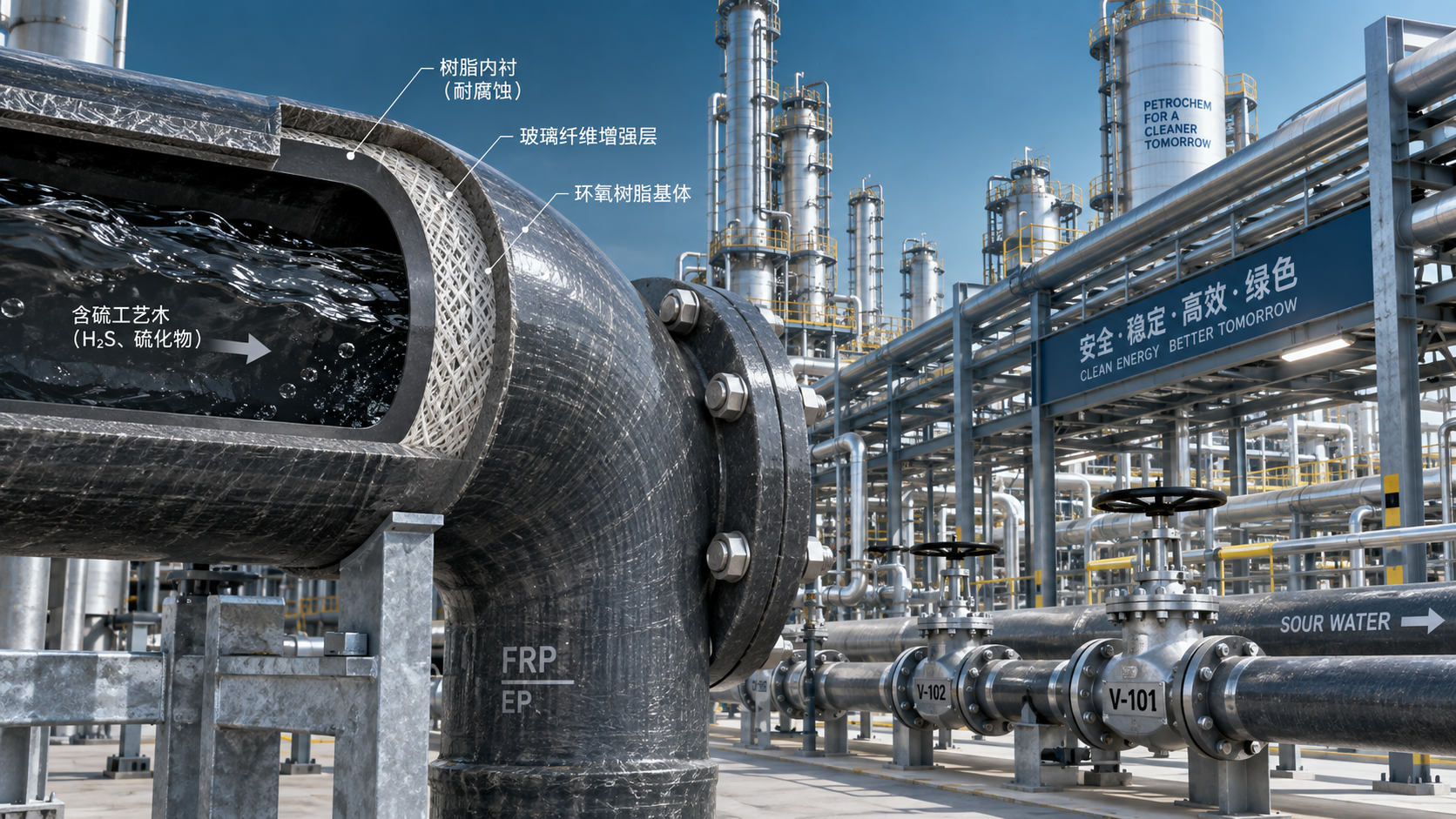
Sour water service places a Glassfiber Reinforced Epoxy Pipe system under a combined chemical, thermal, and mechanical duty. The water phase may contain dissolved hydrogen sulfide, carbon dioxide, chlorides, suspended solids, hydrocarbons, ammonia, and process chemicals. Pipe performance therefore cannot be inferred from a general statement that GRE is corrosion resistant. The resin formulation, laminate construction, joint design, fluid composition, pressure cycling, and operating temperature must be considered together.
Where the system remains within its qualified chemical and temperature envelope, a properly designed GRE line can avoid the electrochemical corrosion mechanisms associated with metallic pipe. Its inside surface does not depend on a sacrificial coating or corrosion allowance. That advantage becomes less certain when the resin is exposed to sustained elevated temperature, unusual solvent content, abrasive solids, or an environment that attacks the resin-rich internal liner rather than the glass reinforcement itself.
What Sour Water Changes in Material Selection
Sour water is not a single fluid. A stream with low dissolved gas content and moderate chlorides behaves differently from hot separator water carrying hydrogen sulfide, carbon dioxide, free hydrocarbon, deposited solids, and intermittent chemical treatment. A material review should start with the expected chemical envelope rather than a nominal service name.
The epoxy resin is the main chemical barrier in a Glassfiber Reinforced Epoxy Pipe. The glass fibers provide strength and stiffness, but the resin transfers load between fibers and protects the laminate against the process fluid. A suitable system normally uses a corrosion-resistant liner or resin-rich inner layer, followed by structural reinforcement designed for internal pressure and external loads. Chemical resistance data must correspond to the actual resin system, cure condition, temperature, and exposure duration. Test results for a generic epoxy laminate do not establish suitability for every GRE construction.
Hydrogen sulfide deserves particular attention because its presence is often treated as the sole definition of sour duty. Dissolved H2S does not produce the sulfide stress cracking mechanism associated with susceptible steels in the same way. However, it remains part of a broader fluid chemistry that can affect resin durability, permeation behavior, and the consequences of a leak. Carbon dioxide can alter water chemistry and scale formation. Chloride concentration, pH, hydrocarbon carryover, oxygen ingress, oxidizing biocides, and aromatic solvents can each alter the compatibility conclusion.
Temperature is often the parameter most likely to overturn an apparently acceptable selection. Chemical attack and diffusion generally accelerate as temperature rises. A resin system that performs satisfactorily in ambient sour water may not retain the same margin during prolonged hot operation, thermal excursions, or shutdown conditions that expose the bore to concentrated treatment chemicals. The maximum normal operating temperature, upset temperature, heat tracing condition, and duration of each exposure should be recorded separately.
Reading the Pressure Rating Correctly
A pressure class is not an independent guarantee of sour water performance. It represents a structural capability under defined assumptions, often including temperature, service factor, pipe dimensions, and a particular laminate design. Chemical exposure can reduce long-term properties, while thermal expansion, cyclic pressure, and installation loads add stress states that are not visible in a simple design-pressure comparison.
For a pressure line, the relevant question is whether the pipe wall, fittings, and joints retain the required pressure capability for the full operating life under the specified fluid and temperature. This calls for a review of:
- Design and upset pressure: include pump dead-head conditions, blocked-in heating, surge, pressure relief scenarios, and static head. A low steady pressure does not eliminate transient loading.
- Pressure cycling: repeated starts, level-control changes, injection pulses, and pump trips may govern fatigue behavior even when each cycle is below the nominal rating.
- Temperature derating: structural ratings and chemical suitability limits are both temperature sensitive, but their reduction curves are not necessarily identical.
- External pressure: buried lines, vacuum conditions, drained-and-isolated sections, and hydrotest arrangements can impose buckling loads that differ from internal-pressure service.
- Fittings and joints: a system is limited by its weakest qualified component. Branches, elbows, reducers, flanges, and field joints need the same service basis as the straight pipe.
Surge analysis is especially relevant in sour water transfer systems. GRE has a different elastic response from steel, and its internal diameter, wall construction, restraint arrangement, and fluid velocity affect the pressure wave. Treating a nonmetallic line as a direct dimensional replacement for an existing steel route can produce incorrect surge assumptions. Supports, anchors, valve closure time, pump controls, and air-pocket management belong in the same review.
Liner Integrity and Permeation
The internal liner is frequently the first layer to show a chemical or process-related problem. It is not intended to carry the full structural load, yet its condition strongly influences the protection of the reinforcing laminate. Resin whitening, blistering, softening, localized erosion, cracking, or fiber exposure require investigation because similar visible symptoms can have different causes.
Blisters may result from diffusion and pressure changes, but they may also indicate incomplete cure, entrapped volatiles, unsuitable resin chemistry, or a localized temperature event. Surface wear near tees and elbows can come from entrained sand or scale rather than chemical attack. A softened surface after cleaning may reflect exposure to a solvent or oxidizing treatment chemical, even where the normal sour water composition is acceptable. Repair scope should be based on the mechanism, depth, location, and extent of degradation rather than appearance alone.
Permeation through polymeric materials is also distinct from a through-wall leak. Small molecules can diffuse into a resin matrix under some conditions. The design concern is whether this leads to pressure buildup between layers, loss of adhesion, changes in mechanical properties, or emissions at joints and interfaces. High temperature, pressure, and free gas or hydrocarbon phases increase the need for a specific material assessment. The relevant process description should state whether the line carries fully liquid water, flashing liquid, entrained gas, intermittent gas slugs, or a mixed-phase stream.
Joints Need the Same Chemical Basis as the Pipe
GRE piping systems rely on several joint concepts, including adhesive-bonded socket joints, laminated field joints, flanged connections, and mechanical connections. Each introduces interfaces and workmanship variables. A pipe shell with suitable sour water resistance does not establish that every adhesive, seal, gasket, backing ring, or field laminate is equally compatible.
Bonded joints require controlled surface preparation, correct adhesive storage, mixing, application thickness, insertion depth, alignment, and cure. Contamination from moisture, oil, dust, or release agents can reduce bond quality without being obvious after assembly. In field-laminated joints, fiber orientation, overlap length, resin ratio, consolidation, and cure temperature influence structural continuity. Cure records and lot traceability are useful because later inspection cannot always verify the internal quality of a completed joint.
Flanged joints introduce a separate sealing question. Bolt load must be sufficient to seat the gasket without crushing a composite flange face or causing long-term relaxation that reduces sealing stress. Rigidly forcing misaligned steel equipment nozzles into a GRE flange connection transfers bending into a component that was not intended to correct piping fit-up. Spool dimensions, support elevations, and nozzle alignment should be confirmed before final tightening.
For gravity or low-pressure water networks, the configuration may appear closer to a municipal installation. The service logic still changes where sour constituents, temperature excursions, and hydrocarbon contamination are present. A referenced GRE Pipe for Municipal Project configuration should therefore be compared against the actual fluid, operating pressure, joint arrangement, and external loading before it is treated as equivalent to process sour water service.
Installation Loads Often Determine Field Reliability
Composite pipe is resistant to internal corrosion, but it is sensitive to unintended point loads, excessive bending, impact damage, and poor restraint design. Transport damage can be subtle: a deep scratch, crushed edge, or impact zone may remain beneath a liner or fitting interface. Acceptance inspection should distinguish superficial handling marks from damage that reaches structural reinforcement or affects a sealing surface.
Above ground, support spacing and support shape should match the pipe system design. Narrow steel edges, unsupported valve weight, or contact with sharp clamps can create concentrated stresses. Guides should permit expected axial thermal movement where required; anchors should be located so that movement is controlled rather than transferred into branches and flanges. Expansion behavior must account for the actual laminate orientation, pipe run geometry, and connection stiffness.
Below ground, soil support and compaction are part of the pipe structure. A rigid pipe-wall calculation is insufficient when trench bedding leaves voids or stones bear against the pipe. Differential settlement near concrete structures, road crossings, valve chambers, and transitions to steel piping can add bending that is absent from the pressure calculation. The line should be backfilled with material and compaction practices appropriate to the pipe design, then protected from later excavation and unsupported exposure.
Qualification Information That Resolves Ambiguity
A technically useful submittal does more than list a nominal diameter, pressure class, and resin name. It connects the delivered system to the stated duty. The fluid description should include expected and credible upset constituents, concentration ranges where available, temperature limits, pressure range, solids, gas content, cleaning chemicals, and planned operating sequence. When these items are missing, qualification is based on assumptions that can quietly migrate into procurement and construction.
Hydrotesting should be planned for the composite system rather than copied from a metallic piping procedure. Test pressure, fill and venting sequence, support condition, test duration, permissible pressure variation, and temperature stabilization should be established in advance. Trapped air stores energy and complicates interpretation of pressure loss. Water chemistry used for testing also deserves review where the system may remain filled for an extended period before start-up.
Service Monitoring and Failure Interpretation
Routine observation is most effective when it focuses on changes rather than isolated events. New dampness at a joint, altered support contact, unusual pipe deflection, a flange weep, liner damage near a high-velocity fitting, or recurring leaks in one area should be linked to pressure history, temperature events, chemical additions, and recent maintenance. Replacing a failed fitting without examining alignment, valve weight, surge, or joint preparation can repeat the same failure mode.
Where a repair is required, the repair material and procedure need compatibility with the process fluid and the original laminate. Surface preparation must remove degraded material and establish a sound bond area; applying resin over an unexamined soft or delaminated zone only conceals the defect. A repair near a pressure-retaining joint or flange often warrants a broader assessment of adjacent pipe, supports, and the event that initiated the damage.
Glassfiber Reinforced Epoxy Pipe can be a strong option for sour water service when its corrosion resistance is evaluated as part of a complete piping system. The durable result comes from matching the resin and liner to the real fluid envelope, preserving pressure capacity under temperature and cycling, qualifying joints and interfaces, and controlling the loads imposed during installation and operation.
Please give us a message
产品介绍产品介绍产品介绍产品介绍产品介绍产品介绍产品介绍产品介绍产品介绍产品介绍产品介绍产品介绍产品介绍产品介绍产品介绍产品介绍产品介绍产品介绍产品介绍产品介绍产品介绍产品介绍产品介绍产品介绍产品介绍产品介绍产品介绍产品介绍产品介绍产品介绍
Please give us a message
产品介绍产品介绍产品介绍产品介绍产品介绍产品介绍产品介绍产品介绍产品介绍产品介绍产品介绍产品介绍产品介绍产品介绍产品介绍产品介绍产品介绍产品介绍产品介绍产品介绍产品介绍产品介绍产品介绍产品介绍产品介绍产品介绍产品介绍产品介绍产品介绍产品介绍
Please give us a message
产品介绍产品介绍产品介绍产品介绍产品介绍产品介绍产品介绍产品介绍产品介绍产品介绍产品介绍产品介绍产品介绍产品介绍产品介绍产品介绍产品介绍产品介绍产品介绍产品介绍产品介绍产品介绍产品介绍产品介绍产品介绍产品介绍产品介绍产品介绍产品介绍产品介绍
Please give us a message
产品介绍产品介绍产品介绍产品介绍产品介绍产品介绍产品介绍产品介绍产品介绍产品介绍产品介绍产品介绍产品介绍产品介绍产品介绍产品介绍产品介绍产品介绍产品介绍产品介绍产品介绍产品介绍产品介绍产品介绍产品介绍产品介绍产品介绍产品介绍产品介绍产品介绍