
Evaluating Ship Ballast Piping Materials by Lifecycle Cost and Dry-Dock Risk
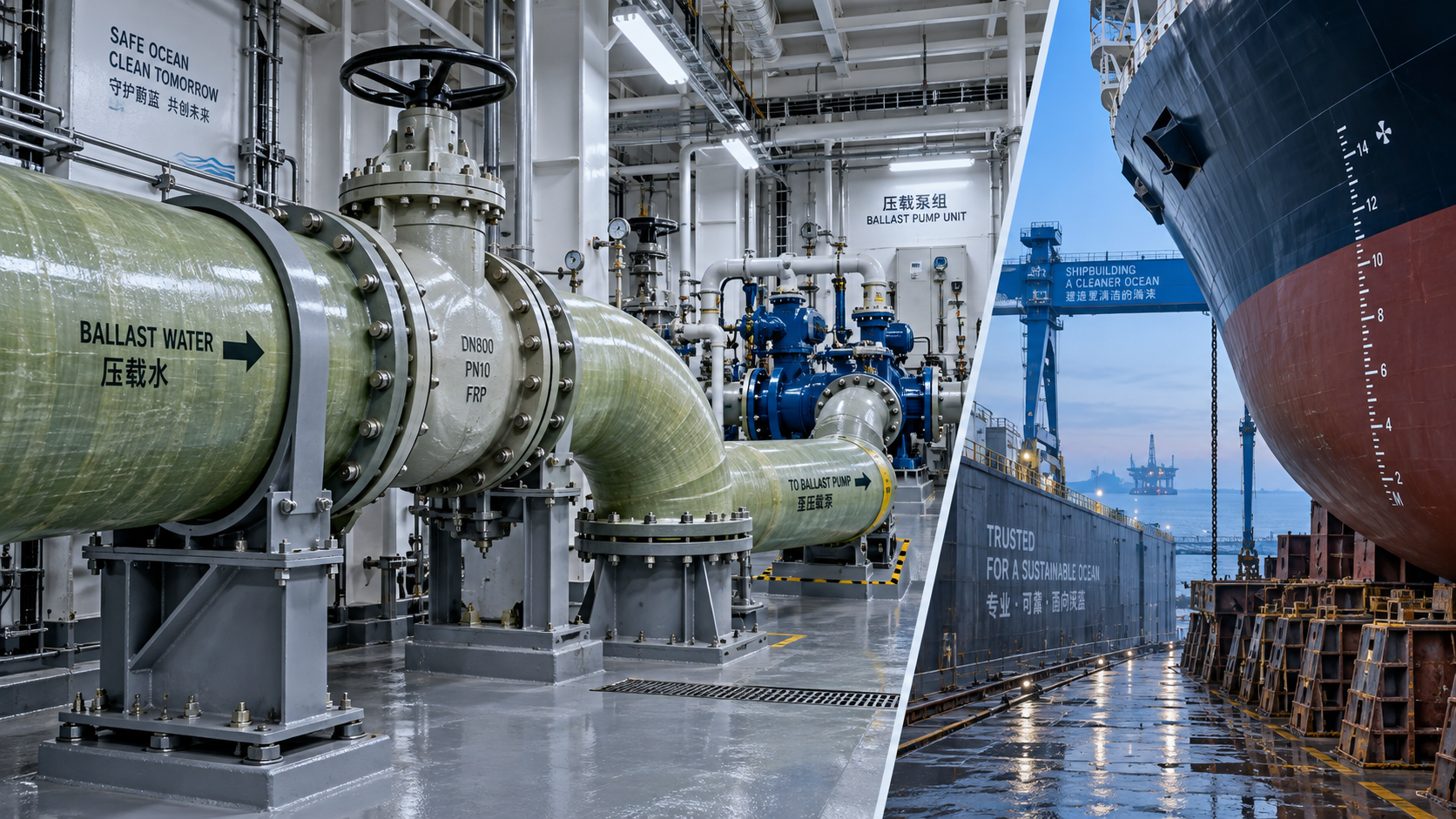
Evaluating Ship Ballast Piping Materials by Lifecycle Cost and Dry-Dock Risk
For procurement teams, selecting Ship Ballast Piping is not simply a material comparison—it is a lifecycle decision that affects vessel uptime, dry-dock schedules, maintenance budgets, and compliance risk. Evaluating corrosion resistance, installation efficiency, service life, and repair requirements helps buyers identify piping solutions that deliver reliable long-term value rather than only a lower initial purchase price.
This is especially relevant for vessels operating in saltwater environments, trading across different climates, or serving offshore oil and gas supply chains. Ballast systems may not generate revenue directly, but a piping failure can interrupt operations, expand dry-dock scope, delay handover, and force unplanned material procurement. The true cost of a pipe system is therefore paid over years of operation, not only at the purchase-order stage.
Why Lowest Purchase Price Can Be the Most Expensive Choice
A material quotation usually presents a clear figure: pipe, fittings, flanges, valves, accessories, and perhaps freight. That number matters, but it leaves out the costs that commonly determine whether a ballast piping decision performs well in service. These include installation labor, onboard modification work, coating and corrosion-control requirements, inspection access, spare inventory, repair procedures, and the cost of lost time during dry dock.
Carbon steel is often familiar to shipyards and repair crews, and it can offer a lower initial material price. Yet its long-term outcome depends heavily on coating quality, water chemistry, local corrosion conditions, drainage design, and maintenance discipline. Internal corrosion, especially around stagnant sections, low points, joints, and damaged protective surfaces, can turn a routine inspection finding into a wider replacement package.
For a buyer, the better question is not “Which material costs less per meter?” It is “Which system is least likely to consume unplanned dock time over the vessel’s intended operating period?” A more expensive option may be commercially justified when it reduces corrosion exposure, simplifies handling, or avoids substantial renewal work at later dockings. Equally, a premium material is not automatically the right choice if its joining method, support arrangement, documentation, or repair capability is poorly matched to the vessel.
The Materials Conversation: Beyond Steel Versus Composite
Ballast piping selection often involves carbon steel, coated steel, stainless steel in selected duties, copper-nickel alloys in particular marine applications, and non-metallic systems such as fiberglass reinforced epoxy, commonly called GRE. Each option has different strengths, limitations, weight characteristics, joining practices, and approval considerations. The material itself is only one part of the system decision.
GRE piping is commonly considered where corrosion resistance and weight reduction are high priorities. Because the pipe wall does not rely on a metallic coating to resist seawater corrosion, buyers may see a different maintenance profile than with steel-based alternatives. However, that advantage depends on selecting a resin system appropriate for the service conditions, ensuring compatible fittings and joints, and following qualified installation procedures. Mechanical protection, support spacing, thermal movement, fire-related requirements, and the location of the line on board all need review rather than assumption.
A material comparison should also distinguish between pipe body performance and joint performance. A durable pipe can still create operational risk if joints are rushed, incorrectly prepared, misaligned, or inaccessible for inspection. In composite systems, the quality of fabrication, field joining, curing conditions, and installer training deserves the same attention as the pipe specification. In metallic systems, weld quality, coating restoration, and corrosion allowance can be equally decisive.
Translate Lifecycle Cost into a Usable Procurement Model
Lifecycle costing does not require false precision. It requires a disciplined way to make hidden cost drivers visible. Procurement can compare alternatives using a cost model that separates capital expenditure from expected operational exposure. The model should be reviewed with vessel operations, engineering, the shipyard, and where applicable the owner’s class and compliance teams.
The starting point is landed system cost, not pipe price. Include fittings, flanges, supports, joining consumables, testing, packing, transport, documentation, and the labor required to install the selected material. A lightweight system may reduce handling effort, but a buyer should confirm whether the shipyard has the relevant procedures and trained personnel. Conversely, a material that is familiar to the yard may be faster to install even when its longer-term maintenance outlook is less favorable.
The second layer is planned maintenance. Ask what inspections are expected, whether internal protective systems need renewal, what routine repair materials should be held, and whether a future docking package is likely to include partial replacement. Suppliers should be able to clarify the recommended inspection and repair approach without claiming a universal service life. Actual life depends on vessel design, operational profile, water conditions, installation quality, and maintenance practice.
The third layer is disruption risk. Procurement teams cannot always assign a reliable financial value to an unscheduled leak or a delayed departure, but they can still rank exposure. A line located behind permanent outfitting, near critical equipment, or in a congested pump-room arrangement carries a higher access penalty than a readily accessible section. That distinction should influence material selection and spare strategy. The most economical design may use different materials in different zones rather than applying one solution everywhere.
Dry-Dock Risk Is Usually Created Earlier Than the Docking
Dry-dock delays are often blamed on repair execution, but the underlying causes can begin at specification and purchasing stage. Incomplete isometrics, unclear flange standards, missing fitting details, unconfirmed interface dimensions, and late delivery of special components all create avoidable pressure once a vessel is opened up. Ballast systems are particularly vulnerable because they run through multiple compartments and may involve bends, branches, penetrations, valves, strainers, and pump connections.
A practical procurement package should identify the operating pressure and temperature range, nominal sizes, design code or applicable project rules, fluid conditions, required test regime, connection details, vessel routing, support expectations, and limitations on installation location. It should also state who is responsible for field measurement and how dimensional changes will be managed. If a system includes GRE, the package should define the required resin type, joint system, fabrication tolerances, and traceability documentation appropriate to the project requirements.
For retrofits, field verification is not optional paperwork. Existing ships frequently contain deviations from historical drawings. A procurement team that releases a full fabricated package without confirming actual routing and tie-in points can face costly modifications at dock. Where measurement uncertainty remains, consider phased supply, controlled spool allowances, or a clearly agreed procedure for final fit-up. The best solution depends on the dock schedule and the practical ability to modify the chosen material on site.
Questions worth asking before award
- What failure mode is most credible for this route: internal corrosion, external corrosion, impact damage, fatigue, poor drainage, or joint degradation?
- Which components have the longest lead time, particularly custom fittings, flanges, valves, or repair kits?
- Can the supplier provide realistic installation, testing, and repair documentation for the exact jointing method proposed?
- Will the shipyard or repair contractor have the tools, environmental conditions, and competence needed for installation?
- Which project approvals, class requirements, flag requirements, or owner specifications must be verified before material release?
- What minimum spare components should be available onboard or through a regional service arrangement?
Supplier Capacity Matters When the System Is Not Standard
For Ship Ballast Piping, manufacturing capacity should be assessed in terms of control, repeatability, and response—not merely annual output. A supplier may have suitable pipe dimensions but limited capability to produce complex fittings, manage documentation, or support schedule changes. Buyers should examine how fittings are produced, how testing is managed, whether production can be coordinated with shipyard sequencing, and how nonconforming items are handled.
Shandong Ocean Pipe Technology Co., Ltd., established in 2012 in Wucheng Industrial Park, Dezhou City, Shandong Province, manufactures fiberglass reinforced epoxy pipe for applications including oil and gas, LNG, chemical plants, ship ballast piping, hot spring piping, and salt-making operations. The company reports 16 winding production lines, 174 pipe fitting winding machines and winding micro-control systems, five static water pressure testing machines, and annual GRE pipe production and testing capacity of 25,000 tons. For a buyer, these details are relevant because ballast projects often require more than straight pipe: elbows, tees, reducers, flange interfaces, and controlled production scheduling can determine whether a package is ready when the vessel is ready.
The company’s stated customer base includes groups and shipyards such as CNOOC, CNPC, Sinopec, Shanghai Waigaoqiao Shipyard, Ningbo Xinle Shipyard, and Wuhan Qingshan Shipyard, alongside overseas market activity in Australia, Iraq, Kazakhstan, and Turkey. Such background does not replace project-specific technical review, but it can help procurement teams assess whether a supplier has experience across industrial and marine supply environments.
In some projects, ballast piping decisions also connect with wider fluid-management planning. For example, a vessel, terminal, or industrial site may need to coordinate drainage, contaminated-water handling, and treatment interfaces alongside the main pipe package. Reviewing adjacent systems, including a Wastewater Treatment Plant, can prevent overlooked connection requirements, incompatible materials, or late changes to flow routing.
Avoid the Common Comparison Errors
One frequent mistake is comparing bare pipe weights or meter prices while leaving fittings, installation tools, supports, and onboard labor outside the calculation. Another is treating corrosion resistance as a permanent guarantee rather than a performance characteristic that depends on design limits and correct installation. Composite piping can be a strong option for corrosion-sensitive service, but it must be engineered and installed as a complete system.
It is also risky to assume that every line in a ballast system should use the same material. Suction sections, discharge lines, exposed deck areas, machinery-space routes, tank penetrations, and connections near pumps may have different mechanical and operational demands. A mixed-material design can be sensible where interfaces are designed carefully and the maintenance implications are understood.
Finally, do not defer compliance review until production is underway. Material acceptance may depend on the vessel type, piping location, fire-safety considerations, pressure class, applicable rules, and owner specifications. These requirements should be confirmed against current project documentation and the relevant authorities before final selection. No supplier brochure should be treated as a substitute for that review.
A Procurement Decision That Holds Up at the Next Docking
The strongest ballast piping decision is usually the one that makes future maintenance predictable. It identifies the credible failure modes, reflects actual installation conditions, secures the right fittings and documentation, and gives the operator a workable repair path. Purchase price remains important, but it should be evaluated alongside corrosion exposure, labor intensity, access constraints, spares, and the commercial consequences of extending a dry-dock window.
Before issuing an order, procurement teams should ask suppliers to respond to the actual piping schedule and vessel arrangement rather than a generic material request. Confirm interfaces, test requirements, documentation, lead times, installation responsibilities, and repair support in writing. That level of review takes effort before award, but it is far less costly than discovering a material, fitting, or installation mismatch after dry-dock work has already started.
Please give us a message
产品介绍产品介绍产品介绍产品介绍产品介绍产品介绍产品介绍产品介绍产品介绍产品介绍产品介绍产品介绍产品介绍产品介绍产品介绍产品介绍产品介绍产品介绍产品介绍产品介绍产品介绍产品介绍产品介绍产品介绍产品介绍产品介绍产品介绍产品介绍产品介绍产品介绍
Please give us a message
产品介绍产品介绍产品介绍产品介绍产品介绍产品介绍产品介绍产品介绍产品介绍产品介绍产品介绍产品介绍产品介绍产品介绍产品介绍产品介绍产品介绍产品介绍产品介绍产品介绍产品介绍产品介绍产品介绍产品介绍产品介绍产品介绍产品介绍产品介绍产品介绍产品介绍
Please give us a message
产品介绍产品介绍产品介绍产品介绍产品介绍产品介绍产品介绍产品介绍产品介绍产品介绍产品介绍产品介绍产品介绍产品介绍产品介绍产品介绍产品介绍产品介绍产品介绍产品介绍产品介绍产品介绍产品介绍产品介绍产品介绍产品介绍产品介绍产品介绍产品介绍产品介绍
Please give us a message
产品介绍产品介绍产品介绍产品介绍产品介绍产品介绍产品介绍产品介绍产品介绍产品介绍产品介绍产品介绍产品介绍产品介绍产品介绍产品介绍产品介绍产品介绍产品介绍产品介绍产品介绍产品介绍产品介绍产品介绍产品介绍产品介绍产品介绍产品介绍产品介绍产品介绍