
Glass Reinforced Epoxy vs Steel: Choosing Pipe Materials for Corrosion Service
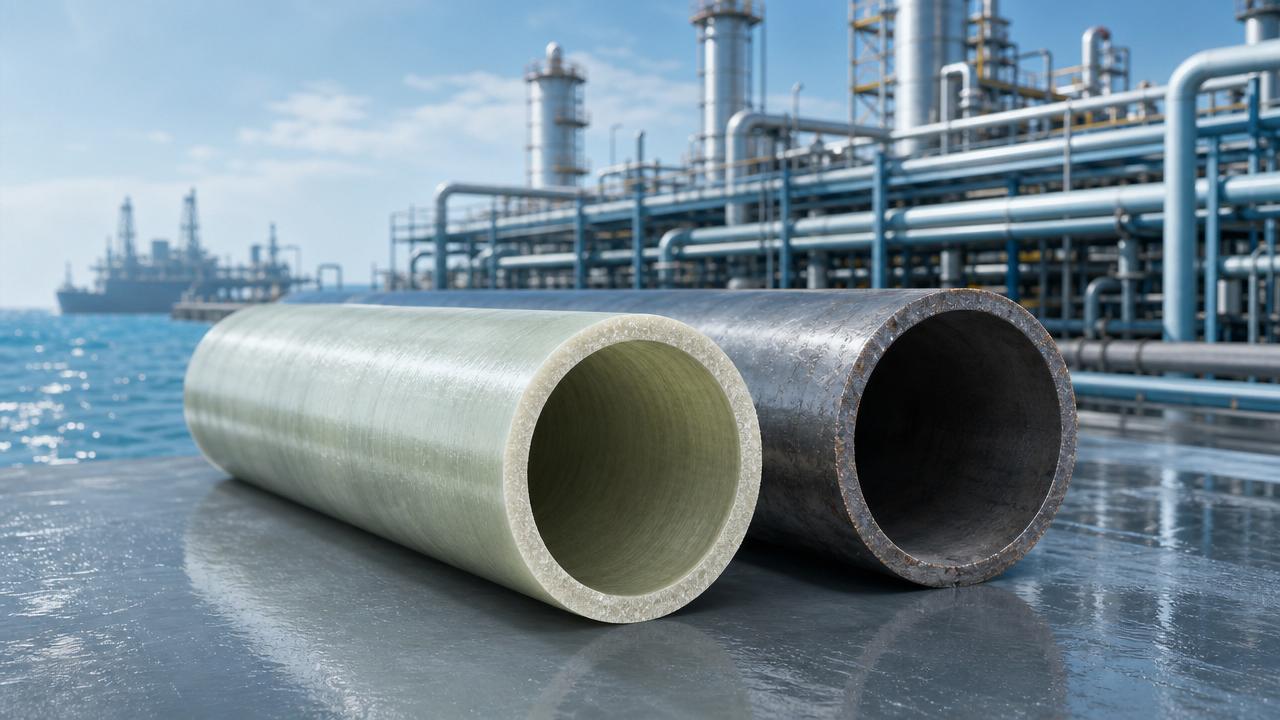
For technical evaluators specifying piping in corrosive environments, the choice between Glass Reinforced Epoxy and steel directly affects lifecycle cost, maintenance frequency, safety, and system reliability. While steel remains familiar and mechanically robust, GRE pipe offers strong corrosion resistance, lightweight handling, and long service performance in oil and gas, marine, chemical, LNG, and salt-related applications. This article compares both materials from an engineering and operational perspective to support more confident pipe material selection.
Why corrosion service changes the pipe material decision
Corrosion service is not only a material problem. It affects inspection intervals, shutdown planning, coating integrity, joint reliability, and the total risk profile of the pipeline system.
Steel is often selected because engineers know its behavior under pressure, impact, and high mechanical load. However, corrosion allowance and protection systems increase complexity.
Glass Reinforced Epoxy uses glass fiber reinforcement and epoxy resin to create a composite pipe wall. The material is designed to resist many aggressive fluids without internal corrosion allowance.
Typical pain points for technical evaluators
- The process medium contains chlorides, brine, seawater, hydrocarbons, or chemical streams that shorten the practical life of conventional steel.
- The project budget is limited, but maintenance shutdowns and coating repairs could cost more than the initial material saving.
- The site has difficult access, so heavy pipe handling, welding work, and hot work permits may delay installation.
- The owner requires traceable testing, stable production capacity, and a manufacturer familiar with industrial pipe applications.
For these conditions, comparing Glass Reinforced Epoxy and steel only by purchase price is incomplete. The better question is how each material performs over the intended service life.
Glass Reinforced Epoxy vs steel: what matters in real operation?
The following comparison focuses on corrosion service, not general structural steel use. It helps evaluators identify where Glass Reinforced Epoxy creates measurable operating advantages.
The table shows why Glass Reinforced Epoxy is attractive in corrosive networks. Steel still has strengths, but its protection strategy must be engineered and maintained.
When steel still deserves consideration
Steel may remain suitable where very high temperature, severe external impact, fire exposure, or unusual mechanical loading dominates the design basis.
In mixed-material systems, steel can also be retained for specific equipment connections, high-load areas, or legacy tie-ins while Glass Reinforced Epoxy handles corrosive pipe runs.
Which applications are better suited to Glass Reinforced Epoxy?
Application fit depends on fluid chemistry, pressure class, temperature, installation route, and inspection philosophy. Glass Reinforced Epoxy is often evaluated where corrosion drives lifecycle cost.
These examples do not remove the need for engineering verification. They clarify where Glass Reinforced Epoxy normally enters the shortlist against coated or alloyed steel.
A note on hydrocarbon transportation
For elevated temperature hydrocarbon applications, product selection should include pressure rating, temperature limit, resin system, joint method, and documentation requirements.
Technical teams evaluating such service may review High Temperature GRE Pipe for Hydrocarbon Transportation with API Monogram as part of a specification discussion.
Technical performance checks before replacing steel
Replacing steel with Glass Reinforced Epoxy should be treated as an engineered substitution, not a simple catalog exchange. The design envelope must be confirmed first.
Key parameters to request from the supplier
- Pressure class and safety factors, including whether the rating applies to continuous or specific operating conditions.
- Maximum operating temperature, short-term temperature exposure, and any derating rules for elevated service.
- Fluid compatibility data for the transported medium, including concentration, impurities, cleaning chemicals, and possible process upset conditions.
- Joint type, installation procedure, curing control, field testing method, and acceptance criteria after installation.
- Support spacing, allowable deflection, burial requirements, external load limits, and resistance to handling damage.
For technical evaluators, the most valuable supplier response is not a broad claim. It is a traceable answer tied to operating pressure, temperature, and medium.
Typical engineering trade-offs
Glass Reinforced Epoxy has strong corrosion performance, but it is not a universal replacement for every steel pipeline. Mechanical design discipline remains essential.
Steel can tolerate certain abuse conditions better, while GRE can reduce corrosion-related shutdowns. The right selection depends on which risk dominates the project.
How to compare lifecycle cost instead of initial price
Initial pipe price is easy to compare, but corrosion service requires a lifecycle view. The following cost map helps avoid underestimating downstream expenses.
A fair evaluation should calculate installed cost, maintenance cost, inspection cost, downtime risk, and expected service conditions. This is where Glass Reinforced Epoxy often becomes competitive.
Procurement questions that reveal hidden cost
- Will steel need internal lining, external coating, inhibitor dosing, or cathodic protection to reach the required service life?
- Does the installation site have restrictions on hot work, heavy lifting, welding inspection, or shutdown duration?
- Can the supplier provide hydrostatic testing capacity, fitting production capability, and consistent pipe documentation?
- Are spare fittings, field joint materials, and repair procedures available within the project schedule?
Standards, testing, and supplier capability to verify
Technical evaluators should ask how Glass Reinforced Epoxy pipe is manufactured, tested, and documented. Composite quality depends on controlled winding, curing, and inspection.
Common specification discussions may reference applicable industry practices, hydrostatic pressure testing, dimensional inspection, resin compatibility, and project-specific acceptance procedures.
What Ocean Pipe brings to specification support
Shandong Ocean Pipe Technology Co., Ltd. was established in 2012 in Wucheng Industrial Park, Dezhou City, Shandong Province, China.
With registered capital of USD 4,200,000, Ocean Pipe has grown into one of China’s top 10 largest manufacturers of Fiberglass Reinforced Epoxy pipe.
The factory operates 16 winding production lines and 174 sets of pipe fitting winding machines with winding micro control systems for production consistency.
It is also equipped with 5 static water pressure testing machines and has annual GRE pipe production and testing capacity of 25,000 tons.
- Application experience covers oil and gas, ship ballast piping, LNG, chemical plants, hot spring piping, and salt making companies.
- Customer references include well-known groups and shipyards such as CNOOC, CNPC, Sinopec, Shanghai Waigaoqiao Shipyard, Ningbo Xinle Shipyard, and Wuhan Qingshan Shipyard.
- Overseas market experience includes Australia, Iraq, Kazakhstan, Turkey, and other countries requiring export coordination and technical communication.
For buyers comparing Glass Reinforced Epoxy and steel, this capacity matters because delivery, fittings, testing, and documentation are part of the technical risk.
Common misconceptions when evaluating Glass Reinforced Epoxy
Many selection errors come from treating composite pipe like metal pipe, or from assuming corrosion resistance alone solves every design challenge.
Misconception 1: corrosion resistance means no maintenance
Glass Reinforced Epoxy can reduce corrosion-driven maintenance, but installed systems still require pressure testing, support checks, joint inspection, and protection from mechanical damage.
Misconception 2: any GRE pipe fits any chemical fluid
Resin system, temperature, concentration, and exposure time determine compatibility. A technical evaluation should include actual medium data, not only the chemical name.
Misconception 3: steel is always safer because it is stronger
Strength must be considered with service degradation. In corrosive operation, steel wall loss, coating failure, and under-deposit corrosion can change the safety margin.
FAQ for technical evaluators and purchasing teams
The following questions reflect common search and procurement concerns when teams compare Glass Reinforced Epoxy with steel for corrosion service.
How should I decide between GRE pipe and coated steel?
Start with the fluid, temperature, pressure, route, and expected maintenance access. If corrosion protection dominates cost and risk, Glass Reinforced Epoxy deserves serious evaluation.
Is Glass Reinforced Epoxy suitable for seawater and brine?
It is commonly considered for seawater, ballast, and brine-related applications. Final selection should confirm pressure class, resin compatibility, joint design, and installation conditions.
What information should be sent for quotation?
Provide pipe size, pressure rating, temperature, medium composition, installation method, fitting list, quantity, testing requirement, delivery destination, and documentation expectations.
Can GRE replace steel in every section of a plant?
No. Some sections may require steel because of temperature, fire exposure, impact, equipment loads, or code requirements. Hybrid material strategies are often practical.
Why choose Ocean Pipe for material evaluation and project supply?
Selecting Glass Reinforced Epoxy for corrosion service requires more than a product catalog. It requires application review, production capability, fitting coordination, and testing support.
Ocean Pipe supports technical evaluators with GRE pipe solutions for oil and gas, marine ballast, LNG-related systems, chemical plants, hot spring lines, and salt applications.
Our team can discuss operating parameters, product selection, fitting requirements, delivery schedules, customization needs, testing expectations, sample support, and quotation details.
If your project is comparing Glass Reinforced Epoxy and steel, contact Ocean Pipe with your medium, pressure, temperature, diameter, and installation conditions for a focused technical review.
Please give us a message
产品介绍产品介绍产品介绍产品介绍产品介绍产品介绍产品介绍产品介绍产品介绍产品介绍产品介绍产品介绍产品介绍产品介绍产品介绍产品介绍产品介绍产品介绍产品介绍产品介绍产品介绍产品介绍产品介绍产品介绍产品介绍产品介绍产品介绍产品介绍产品介绍产品介绍
Please give us a message
产品介绍产品介绍产品介绍产品介绍产品介绍产品介绍产品介绍产品介绍产品介绍产品介绍产品介绍产品介绍产品介绍产品介绍产品介绍产品介绍产品介绍产品介绍产品介绍产品介绍产品介绍产品介绍产品介绍产品介绍产品介绍产品介绍产品介绍产品介绍产品介绍产品介绍
Please give us a message
产品介绍产品介绍产品介绍产品介绍产品介绍产品介绍产品介绍产品介绍产品介绍产品介绍产品介绍产品介绍产品介绍产品介绍产品介绍产品介绍产品介绍产品介绍产品介绍产品介绍产品介绍产品介绍产品介绍产品介绍产品介绍产品介绍产品介绍产品介绍产品介绍产品介绍
Please give us a message
产品介绍产品介绍产品介绍产品介绍产品介绍产品介绍产品介绍产品介绍产品介绍产品介绍产品介绍产品介绍产品介绍产品介绍产品介绍产品介绍产品介绍产品介绍产品介绍产品介绍产品介绍产品介绍产品介绍产品介绍产品介绍产品介绍产品介绍产品介绍产品介绍产品介绍