
Glass Reinforced Epoxy Pipe Properties: Strength, Weight and Chemical Resistance
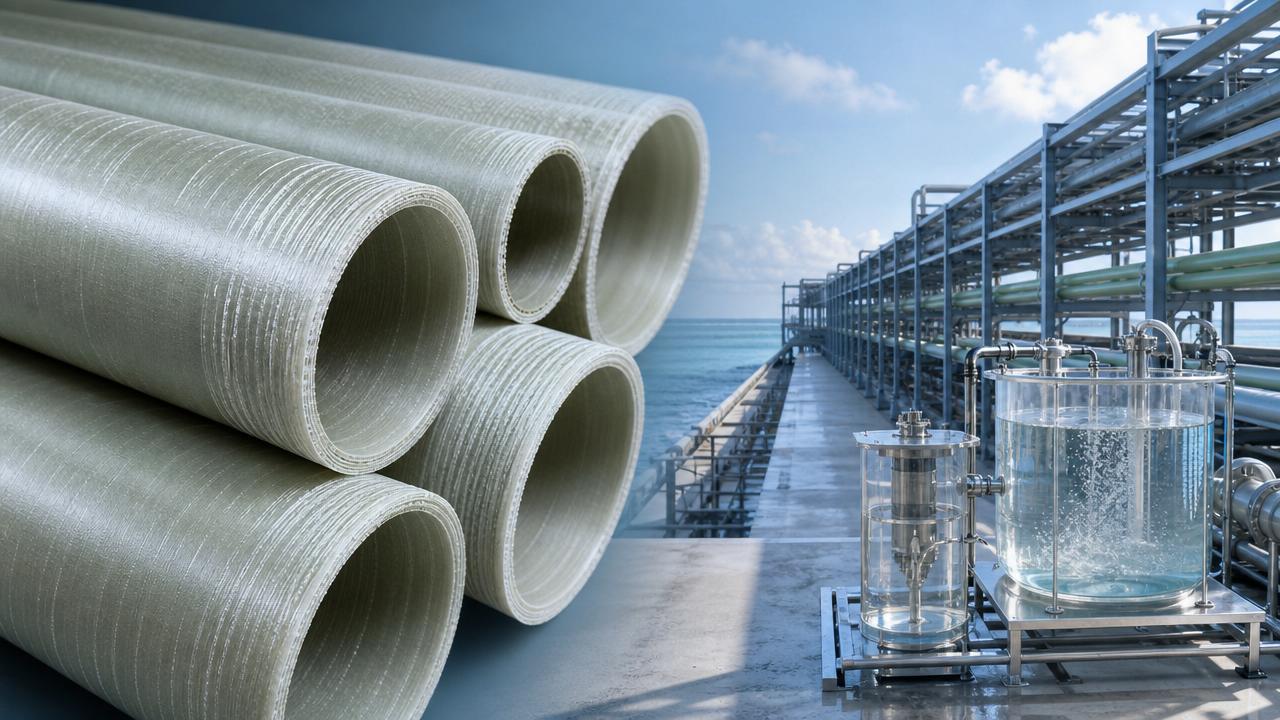
Glass Reinforced Epoxy Pipe Properties: Strength, Weight and Chemical Resistance
For quality control and safety managers, understanding Glass Reinforced Epoxy pipe properties is essential when evaluating piping systems for demanding industrial environments.
GRE pipes are valued for their high strength-to-weight ratio, corrosion resistance, and reliable performance in chemical, oil and gas, marine, and high-salinity applications.
This article examines the key factors that influence strength, weight, and chemical resistance, helping technical teams assess material suitability and reduce operational risks.
What Is Glass Reinforced Epoxy Pipe and Why Do Its Properties Matter?
Glass Reinforced Epoxy pipe is a composite piping material made from glass fiber reinforcement and an epoxy resin matrix.
The glass fibers carry mechanical loads, while the epoxy resin provides bonding, shape stability, and chemical protection.
This combination gives Glass Reinforced Epoxy a different performance profile from carbon steel, stainless steel, thermoplastics, and traditional ceramic-lined systems.
Its properties matter because industrial piping rarely fails from one factor alone.
Pressure, temperature, fluid chemistry, installation quality, and long-term fatigue often interact during service.
A suitable Glass Reinforced Epoxy system must match the operating envelope, not only the nominal pipe size.
In fiberglass and ceramic material applications, GRE offers a useful balance between engineered strength and non-metallic durability.
It is especially relevant where corrosion, salinity, chemical exposure, and maintenance access create long-term cost pressure.
Common applications include oilfield water injection, ship ballast lines, LNG facilities, chemical plants, hot spring pipelines, and salt-making systems.
Glass Reinforced Epoxy also supports marine emission-control projects, including The application of GRE piping in marine scrubber systems.
How Strong Is Glass Reinforced Epoxy Pipe Under Pressure and Load?
The strength of Glass Reinforced Epoxy pipe depends on fiber architecture, winding angle, resin quality, curing control, and laminate thickness.
Filament winding allows fibers to be oriented according to hoop stress and axial stress requirements.
Hoop strength resists internal pressure, while axial strength supports handling loads, soil loads, and thermal movement.
This engineered orientation is a key reason Glass Reinforced Epoxy can deliver reliable pressure performance at relatively low weight.
Unlike steel, GRE does not rely on metallic wall thickness alone for pressure capacity.
The laminate design must be validated through pressure rating, qualification testing, and manufacturing process control.
Static hydrostatic testing is commonly used to confirm integrity before delivery or installation.
For critical service, burst testing, long-term regression data, and joint qualification may also be reviewed.
What Strength Factors Should Be Checked?
- Rated pressure at the intended operating temperature.
- Pipe stiffness for buried or supported installation.
- Joint strength under axial and bending loads.
- Resistance to cyclic pressure or water hammer.
- Compatibility with supports, clamps, and thrust restraints.
Glass Reinforced Epoxy pipe performs best when design calculations include both normal operation and abnormal events.
Pressure surges, pump starts, thermal gradients, and accidental impact should not be ignored.
Where heavy mechanical abuse is likely, protective routing or shielding may be necessary.
How Much Weight Advantage Does Glass Reinforced Epoxy Provide?
Weight reduction is one of the most practical benefits of Glass Reinforced Epoxy piping.
Compared with steel, GRE is significantly lighter, which simplifies transportation, lifting, installation, and maintenance planning.
Lower pipe weight can reduce crane demand, installation crew effort, and structural load on pipe racks or vessels.
This is especially valuable in shipyards, offshore facilities, marine ballast systems, and retrofit projects.
A lighter Glass Reinforced Epoxy system may also reduce support spacing complications when properly engineered.
However, low weight should not be confused with low design responsibility.
GRE has different handling limits from metal pipe, especially regarding point loading, sharp impacts, and improper slinging.
Installation teams should avoid dragging pipe ends, striking joints, or over-tightening clamps.
Where Does Lower Weight Create Value?
- Marine piping where vessel weight affects efficiency and layout.
- Chemical plants requiring faster replacement of corroded lines.
- Remote oil and gas sites with limited lifting equipment.
- High-salinity projects where steel coating maintenance is costly.
- Factory modules needing easier prefabrication and assembly.
The best evaluation compares total installed weight, not only pipe body weight.
Fittings, flanges, anchors, supports, and installation method all influence final project value.
How Chemically Resistant Is Glass Reinforced Epoxy Pipe?
Chemical resistance is a core reason industrial sites choose Glass Reinforced Epoxy piping.
The epoxy matrix protects the laminate from many corrosive fluids, brines, seawater, acids, and process chemicals.
Unlike metallic pipe, GRE does not rust, pit, or suffer galvanic corrosion in the same way.
This makes Glass Reinforced Epoxy attractive for saltwater, produced water, ballast water, and certain chemical transfer systems.
Still, chemical compatibility must be verified against the exact service fluid.
Concentration, temperature, pressure, impurities, and exposure duration can change material behavior.
Some solvents, oxidizers, or elevated-temperature chemical mixtures may require special resin systems or alternative materials.
A compatibility review should include both normal chemistry and cleaning chemicals used during maintenance.
Practical Chemical Resistance Questions
- What is the exact fluid composition?
- What is the maximum continuous operating temperature?
- Are shock temperatures possible during cleaning?
- Will the pipe contact hydrocarbons, acids, alkalis, or oxidizers?
- Are permeation, swelling, or liner degradation concerns?
Glass Reinforced Epoxy generally offers excellent service life in seawater and brine environments.
That advantage becomes stronger where coating repair, cathodic protection, and corrosion allowance are difficult to manage.
How Does Glass Reinforced Epoxy Compare With Steel and Thermoplastic Pipe?
Material comparison should be based on service conditions, not a single property.
Steel offers high impact tolerance and familiar construction practices, but corrosion control can increase lifecycle cost.
Thermoplastic pipes can resist many chemicals, but may face pressure, temperature, and stiffness limits.
Glass Reinforced Epoxy often sits between these options with strong corrosion resistance and engineered pressure performance.
It is not a universal replacement, but it is highly competitive in selected industrial conditions.
In marine scrubber systems, ballast piping, and chemical wastewater service, Glass Reinforced Epoxy can reduce corrosion-related downtime.
In heavy mechanical zones, steel protection or hybrid layouts may still be appropriate.
What Risks or Misunderstandings Should Be Avoided When Selecting GRE Pipe?
A common mistake is selecting Glass Reinforced Epoxy only by nominal pressure rating.
Pressure rating is important, but it does not cover every installation and chemical condition.
Temperature derating, joint type, burial depth, support spacing, and external loads also require review.
Another misunderstanding is assuming all GRE products are identical.
Manufacturing equipment, winding control, resin formulation, curing consistency, and testing capacity affect final reliability.
Shandong Ocean Pipe Technology Co., Ltd. was established in 2012 in Wucheng Industrial Park, Dezhou City, Shandong Province, China.
With 16 winding production lines, the company manufactures Glass Reinforced Epoxy pipe for demanding industrial sectors.
Its production resources include pipe fitting winding machines, micro control systems, and static water pressure testing machines.
Such process control helps support consistent GRE pipe performance for oil and gas, LNG, shipyard, chemical, and salt-making projects.
Selection Checklist for Reliable Performance
- Define fluid chemistry, temperature range, pressure, and surge conditions.
- Confirm Glass Reinforced Epoxy resin compatibility with service and cleaning fluids.
- Review pipe stiffness, support spacing, and burial requirements.
- Check joint method, installation training, and inspection procedure.
- Request hydrostatic testing records and relevant qualification documents.
Proper inspection also matters after delivery.
Visual checks should identify cracks, delamination, damaged ends, contamination, and incorrect storage conditions.
During installation, joint cleanliness and curing conditions are especially important for bonded systems.
How Should Glass Reinforced Epoxy Pipe Be Evaluated Before Procurement?
Before procurement, technical evaluation should connect material properties with the actual risk profile of the project.
A strong Glass Reinforced Epoxy proposal should provide design basis, material data, testing method, and installation requirements.
It should also explain any limitation clearly, especially for temperature, chemical exposure, and mechanical protection.
For high-salinity or marine systems, corrosion resistance may deliver major lifecycle savings.
For crowded plant areas, low weight may accelerate installation and reduce shutdown duration.
For chemical transfer lines, compatibility validation is the central decision point.
The evaluation should not stop at material datasheets.
Factory capability, inspection discipline, project references, and after-sales technical support should be considered together.
Ocean Pipe supplies GRE products used by oil, gas, shipyard, LNG, chemical, hot spring, and salt-making customers.
Its markets include China and overseas regions such as Australia, Iraq, Kazakhstan, and Turkey.
These application backgrounds are useful when assessing suitability for similar operating environments.
FAQ Summary: Key Glass Reinforced Epoxy Pipe Decisions
Glass Reinforced Epoxy pipe combines strength, low weight, and chemical resistance in a practical non-metallic piping solution.
Its value is strongest where corrosion control, installation efficiency, and long service life are major priorities.
The right next step is to define operating conditions, confirm compatibility, and request project-specific technical data.
For marine, chemical, oil and gas, and high-salinity projects, a qualified Glass Reinforced Epoxy supplier can support safer decisions.
Please give us a message
产品介绍产品介绍产品介绍产品介绍产品介绍产品介绍产品介绍产品介绍产品介绍产品介绍产品介绍产品介绍产品介绍产品介绍产品介绍产品介绍产品介绍产品介绍产品介绍产品介绍产品介绍产品介绍产品介绍产品介绍产品介绍产品介绍产品介绍产品介绍产品介绍产品介绍
Please give us a message
产品介绍产品介绍产品介绍产品介绍产品介绍产品介绍产品介绍产品介绍产品介绍产品介绍产品介绍产品介绍产品介绍产品介绍产品介绍产品介绍产品介绍产品介绍产品介绍产品介绍产品介绍产品介绍产品介绍产品介绍产品介绍产品介绍产品介绍产品介绍产品介绍产品介绍
Please give us a message
产品介绍产品介绍产品介绍产品介绍产品介绍产品介绍产品介绍产品介绍产品介绍产品介绍产品介绍产品介绍产品介绍产品介绍产品介绍产品介绍产品介绍产品介绍产品介绍产品介绍产品介绍产品介绍产品介绍产品介绍产品介绍产品介绍产品介绍产品介绍产品介绍产品介绍
Please give us a message
产品介绍产品介绍产品介绍产品介绍产品介绍产品介绍产品介绍产品介绍产品介绍产品介绍产品介绍产品介绍产品介绍产品介绍产品介绍产品介绍产品介绍产品介绍产品介绍产品介绍产品介绍产品介绍产品介绍产品介绍产品介绍产品介绍产品介绍产品介绍产品介绍产品介绍