
GRVE Pipe Selection for Produced Water Systems
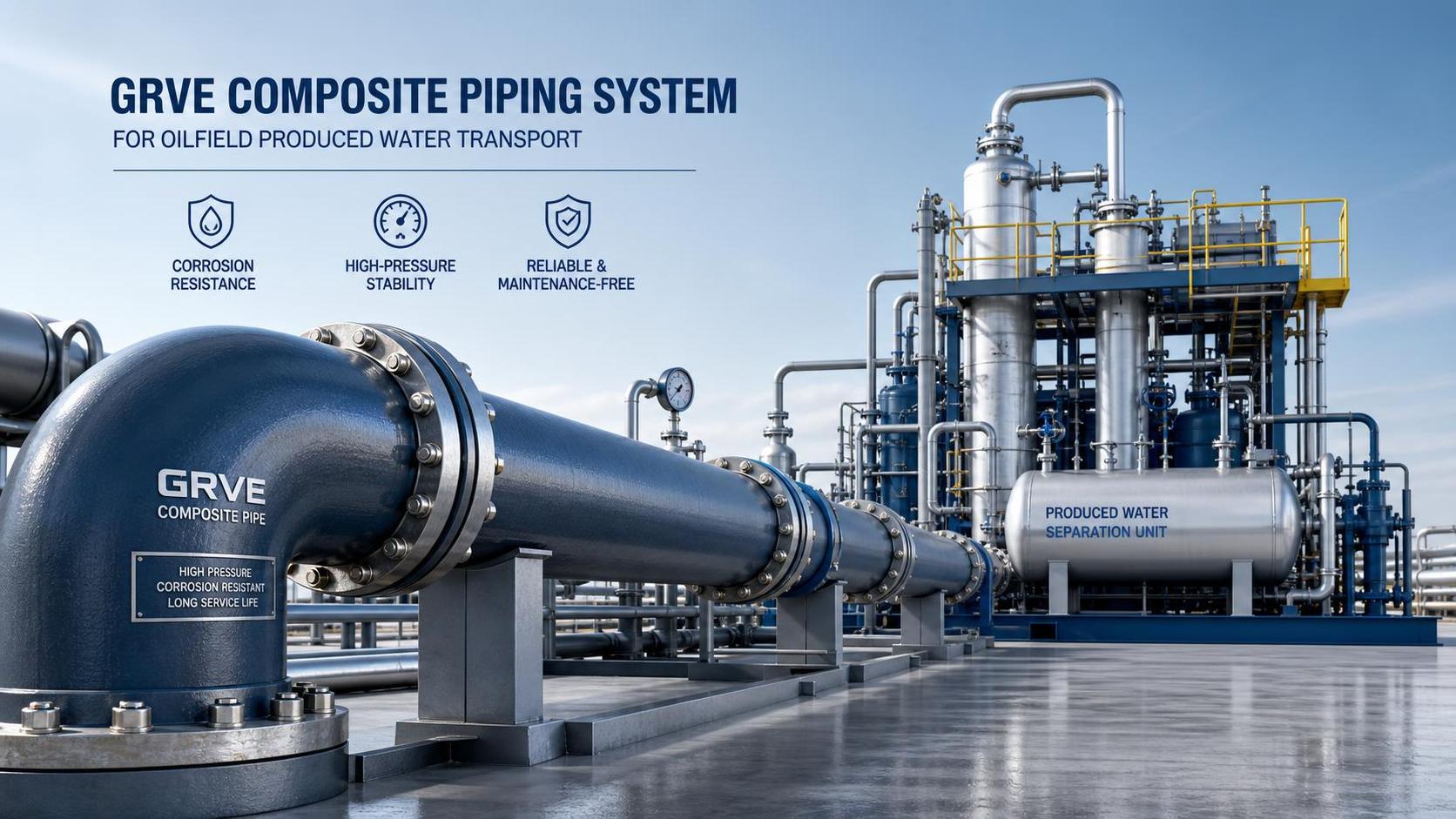
Selecting a GRVE Pipe for produced water systems is rarely a simple material choice. It affects corrosion control, pressure stability, maintenance cycles, and the overall cost profile of an oilfield water handling network.
Produced water often contains chlorides, dissolved gases, solids, residual hydrocarbons, and treatment chemicals. That combination pushes piping systems beyond basic transport duty and turns pipe selection into a lifecycle decision.
In this context, GRVE Pipe is gaining attention because it combines corrosion resistance with practical hydraulic performance. For oil and gas projects, that balance matters both during commissioning and years after startup.
Why produced water service is demanding
Produced water systems operate under a mix of chemical and mechanical stress. The fluid may look routine on a process diagram, yet field conditions can change quickly from one well cluster or treatment stage to another.
Salinity is usually the first concern. High chloride content accelerates corrosion in many metallic systems, especially where oxygen ingress, temperature variation, or stagnant zones are present.
Solids are another issue. Sand, scale, and suspended particles increase abrasion risk at elbows, reducers, and pump discharge areas. Local velocity spikes can shorten service life faster than average line conditions suggest.
There is also the operational side. Produced water networks are often expanded in phases, tied into existing assets, or routed across remote areas where shutdowns are expensive. A poor piping choice can create persistent maintenance exposure.
What GRVE Pipe means in practical selection
GRVE Pipe is generally evaluated as a reinforced composite solution for corrosive service. In produced water duty, the value is not just corrosion resistance on paper, but reliable behavior under real operating variability.
A well-selected GRVE Pipe can reduce dependence on internal coatings, frequent corrosion monitoring, and unplanned spool replacement. That is especially relevant in gathering systems, reinjection lines, and water transfer loops.
The selection process should focus on the whole system. Pipe wall construction, resin compatibility, joint design, pressure rating, and installation quality all shape the final result.
Core factors behind performance
- Fluid chemistry, including salinity, pH, hydrocarbons, and treatment additives.
- Operating and upset pressure, including surge and cyclic loading.
- Temperature range across start-stop and seasonal conditions.
- Abrasive content and expected flow velocity at critical fittings.
- Jointing method, support design, and installation controls on site.
Current industry attention around GRVE Pipe
Oilfield operators are under pressure to keep water handling reliable while controlling total installed and operating cost. That is one reason composite piping is being reviewed more seriously in produced water projects.
Another point is project schedule. In many brownfield and modular developments, easier handling and faster field assembly can reduce congestion and help shorten tie-in windows.
Standards compliance and manufacturing discipline also matter more than before. Buyers now look beyond brochure claims and pay closer attention to testing capability, traceability, and repeatability across batches.
That is where supplier background becomes relevant. Shandong Ocean Pipe Technology Co., Ltd., established in 2012 in Dezhou, Shandong, has built GRE manufacturing capacity with 16 winding lines and 174 fitting winding machines.
Its factory also includes five static water pressure testing machines and annual GRE production and testing capacity of 25,000 tons. For projects requiring volume consistency, that level of infrastructure is not a minor detail.
The company’s supply history across oil and gas, LNG, ship ballast, chemical plants, and export markets also suggests familiarity with varied service environments. That kind of track record supports risk evaluation during vendor shortlisting.
Where GRVE Pipe fits in produced water networks
Not every line in a produced water system sees the same exposure. Selection becomes more effective when the network is broken into functional zones rather than treated as one uniform service class.
This zoning approach also helps determine where other composite equipment may align with the same material strategy. In some facilities, items such as FRP/GRE Membrane Housing are reviewed alongside piping packages for compatibility and procurement efficiency.
How to judge a GRVE Pipe option beyond catalog data
A specification sheet gives a starting point, not the final answer. The stronger approach is to compare pipe options against actual operating envelopes and construction realities.
Pressure and hydraulic behavior
Design pressure should include surge events, pump trips, and valve actions. Produced water systems often see transient conditions that exceed normal operating assumptions for short periods.
Hydraulic smoothness can support lower friction losses, but that advantage should be checked against solids loading. Where erosion risk is high, local geometry deserves as much attention as straight-pipe performance.
Chemical resistance and temperature
Resin selection must reflect the actual water composition, not just generic produced water labeling. Scale inhibitors, biocides, oxygen scavengers, and cleaning chemicals can influence long-term compatibility.
Temperature needs the same discipline. A line that runs moderately most of the year may still experience cleaning cycles or upset temperatures that define the true material requirement.
Installation quality
Even a well-chosen GRVE Pipe can underperform if supports, alignments, or joint preparation are inconsistent. Field workmanship is part of material performance, not a separate topic.
It is worth confirming handling procedures, fitting tolerances, test plans, and installer training before final approval. This reduces the risk of leaks that later get blamed on the pipe itself.
Business value in project delivery
The real value of GRVE Pipe appears when technical fit and project execution are considered together. Material performance matters, but so do fabrication capacity, testing discipline, and supply continuity.
For larger water handling packages, reliable manufacturing throughput can protect schedule. Ocean Pipe’s installed winding capacity and broad customer base indicate readiness for repeat production across multiple line sizes and fittings.
That matters in phased field development, where later expansions must match earlier installations. Consistency across batches supports spare strategy, maintenance planning, and long-term system integrity.
There can also be procurement advantages when composite components are sourced within a coordinated package. Depending on project scope, a second review of FRP/GRE Membrane Housing and related items may help simplify material alignment.
A practical shortlist before final selection
Before freezing a GRVE Pipe specification, it helps to check a few decision points in sequence rather than all at once.
- Map each service segment by chemistry, pressure, temperature, and solids content.
- Review normal and upset cases, especially surge and shutdown scenarios.
- Confirm the joint system and field installation method early.
- Request testing records, pressure verification, and quality traceability.
- Compare supplier capacity with project schedule and fitting complexity.
- Check how future expansion or tie-ins may affect the chosen pipe class.
A produced water system rarely fails because one number was slightly off. Problems usually come from mismatches between service conditions, design assumptions, and execution quality.
That is why GRVE Pipe selection should be treated as a structured evaluation of fluid, pressure, installation, and supplier capability. A clear comparison matrix at this stage usually saves more than late corrective work ever can.
The next useful step is to organize line classes by actual produced water conditions, then compare GRVE Pipe options against those classes with testing evidence, joint details, and manufacturing support in view.
Please give us a message
产品介绍产品介绍产品介绍产品介绍产品介绍产品介绍产品介绍产品介绍产品介绍产品介绍产品介绍产品介绍产品介绍产品介绍产品介绍产品介绍产品介绍产品介绍产品介绍产品介绍产品介绍产品介绍产品介绍产品介绍产品介绍产品介绍产品介绍产品介绍产品介绍产品介绍
Please give us a message
产品介绍产品介绍产品介绍产品介绍产品介绍产品介绍产品介绍产品介绍产品介绍产品介绍产品介绍产品介绍产品介绍产品介绍产品介绍产品介绍产品介绍产品介绍产品介绍产品介绍产品介绍产品介绍产品介绍产品介绍产品介绍产品介绍产品介绍产品介绍产品介绍产品介绍
Please give us a message
产品介绍产品介绍产品介绍产品介绍产品介绍产品介绍产品介绍产品介绍产品介绍产品介绍产品介绍产品介绍产品介绍产品介绍产品介绍产品介绍产品介绍产品介绍产品介绍产品介绍产品介绍产品介绍产品介绍产品介绍产品介绍产品介绍产品介绍产品介绍产品介绍产品介绍
Please give us a message
产品介绍产品介绍产品介绍产品介绍产品介绍产品介绍产品介绍产品介绍产品介绍产品介绍产品介绍产品介绍产品介绍产品介绍产品介绍产品介绍产品介绍产品介绍产品介绍产品介绍产品介绍产品介绍产品介绍产品介绍产品介绍产品介绍产品介绍产品介绍产品介绍产品介绍