
GRVE Pipe Procurement Checks Before Project Approval
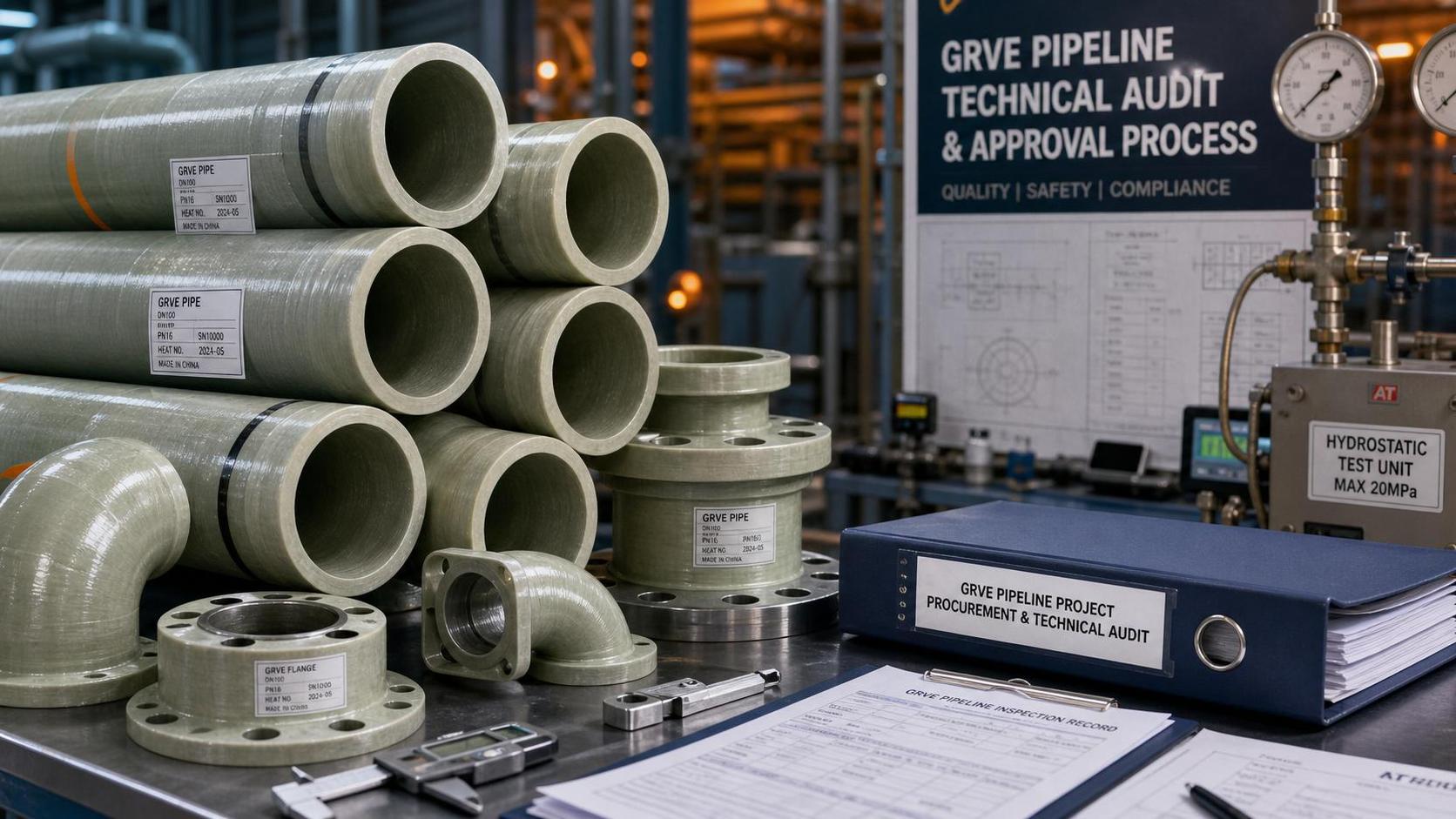
GRVE Pipe procurement checks that matter before approval
Project approval often slows down at one practical question: is the selected GRVE Pipe really fit for oil service, or only acceptable on paper?
That question deserves more than a price comparison.
In upstream, refinery, and terminal work, pipe failure usually costs far more than the initial order value.
The real review should connect specification, testing, supplier capacity, and delivery control to operating risk.
For GRVE Pipe, corrosion resistance is often the headline benefit.
Still, approval decisions are rarely won by one property alone.
Pressure class, joint integrity, chemical compatibility, fabrication consistency, and traceable testing all affect lifecycle cost.
In practice, better purchasing decisions come from verifying what the supplier can repeatedly deliver, not just what a brochure promises.
What should be confirmed first when GRVE Pipe enters an oil project review?
Start with service conditions, because every later check depends on them.
A GRVE Pipe line for produced water behaves differently from one carrying aggressive chemicals, ballast media, or hydrocarbon-related utility fluids.
The baseline review should cover design pressure, surge pressure, operating temperature, fluid composition, installation route, and expected service life.
Without that map, comparisons between suppliers become misleading.
It also helps to confirm whether the project needs buried pipe, above-ground pipe, skid integration, or complex fittings.
GRVE Pipe may pass the pressure requirement, yet still create problems if supports, thermal movement, or joint layout were overlooked.
A practical early screen looks like this:
This first filter saves time because it removes technically weak options before commercial discussions begin.
How do you judge whether a supplier can support more than just sample quality?
The useful question is not whether one sample looks good.
It is whether the factory can hold the same quality across the full batch, fittings included, within the delivery window.
That is where supplier scale and production control become part of technical risk management.
For example, Shandong Ocean Pipe Technology Co., Ltd. has operated since 2012 in Dezhou, Shandong.
Its registered capital is USD 4.2 million, and it is recognized among the larger Chinese manufacturers of fiberglass reinforced epoxy pipe.
The factory runs 16 winding lines, 174 fitting winding machines, micro control systems, and five static water pressure testing machines.
That matters because fitting output, hydrotest capacity, and line availability often determine whether a GRVE Pipe order stays on schedule.
Annual production and testing capacity of 25,000 tons also says something important.
It suggests the supplier is built for repeat industrial supply rather than occasional custom fabrication.
A stronger review usually asks for:
- Factory equipment list tied to the required pipe diameters and fitting types
- Recent project references in oil, gas, LNG, marine ballast, or refinery service
- Testing workflow from raw material entry to final pressure test
- Inspection records that match actual purchase scope
- Export or logistics experience for the destination market
Reference customers also help, but only when they resemble the current project.
A supplier serving CNOOC, CNPC, Sinopec, shipyards, and overseas markets such as Iraq, Kazakhstan, Australia, and Turkey has at least demonstrated broader operating exposure.
That does not replace due diligence, yet it reduces uncertainty around documentation, standards, and shipment handling.
Which technical documents actually prove GRVE Pipe suitability?
Many approvals become weak because the file set is large but not decisive.
What matters is evidence that the selected GRVE Pipe design matches service conditions and was tested in a relevant way.
Useful documents normally include material data, pressure design basis, hydrostatic testing records, dimensional inspection reports, and joint qualification details.
Need-to-have certificates differ by project, but traceability should never be vague.
In oil applications, connections are often the hidden checkpoint.
Pipe body strength may be acceptable while elbows, tees, or bonded joints remain the real weakness.
That is one reason engineered packages such as GRE Pipe for Refinery tend to attract attention in refinery reviews.
The package logic forces closer examination of fittings, pressure classes, and system compatibility.
A disciplined file review should answer three questions clearly:
- Was the design validated for the stated operating envelope?
- Can every batch be tied back to test and inspection records?
- Do field installation instructions protect the approved design intent?
If one of those answers is uncertain, the approval should remain conditional.
Where do cost surprises usually appear in a GRVE Pipe purchase?
The common mistake is to treat pipe price as total cost.
In reality, GRVE Pipe cost exposure usually sits in fittings, freight, field joining time, testing delays, and replacement risk after startup.
A lower quotation can become expensive when the supplier has limited fitting capacity or inconsistent documentation.
Schedule is another hidden cost center.
If the project needs staged deliveries, late fittings may stop installation even when straight pipe is already onsite.
For oil projects, shutdown windows make that risk even sharper.
A more grounded cost review compares the following elements, not just unit price:
More often than not, the best value comes from stable execution rather than the cheapest opening offer.
What are the most common approval-stage mistakes with GRVE Pipe?
One recurring mistake is approving GRVE Pipe based on generic corrosion claims without checking the exact fluid and temperature profile.
Another is assuming all epoxy-based composite pipe systems perform the same way.
They do not.
Manufacturing process, resin system, reinforcement control, and fitting quality can create large differences in field performance.
There is also a paperwork trap.
Some approvals rely heavily on certificates, while giving too little attention to production capacity and testing throughput.
If the supplier cannot sustain batch testing or fitting output, the approved specification may still miss the project deadline.
A final mistake is separating procurement review from construction reality.
Handling, support spacing, joint assembly, and field hydrotest procedures should be checked before approval, not after delivery.
That is especially true when evaluating solutions such as GRE Pipe for Refinery, where system conditions are rarely simple.
So what is a practical way to move from review to a confident decision?
A solid approval decision usually comes from a short checklist, not a thick file.
Confirm the service envelope first.
Then verify GRVE Pipe design suitability, fitting integrity, production capacity, testing traceability, and realistic delivery timing.
After that, compare total execution risk instead of unit price alone.
Suppliers with established oil and gas references, stable manufacturing resources, and documented test capability usually create fewer approval-stage surprises.
The next sensible step is to organize project conditions into a single review sheet.
Use it to match each GRVE Pipe offer against service data, standards, batch testing, fitting scope, and shipment plan.
That approach makes cost, schedule, and technical risk visible before the project is committed.
When the approval file answers those points clearly, the decision is usually faster and more defensible.
Please give us a message
产品介绍产品介绍产品介绍产品介绍产品介绍产品介绍产品介绍产品介绍产品介绍产品介绍产品介绍产品介绍产品介绍产品介绍产品介绍产品介绍产品介绍产品介绍产品介绍产品介绍产品介绍产品介绍产品介绍产品介绍产品介绍产品介绍产品介绍产品介绍产品介绍产品介绍
Please give us a message
产品介绍产品介绍产品介绍产品介绍产品介绍产品介绍产品介绍产品介绍产品介绍产品介绍产品介绍产品介绍产品介绍产品介绍产品介绍产品介绍产品介绍产品介绍产品介绍产品介绍产品介绍产品介绍产品介绍产品介绍产品介绍产品介绍产品介绍产品介绍产品介绍产品介绍
Please give us a message
产品介绍产品介绍产品介绍产品介绍产品介绍产品介绍产品介绍产品介绍产品介绍产品介绍产品介绍产品介绍产品介绍产品介绍产品介绍产品介绍产品介绍产品介绍产品介绍产品介绍产品介绍产品介绍产品介绍产品介绍产品介绍产品介绍产品介绍产品介绍产品介绍产品介绍
Please give us a message
产品介绍产品介绍产品介绍产品介绍产品介绍产品介绍产品介绍产品介绍产品介绍产品介绍产品介绍产品介绍产品介绍产品介绍产品介绍产品介绍产品介绍产品介绍产品介绍产品介绍产品介绍产品介绍产品介绍产品介绍产品介绍产品介绍产品介绍产品介绍产品介绍产品介绍