
GRE Tubing Uses in Harsh Chemical Environments
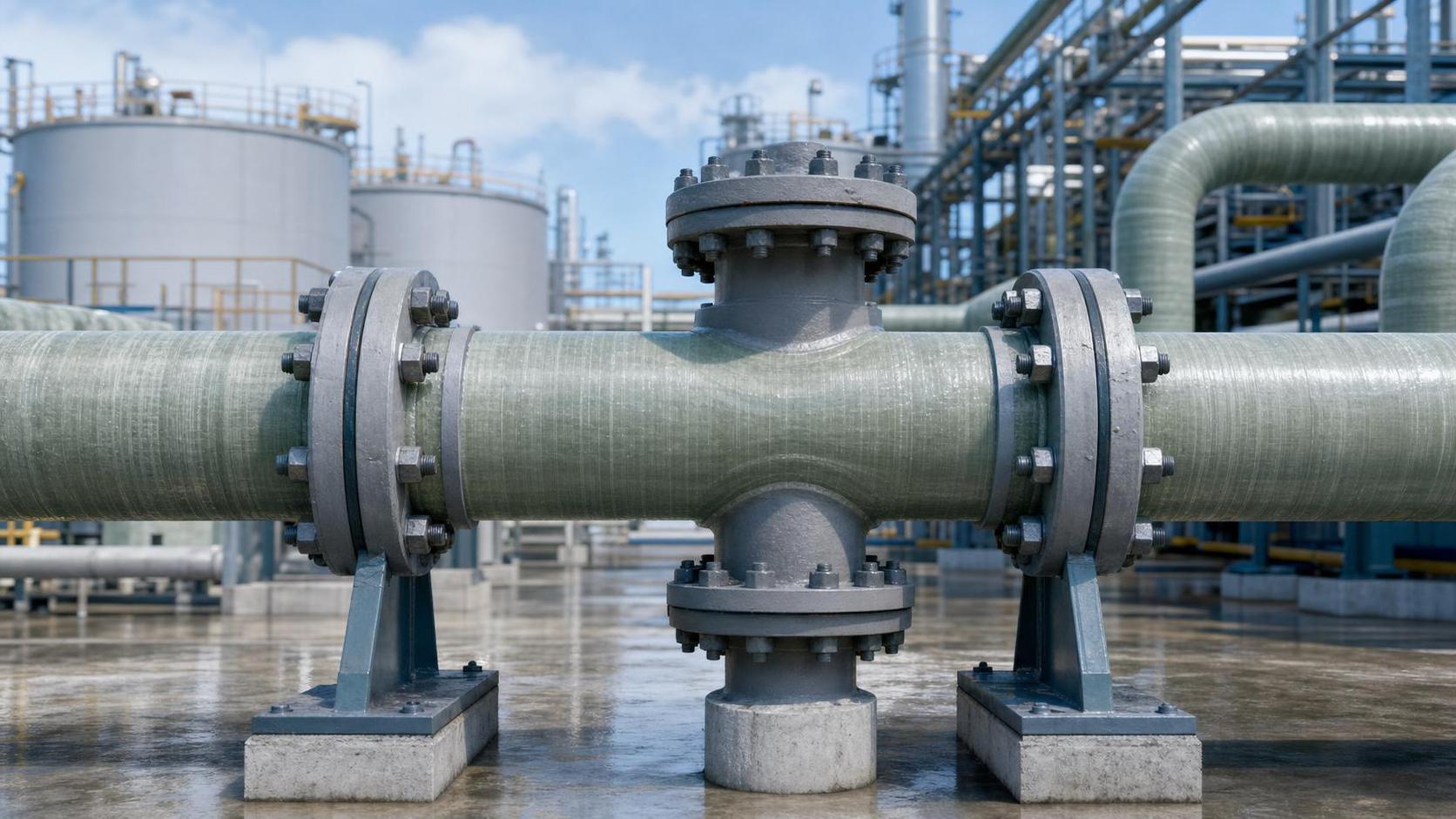
Why GRE Tubing Matters When Chemical Conditions Become Unforgiving
In chemical service, piping failure rarely comes from one factor alone.
Corrosive media, pressure cycling, temperature shifts, and installation stress often interact over time.
That is where GRE Tubing stands out within glass and ceramic composite material applications.
Its fiberglass-reinforced epoxy structure supports corrosion resistance, dimensional stability, and lower maintenance exposure in aggressive systems.
In actual projects, the better question is not whether GRE Tubing can resist chemicals.
The real issue is which service conditions it fits best, and where design discipline becomes critical.
That distinction matters in acid transfer lines, brine systems, offshore utilities, and mixed-media process loops.
It also explains why established GRE pipe manufacturers invest heavily in winding consistency and pressure testing.
Shandong Ocean Pipe Technology Co., Ltd., founded in 2012 in Dezhou, has built this capability around 16 winding lines and 5 hydrostatic testing machines.
With annual production and testing capacity reaching 25,000 tons, its experience across oil and gas, LNG, ship ballast, chemical plants, hot spring lines, and salt making gives useful application context.
Different Harsh Environments Create Different Demands
Many systems are labeled “corrosive,” yet the demands are not identical.
A stable brine line behaves differently from an intermittent acid wash circuit.
A buried chemical discharge route faces different risks than an exposed offshore utility header.
When selecting GRE Tubing, practical evaluation usually starts with four variables.
- Media type, including concentration, solids content, and cleaning chemicals.
- Temperature profile, especially normal operation versus upset conditions.
- Pressure behavior, including surge, vacuum, and repeated cycling.
- Site stress, such as vibration, support spacing, UV exposure, and installation alignment.
This is why one GRE Tubing specification may perform well in one plant area, yet require adjustment in another.
Material selection in harsh chemical environments is a system decision, not only a catalog choice.
Where GRE Tubing Performs Best in Chemical Plant Service
Continuous corrosion exposure with limited shutdown windows
In continuous processing lines, corrosion resistance alone is not enough.
The piping also has to maintain stable performance between maintenance intervals.
GRE Tubing is commonly used here because it avoids the rust-related degradation seen in many metallic systems.
It is especially useful in transfer lines carrying saline water, process chemicals, and moderate-temperature corrosive fluids.
More importantly, the smoother internal surface can help reduce scale attachment in some services.
Mixed industrial environments with chemical and marine influence
Some sites do not fit a single category.
Coastal terminals, ship support systems, and offshore-adjacent plants often handle both chemicals and salt-rich atmospheres.
In these conditions, GRE Tubing is valued for combining chemical resistance with lower external corrosion concern.
That overlap is one reason integrated solutions like GRE Pipe for Marine & Offshore appear in project discussions beyond pure marine service.
Salt making and high-chloride fluid handling
Salt production and brine circulation expose piping to persistent chloride attack.
That environment can punish metal systems through localized corrosion and shortened service life.
GRE Tubing is often chosen here because long-term resistance matters more than headline pressure numbers alone.
The evaluation focus shifts toward resin compatibility, joint integrity, and support design under full operating load.
The Same Material Is Judged Differently Across Scenarios
A useful way to compare harsh chemical applications is to examine what each one prioritizes.
This kind of comparison helps avoid treating all corrosive systems as equivalent.
It also improves the odds that GRE Tubing is used where its material profile brings the highest value.
What Often Gets Misjudged Before Installation
One common mistake is focusing only on chemical resistance tables.
Those tables are useful, but they rarely capture field movement, surge loads, or installation tolerances.
Another mistake is assuming intermittent duty is automatically less demanding.
In reality, stop-start operation can increase thermal stress and pressure fluctuation.
Sites also tend to underestimate fittings and joints.
In harsh chemical environments, system reliability often depends on these details more than on straight pipe sections.
- Do not compare only initial purchase cost against metallic alternatives.
- Check shutdown frequency, replacement difficulty, and access constraints.
- Review abnormal conditions, including flushing, cleaning, and accidental over-temperature events.
- Confirm whether outdoor exposure changes support, coating, or inspection needs.
How to Match GRE Tubing to Real Operating Priorities
In practice, a good selection process starts with the fluid, but it should not end there.
Operating temperature range, pressure events, mechanical loading, and installation method all shape long-term results.
For plants handling several corrosive streams, it is often better to group lines by service severity.
That makes specification more accurate than applying one generic GRE Tubing standard everywhere.
Manufacturing consistency also matters when systems carry higher risk or wider project scope.
Suppliers with large-scale winding control, fitting production capacity, and hydrostatic verification typically offer more reliable traceability.
This is relevant in projects spanning chemical plants, ship ballast networks, LNG support lines, and industrial utility systems.
In these crossover applications, solutions such as GRE Pipe for Marine & Offshore reflect how GRE systems are adapted to mixed service realities rather than isolated use cases.
A Practical Next Step Before Final Specification
GRE Tubing works best when the selection process follows the operating scene, not just the material brochure.
The most effective review usually maps chemical media, temperature range, pressure behavior, and maintenance constraints together.
From there, it becomes easier to judge whether the line needs broader corrosion resistance, stronger pressure assurance, or tighter installation control.
For harsh chemical environments, that kind of structured comparison reduces misapplication and improves lifecycle planning.
A sensible next move is to list actual service conditions, verify upset scenarios, and compare them against resin compatibility, joint design, and testing expectations.
That approach makes GRE Tubing a design decision grounded in field reality, not only in nominal performance data.
Please give us a message
产品介绍产品介绍产品介绍产品介绍产品介绍产品介绍产品介绍产品介绍产品介绍产品介绍产品介绍产品介绍产品介绍产品介绍产品介绍产品介绍产品介绍产品介绍产品介绍产品介绍产品介绍产品介绍产品介绍产品介绍产品介绍产品介绍产品介绍产品介绍产品介绍产品介绍
Please give us a message
产品介绍产品介绍产品介绍产品介绍产品介绍产品介绍产品介绍产品介绍产品介绍产品介绍产品介绍产品介绍产品介绍产品介绍产品介绍产品介绍产品介绍产品介绍产品介绍产品介绍产品介绍产品介绍产品介绍产品介绍产品介绍产品介绍产品介绍产品介绍产品介绍产品介绍
Please give us a message
产品介绍产品介绍产品介绍产品介绍产品介绍产品介绍产品介绍产品介绍产品介绍产品介绍产品介绍产品介绍产品介绍产品介绍产品介绍产品介绍产品介绍产品介绍产品介绍产品介绍产品介绍产品介绍产品介绍产品介绍产品介绍产品介绍产品介绍产品介绍产品介绍产品介绍
Please give us a message
产品介绍产品介绍产品介绍产品介绍产品介绍产品介绍产品介绍产品介绍产品介绍产品介绍产品介绍产品介绍产品介绍产品介绍产品介绍产品介绍产品介绍产品介绍产品介绍产品介绍产品介绍产品介绍产品介绍产品介绍产品介绍产品介绍产品介绍产品介绍产品介绍产品介绍