
GRE Pipe vs FRP Pipe: What Is the Difference?
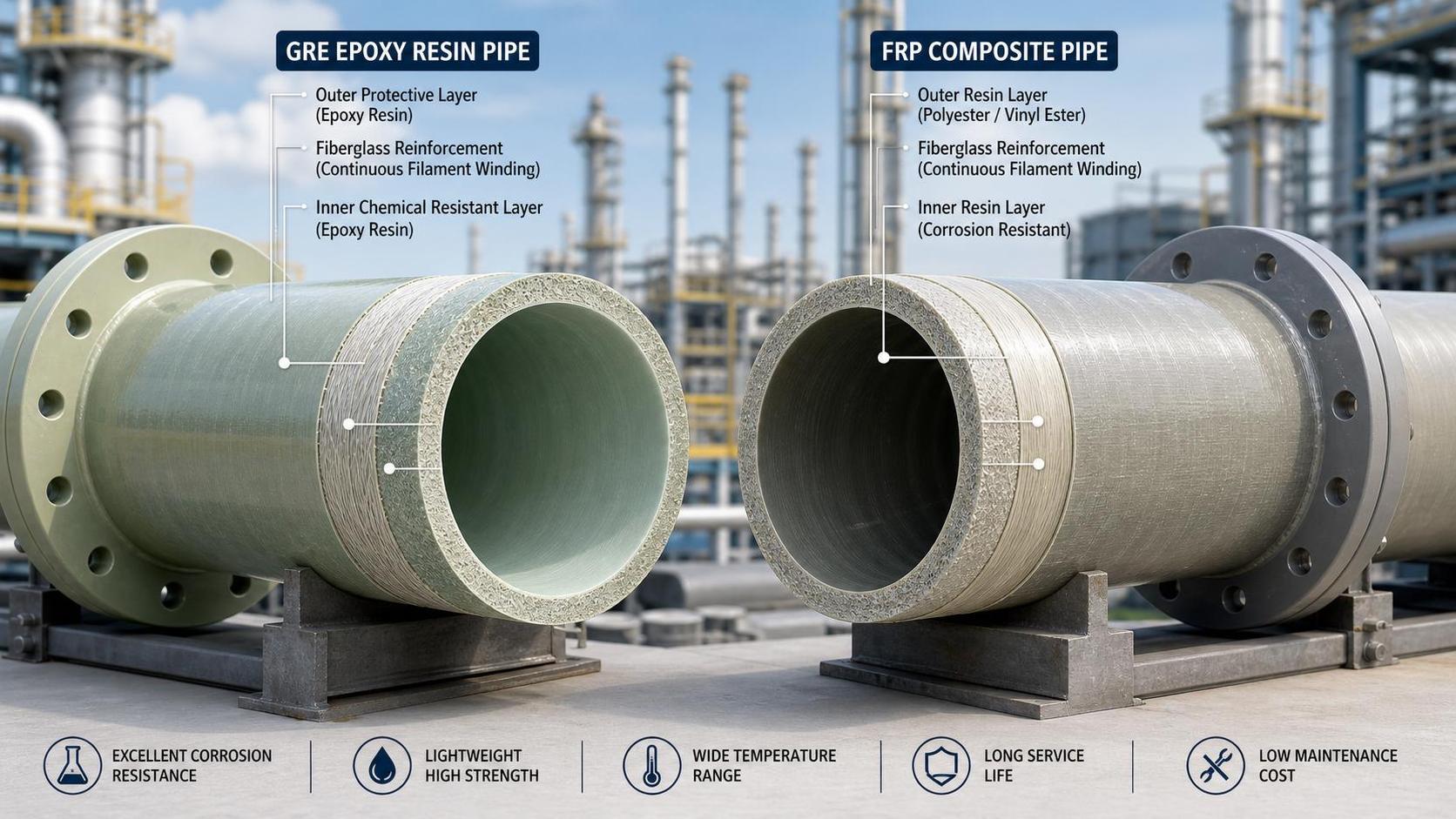
GRE Pipe vs FRP Pipe: where does the real difference come from?
When people compare GRE Pipe and FRP pipe, they often assume the names describe the same product. That is only partly true.
Both belong to composite piping made from glass fiber reinforcement. The important difference usually lies in the resin system, pressure design, and service environment.
In simple terms, GRE Pipe uses epoxy resin with fiberglass reinforcement. FRP pipe is a broader category and may use polyester, vinyl ester, or epoxy resin.
That distinction matters because resin choice affects strength retention, corrosion resistance, temperature tolerance, and long-term reliability in aggressive media.
This is why the GRE Pipe versus FRP pipe question appears so often in oil and gas, marine systems, LNG facilities, and chemical plants.
A more useful way to read the comparison is not “which one is always better,” but “which composite pipe fits the operating conditions better.”
Is GRE Pipe just another name for FRP pipe?
Not exactly. FRP pipe is the umbrella term. It refers to fiberglass reinforced plastic or fiberglass reinforced polymer piping in general.
GRE Pipe is a more specific type within that family. It combines glass fiber with epoxy resin, then forms the pipe through controlled winding and curing.
Because of that, every GRE Pipe can be described as FRP pipe, but not every FRP pipe is GRE Pipe.
This is also why technical documents may use the words differently. Some markets say FRP when they mean general composite pipe. Others specify GRE when resin performance is critical.
In practical selection, the word FRP alone is too broad. It does not tell you enough about the expected pressure class, thermal stability, or chemical compatibility.
For that reason, engineers usually ask one more question: what resin is used, and how is the laminate structure designed?
What changes when the resin is epoxy instead of a general FRP resin?
This is where the comparison becomes meaningful. The resin matrix is not a minor detail. It controls how the pipe behaves under heat, pressure, and chemical attack.
GRE Pipe typically offers stronger adhesion between glass fibers and the resin matrix. That often supports better mechanical strength and dimensional stability.
Epoxy systems also tend to perform well where pressure cycling and elevated temperatures are part of daily operation. That is one reason GRE Pipe is common in demanding industrial lines.
By contrast, general FRP pipe may use polyester or vinyl ester resin. Those systems can still perform very well, especially in corrosive service, but their design targets may differ.
A short comparison helps clarify the usual decision points.
The key takeaway is simple. The label FRP pipe does not automatically match the performance of GRE Pipe unless the resin and structural design are equally specified.
Which applications usually favor GRE Pipe?
GRE Pipe is often chosen where corrosion resistance alone is not enough. The line may also face pressure loads, thermal variation, vibration, or long continuous service.
That is why GRE Pipe appears frequently in offshore and onshore energy systems, ballast piping, LNG support lines, and chemical process networks.
In marine environments, salt exposure and weight control matter at the same time. Composite pipe offers corrosion benefits, while epoxy-based systems can help with demanding mechanical conditions.
A useful reference is The application of GRE piping in marine scrubber systems, where the material is considered in a real marine treatment environment rather than in theory alone.
In actual industry supply, manufacturing capability also matters. Consistent winding control, fitting production, and hydrostatic testing influence whether the designed performance is delivered.
Shandong Ocean Pipe Technology Co., Ltd., established in 2012 in Dezhou, Shandong, has built large-scale GRE Pipe capacity with 16 winding production lines and 5 static pressure testing machines.
Its products are used in oil and gas, ship ballast piping, LNG, chemical plants, hot spring pipelines, and salt production systems, which reflects the typical range where GRE Pipe is evaluated seriously.
Does FRP pipe still make sense in many projects?
Yes, absolutely. The comparison should not suggest that general FRP pipe is outdated or inferior in every case.
For lower pressure service, water transfer, drainage, or selected chemical applications, FRP pipe can be efficient, durable, and cost-conscious when properly specified.
The mistake is not choosing FRP pipe. The mistake is choosing a broad category name without checking whether the resin system matches the medium and operating range.
In other words, FRP pipe is not one fixed performance level. It covers multiple material recipes, manufacturing methods, and service limits.
A vinyl ester FRP pipe may be excellent for certain corrosive chemicals. A polyester-based option may fit less demanding service. GRE Pipe may be the safer choice where higher mechanical confidence is needed.
So the right question is rarely “GRE Pipe or FRP pipe?” More often, it is “Which composite pipe design best fits this operating window?”
What do people often misunderstand when comparing GRE Pipe and FRP pipe?
One common misunderstanding is focusing only on corrosion resistance. Composite pipes are often selected for anti-corrosion performance, but pressure, temperature, and joining conditions matter just as much.
Another issue is assuming that lighter weight always means easier success. Installation can be faster, but support spacing, thermal movement, and connection design still need proper engineering.
People also overlook fittings. A pipeline is not only straight pipe. Elbows, tees, reducers, and flanges can become the weak point if they are not made to the same standard.
This is why manufacturers with mature fitting production and testing systems often stand out. Large equipment fleets and pressure verification reduce inconsistency across the complete system.
- Do not compare names only. Compare resin, liner, reinforcement, and pressure class.
- Check actual service temperature, including upset conditions, not just normal operation.
- Review chemical compatibility against the full media composition.
- Confirm whether fittings and joints are tested under realistic loads.
- Look at lifecycle value, not only initial material price.
Those points usually reveal more than a basic catalog description.
How should you decide between GRE Pipe and FRP pipe for a real project?
A practical decision starts with the service conditions, not the product name. That sounds obvious, but it prevents many costly specification mistakes.
Begin with five checks: fluid composition, operating and peak temperature, design pressure, installation environment, and expected service life.
Then compare candidate materials against those conditions. If the line faces elevated heat, pressure cycling, or mission-critical reliability, GRE Pipe often deserves closer attention.
If the service is less severe, a suitable FRP pipe design may offer adequate performance without unnecessary over-specification.
It also helps to ask for manufacturing and testing evidence. Production scale alone is not enough, but it can signal process stability when paired with pressure testing and proven project references.
Ocean Pipe, for example, reports annual GRE pipe production and testing capacity of 25,000 tons and supplies domestic and overseas projects across marine and industrial sectors.
That kind of background is useful when you are trying to separate a paper specification from a workable supply solution.
So, which one is better?
The honest answer is that GRE Pipe is not automatically better than FRP pipe in every case. It is often better suited for tougher operating demands.
If you need a broad rule, use this one: choose by resin system, structural design, and service conditions, not by shorthand labels alone.
GRE Pipe usually stands out when pressure, temperature stability, and long-term structural confidence are high priorities. General FRP pipe remains a valid choice when the duty is clearly defined and less severe.
A sensible next step is to list your medium, temperature range, pressure class, fittings requirement, and installation setting. Then compare composite options against those facts.
That approach turns the GRE Pipe versus FRP pipe question from a naming debate into a material decision you can actually defend.
Please give us a message
产品介绍产品介绍产品介绍产品介绍产品介绍产品介绍产品介绍产品介绍产品介绍产品介绍产品介绍产品介绍产品介绍产品介绍产品介绍产品介绍产品介绍产品介绍产品介绍产品介绍产品介绍产品介绍产品介绍产品介绍产品介绍产品介绍产品介绍产品介绍产品介绍产品介绍
Please give us a message
产品介绍产品介绍产品介绍产品介绍产品介绍产品介绍产品介绍产品介绍产品介绍产品介绍产品介绍产品介绍产品介绍产品介绍产品介绍产品介绍产品介绍产品介绍产品介绍产品介绍产品介绍产品介绍产品介绍产品介绍产品介绍产品介绍产品介绍产品介绍产品介绍产品介绍
Please give us a message
产品介绍产品介绍产品介绍产品介绍产品介绍产品介绍产品介绍产品介绍产品介绍产品介绍产品介绍产品介绍产品介绍产品介绍产品介绍产品介绍产品介绍产品介绍产品介绍产品介绍产品介绍产品介绍产品介绍产品介绍产品介绍产品介绍产品介绍产品介绍产品介绍产品介绍
Please give us a message
产品介绍产品介绍产品介绍产品介绍产品介绍产品介绍产品介绍产品介绍产品介绍产品介绍产品介绍产品介绍产品介绍产品介绍产品介绍产品介绍产品介绍产品介绍产品介绍产品介绍产品介绍产品介绍产品介绍产品介绍产品介绍产品介绍产品介绍产品介绍产品介绍产品介绍