
FRP Pipe vs GRP Pipe: Material Differences and Practical Selection
FRP Pipe vs GRP Pipe: Material Differences and Practical Selection
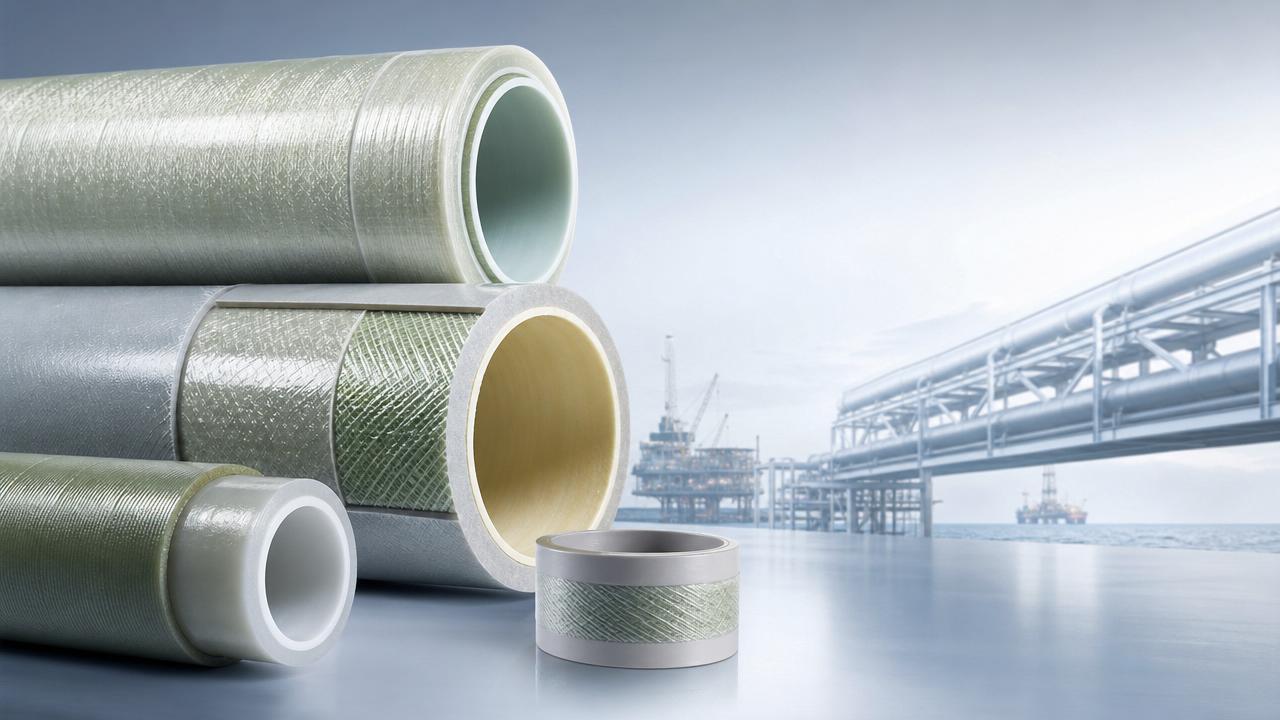
When comparing FRP Pipe and GRP pipe, the key question is not which term sounds more advanced.
The real issue is how resin, reinforcement, pressure class, temperature, and service media affect long-term reliability.
In oil and gas, marine, chemical, and industrial piping, this difference directly influences safety, maintenance, and lifecycle cost.
A suitable FRP Pipe can reduce corrosion risk, weight, installation time, and shutdown frequency when correctly specified.
Composite Piping Demand Is Moving Toward More Precise Material Selection
Composite piping is gaining attention as steel systems face corrosion, coating failure, and high maintenance pressure.
However, the market no longer accepts broad material labels without technical verification.
The term FRP Pipe usually means fiberglass reinforced plastic pipe, covering multiple resin systems and reinforcement designs.
GRP pipe commonly refers to glass reinforced plastic pipe, often used in water, sewage, desalination, and utility systems.
In practice, GRP is a category within the wider FRP Pipe family, not a completely separate technology.
This distinction matters because different resin matrices create different resistance to chemicals, hydrocarbons, heat, and pressure.
Why the Difference Between FRP Pipe and GRP Pipe Is Becoming More Important
Several industry signals are pushing composite pipe selection from simple price comparison toward performance-based evaluation.
- Projects require longer design life with fewer coating and replacement activities.
- Chemical processes use more aggressive fluids and complex temperature cycles.
- Marine systems need lightweight piping with strong seawater corrosion resistance.
- Oilfield applications demand higher pressure resistance and stable mechanical strength.
- Environmental expectations encourage lower leakage risk and safer material performance.
These signals explain why FRP Pipe specifications increasingly mention resin type, winding angle, liner design, and testing standards.
A general GRP pipe may work well for water transport but may not suit hydrocarbons or high-temperature chemicals.
Material Composition: The Core Technical Difference
FRP Pipe is a broad composite structure made from fiber reinforcement and polymer resin.
The reinforcement is usually glass fiber, but carbon, aramid, or hybrid fibers may also appear in special designs.
The resin may be epoxy, vinyl ester, polyester, phenolic, or other thermoset systems.
GRP pipe is usually glass fiber reinforced plastic, commonly based on polyester or vinyl ester resin.
Therefore, every GRP pipe is generally an FRP Pipe, but not every FRP Pipe should be called GRP.
Resin System Trends Are Changing Performance Expectations
The resin system controls chemical resistance, temperature tolerance, bonding strength, and aging behavior.
For high-performance FRP Pipe, epoxy resin is often selected for pressure piping and hydrocarbon service.
Fiberglass reinforced epoxy pipe, often called GRE pipe, is widely used in oil, gas, marine, and chemical projects.
Vinyl ester resin performs well against many acids, alkalis, and corrosive industrial fluids.
Polyester resin is economical and common in water or non-critical utility applications.
This is why FRP Pipe selection must begin with fluid chemistry, pressure, temperature, and operating cycles.
Why GRE Pipe Is Often Considered for Demanding Projects
GRE pipe combines glass fiber reinforcement with epoxy resin, creating strong adhesion and stable mechanical performance.
It is frequently used where corrosion resistance and pressure strength must work together.
Compared with ordinary GRP pipe, GRE-based FRP Pipe can provide better resistance in selected harsh environments.
Still, the exact performance depends on design, manufacturing control, testing, and installation quality.
Reinforcement Design Determines Strength, Not Only Material Name
Composite pipe strength does not come from resin alone.
Glass fiber orientation, winding angle, fiber content, and wall structure define pressure capacity and stiffness.
A well-designed FRP Pipe uses hoop fibers to resist internal pressure and axial fibers to support longitudinal loads.
For buried piping, stiffness and soil interaction become critical.
For ship ballast systems, vibration, seawater exposure, and space limitations influence the final pipe design.
For oilfield service, pressure rating, joint integrity, and compatibility with transported fluids must be confirmed.
In upstream operations, piping choices may also interact with well completion equipment such as Sand Control Screens.
The full system must be evaluated rather than treating each component as an isolated item.
Application Differences Are More Practical Than Terminology
The most useful question is where the pipe will operate and what failure mode must be prevented.
FRP Pipe is often selected for corrosion-sensitive systems requiring weight reduction and custom engineering.
GRP pipe is widely selected for water supply, drainage, municipal pipelines, cooling water, and low-corrosion utility networks.
In oil and gas, FRP Pipe specifications often emphasize epoxy resin, pressure class, and hydrocarbon compatibility.
In chemical plants, resin selection depends on acid concentration, solvent exposure, and process temperature.
In shipbuilding, non-metallic piping supports corrosion control and improves weight management.
Key Factors Driving Selection Decisions
The correct pipe choice should be based on measurable conditions, not only name preference.
- Confirm internal pressure, vacuum condition, surge pressure, and safety factor.
- Check continuous temperature and short-term peak temperature.
- Identify all fluids, including cleaning agents and accidental contaminants.
- Review aboveground, buried, offshore, or onboard installation conditions.
- Evaluate joint type, field assembly method, and inspection requirements.
- Request hydrostatic testing, dimensional control, and batch traceability.
A low-cost GRP pipe can become expensive if resin compatibility is wrong.
A high-grade FRP Pipe can also be excessive if the service condition is simple water conveyance.
How the Difference Affects Engineering, Procurement, and Operation
For engineering design, the difference affects allowable stress, support spacing, expansion analysis, and joint selection.
For procurement, it changes qualification documents, material certificates, testing reports, and supplier evaluation.
For operation, it influences inspection intervals, repair methods, leak risk, and shutdown planning.
A clearly specified FRP Pipe reduces ambiguity during tendering and prevents mismatched quotations.
Clear terminology also helps compare GRE, GRP, and other composite pipe options fairly.
Manufacturing Capability Is Part of Material Reliability
Composite pipe performance depends strongly on production consistency.
Winding control, curing quality, resin distribution, and testing accuracy all affect final service performance.
Shandong Ocean Pipe Technology Co., Ltd. was established in 2012 in Wucheng Industrial Park, Dezhou, Shandong, China.
The company focuses on fiberglass reinforced epoxy pipe and has become a major GRE pipe manufacturer in China.
Its facilities include 16 winding production lines and 174 sets of fitting winding machines with micro-control systems.
The factory also operates five static water pressure testing machines.
Annual GRE pipe production and testing capacity reaches about 25,000 tons.
Applications include oil and gas, ship ballast piping, LNG, chemical plants, hot spring systems, and salt-making companies.
This type of manufacturing background is relevant when selecting FRP Pipe for demanding corrosion and pressure environments.
Selection Guidance for Future Projects
The selection path should move from service condition to material system, then to manufacturing verification.
If uncertainty exists, request compatibility data, pressure test records, and references from similar operating conditions.
For complex projects, trial sections or sample testing can reduce selection risk before full installation.
Practical Conclusion: Choose by Performance, Not by Label
FRP Pipe and GRP pipe are closely related, but their practical roles are not always identical.
FRP Pipe is the broader category, while GRP pipe usually describes glass-reinforced plastic systems for many utility applications.
For demanding oil, gas, marine, and chemical projects, GRE-based FRP Pipe often deserves closer evaluation.
The best decision connects resin chemistry, reinforcement design, pressure rating, testing, and installation conditions.
Before final selection, define the operating environment and compare verified technical documents, not only product names.
For integrated oilfield planning, related components such as Sand Control Screens should also align with the system strategy.
A reliable FRP Pipe choice starts with clear service data, qualified production capability, and disciplined performance verification.
Please give us a message
产品介绍产品介绍产品介绍产品介绍产品介绍产品介绍产品介绍产品介绍产品介绍产品介绍产品介绍产品介绍产品介绍产品介绍产品介绍产品介绍产品介绍产品介绍产品介绍产品介绍产品介绍产品介绍产品介绍产品介绍产品介绍产品介绍产品介绍产品介绍产品介绍产品介绍
Please give us a message
产品介绍产品介绍产品介绍产品介绍产品介绍产品介绍产品介绍产品介绍产品介绍产品介绍产品介绍产品介绍产品介绍产品介绍产品介绍产品介绍产品介绍产品介绍产品介绍产品介绍产品介绍产品介绍产品介绍产品介绍产品介绍产品介绍产品介绍产品介绍产品介绍产品介绍
Please give us a message
产品介绍产品介绍产品介绍产品介绍产品介绍产品介绍产品介绍产品介绍产品介绍产品介绍产品介绍产品介绍产品介绍产品介绍产品介绍产品介绍产品介绍产品介绍产品介绍产品介绍产品介绍产品介绍产品介绍产品介绍产品介绍产品介绍产品介绍产品介绍产品介绍产品介绍
Please give us a message
产品介绍产品介绍产品介绍产品介绍产品介绍产品介绍产品介绍产品介绍产品介绍产品介绍产品介绍产品介绍产品介绍产品介绍产品介绍产品介绍产品介绍产品介绍产品介绍产品介绍产品介绍产品介绍产品介绍产品介绍产品介绍产品介绍产品介绍产品介绍产品介绍产品介绍