
FRP Pipe for Chemical Plants: Selection Criteria for Corrosive Media
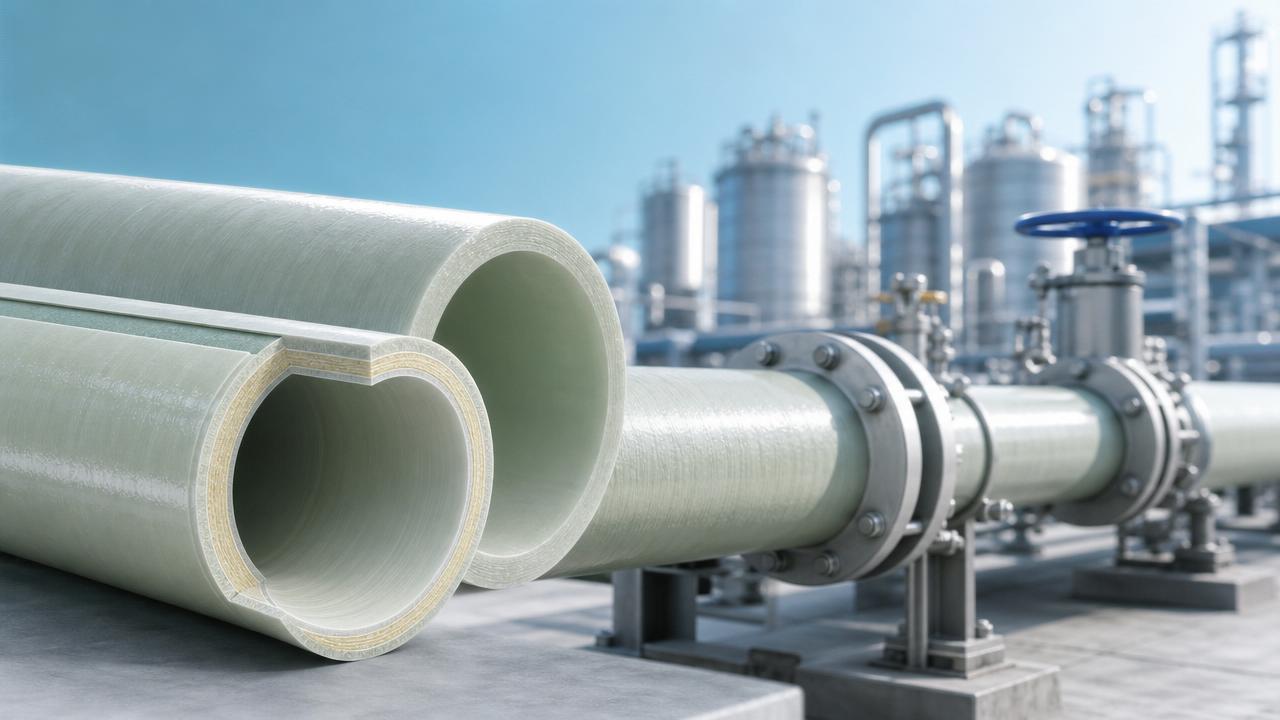
FRP Pipe for Chemical Plants: Selection Criteria for Corrosive Media
Selecting the right FRP Pipe for chemical plants is critical when corrosive media, high operating demands, and long-term project reliability are at stake.
For project managers, the challenge is balancing corrosion resistance, compliance, installation efficiency, lifecycle cost control, and supplier capability within one defensible decision.
Start with the Real Project Risk: Corrosion Failure, Not Pipe Price
In chemical plants, piping failure rarely begins as a simple purchasing mistake. It usually starts with incomplete media evaluation or underestimated operating conditions.
An FRP Pipe may look similar across suppliers, but its resin system, liner design, reinforcement structure, and manufacturing quality determine field performance.
For project managers, the first selection question should not be “Which pipe is cheaper?” It should be “Which pipe survives the actual chemical service?”
Corrosion failure can stop production, contaminate systems, trigger safety incidents, and create unplanned replacement costs far exceeding the initial pipe investment.
Therefore, the right procurement approach is risk-based. Evaluate the process medium, service temperature, pressure, installation environment, standards, and supplier evidence together.
Define the Corrosive Media Before Selecting the Pipe Structure
The chemical composition of the conveyed medium is the foundation of FRP Pipe selection. Generic descriptions such as wastewater or acid are insufficient.
Engineering teams should identify concentration, impurities, pH range, oxidizing agents, suspended solids, cleaning chemicals, and possible upset conditions before specifying materials.
Sulfuric acid, hydrochloric acid, sodium hydroxide, brine, solvents, and mixed industrial effluent may require different resin systems and corrosion barriers.
Temperature is equally important because many chemicals become more aggressive as temperature rises. A safe material at ambient temperature may fail in heated service.
Project managers should request chemical resistance data that matches actual concentration and temperature, rather than relying only on general compatibility charts.
Where media composition changes over time, conservative design is usually preferable. This is common in chemical drainage, neutralization, salt processing, and wastewater pipelines.
Choose the Resin System According to Chemical Service
The resin system is the main defense against chemical attack. In many FRP Pipe applications, resin selection matters more than wall thickness alone.
Vinyl ester resins are widely used for strong acids, alkalis, oxidizing media, and many industrial chemicals requiring higher corrosion resistance.
Epoxy-based GRE pipe is often selected where pressure performance, dimensional stability, and long-term mechanical reliability are essential under demanding service conditions.
Isophthalic or orthophthalic polyester systems may suit less aggressive environments, but they should not be assumed suitable for severe chemical exposure.
The selected resin must also match temperature requirements, flame expectations, electrical considerations, and the plant owner’s approved material specifications.
For critical lines, project managers should ask suppliers to provide past project references, test data, and engineering justification for the proposed resin system.
Pay Attention to the Corrosion Barrier and Inner Liner
The inner liner is the first surface exposed to corrosive media. Its design directly affects service life, especially in aggressive chemical pipelines.
A typical corrosion barrier may include resin-rich layers, surface veil, chopped strand mat, and transition layers before the structural reinforcement begins.
The liner must resist chemical penetration, abrasion, and permeation. Poor liner quality can cause blistering, cracking, delamination, or premature leakage.
For media containing solids, slurry, crystallized salts, or abrasive particles, corrosion resistance alone is not enough. Abrasion resistance must also be reviewed.
Project teams should confirm liner thickness, veil material, resin content, curing process, and quality inspection methods during technical clarification.
For plant upgrades or retrofit projects, samples of existing deposits or wastewater can help suppliers recommend a more accurate liner configuration.
Match Pressure, Temperature, and Mechanical Loads to Operating Reality
Chemical plants often include pumps, valves, expansion joints, supports, tanks, and equipment nozzles that create combined stresses on piping systems.
An FRP Pipe specification should include design pressure, test pressure, vacuum conditions, surge pressure, operating temperature, and maximum short-term temperature.
Pressure rating should not be selected only from normal operating pressure. Pump starts, valve closure, water hammer, and maintenance operations may create peaks.
Thermal expansion also needs attention. FRP materials expand differently from steel, so support spacing and anchoring must be properly engineered.
External loads such as burial depth, traffic load, wind load, seismic demand, and pipe rack arrangement should be included in design review.
For project managers, early coordination between process, piping, civil, and procurement teams prevents later disputes about responsibility and design assumptions.
Verify Standards, Testing, and Documentation Before Approval
In industrial projects, material approval depends on more than supplier claims. Standards, inspection plans, and traceable documentation protect the project team.
Common reference standards may include ASTM, AWWA, ISO, API-related project specifications, or owner-specific requirements depending on application and region.
Project managers should confirm hydrostatic testing, dimensional inspection, visual inspection, resin cure verification, raw material certificates, and batch traceability.
For GRE and FRP Pipe systems, factory pressure testing is especially valuable because it identifies manufacturing defects before shipment and installation.
Documentation should also include installation manuals, handling instructions, jointing procedures, repair guidance, and recommended commissioning practices.
When procurement involves international delivery, packaging, marking, inspection hold points, and third-party acceptance should be clearly written into the purchase order.
Evaluate Joint Systems Because Many Failures Occur at Connections
Even a well-designed pipe body can underperform if the joint system is unsuitable or poorly installed in the field.
Common FRP Pipe joints include bell-and-spigot adhesive joints, laminated joints, flanged joints, threaded connections, and mechanical couplings depending on service conditions.
For chemical plants, joint selection should consider pressure, temperature, media, installation space, maintenance access, and the installer’s practical skill level.
Adhesive-bonded systems require clean surfaces, correct mixing, curing control, and environmental protection. Humidity, dust, and temperature can affect bonding quality.
Flanged joints are convenient near equipment, valves, and instruments, but gasket compatibility and bolt torque control are critical for leak prevention.
Project managers should require installation training or supervision for key lines, especially when local contractors have limited FRP Pipe experience.
Consider Installation Efficiency and Shutdown Constraints
Compared with many metallic systems, FRP Pipe offers weight advantages that can reduce lifting requirements, installation time, and field labor intensity.
This benefit is important for chemical plant expansions, brownfield replacement, ship ballast systems, and projects with limited shutdown windows.
However, installation efficiency depends on prefabrication accuracy, spool planning, joint method, support readiness, and delivery coordination.
Project managers should ask whether the supplier can provide fittings, elbows, tees, reducers, flanges, and customized spools from one production system.
For complex plants, a coordinated pipe and fitting package reduces mismatch risk and helps the site team avoid costly field modifications.
Where chemical drainage or effluent transfer is involved, selection may overlap with systems used in a Wastewater Treatment Plant, especially under mixed-media corrosion.
Calculate Lifecycle Cost, Not Only Initial Procurement Cost
A lower-priced pipe can become expensive if it requires frequent maintenance, early replacement, shutdowns, or chemical leak response.
Lifecycle cost includes purchase price, freight, installation labor, supports, inspection, downtime, maintenance, replacement frequency, and disposal considerations.
FRP Pipe can provide strong lifecycle value when corrosion resistance reduces coating maintenance, internal scaling, wall loss, and unplanned shutdowns.
For project approval, managers should compare alternatives using service life assumptions, maintenance intervals, and potential production loss scenarios.
This approach is particularly useful when internal stakeholders question why FRP or GRE pipe costs more than basic material alternatives.
A well-supported lifecycle comparison helps procurement, engineering, and finance align around total project value instead of unit price alone.
Assess Supplier Capability as Part of Technical Risk Control
For chemical plant projects, supplier capability is not a secondary issue. It directly affects quality consistency, delivery reliability, and technical support.
A qualified supplier should demonstrate stable production capacity, controlled winding technology, pressure testing capability, fitting fabrication, and experience in industrial projects.
Shandong Ocean Pipe Technology Co., Ltd., established in 2012 in Dezhou, Shandong, focuses on Fiberglass Reinforced Epoxy pipe manufacturing.
The company operates multiple winding production lines, pipe fitting winding machines, micro control systems, and static water pressure testing equipment.
Its GRE pipe products are used in oil and gas, ship ballast piping, LNG, chemical plants, hot spring systems, and salt-making industries.
For project managers, such manufacturing scale and application experience can support schedule control, quality assurance, and technical communication during procurement.
Ask These Technical Questions Before Final Selection
Before approving an FRP Pipe supplier, project teams should prepare a focused checklist that connects operating conditions with material decisions.
First, ask which resin system is proposed and why it fits the stated chemical concentration, temperature, and expected service life.
Second, confirm the corrosion barrier structure, liner thickness, veil type, resin content, and inspection method used during manufacturing.
Third, check pressure class, stiffness, temperature rating, vacuum resistance, surge allowance, and compatibility with buried or aboveground installation.
Fourth, review joint types, gasket materials, adhesive systems, flange standards, installation procedures, and site curing requirements.
Finally, request project references, testing reports, manufacturing capacity evidence, quality control plans, and after-sales support arrangements.
Common Selection Mistakes Project Managers Should Avoid
One common mistake is using a standard pipe specification for all chemical lines without considering differences in media aggressiveness.
Another mistake is ignoring abnormal operating conditions, such as cleaning cycles, temporary high temperatures, accidental concentration changes, or stagnant chemical exposure.
Some projects also underestimate joint quality, assuming that factory-made pipe alone determines system reliability. Field installation deserves equal attention.
Choosing a supplier based only on the lowest quotation can create hidden risks if testing, documentation, or fitting accuracy is insufficient.
Project managers should also avoid separating pipe procurement from support design, because improper support spacing can shorten service life.
A disciplined selection process reduces disputes between engineering, procurement, construction, and operations after the system enters service.
When FRP Pipe Is a Strong Fit for Chemical Plants
FRP Pipe is especially suitable where corrosion resistance, moderate weight, hydraulic efficiency, and long service life are project priorities.
It is often used for acid transfer, alkali lines, seawater, brine, cooling water, wastewater, chemical drainage, and certain process pipelines.
The smooth inner surface can reduce friction loss and scaling compared with some metallic alternatives, supporting pumping efficiency over time.
Its non-metallic nature also helps avoid many corrosion mechanisms associated with steel, including rusting, galvanic corrosion, and coating breakdown.
However, FRP is not automatically suitable for every chemical, solvent, high-temperature line, or severe mechanical impact environment.
The best results come from matching the pipe system to actual service data, verified design standards, and a capable manufacturer.
Conclusion: Select for Service Conditions, Prove the Decision with Data
For chemical plants, the right FRP Pipe decision begins with corrosive media analysis and ends with verified manufacturing and installation control.
Project managers should prioritize resin compatibility, corrosion barrier design, pressure rating, joint reliability, documentation, and supplier capability.
This approach turns pipe selection from a price comparison into a risk-managed engineering decision with measurable lifecycle value.
When corrosive media, uptime, safety, and project schedule all matter, selecting FRP Pipe with clear criteria is the safest path.
Please give us a message
产品介绍产品介绍产品介绍产品介绍产品介绍产品介绍产品介绍产品介绍产品介绍产品介绍产品介绍产品介绍产品介绍产品介绍产品介绍产品介绍产品介绍产品介绍产品介绍产品介绍产品介绍产品介绍产品介绍产品介绍产品介绍产品介绍产品介绍产品介绍产品介绍产品介绍
Please give us a message
产品介绍产品介绍产品介绍产品介绍产品介绍产品介绍产品介绍产品介绍产品介绍产品介绍产品介绍产品介绍产品介绍产品介绍产品介绍产品介绍产品介绍产品介绍产品介绍产品介绍产品介绍产品介绍产品介绍产品介绍产品介绍产品介绍产品介绍产品介绍产品介绍产品介绍
Please give us a message
产品介绍产品介绍产品介绍产品介绍产品介绍产品介绍产品介绍产品介绍产品介绍产品介绍产品介绍产品介绍产品介绍产品介绍产品介绍产品介绍产品介绍产品介绍产品介绍产品介绍产品介绍产品介绍产品介绍产品介绍产品介绍产品介绍产品介绍产品介绍产品介绍产品介绍
Please give us a message
产品介绍产品介绍产品介绍产品介绍产品介绍产品介绍产品介绍产品介绍产品介绍产品介绍产品介绍产品介绍产品介绍产品介绍产品介绍产品介绍产品介绍产品介绍产品介绍产品介绍产品介绍产品介绍产品介绍产品介绍产品介绍产品介绍产品介绍产品介绍产品介绍产品介绍