
FRP Pipe Material Guide: Resin Types, Reinforcement and Liner Options
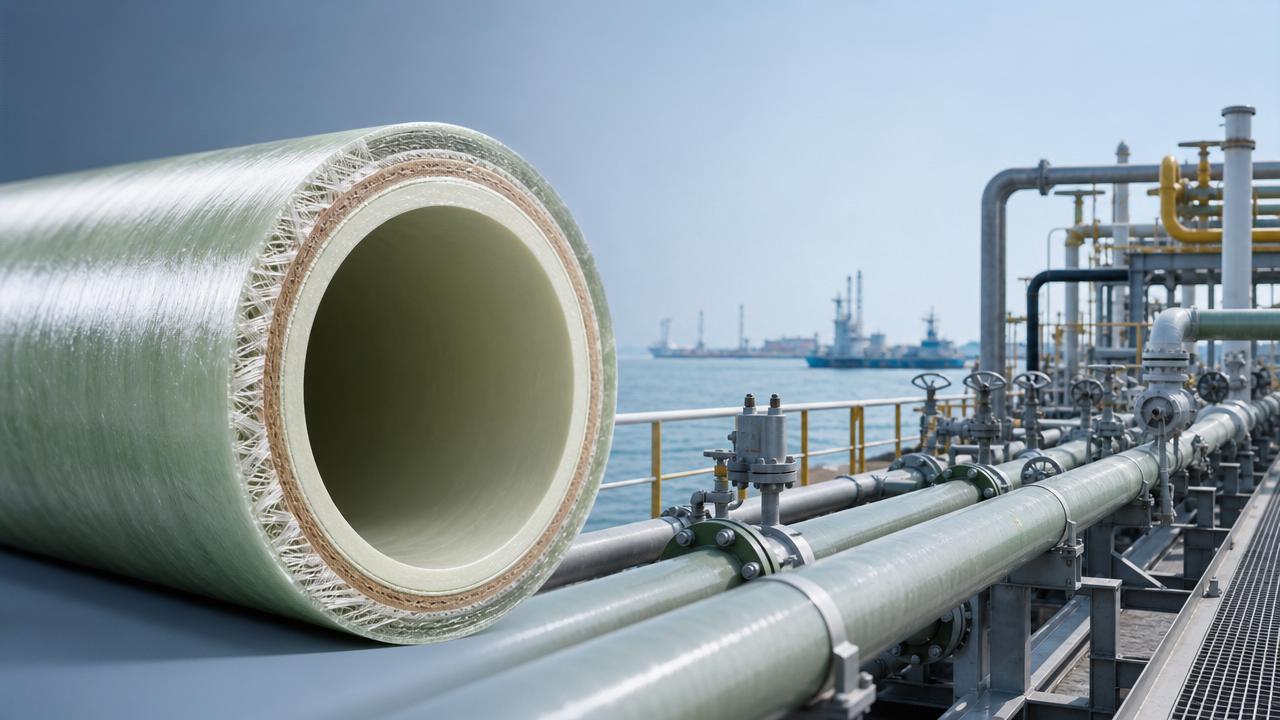
Selecting the right FRP Pipe material is a critical step in ensuring long-term performance, corrosion resistance, and lifecycle value for industrial piping systems.
For technical evaluation, resin types, glass fiber reinforcement, and liner options directly affect pressure rating, chemical compatibility, temperature tolerance, and installation reliability.
This guide explains key material decisions behind fiberglass reinforced plastic piping for oil and gas, marine, LNG, chemical, geothermal, and salt-processing applications.
What Is an FRP Pipe Material System?
An FRP Pipe is not a single material. It is a composite system designed around resin, reinforcement, liner, and manufacturing control.
The resin provides chemical resistance, thermal behavior, and environmental durability. The glass fiber reinforcement provides strength, stiffness, and pressure-bearing capacity.
The liner protects the inner surface from transported media. It also influences hydraulic smoothness, permeation resistance, and long-term corrosion performance.
In a well-designed FRP Pipe, each layer has a clear function. The material selection must match actual fluid, pressure, temperature, and installation conditions.
This is why two pipes with similar outside appearance may perform very differently under hydrocarbons, brine, acids, alkalis, or seawater.
Why does composite structure matter?
Composite behavior depends on the interaction between matrix and fiber. Resin transfers stress, while fibers carry much of the mechanical load.
If resin compatibility is wrong, the FRP Pipe may soften, crack, blister, or lose bonding strength before reaching its expected service life.
If reinforcement design is weak, the pipe may fail under pressure cycling, axial load, buried soil load, or handling stress.
Which Resin Type Is Best for an FRP Pipe?
Resin selection is usually the first material decision. It defines the chemical window and thermal limits of an FRP Pipe system.
Common resin families include epoxy, vinyl ester, polyester, and phenolic systems. Each has different strengths and limitations.
Epoxy resin for GRE pipe applications
Epoxy-based GRE pipe is widely used where pressure, chemical exposure, and dimensional stability are important.
It offers strong bonding with glass fiber, good mechanical performance, and reliable resistance to many hydrocarbons and produced water conditions.
For hydrocarbon transport or high-temperature service, epoxy systems often provide a balanced solution when properly formulated and cured.
For example, High Temperature GRE Pipe for Hydrocarbon Transportation with API Monogram is relevant where elevated temperature and hydrocarbon resistance are key concerns.
Vinyl ester resin for aggressive chemicals
Vinyl ester resin is often selected for acidic, alkaline, or oxidizing chemical environments.
It provides strong corrosion resistance and is common in chemical plant piping, wastewater systems, and industrial process lines.
However, temperature, solvent exposure, and mechanical requirements must still be verified before selecting this FRP Pipe option.
Polyester resin for moderate service
Polyester resin can be economical for moderate corrosion environments, drainage, seawater, or low-risk industrial fluids.
It may not match epoxy or vinyl ester performance under severe temperature, pressure, or chemical exposure.
When lifecycle value matters, initial cost should be compared with service risk, maintenance frequency, and replacement difficulty.
How Does Glass Fiber Reinforcement Affect FRP Pipe Performance?
Glass fiber reinforcement determines much of the mechanical strength of an FRP Pipe. The fiber type, angle, content, and placement all matter.
In pressure pipe design, hoop strength resists internal pressure. Axial strength supports handling, thermal movement, and installation loads.
A reliable FRP Pipe design balances hoop and axial reinforcement instead of maximizing only one direction.
E-glass and corrosion-resistant glass
E-glass is widely used because it offers stable mechanical performance and practical cost efficiency.
In stronger corrosive environments, corrosion-resistant glass may be considered, especially where acid exposure or permeation risk is higher.
The chosen glass fiber must work with the resin system. Poor wet-out can reduce strength and create hidden defects.
Winding angle and pressure rating
Filament winding allows controlled fiber placement around the pipe body. This is central to pressure-bearing FRP Pipe performance.
Higher hoop orientation improves internal pressure resistance. Additional axial reinforcement improves longitudinal load capacity.
For buried pipe, ship ballast piping, and offshore systems, design should also consider external load, support spacing, and movement.
Why production consistency is important
Even excellent material specifications can fail if winding tension, resin content, curing, and testing are inconsistent.
Shandong Ocean Pipe Technology Co., Ltd. operates 16 winding production lines and 174 sets of pipe fitting winding machines.
Its micro-control winding systems and static water pressure testing capacity support stable GRE pipe production for demanding industrial projects.
Which Liner Option Should Be Used for an FRP Pipe?
The liner is the first barrier between the FRP Pipe and transported fluid. It must match chemical and temperature exposure.
A liner may include resin-rich layers, glass veil, synthetic veil, or special corrosion barrier construction.
The correct liner helps reduce permeation, surface attack, scaling, and erosion-related damage.
Resin-rich liner
A resin-rich liner offers a smooth internal surface and good chemical protection for many industrial fluids.
It is commonly used where corrosion resistance and hydraulic efficiency are both important.
For an FRP Pipe carrying brine, seawater, or process water, liner integrity is critical to stable service.
Glass veil or synthetic veil
A veil layer can improve inner surface quality and strengthen the corrosion barrier.
Glass veil is common, while synthetic veil may be selected for specific chemical exposure.
The choice should be based on fluid chemistry, temperature, cleaning method, and expected operating duration.
Erosion and abrasion considerations
If the fluid contains sand, crystals, or suspended solids, erosion risk must be evaluated early.
An FRP Pipe may require adjusted liner thickness, controlled velocity, or alternative fittings in elbows and reducers.
Salt making, geothermal water, and produced water lines often need this additional review.
How Should FRP Pipe Materials Be Matched to Application Scenarios?
Material selection should begin with operating data, not only pipe diameter or pressure class.
Important inputs include fluid composition, pressure, temperature, flow velocity, installation method, design life, and applicable standards.
For salt-processing operations, chloride resistance is important. The FRP Pipe system should also address crystallization, erosion, and maintenance access.
For marine projects, low weight can reduce installation complexity. Still, joint design and support layout remain essential.
What Are Common FRP Pipe Selection Mistakes?
A frequent mistake is selecting an FRP Pipe only by nominal pressure. Pressure class alone does not prove chemical compatibility.
Another mistake is using room-temperature chemical data for elevated-temperature service. Resin resistance can change significantly with heat.
Ignoring installation loads is also risky. Composite pipe performs best when supports, joints, and handling methods follow design assumptions.
Risk checklist before confirmation
- Confirm full fluid composition, including trace solvents and contaminants.
- Check maximum, minimum, and upset operating temperature.
- Review pressure cycling, surge pressure, and vacuum conditions.
- Evaluate burial depth, soil load, supports, and thermal movement.
- Verify joint type, fitting design, and hydrostatic testing requirements.
- Confirm standards, documentation, inspection, and quality records.
A suitable FRP Pipe specification should combine material data, design calculations, manufacturing control, and installation guidance.
How Do Cost, Lifecycle, and Quality Control Affect the Final Choice?
FRP Pipe cost should be evaluated over the whole lifecycle. Initial price is only one part of project value.
Lower corrosion maintenance, reduced weight, faster installation, and longer service intervals can improve total economics.
However, these benefits depend on correct material selection and disciplined production control.
Ocean Pipe was established in 2012 in Wucheng Industrial Park, Dezhou City, Shandong Province, China.
With registered capital of USD 4,200,000, it has become one of China’s major Fiberglass Reinforced Epoxy pipe producers.
The factory has five static water pressure testing machines and annual GRE pipe production and testing capacity of 25,000 tons.
Its products are used in oil and gas, ship ballast piping, LNG, chemical plants, hot spring piping, and salt-making systems.
Project experience includes customers from CNOOC, CNPC, Sinopec, Shanghai Waigaoqiao Shipyard, Ningbo Xinle Shipyard, and Wuhan Qingshan Shipyard.
Markets have also expanded to Australia, Iraq, Kazakhstan, Turkey, and other overseas countries.
FRP Pipe FAQ: Quick Answers for Material Decisions
Conclusion: How to Move from Material Choice to Reliable FRP Pipe Service
A reliable FRP Pipe begins with clear service data and ends with verified production quality.
Resin type defines chemical and thermal resistance. Glass fiber reinforcement defines strength. Liner design protects the corrosion barrier.
For demanding hydrocarbon service, high-temperature GRE solutions such as High Temperature GRE Pipe for Hydrocarbon Transportation with API Monogram can be reviewed against actual operating requirements.
Before final selection, prepare fluid data, pressure class, temperature range, layout drawings, joint requirements, and applicable standards.
With these inputs, an FRP Pipe material system can be matched more accurately to lifecycle value, corrosion resistance, and dependable field performance.
Please give us a message
产品介绍产品介绍产品介绍产品介绍产品介绍产品介绍产品介绍产品介绍产品介绍产品介绍产品介绍产品介绍产品介绍产品介绍产品介绍产品介绍产品介绍产品介绍产品介绍产品介绍产品介绍产品介绍产品介绍产品介绍产品介绍产品介绍产品介绍产品介绍产品介绍产品介绍
Please give us a message
产品介绍产品介绍产品介绍产品介绍产品介绍产品介绍产品介绍产品介绍产品介绍产品介绍产品介绍产品介绍产品介绍产品介绍产品介绍产品介绍产品介绍产品介绍产品介绍产品介绍产品介绍产品介绍产品介绍产品介绍产品介绍产品介绍产品介绍产品介绍产品介绍产品介绍
Please give us a message
产品介绍产品介绍产品介绍产品介绍产品介绍产品介绍产品介绍产品介绍产品介绍产品介绍产品介绍产品介绍产品介绍产品介绍产品介绍产品介绍产品介绍产品介绍产品介绍产品介绍产品介绍产品介绍产品介绍产品介绍产品介绍产品介绍产品介绍产品介绍产品介绍产品介绍
Please give us a message
产品介绍产品介绍产品介绍产品介绍产品介绍产品介绍产品介绍产品介绍产品介绍产品介绍产品介绍产品介绍产品介绍产品介绍产品介绍产品介绍产品介绍产品介绍产品介绍产品介绍产品介绍产品介绍产品介绍产品介绍产品介绍产品介绍产品介绍产品介绍产品介绍产品介绍